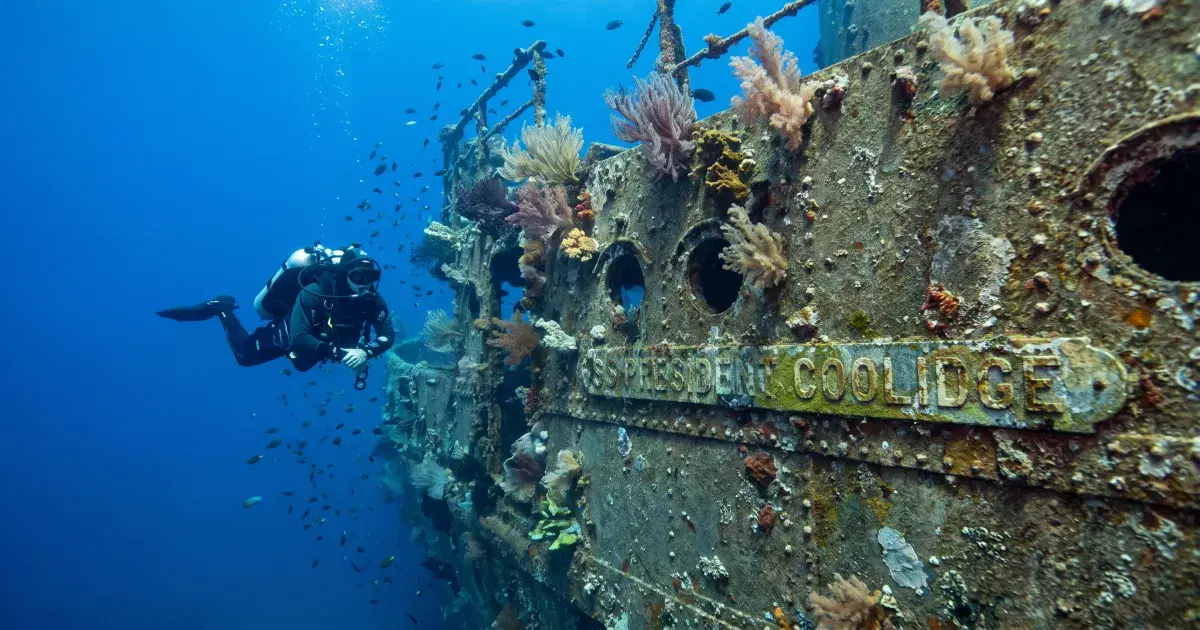
The SS President Coolidge is a rare combination for a wreck dive: one of the largest diveable shipwrecks anywhere, and one a diver can reach by walking straight off the beach.
How big is the SS President Coolidge wreck?
The Coolidge was a large ocean liner turned troop transport, roughly 200 meters (about 650 feet) long, and it remains largely intact on the seafloor off Espiritu Santo. That scale puts it among the biggest diveable wrecks in the world, with enough structure and cargo holds that a single dive only ever covers a fraction of the ship.
Is the SS President Coolidge suitable for beginner divers?
Parts of it, yes. The wreck's shallower bow section sits around 20 meters (about 66 feet) deep and is accessible to Open Water divers with a guide, giving newer divers a real look at the ship's scale without needing advanced training. The deeper stern and interior swim-throughs require more experience and, in some cases, technical training, so a beginner's Coolidge dive is a limited but still worthwhile slice of the whole wreck.
How many dives do I need to see the whole wreck?
Realistically, more than most divers manage in a single trip. Between the ship's overall size, the range of depths involved, and the number of distinct areas worth exploring (cargo holds, the promenade deck, the famous "Lady and the Unicorn" porcelain relief), divers who want to see most of it typically plan for multiple days of diving, often in the range of 10 or more dives, rather than a single visit.
What certification do I need for penetration dives on the Coolidge?
Entering the wreck's interior, beyond simple swim-throughs near entry points, generally calls for wreck-diving specialty training or equivalent logged experience, since navigating inside a large sunken ship carries real risks around silt-out visibility and finding the way back out. The deepest sections of the wreck, extending past 70 meters (about 230 feet) in places, are technical-diving territory and outside recreational limits entirely.
What's the history behind the SS President Coolidge sinking?
The Coolidge was a civilian ocean liner converted into a troop transport during World War II. In October 1942, she struck mines laid in the channel while trying to enter Espiritu Santo's harbor; the captain deliberately ran her aground to allow the troops aboard to evacuate safely, and the ship later slid off the reef into deeper water, where she remains today.
Can I shore-dive the Coolidge, or do I need a boat?
Shore access is one of the wreck's defining features. Divers can walk in from the beach near Million Dollar Point and reach the wreck without needing a boat, which is unusual for a dive of this scale and depth and part of why the Coolidge draws wreck divers specifically to Espiritu Santo.
What marine life lives on the wreck today?
Decades underwater have let soft corals and other marine growth colonize much of the ship's structure, and divers regularly encounter reef fish, occasional turtles, and schooling fish species around the hull. The marine life is a secondary draw compared to the wreck's scale and history, but it adds color and life to what would otherwise be a purely industrial dive.
FAQ
Do I need a guide to dive the SS President Coolidge? Yes, local guides who know the wreck are effectively required, both for navigation given the ship's size and interior complexity and because access is generally arranged through local dive operators familiar with the site.
Is the SS President Coolidge one of the world's best wreck dives? It's frequently mentioned among the world's top wreck dives for its size, condition, shore accessibility, and history, though "best" is subjective and depends on what a diver values most in a wreck experience.
How deep is the deepest point of the SS President Coolidge? The wreck extends from around 20 meters near the bow down past 70 meters in its deepest sections, putting much of the ship well beyond recreational depth limits and into technical-diving territory.