Boxer Shrimp (assorted)
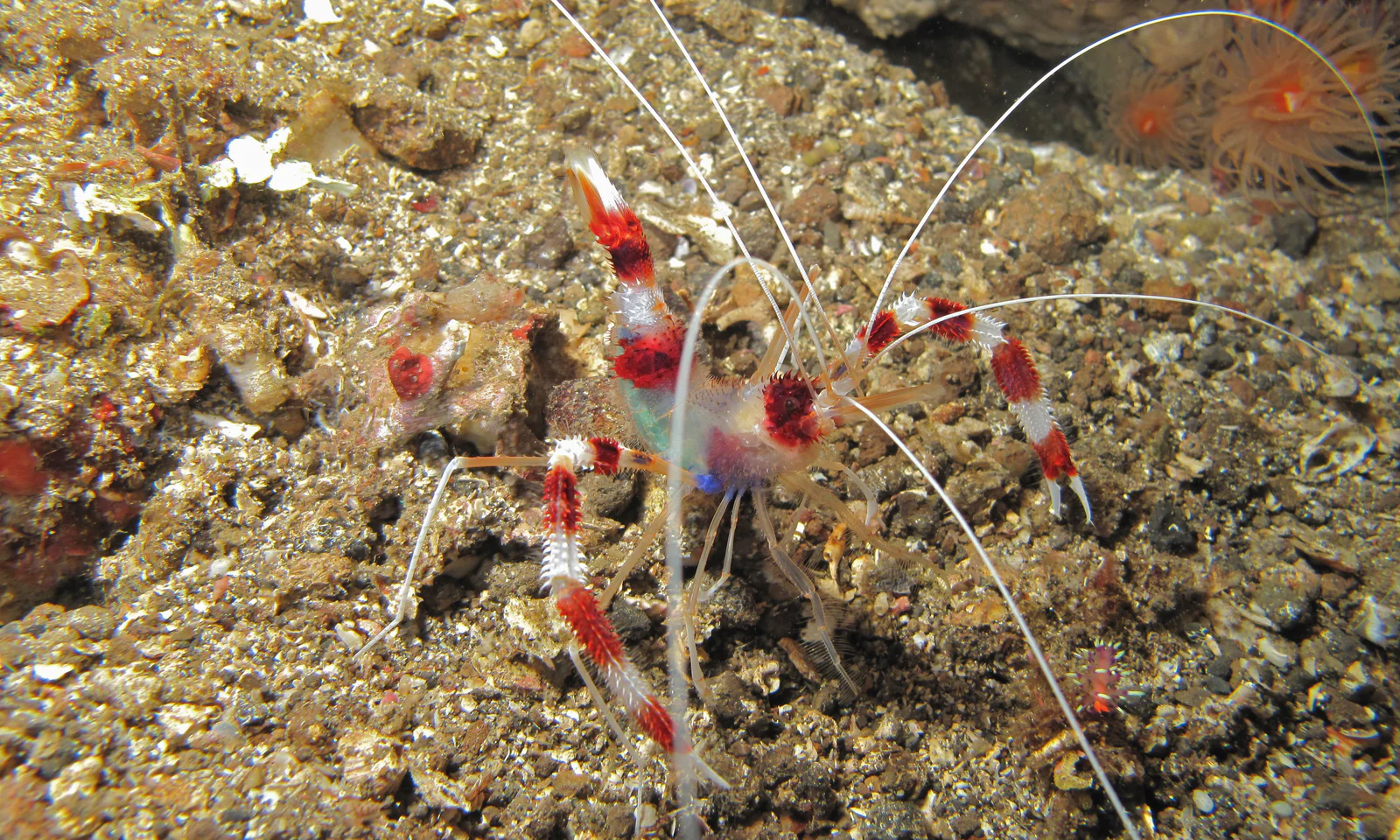
Bildnachweis: Bernard Dupont · CC BY-SA 2.0 · Wikimedia Commons, cropped by this page
Stenopodidea spp. (boxer shrimps)
Über Boxer Shrimp (assorted).
Boxer shrimps are the Stenopodidea, a small group of decapod crustaceans. Wikipedia says they are often confused with caridean shrimps or dendrobranchiate prawns but belong to neither. This group entry covers sightings where the species was not recorded. The World Register of Marine Species (WoRMS) lists Stenopodidea as an accepted infraorder of the Decapoda, with the authority Spence Bate, 1888; Wikipedia gives Claus, 1872.
Wikipedia says boxer shrimps differ from prawns in lacking branching gills and in brooding their eggs rather than releasing them into the water, and from caridean shrimps in their greatly enlarged third pair of legs. It counts 71 living species in 12 genera, in three families: Stenopodidae, Spongicolidae and Macromaxillocarididae. The best known is the banded boxer or banded coral shrimp (Stenopus hispidus), which has its own entry: Wikipedia gives it a total length of 60 mm, with a transparent body whose carapace, abdomen and large third legs are banded red and white, and long white antennae.
No conservation status applies to the group as a whole.
Lebensraum.
Wikipedia says the banded boxer shrimp is pan-tropical, in the Atlantic, Indian and Pacific Oceans, living below the intertidal zone on coral reefs to depths of up to 210 m. Most members of the family Spongicolidae, by contrast, live inside the body cavity of glass sponges; only its genus Microprosthema lives in the shallows. The sources cited here give no range or depth for the group as a whole.
Where Divers Find Them
At Ghost Bay in Amed, Bali, Amed Jepun Divers says "Boxer shrimp hide in bottle necks". It does not name the species or say how often they are seen.
Verhalten.
Wikipedia describes the banded boxer shrimp as a cleaner: it advertises to passing fish by waving its long white antennae and removes parasites, fungi and damaged tissue from them with its claws. It says the species is monogamous, that females are usually larger than males, and that it occupies a territory 1 to 2 m across. These statements are about that one species; the sources cited here do not describe the behaviour of the group as a whole.
Underwater Encounter Behavior
The sources cited here do not describe how boxer shrimps react to divers.
Wo man es sehen kann.
Nachweise aus allen Reisezielen · 1 Tauchplatz
Das allgemeine Verbreitungsgebiet ist kein Nachweis für das Vorkommen an einem bestimmten Tauchplatz.
Galerie.
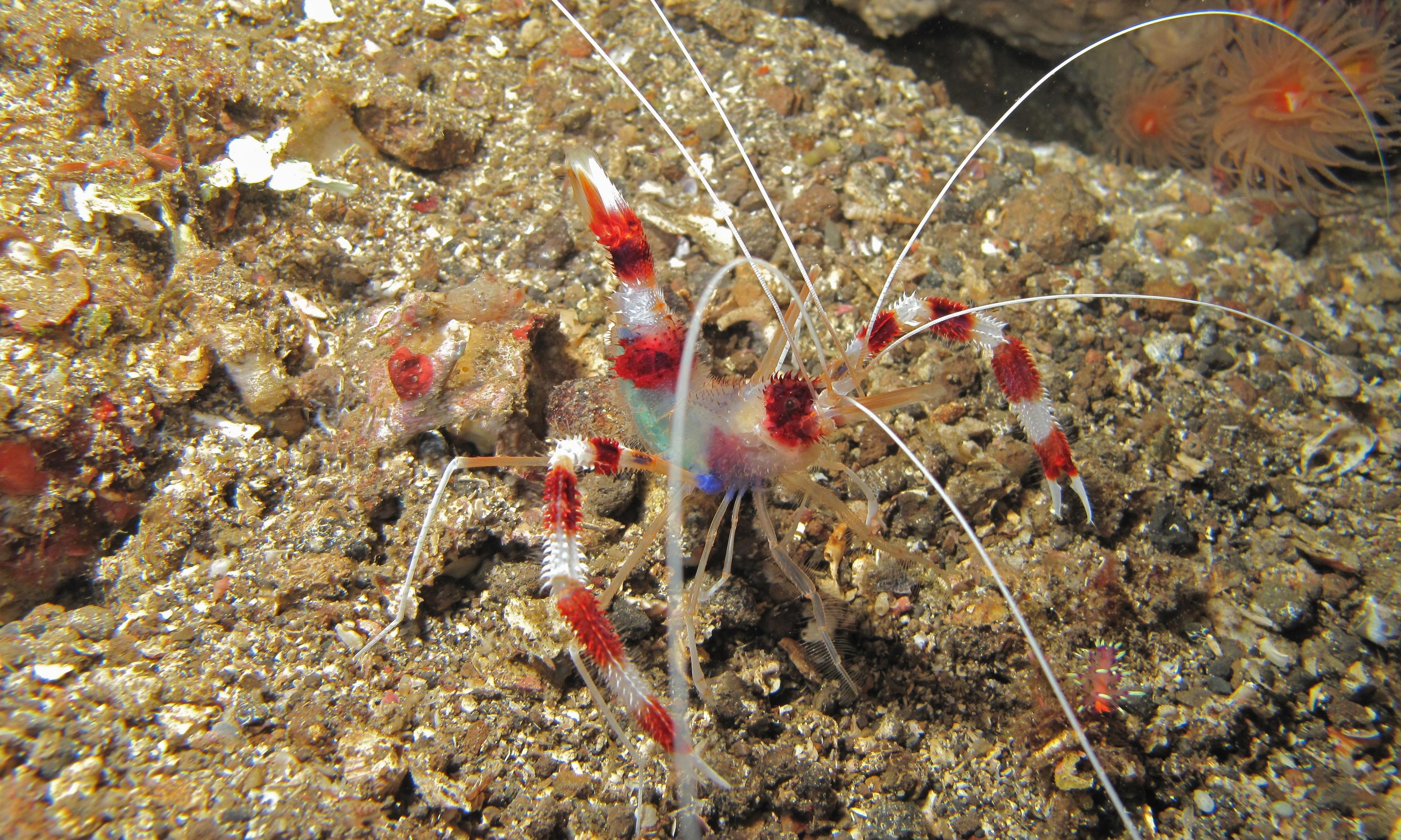
A banded boxer shrimp (Stenopus hispidus), one species of the boxer shrimps, on rubble at Nudi Falls, Lembeh Strait, North Sulawesi, Indonesia, photographed on 2009-10-16. This photograph is not from Amed. This page's frame crops the photograph.
Bildnachweis: Bernard Dupont · CC BY-SA 2.0 · Wikimedia Commons, cropped by this page