Cockatoo Waspfish
 KI-generiert
Bildnachweis: AI-generated illustration · Diveity
Ablabys taenianotus
Über Cockatoo Waspfish.
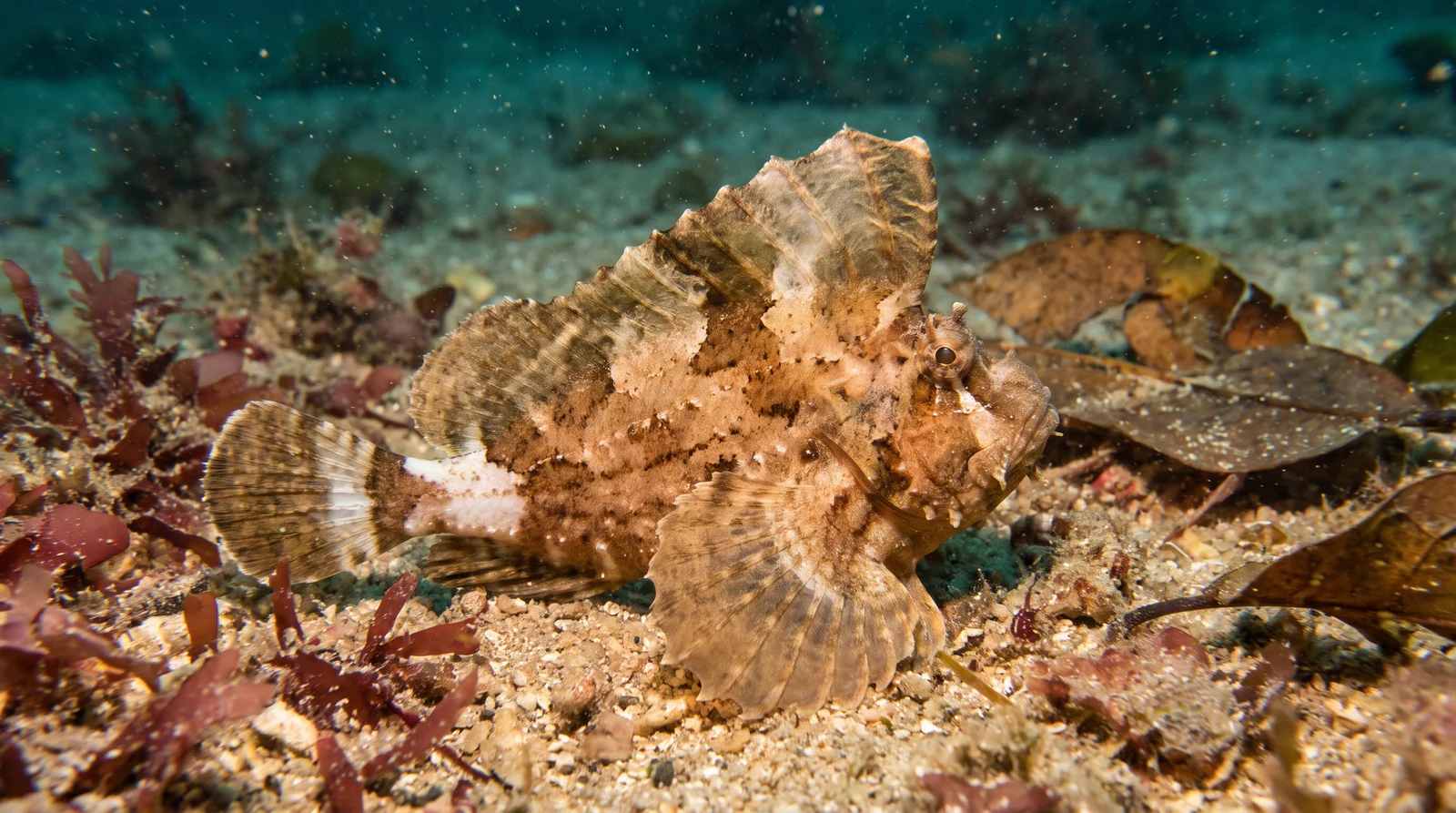
The cockatoo waspfish (Ablabys taenianotus) is a small, venomous waspfish. The World Register of Marine Species (WoRMS) lists Ablabys taenianotus (Cuvier, 1829) as the accepted name in the family Tetrarogidae, and FishBase places it in the same family. Wikipedia's article names a different family in its taxobox (Synanceiidae) and in its text (Scorpaenidae); the family here follows WoRMS and FishBase.
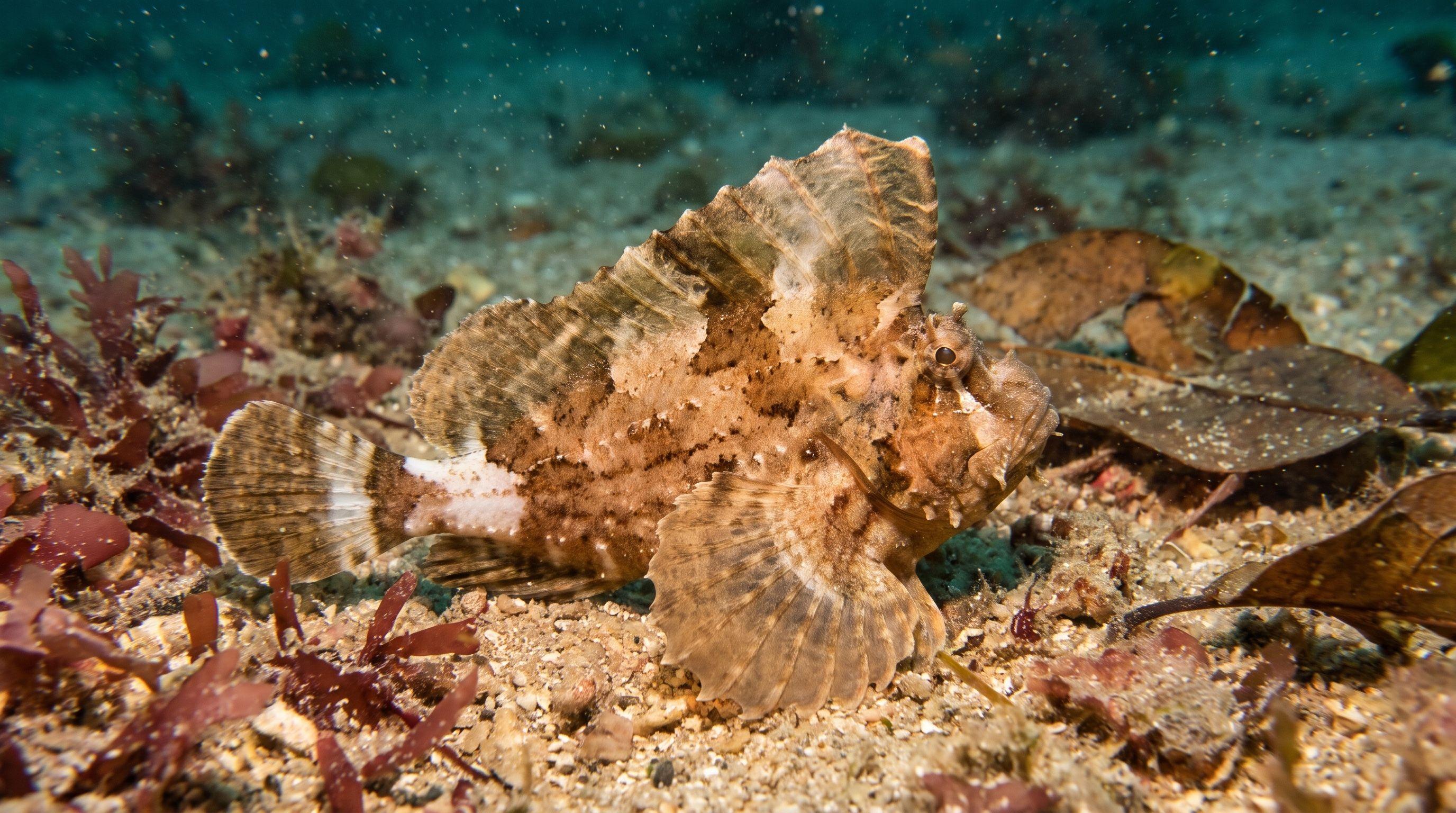
Wikipedia describes a laterally compressed body with a dorsal fin that runs from the top of the head almost to the tail; spread, it looks like a cockatoo's crest. The dorsal spines are venomous. Its colour varies from cream to dark brown with irregular spots. FishBase gives a maximum length of 15 cm.
FishBase lists the species as Least Concern on the IUCN Red List (version 2025-2, global).
Lebensraum.
FishBase gives its range as the eastern Indian Ocean and western Pacific, from the Andaman Sea to Fiji, north to Japan and south to Australia, and says it is replaced by Ablabys binotatus in the western Indian Ocean. FishBase says it inhabits shallow subtidal areas with sand, rubble and weed and gives a depth range of 1 to 78 m. Wikipedia gives about 0.6 to 18 m on sandy, silty or rubble bottoms and in seagrass. The two depth ranges differ and are both given here.
Where Divers Find Them
At Amed, Bali, Amed Jepun Divers says divers at Melasti may encounter cockatoo waspfish at night, with no frequency or season.
Verhalten.
Wikipedia says it is benthic and nocturnal and mostly stays on the bottom, moving with its pectoral fins. It ambushes passing prey while mimicking a crumpled dead leaf or a drifting piece of seaweed, and lets itself drift with the water as an inert object would. It may be found singly or in pairs and feeds on small shrimps and other tiny crustaceans.
Underwater Encounter Behavior
The sources cited here do not describe how the cockatoo waspfish reacts to divers. Its dorsal spines are venomous, according to Wikipedia and FishBase.
Wo man es sehen kann.
Nachweise aus allen Reisezielen · 5 Tauchplätze
Das allgemeine Verbreitungsgebiet ist kein Nachweis für das Vorkommen an einem bestimmten Tauchplatz.
Gapang House Reef
Pulau Weh
Dokumentiertes Vorkommen am Tauchplatz
Saison noch nicht dokumentiert
Quelle geprüft am 2026-11-18 · Quelle: Lumba Lumba Diving Centre · Beobachtungsdatum nicht dokumentiert
Hairball
Lembeh Strait
Dokumentiertes Vorkommen am Tauchplatz
Saison noch nicht dokumentiert
Quelle geprüft am 2026-11-20 · Quelle: Matuari Sarawet (blog) · Beobachtungsdatum nicht dokumentiert
Melasti
Amed
Dokumentiertes Vorkommen am Tauchplatz
Saison noch nicht dokumentiert
Quelle geprüft am 2026-11-07 · Quelle: Amed Jepun Divers · Beobachtungsdatum nicht dokumentiert
Nudi Retreat
Lembeh Strait
Dokumentiertes Vorkommen am Tauchplatz
Saison noch nicht dokumentiert
Quelle geprüft am 2026-11-20 · Quelle: Matuari Sarawet (blog) · Beobachtungsdatum nicht dokumentiert
Teluk Kembahu (TK)
Lembeh Strait
Dokumentiertes Vorkommen am Tauchplatz
Saison noch nicht dokumentiert
Quelle geprüft am 2026-11-20 · Quelle: Murex Resorts · Beobachtungsdatum nicht dokumentiert
Galerie.
 KI-generiert
Bildnachweis: AI-generated illustration · Diveity