Coconut Octopus
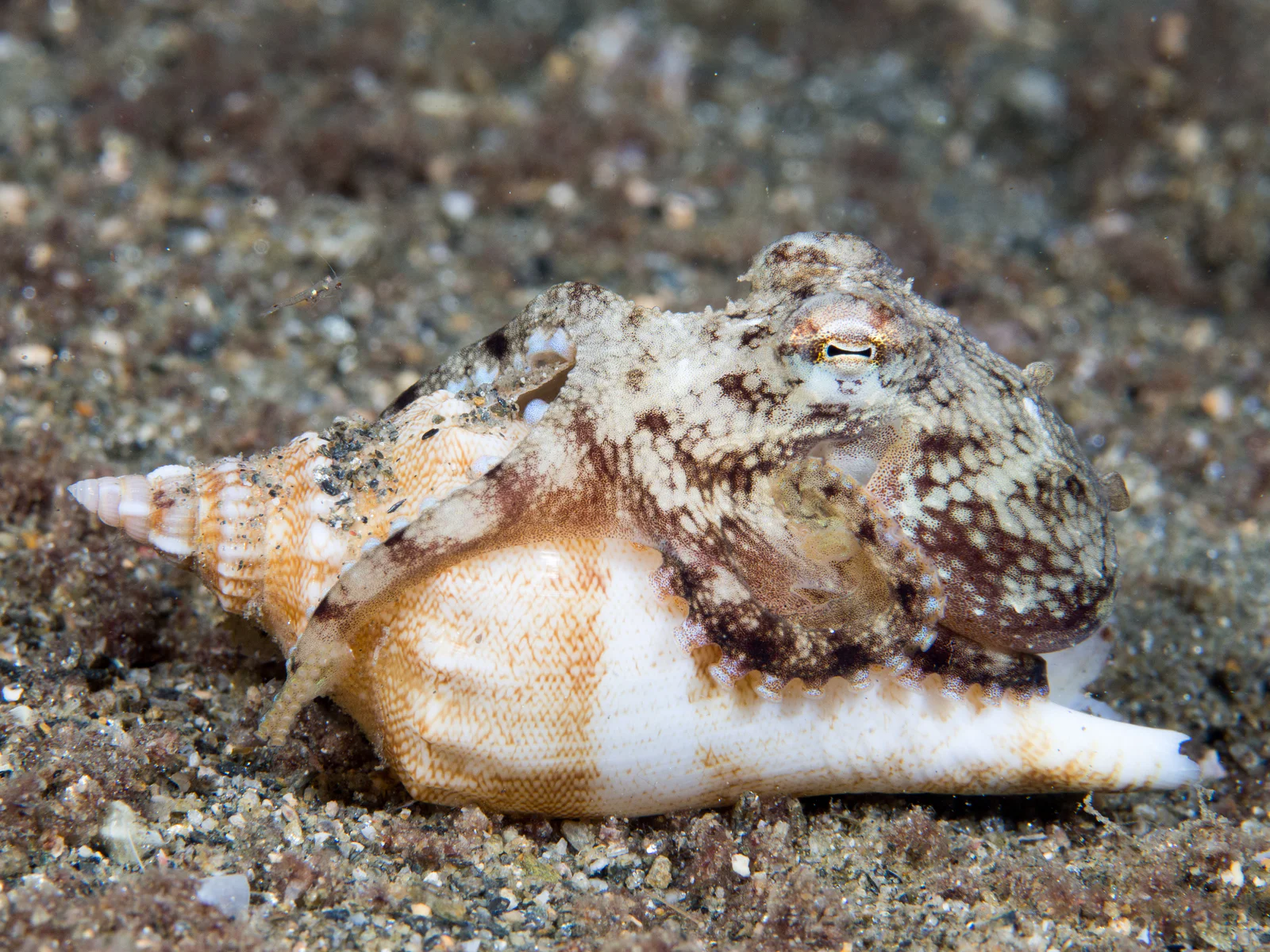
Bildnachweis: Rickard Zerpe · CC BY 2.0 · Wikimedia Commons (from Flickr), cropped by this page
Amphioctopus marginatus
Über Coconut Octopus.
The coconut octopus (Amphioctopus marginatus), also called the veined octopus, is an octopus of the family Octopodidae. The World Register of Marine Species (WoRMS) lists Amphioctopus marginatus (Taki, 1964) as the accepted name; it was first described as Octopus marginatus.
Wikipedia gives a body of typically 5 to 10 cm and a length of up to about 30 cm including the arms, and a weight of up to 400 g; SeaLifeBase gives the same maximum length and weight and a mantle length of 10 cm. Wikipedia describes dark branching lines like veins and dark arms with contrasting light suckers; SeaLifeBase adds dark purple reticulations on the arm crown with pink to white suckers.
SeaLifeBase lists the species as Least Concern on the IUCN Red List (version 2025-2, global; assessed 21 July 2014).
Lebensraum.
SeaLifeBase gives its range as the Indo-West Pacific and a depth range of 0 to 190 m, in coastal muddy waters. Wikipedia says it prefers shallow subtidal waters on sandy substrates with plentiful shells or litter, and that large numbers can be found where there is more litter to use as shelter.
Where Divers Find Them
At Amed, Bali, Amed Jepun Divers names the coconut octopus among the rare macro species to spot at Ghost Bay. It does not say how often.
Verhalten.
SeaLifeBase says it feeds on crustaceans such as Calappa crabs, and on bivalves. It makes dens in clamshells, coconut shells, bottles and other discarded objects, and carries a shell or half a coconut shell while it searches for another to enclose itself. Wikipedia describes this gathering of shells for later use as tool use, observed in Bali and North Sulawesi, and says the species is one of two octopuses known to walk on two arms. Wikipedia says the female guards her eggs inside a shelter such as a coconut shell, and starves while brooding.
Underwater Encounter Behavior
The sources cited here do not describe how the coconut octopus reacts to divers.
Wo man es sehen kann.
Nachweise aus allen Reisezielen · 1 Tauchplatz
Das allgemeine Verbreitungsgebiet ist kein Nachweis für das Vorkommen an einem bestimmten Tauchplatz.
Galerie.
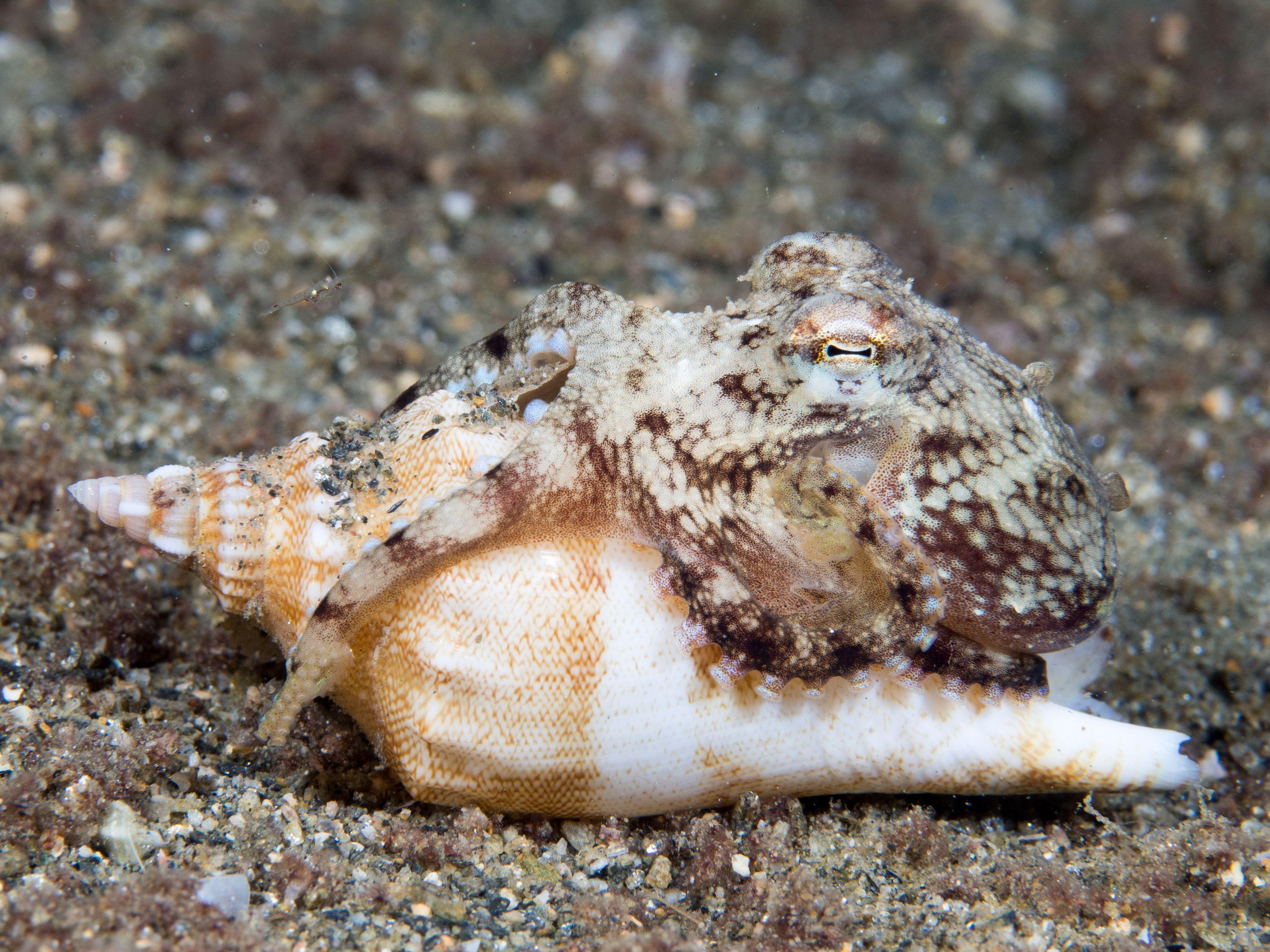
A coconut octopus (Amphioctopus marginatus) riding a gastropod shell on sand at Romblon, Philippines, photographed on 4 June 2016. This photograph is not from Amed. This page's frame crops the photograph.
Bildnachweis: Rickard Zerpe · CC BY 2.0 · Wikimedia Commons (from Flickr), cropped by this page