Flounders (assorted)
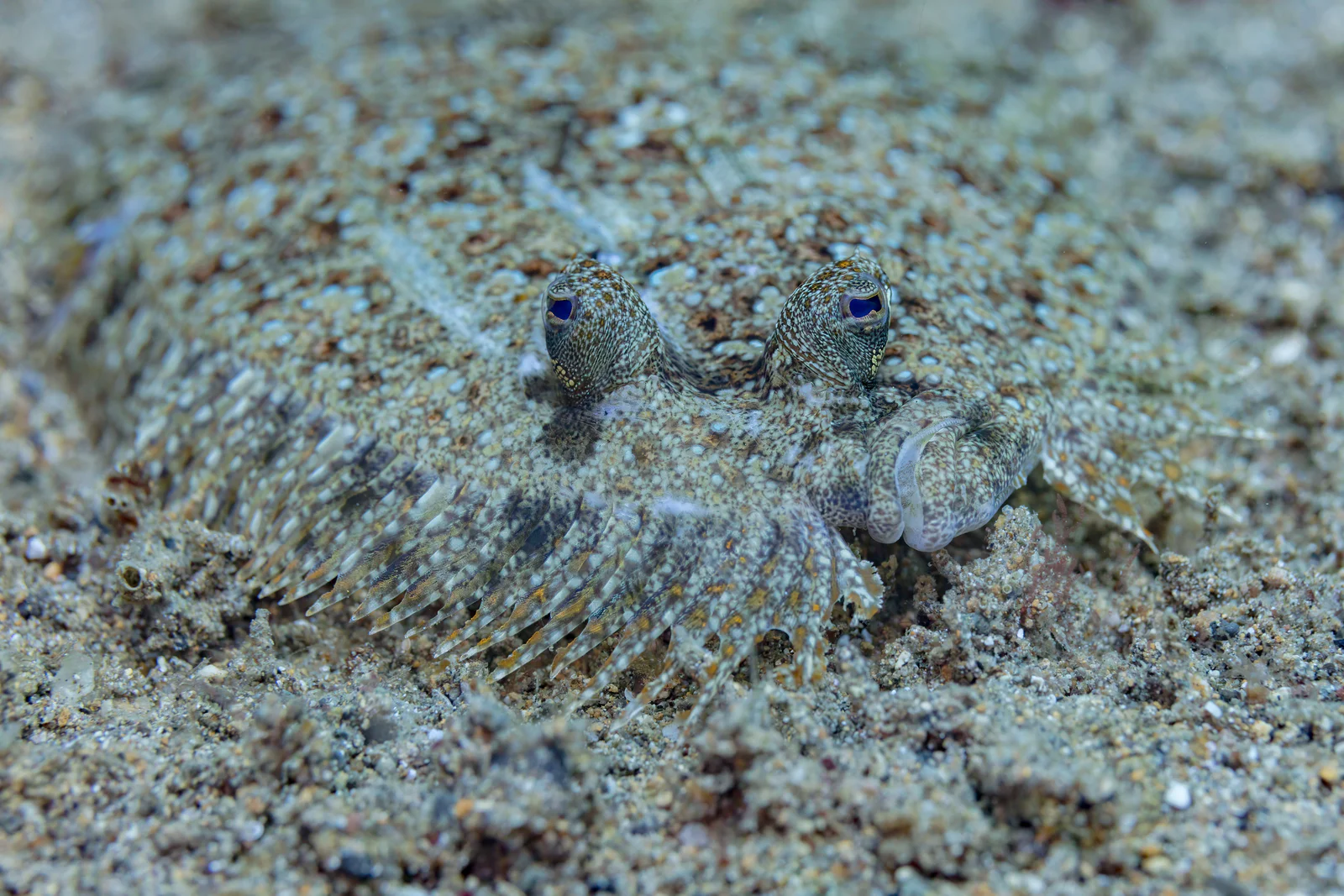
Bildnachweis: Diego Delso, delso.photo · CC BY-SA 4.0 · Wikimedia Commons, cropped by this page
Pleuronectoidei spp. (flounders)
Über Flounders (assorted).
Flounders are flatfishes, and the name does not mean one species. Wikipedia says it is used for several only distantly related species, all in the suborder Pleuronectoidei, in the families Achiropsettidae, Bothidae, Pleuronectidae, Paralichthyidae and Samaridae. This group entry covers sightings where the species was not recorded. The peacock flounder (Bothus lunatus) has its own entry. The World Register of Marine Species (WoRMS) lists Pleuronectoidei as an accepted suborder of the order Pleuronectiformes; Wikipedia places it in the order Carangiformes.
Wikipedia says an adult flatfish has both eyes on the side of the head that faces upwards, because one eye migrates towards the other during metamorphosis, and that the side facing the seabed is usually colourless or very pale. In the lefteye flounders (Bothidae), most species lie on the bottom on their right side with both eyes on the left. Wikipedia counts more than 160 species in that family, from 4.5 cm to 1.5 m long. Its article on flounders gives a typical length of 22 to 60 cm and up to 95 cm.
No conservation status applies to the group as a whole.
Lebensraum.
Wikipedia describes flounders as demersal fish, found at the bottom of oceans around the world, and says some species also enter estuaries. It says they feed at soft muddy areas of the sea bottom, near bridge piles, docks and coral reefs. The sources cited here do not say which flounders live in Bali.
Where Divers Find Them
At Pyramids in the Amed area of Bali, Amed Jepun Divers says "the sandy areas reveal flounders, stingrays, and the occasional leaf scorpionfish", and SSI lists "Flounder fish" among the fish of the site. Neither names the species or says how often they are seen.
Verhalten.
Wikipedia says flounders ambush their prey and that their diet consists mainly of fish spawn, crustaceans, polychaetes and small fish. It says flatfishes generally rely on camouflage to avoid predators, and that some can change their pigmentation to match the background.
Underwater Encounter Behavior
The sources cited here do not describe how flounders react to divers.
Wo man es sehen kann.
Nachweise aus allen Reisezielen · 7 Tauchplätze
Das allgemeine Verbreitungsgebiet ist kein Nachweis für das Vorkommen an einem bestimmten Tauchplatz.
Blue Lagoon
Padang Bai
Dokumentiertes Vorkommen am Tauchplatz
Saison noch nicht dokumentiert
Quelle geprüft am 2026-11-11 · Quelle: Waterworx · Beobachtungsdatum nicht dokumentiert
Boga Wreck
Tulamben
Dokumentiertes Vorkommen am Tauchplatz
Saison noch nicht dokumentiert
Quelle geprüft am 2026-11-09 · Quelle: Amed Jepun Divers · Beobachtungsdatum nicht dokumentiert
Eel Garden
Menjangan
Dokumentiertes Vorkommen am Tauchplatz
Saison noch nicht dokumentiert
Quelle geprüft am 2026-11-13 · Quelle: ScubaGo · Beobachtungsdatum nicht dokumentiert
Pos 1
Menjangan
Dokumentiertes Vorkommen am Tauchplatz
Saison noch nicht dokumentiert
Quelle geprüft am 2026-11-13 · Quelle: Abyss Ocean World · Beobachtungsdatum nicht dokumentiert
Pyramids
Amed
Dokumentiertes Vorkommen am Tauchplatz
Saison noch nicht dokumentiert
Quelle geprüft am 2026-11-08 · Quellen: Amed Jepun Divers und SSI · Beobachtungsdatum nicht dokumentiert
Retak Larry
Lembeh Strait
Dokumentiertes Vorkommen am Tauchplatz
Saison noch nicht dokumentiert
Quelle geprüft am 2026-11-20 · Quelle: Matuari Sarawet (blog) · Beobachtungsdatum nicht dokumentiert
USAT Liberty Wreck
Tulamben
Dokumentiertes Vorkommen am Tauchplatz
Saison noch nicht dokumentiert
Quelle geprüft am 2026-11-09 · Quelle: The Jakarta Post · Beobachtungsdatum nicht dokumentiert
Galerie.
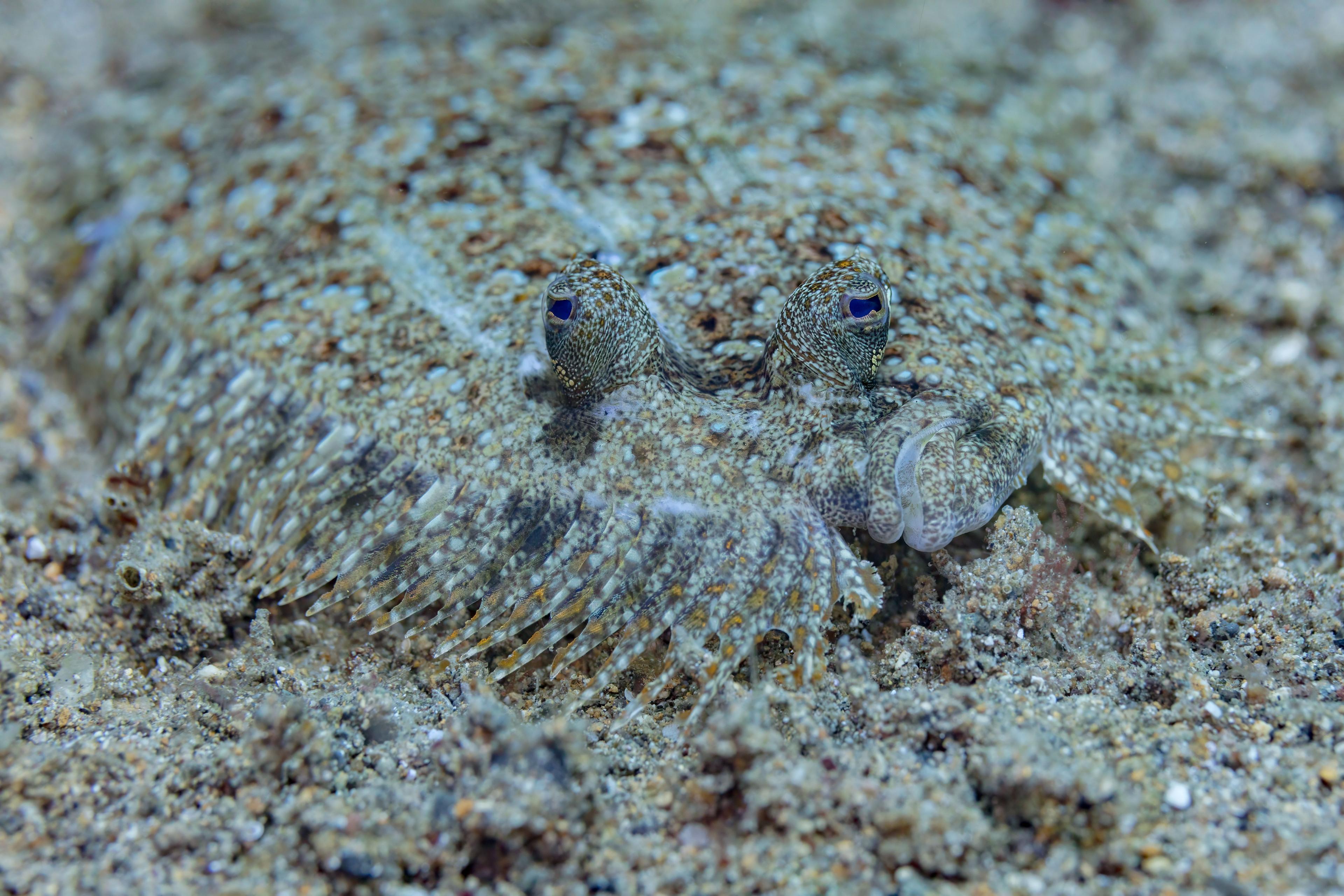
A leopard flounder, Bothus pantherinus, one of the lefteye flounders (family Bothidae), photographed at Anilao, Philippines, in 2023 and identified by the photographer, lying on sand with both raised eyes on the upper side of its head. This photograph is not from Amed, and the sources for Amed's sightings name the fish only as flounders, without a family or species. This page's frame crops the photograph.
Bildnachweis: Diego Delso, delso.photo · CC BY-SA 4.0 · Wikimedia Commons, cropped by this page