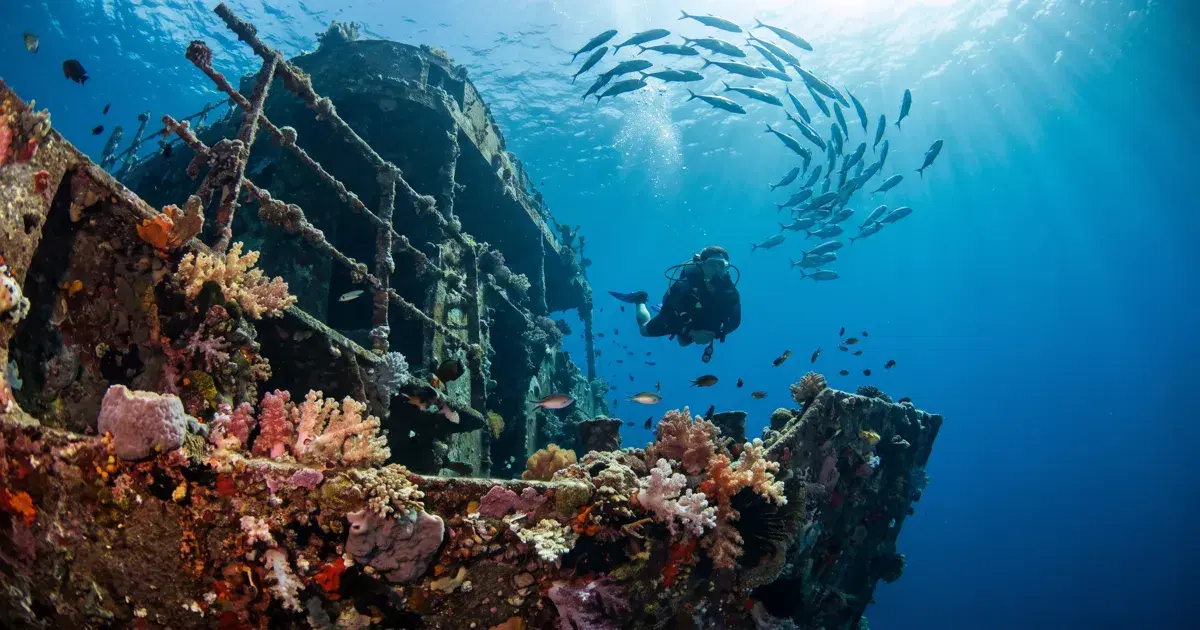
The USAT Liberty sits in roughly 5 to 30 meters of water a short walk off a black-sand beach in Tulamben, and you can be looking at its hull within about five minutes of stepping into the water.
How deep is the USAT Liberty wreck?
The shallowest part of the wreck, a scattered debris field near the bow, starts around 5 meters (about 16 feet). The main hull structure runs from roughly 9 to 30 meters (30 to 100 feet), and the deepest sections at the stern sit close to 30 meters. That spread is what makes the Liberty work for almost every certification level on the same trip, since a snorkeler can see part of it from the surface while a technical diver still has somewhere to go.
Can beginners dive the USAT Liberty?
Yes, for the upper two-thirds of the wreck. Open Water divers can comfortably explore down to around 18 meters (60 feet), which covers most of the hull's recognizable structure, coral growth, and resident fish life. Going past 18 meters or into any of the wreck's swim-throughs calls for an Advanced certification at minimum, and true penetration into enclosed spaces requires specific wreck training. Guides here are used to mixed groups and will keep newer divers on the shallower sections.
What's the best time of day to dive the Liberty wreck?
Early morning, generally before 9am, is when the site is calmest and least crowded. Visibility tends to be best then too, since afternoon winds and boat traffic from nearby operators can stir up the shallow sand around the wreck. A handful of local shops also run dawn dives specifically to beat the crowds, which is worth asking about if you're staying in Tulamben overnight.
Why did the USAT Liberty sink at Tulamben?
The USAT Liberty was a US Army cargo ship torpedoed by a Japanese submarine in the Lombok Strait in 1942. It was towed toward Singaraja for repair but ran aground on Tulamben's beach instead, where it sat as a beached wreck for over two decades. Mount Agung's 1963 eruption shook the ship apart and slid it into the water, settling it just offshore in the position divers explore today.
What marine life lives on the wreck today?
More than six decades underwater have turned the hull into an artificial reef with dense coral growth, particularly gorgonian fans and soft corals on the upper structure. Divers regularly see schools of jackfish and bumphead parrotfish circling the wreck, along with resident bamboo sharks tucked into the hull's overhangs and, less predictably, the occasional pygmy seahorse on one of the gorgonians for those who look closely.
Do I need a guide to dive the Liberty?
Not legally, but most operators strongly recommend one, and it's close to mandatory if you plan to go past the shallow sections. The wreck's layout is straightforward enough that experienced local divers sometimes dive it unguided, but a guide knows where the current marine life is hiding and can keep you off the more fragile coral growth, which matters given how much traffic this single wreck sees.
How crowded does the Liberty wreck get?
This is Bali's single most-dived site, and it shows. Mid-morning through early afternoon, expect other groups on nearly every part of the wreck, especially near the recognizable bow and stern sections. Crowding thins out considerably before 8am and again in the late afternoon, and night dives on the wreck are notably quieter than any daytime slot.
FAQ
Is the USAT Liberty a good first wreck dive? Yes, for Open Water and Advanced divers working within their depth limits. The shallow debris field and mid-depth hull sections give a real wreck-diving experience without requiring penetration training.
How long has the USAT Liberty been underwater? Since 1963, when Mount Agung's eruption dislodged it from the beach, meaning the wreck has had well over 60 years to develop into a full artificial reef.
Can I snorkel the USAT Liberty? Yes, partially. The shallowest debris around 5 meters is visible from the surface on a calm day, though the bulk of the hull and most of the marine life sit deeper than snorkeling depth.