Fire Dartfish
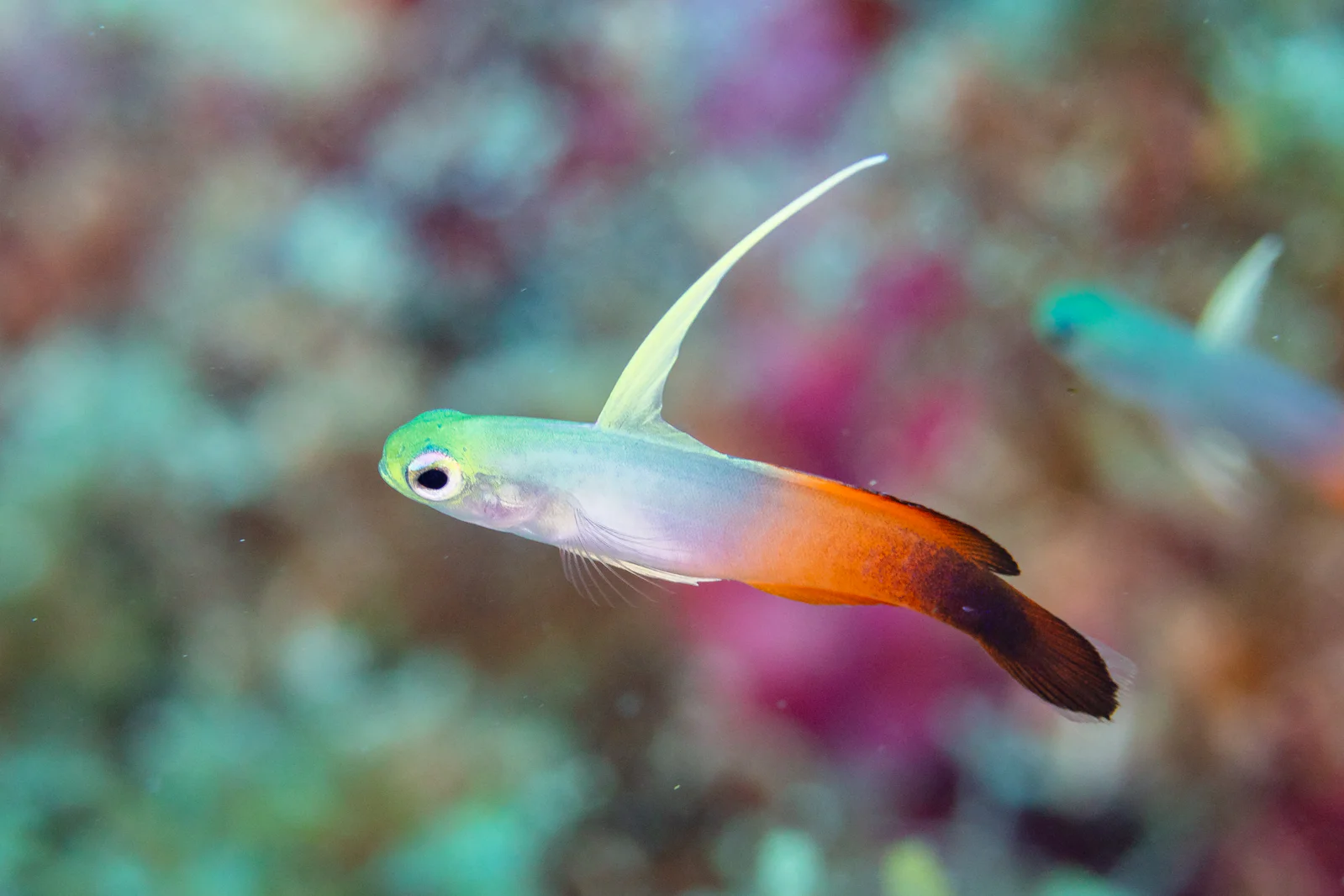
Crédito de la imagen: Diego Delso, delso.photo · CC BY-SA 4.0 · Wikimedia Commons, cropped by this page
Nemateleotris magnifica
Acerca de Fire Dartfish.
The fire dartfish (Nemateleotris magnifica), also called the fire goby, magnificent fire fish or red fire goby, is a small dartfish. The World Register of Marine Species (WoRMS) lists Nemateleotris magnifica Fowler, 1938 as the accepted name in the family Gobiidae, and Wikipedia does the same; FishBase places it in the wormfish family Microdesmidae (subfamily Ptereleotrinae). FishBase's English name is fire goby.
FishBase gives a maximum length of 9 cm (total length) and an elongated body. Wikipedia describes a bright yellow head merging into a white body that shades into a red-orange tail, and a very long first dorsal fin that the fish flicks back and forth.
FishBase lists the species as Least Concern on the IUCN Red List (version 2025-2, global; assessed 18 August 2023).
Dónde vive.
FishBase gives its range as the Indo-Pacific, from East Africa to the Hawaiian, Marquesan and Pitcairn islands, north to the Ryukyu Islands and south to New Caledonia and the Austral Islands, and throughout Micronesia. It is marine and reef-associated, with a depth range of 0 to 70 m and usually 6 to 28 m (FishBase); Wikipedia gives 6 to 70 m. FishBase says adults live on the upper parts of outer reef slopes.
Where Divers Find Them
At Gili Selang, off Amed in Bali, Diveplanit's account of one dive shows fire dartfish "hovering above their holes". It does not say how often they are seen.
Cómo se comporta.
FishBase says it hovers above the bottom facing the current to feed on zooplankton, copepods and crustacean larvae, that several individuals, especially juveniles, may share one hole, and that it habitually flicks its pennant-like first dorsal fin. Wikipedia says adults occupy burrows alone or in pairs while juveniles live in small groups, that the species is monogamous, and that the fin flicking is a signal to others of its kind.
Underwater Encounter Behavior
The sources cited here do not describe how the fire dartfish reacts to divers; Wikipedia says it retreats to its burrow if threatened. FishBase lists it as harmless to humans.
Dónde verlo.
Evidencia para amed · 1 sitio de buceo
La distribución general no demuestra la presencia en un sitio de buceo concreto.
Galería.
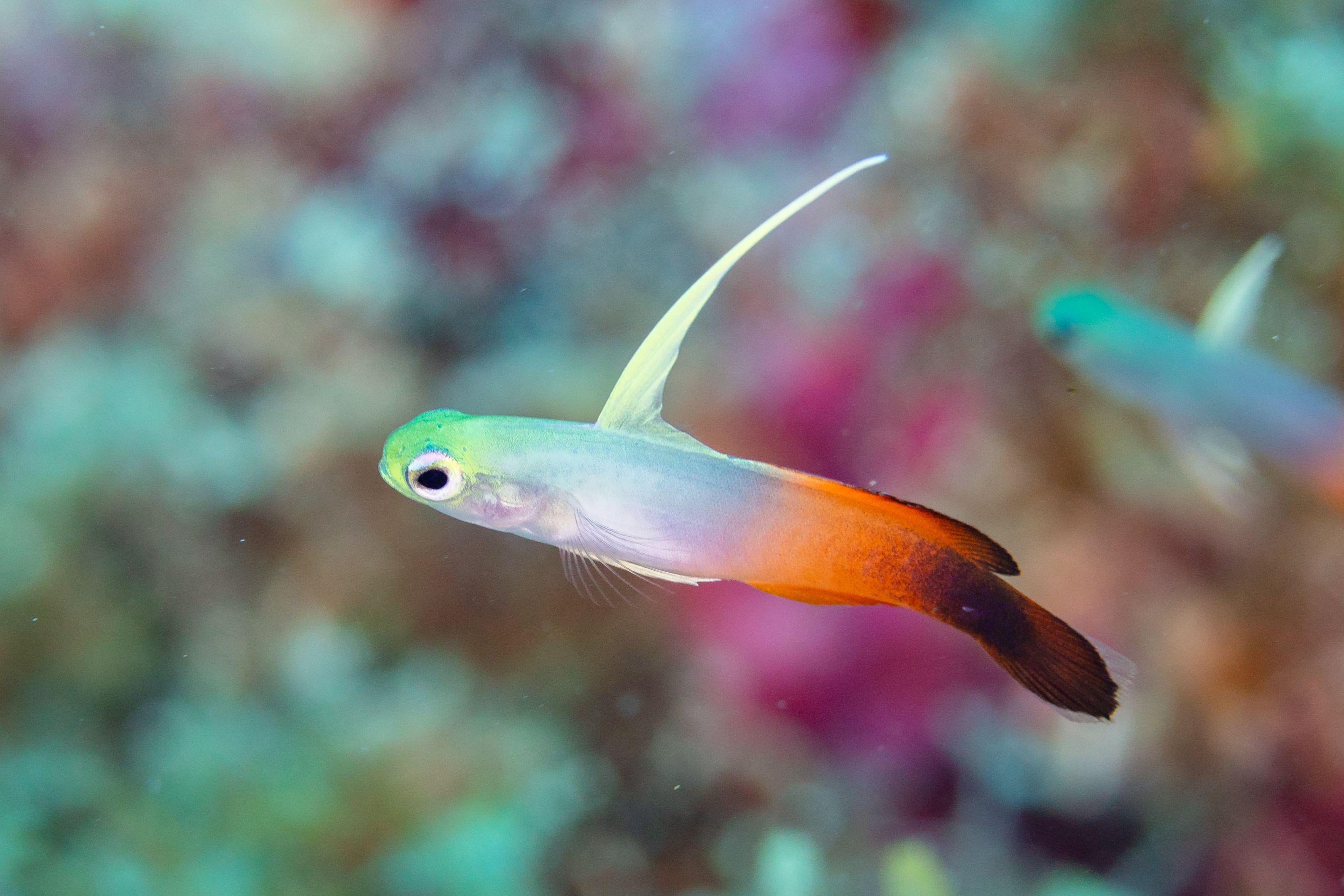
A fire dartfish swimming above the reef at Nosy Antanimora, Madagascar, photographed on 2025-09-15; a second, blurred fish is behind it. This photograph is not from Amed. This page's frame crops the photograph.
Crédito de la imagen: Diego Delso, delso.photo · CC BY-SA 4.0 · Wikimedia Commons, cropped by this page