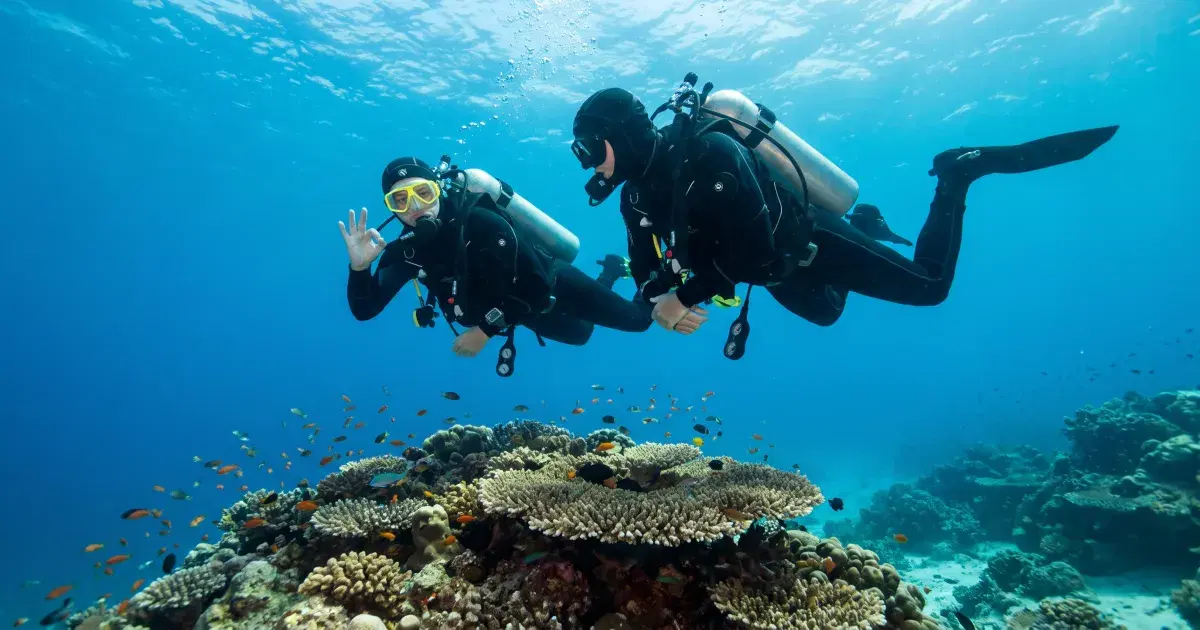
The buddy system gets taught in every Open Water course, but a lot of new divers only remember the surface-level version: stay near your buddy. There's more to it than that.
How do you find a reliable dive buddy when traveling solo?
Most dive operators pair solo travelers with another solo diver or with a divemaster acting as buddy, so showing up without a pre-arranged partner isn't usually a problem on a guided boat or shore dive. Dive resorts and liveaboards do this routinely as part of booking a solo spot. Outside of guided trips, dive clubs and buddy-finder communities within diving apps are the other common route, letting divers connect with a similar certification level and travel dates before a trip starts.
What are a dive buddy's actual responsibilities underwater?
A dive buddy's job goes beyond swimming nearby. Before entering the water, buddies run a pre-dive safety check together, commonly remembered by the acronym BWRAF (BCD, weights, releases, air, final check), confirming each other's gear is set up correctly. Underwater, buddies monitor each other's air supply, depth, and general condition, watch for signs of trouble like rapid breathing or disorientation, and are the first line of response if something goes wrong, including sharing air through a backup regulator (octopus) in an out-of-air emergency.
How close should you stay to your buddy underwater?
Close enough to reach your buddy within a few seconds if something happens, which in practice means staying within visual range at minimum and closer in low-visibility, current, or night-diving conditions. In good visibility on an easy reef dive, that might mean staying within eyesight a few meters apart; in murky water, at night, or inside an overhead environment like a wreck or cave, that distance should shrink to arm's reach. The exact spacing depends on conditions, not a fixed number, but the underlying rule stays the same: if you can't reach your buddy quickly, you're too far apart.
FAQ
What happens if I lose my buddy underwater? Standard training calls for a brief search, generally about one minute, looking around and up toward the surface, since a lost buddy often has already ascended. If there's no reunion within that window, most training agencies teach a safe, controlled ascent to the surface to regroup rather than continuing to search at depth.
Do certified divers still need a buddy on every dive? Yes, for recreational diving the buddy system remains standard practice regardless of certification level or experience, since even experienced divers can face equipment failure or a medical issue that a buddy can help resolve.
Can a divemaster count as my buddy on a guided dive? Often yes, particularly for solo travelers on a group boat dive, though it's worth confirming with the operator since some guided dives split the group into smaller buddy pairs instead of having the divemaster serve as buddy for everyone.