Arc-eye Hawkfish
 AI-generated
Image credit: AI-generated illustration · License unspecified · Source unspecified
Paracirrhites arcatus
About Arc-eye Hawkfish.
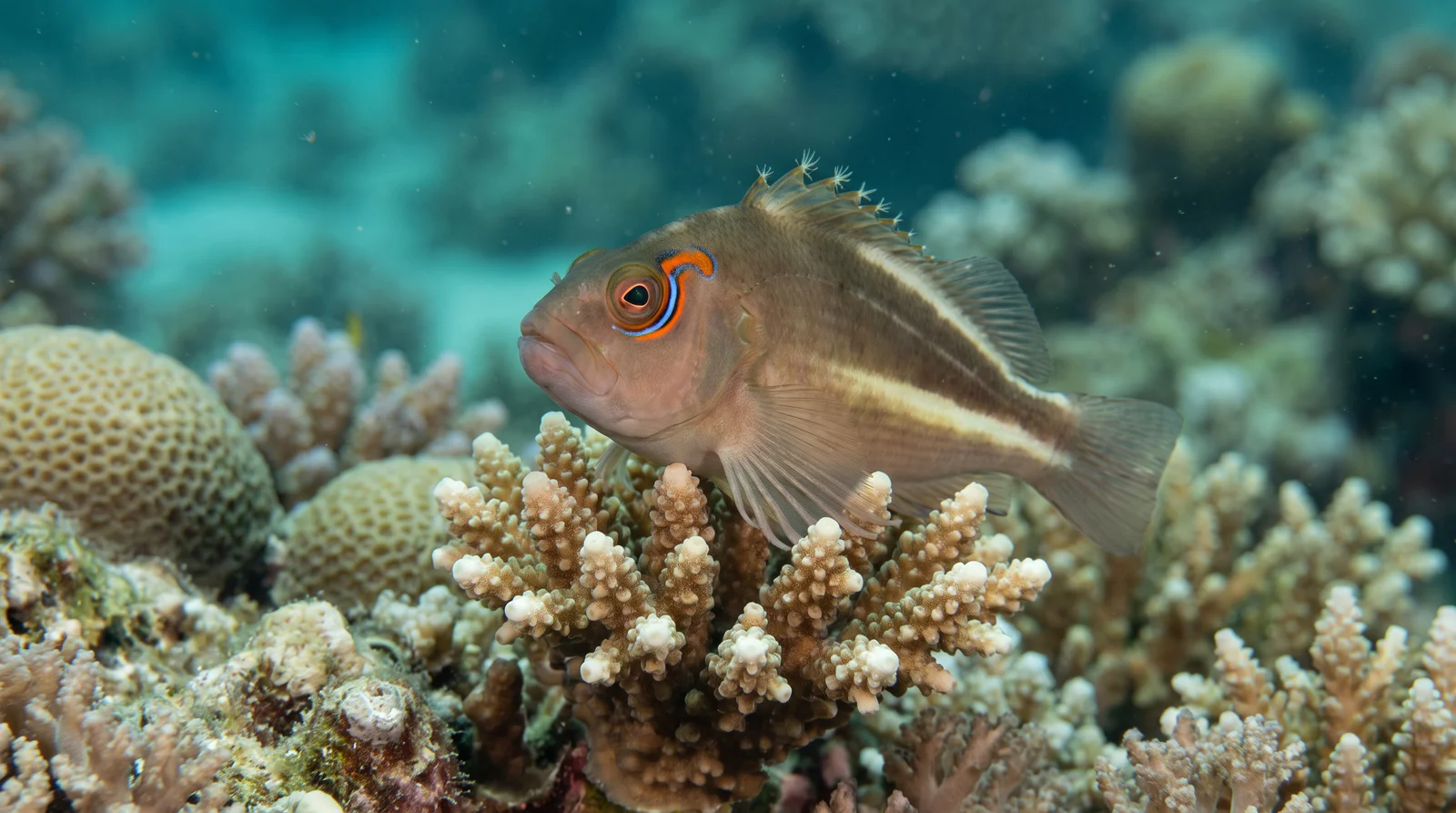
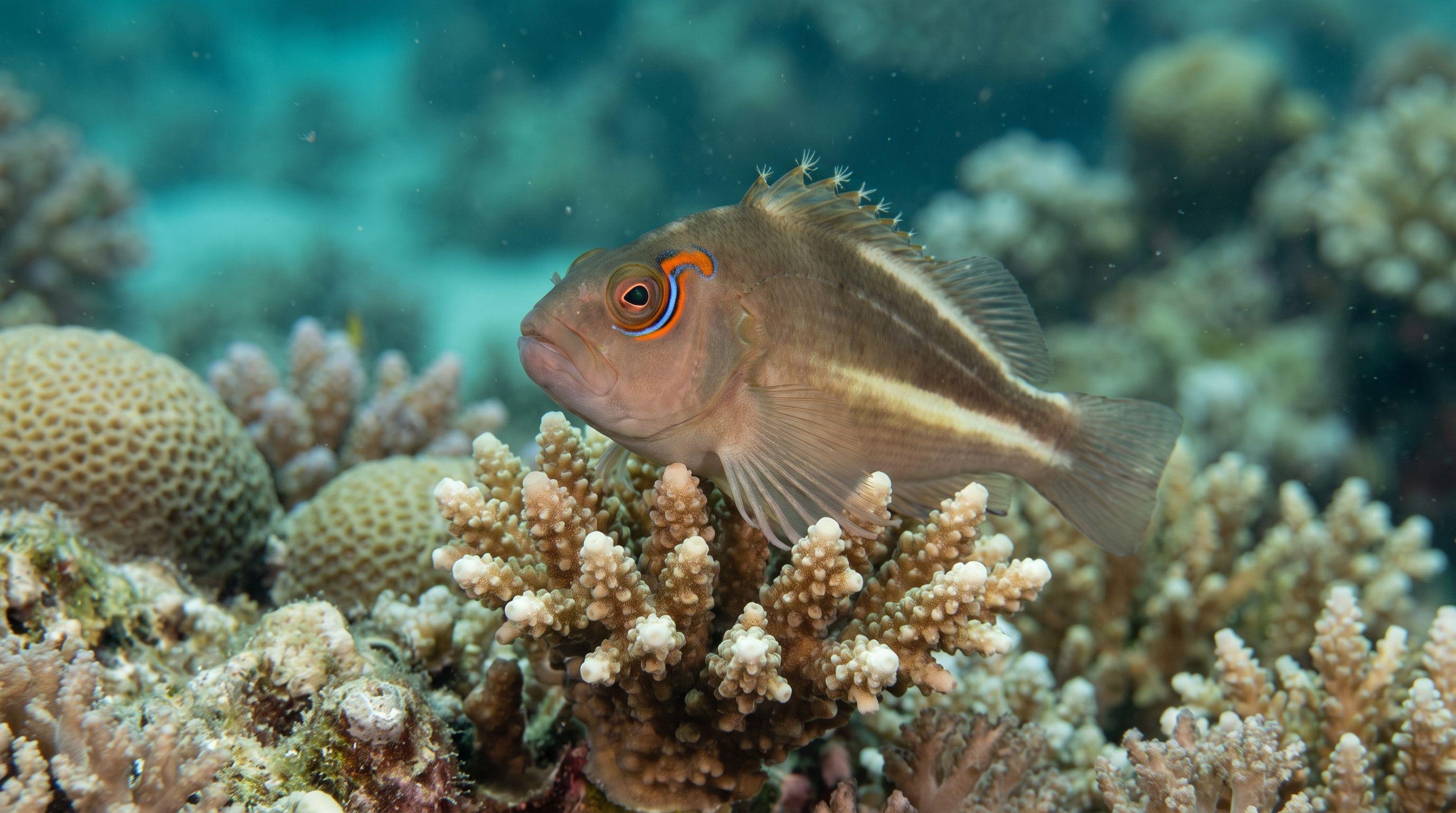
The Arc-eye Hawkfish, scientifically known as Paracirrhites arcatus, is a captivating small reef predator characterized by its distinctive appearance and vibrant coloration. This species typically exhibits a relatively deep, fusiform body with a compressed cross-section, and reaches a maximum published total length of 20 cm / 7.9 in. While its background color is highly variable, often appearing as a pale pinkish-brown, individuals can display a wide spectrum of hues including olive, reddish-brown, yellow, greenish-brown, dark brown, deep red, or orange, frequently appearing darker dorsally.
A defining feature, from which it derives its common name, is the prominent horseshoe-shaped or arc-like mark located behind each eye. This intricate marking consists of three thin lines, which can be a combination of orange and blue, or yellow, red, and blue. Adding to its striking facial patterns, the gill cover is adorned with three orange bands set within a light blue area. Many Arc-eye Hawkfish also exhibit a broad white to pink stripe that extends horizontally along the side, from the mid-body to the tail.
Its fins are also noteworthy; the dorsal fin features 10 spines, each tipped with a delicate branched cirrus, followed by 11 soft rays, while the anal fin possesses 3 spines and 6 soft rays. The caudal fin is typically slightly rounded to truncate. Uniquely, its large, scaleless pectoral fins are thickened and allow the fish to perch comfortably on corals or rocky substrates without being stung, a behavior reminiscent of a bird of prey. This adaptation, coupled with the absence of a swim bladder, enables the Arc-eye Hawkfish to make rapid, sudden darts when ambushing prey. With its large, expressive eyes providing keen vision, this species is well-equipped for its predatory lifestyle on the reef.
Where it lives.
The Arc-eye Hawkfish is widely distributed throughout the tropical Indo-Pacific region. Its extensive range spans from East Africa eastward to the Hawaiian, Line, and Mangaréva islands, extending northward to southern Japan, and southward to Australia and Rapa. Specific areas within its distribution include the Red Sea, the Maldives, and the iconic Great Barrier Reef.
This benthic species is intricately associated with coral reefs, typically inhabiting shallow waters in both lagoon and seaward reef environments. Arc-eye Hawkfish show a strong preference for perching on the heads of small branching corals, such as Pocillopora, Stylophora, and Acropora, as well as on rocky outcroppings. They are commonly found at depths ranging from 1 to 33 meters (approximately 3 to 110 feet), but have been recorded at a maximum depth of 91 meters (about 299 feet). Preferred water temperatures for this species are typically between 24 and 27 °C.
How it behaves.
The Arc-eye Hawkfish is a classic sit-and-wait ambush predator, a behavior that gives rise to its common name. Rather than constantly swimming, it conserves energy by perching motionless on coral heads or rocky ledges, utilizing its thickened, scaleless pectoral fin rays as props. From these strategic elevated positions, it observes its surroundings with keen eyesight, waiting for unsuspecting prey to venture close enough. Once prey is spotted, the hawkfish executes a surprisingly rapid dart to seize it, a maneuver facilitated by its lack of a swim bladder.
This species is primarily carnivorous, with its diet consisting mainly of shrimps, small fishes, crabs, and other crustaceans. It is an opportunistic feeder and generally active during daylight hours. Socially, Arc-eye Hawkfish are typically solitary, though they do form pairs for reproduction. They are known to be territorial and can exhibit semi-aggressive behavior, especially towards intruders, conspecifics, or other fish that mimic their perching behavior. Males are particularly territorial and will maintain a harem of several females. During the breeding season, dominant males are polygamous and engage in distinct pairing, with spawning ascents occurring in the water column at dusk. This species is a sequential hermaphrodite, meaning females may change gender to become male. When approached by divers, they often freeze in position, likely in an attempt to avoid detection. At night, they seek protection by hiding within the branches of corals such as Acropora.
Where to see it.
Evidence for philippines · 1 dive site
General range is not evidence of occurrence at a specific dive site.
Gallery.
 AI-generated
AI-generated illustration
Image credit: AI-generated illustration · License unspecified · Source unspecified