Atlantic Trumpetfish
 AI-generated
Image credit: AI-generated illustration · License unspecified · Source unspecified
Aulostomus maculatus
About Atlantic Trumpetfish.
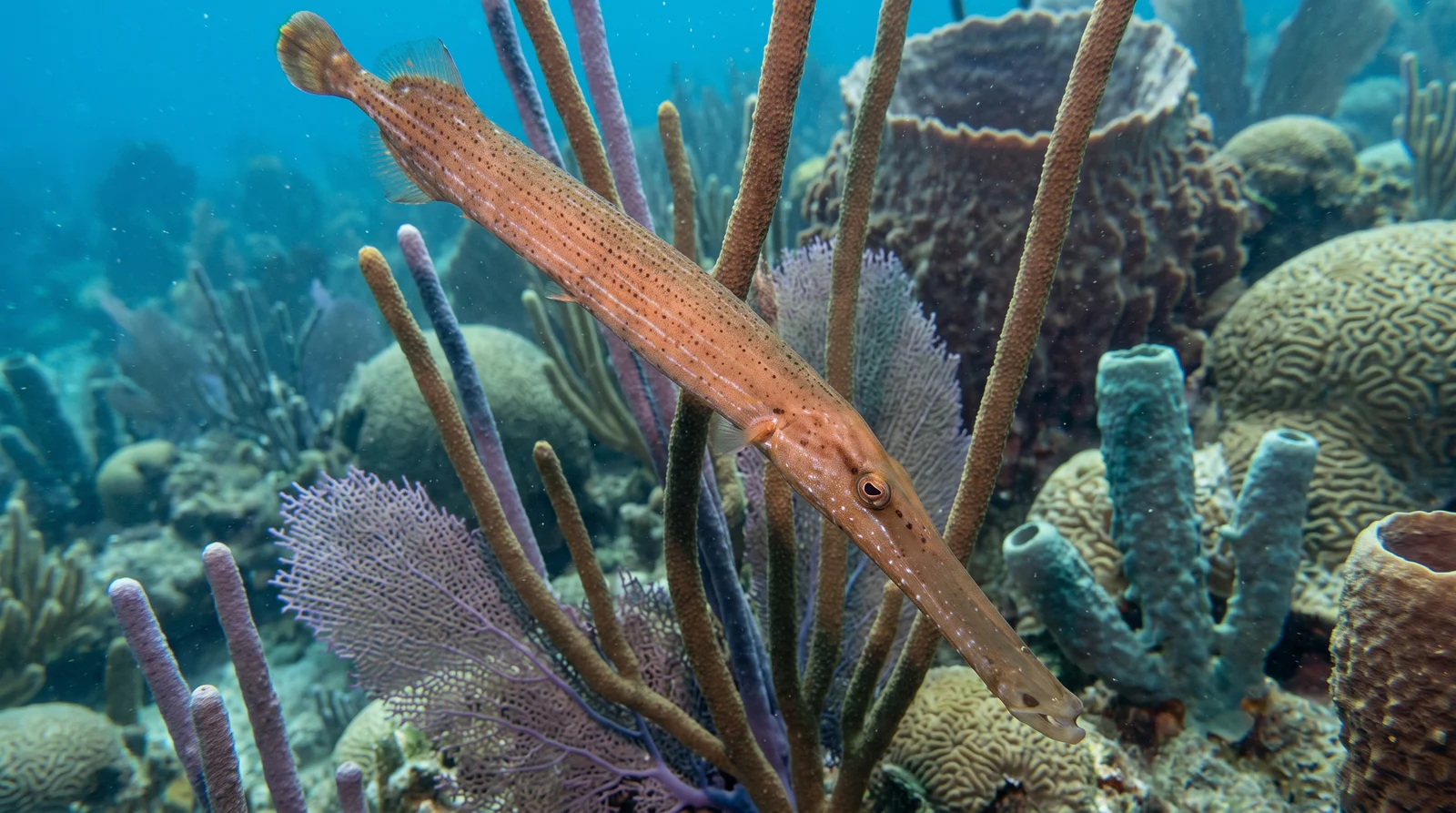
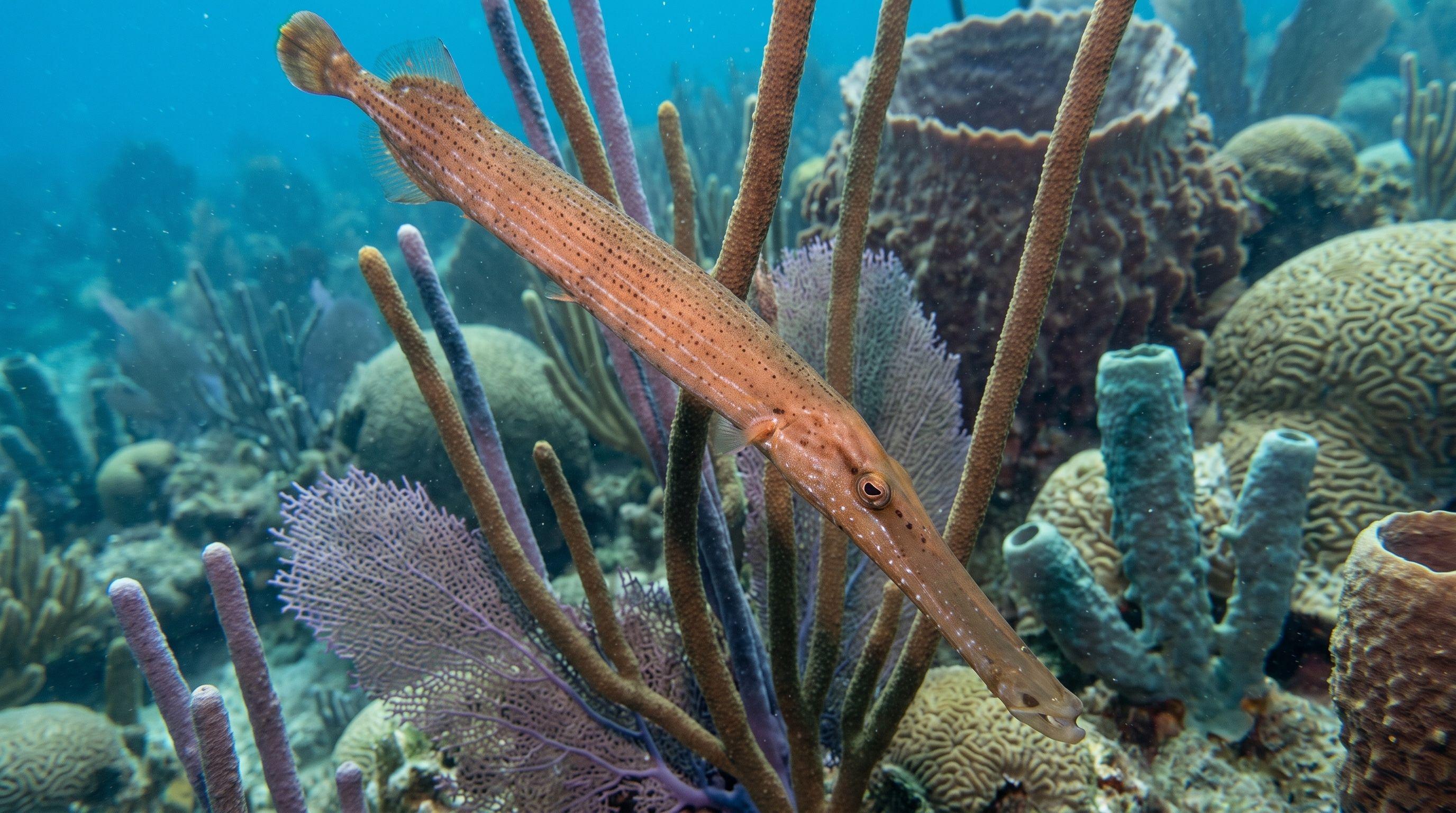
The Atlantic Trumpetfish, Aulostomus maculatus, is a fascinating and highly camouflaged marine species, instantly recognizable by its elongated, slender body and distinctive tubular snout. This unique physical characteristic, resembling the mouthpiece of a trumpet, is where the fish derives its common name. The head itself is long and compressed, culminating in a small, upturned mouth located at the tip of the snout, which surprisingly, can expand to the full diameter of its body during feeding, creating a powerful suction force. A prominent barbel can be observed at the tip of its lower jaw.
Its dorsal and anal fins are notably small, reduced, and positioned far back on its body, contributing to an almost snake-like appearance as it glides through the water. The caudal, or tail, fin is small and rounded. The body is covered with small, rough scales. While the Atlantic Trumpetfish can reach a maximum reported length of 100 cm (39.4 inches) TL, individuals around 60 cm (24 inches) are more commonly observed.
Coloration is highly variable and serves as a crucial element of its camouflage strategy. Common hues include reddish-brown (the most prevalent), blue-grey, and yellow-green. This species possesses specialized skin cells called chromatophores, enabling it to rapidly change its color and patterns to seamlessly blend with its immediate surroundings. Irregular dark black or brown spots and blotches are frequently present across its body. Additionally, many individuals display silvery streaks along the head and flanks, a black bar at the base of the dorsal and anal fins (sometimes reduced to a spot), and one or two distinct spots on the caudal fin. A striking feature of its behavior is its tendency to swim or float vertically, head-down, often among vertical structures like sea whips, further enhancing its ability to disappear within the reef environment. They are closely related to pipefishes and seahorses, sharing some of their unique characteristics.
Where it lives.
The Atlantic Trumpetfish (Aulostomus maculatus) is a widespread inhabitant of the tropical Western Atlantic Ocean. Its distribution spans from southern Florida and Bermuda, extending southwards to the northern coast of South America, and encompasses the entirety of the Caribbean Sea and the Gulf of Mexico. In the Eastern Atlantic, isolated populations are also found off St. Paul's Rocks.
These fish prefer shallow, clear coastal waters that offer complex reef structures, which are vital for both hunting and evading predators. Their primary habitats include vibrant coral reefs, expansive seagrass beds, and rocky areas. Within these environments, trumpetfish are particularly drawn to areas rich in vertical structures such as sea whips, gorgonians, sponges, and sea fans. They utilize these vertical elements for camouflage, often aligning their bodies to mimic the surrounding growth. While typically found in shallow tropical waters, they are most commonly observed at depths ranging from 2 to 25 meters (approximately 6 to 82 feet). Although some reports suggest they can occur at depths up to 300 meters, their usual range is considerably shallower. Despite the global decline of coral reefs and seagrass beds, the Atlantic Trumpetfish has demonstrated resilience, adapting to and utilizing other available habitats like rocky reefs.
How it behaves.
The Atlantic Trumpetfish is a highly specialized carnivorous ambush predator, relying on cunning camouflage and strategic hunting techniques rather than speed to capture its prey. Its diet primarily consists of small fish, such as gobies, blennies, grunts, damselfish, and surgeonfish, as well as various invertebrates, notably shrimp and other crustaceans.
One of its most distinctive hunting methods is vertical hovering. The trumpetfish will align its elongated body vertically, often head-down, amidst branching corals, sea whips, sea fans, sponges, or even within seagrass beds. In this posture, it remains motionless or drifts slowly with the current, effectively disappearing into the environment until an unsuspecting prey item swims close enough to strike. It can even mimic the swaying motion of gorgonians to further enhance its disguise.
Another remarkable strategy is shadow stalking, a behavior unique among non-human animals. The trumpetfish will swim closely behind or alongside larger, non-threatening herbivorous fish, such as parrotfish, surgeonfish, or hogfish, using them as a mobile screen to approach its prey undetected. This tactic reduces the likelihood of its own detection by both prey and potential predators. Once an opportunity arises, the trumpetfish will rapidly coil its body into an S-shape, then lunge forward, expanding its tubular mouth to create a powerful vacuum that sucks the prey in whole. While typically solitary hunters, trumpetfish may occasionally join schools of larger fish, like striped parrotfish, for enhanced protection and to improve their foraging success. They are known to sleep in groups for protection. Interaction with divers is generally harmless, and their unique behaviors make them a popular subject for underwater observation and photography.
Where to see it.
Evidence for philippines · No dive sites
General range is not evidence of occurrence at a specific dive site.
No documented dive-site associations in this destination yet.
Gallery.
 AI-generated
AI-generated illustration
Image credit: AI-generated illustration · License unspecified · Source unspecified