Bannerfish (assorted)
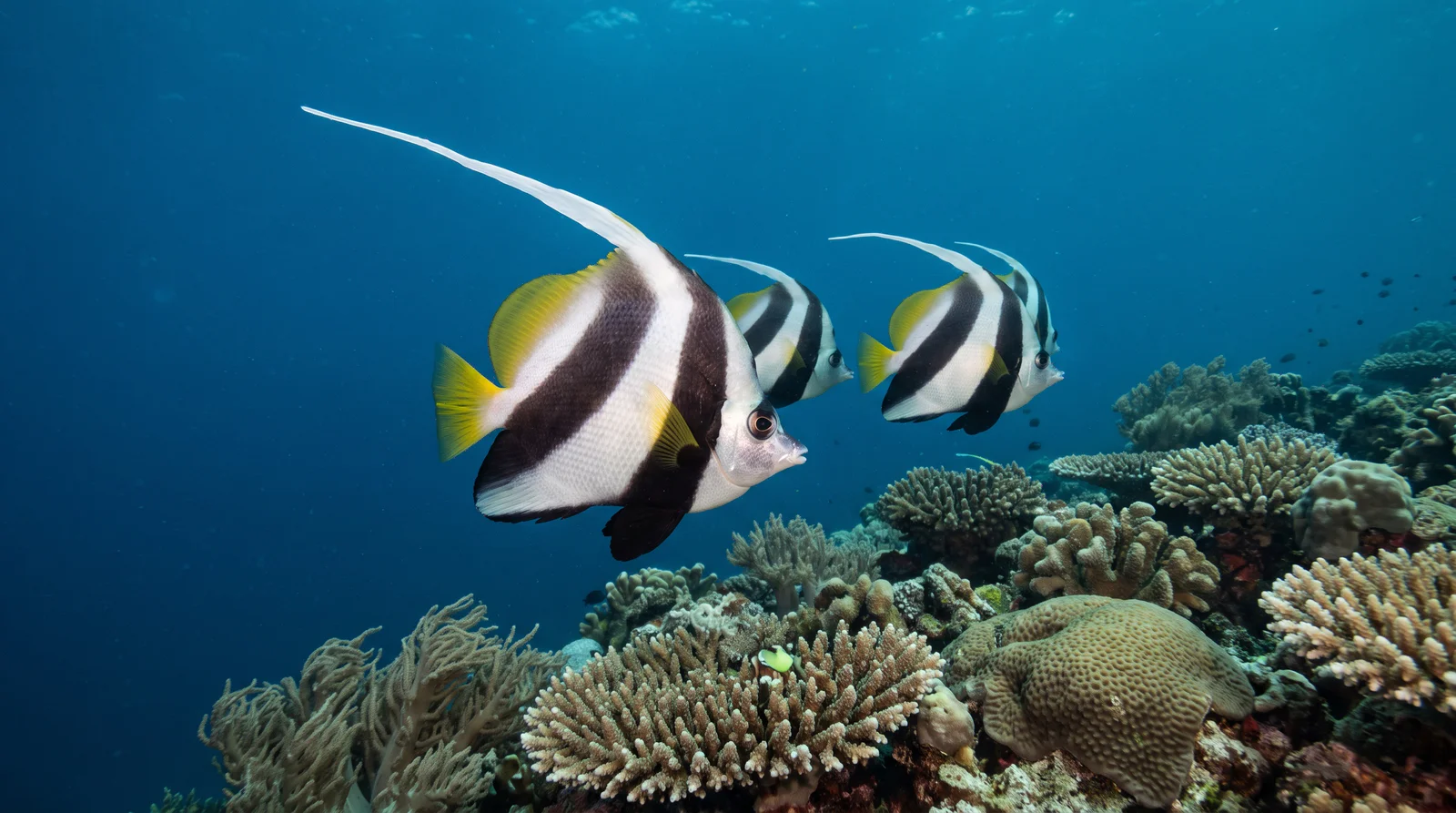 AI-generated
Image credit: AI-generated illustration · Generated for Diveity; no third-party rights · Higgsfield nano_banana_pro image generation
Heniochus spp.
About Bannerfish (assorted).
Bannerfishes are butterflyfishes of the genus Heniochus (family Chaetodontidae). This group entry covers bannerfish sightings where the species was not recorded. Diveity also has individual pages for the Longfin Bannerfish (Heniochus acuminatus), the Butterflyfish (assorted) group entry covering the genus Chaetodon, and the Moorish Idol (Zanclus cornutus), a lookalike that belongs to a different family. WoRMS lists eight accepted species in Heniochus: H. acuminatus, H. chrysostomus, H. diphreutes, H. intermedius, H. monoceros, H. pleurotaenia, H. singularius and H. varius.
Two of these are easily confused. The Reef Life Survey describes H. acuminatus as difficult to distinguish from the Schooling Bannerfish, H. diphreutes. Both are black-and-white banded fishes with a long, trailing white dorsal-fin filament, the "banner", and yellow on the rear of the dorsal fin. The Reef Life Survey says H. diphreutes has a slightly shorter snout and a shorter anal fin, with the black rear margin not extending as close to the lower corner of the tail.
Identification
- Banner: The Reef Life Survey describes both H. acuminatus and H. diphreutes as black and white banded with a long white filament trailing from the dorsal fin.
- Horned species: FishBase says adults of H. varius have a pair of prominent horns on the forehead above the eyes. The Reef Life Survey describes it as brown with two thin white stripes forming a triangle, and notes that it lacks the yellow pectoral fins of H. monoceros and H. singularius.
- Size: FishBase gives maximum total lengths of 18 cm for H. chrysostomus, 19 cm for H. varius, 21 cm for H. diphreutes, 24 cm for H. monoceros, 25 cm for H. acuminatus and 30 cm for H. singularius, which it calls the largest of the bannerfishes.
- Lookalike: WoRMS places the Moorish Idol (Z. cornutus) in the family Zanclidae. FishBase describes a tubular snout with a small mouth and dorsal spines elongated into a whip-like filament, and gives a maximum length of 23 cm.
Conservation status varies by species. FishBase lists IUCN Least Concern for H. acuminatus, H. diphreutes, H. varius, H. chrysostomus, H. monoceros and H. singularius, all assessed in 2009. Statuses for H. intermedius and H. pleurotaenia were not checked for this entry.
Where it lives.
Bannerfishes are reef-associated fishes of the Indo-Pacific, and their ranges differ by species. FishBase gives H. acuminatus from the Persian/Arabian Gulf and Tanzania to Japan, Micronesia, Australia and French Polynesia, and H. diphreutes from the Red Sea to South Africa and east to Indonesia, Japan, Australia and Hawaii. It describes H. varius as occurring from Indonesia to the Society Islands and north to southern Japan, replaced in the Indian Ocean by H. pleurotaenia. For H. singularius it gives the Andaman Islands to Samoa.
Where Divers Find Them
- Depth: FishBase gives 2-178 m for H. acuminatus (usually 15-75 m), 5-210 m for H. diphreutes (usually 5-30 m), 0-30 m for H. varius, 2-60 m for H. chrysostomus, 2-30 m for H. monoceros and 2-250 m for H. singularius (usually 15-40 m).
- Channels and outer slopes: FishBase says H. acuminatus inhabits deep, protected lagoons and channels and the deeper parts of outer reef slopes. H. diphreutes occurs mainly along outer reef slopes in current channels, with juveniles in aggregations around isolated patch reefs and adults in large schools well above the bottom.
- Coral-rich reef: FishBase describes H. chrysostomus as common in coral-rich areas of subtidal reef flats and lagoon and seaward reefs, and H. monoceros on lagoon and seaward reefs with rich coral growth. H. singularius prefers rich coral growth and high vertical relief, and H. varius occurs in deep lagoons and steep outer slopes with mixed algae and coral.
- Moorish Idol: FishBase describes adults as inhabiting turbid inner lagoons, reef flats and clear seaward rocky and coral reefs, from 0 to 182 m.
Because the depth ranges overlap widely, depth alone will not separate the species. The habitat notes above, whether the fish is alone, paired or in a school, and the field marks are more useful, and a photograph of the head, banner and anal fin helps with identification afterwards.
How it behaves.
Social behaviour and diet differ between bannerfish species. FishBase lists each Heniochus species checked here as oviparous, forming pairs during breeding.
Underwater Encounter Behavior
FishBase describes juvenile H. acuminatus as often solitary and adults as occurring in pairs; it is planktivorous and generally stays within a few metres of the reef, and juveniles may sometimes pick parasites from other fish. For H. diphreutes FishBase gives adults in large schools well above the bottom, feeding on plankton, with juveniles that may act as cleaners (also observed in adults). The other species feed on the bottom. FishBase says H. chrysostomus feeds mainly on coral polyps, with solitary juveniles and adults usually in pairs; H. singularius is uncommon, feeds on coral polyps and is solitary or in small groups, with solitary, secretive juveniles on inshore reefs. H. monoceros feeds on bottom-living animals, with adults often paired and occasionally hovering side by side under tabular corals. H. varius is solitary or in small groups and feeds on corals and other invertebrates. For the Moorish Idol, FishBase says adults occur singly, in pairs and occasionally in large schools, and feed on small encrusting animals.
Diver Tips
- Record the group: Note whether the fish was alone, paired or in a school, and photograph the banner, snout and anal fin side-on; these are the features the sources use to separate species.
- Harmless: FishBase lists the threat to humans as harmless for the bannerfish species checked here.
- Look, do not touch: Keep a respectful distance and do not chase or feed the fish.
- Protect the coral: Several species feed on coral polyps or live in coral-rich areas, so keep good buoyancy and avoid touching the reef.
Where to see it.
Evidence for philippines · 6 dive sites
General range is not evidence of occurrence at a specific dive site.
Angol Point
Boracay
Documented site occurrence
Season not yet documented
Source reviewed on 2026-10-15 · Source: Eclipse Dive Center Boracay, "Dive Sites" page · Observation date not documented
Balinghai Wall
Boracay
Documented site occurrence
Season not yet documented
Source reviewed on 2026-10-15 · Source: New Wave Divers Boracay (dive-site page) · Observation date not documented
Punta Bunga
Boracay
Documented site occurrence
Season not yet documented
Source reviewed on 2026-10-15 · Source: New Wave Divers Boracay (dated dive log) · Observation date not documented
Talima Marine Sanctuary
Mactan
Documented site occurrence
Season not yet documented
Source reviewed on 2026-10-15 · Source: Coral Sea Dive Center, "Dive Sites" page · Observation date not documented
Virgin Drop
Boracay
Documented site occurrence
Season not yet documented
Source reviewed on 2026-10-15 · Source: New Wave Divers Boracay (dated dive log) · Observation date not documented
Yapak
Boracay
Documented site occurrence
Season not yet documented
Source reviewed on 2026-10-15 · Source: New Wave Divers Boracay (dive-site page) · Observation date not documented
Gallery.
 AI-generated
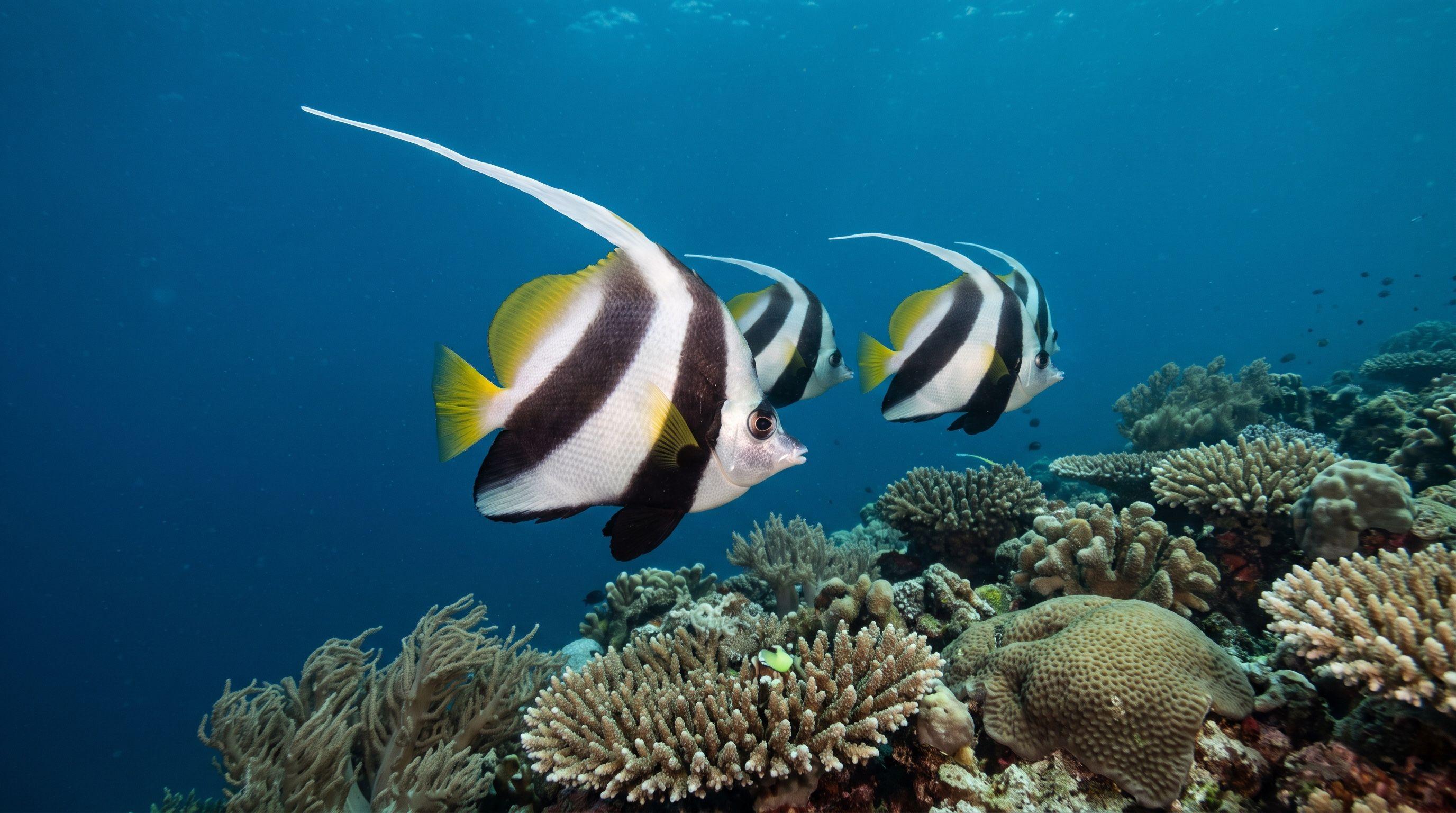
AI-generated illustration
Image credit: AI-generated illustration · Generated for Diveity; no third-party rights · Higgsfield nano_banana_pro image generation