Bicolor Damselfish
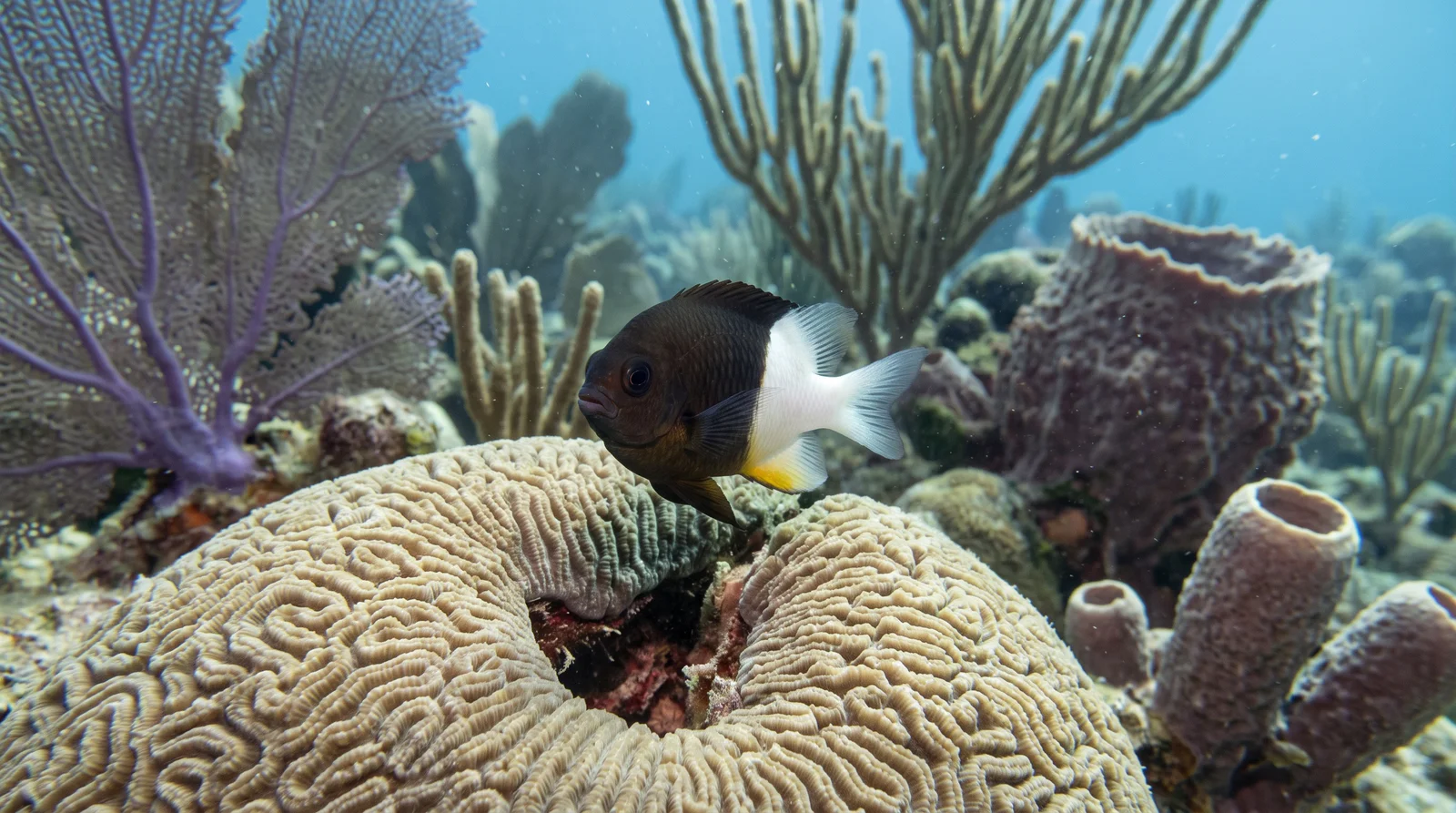 AI-generated
Image credit: AI-generated illustration · License unspecified · Source unspecified
Stegastes partitus
About Bicolor Damselfish.
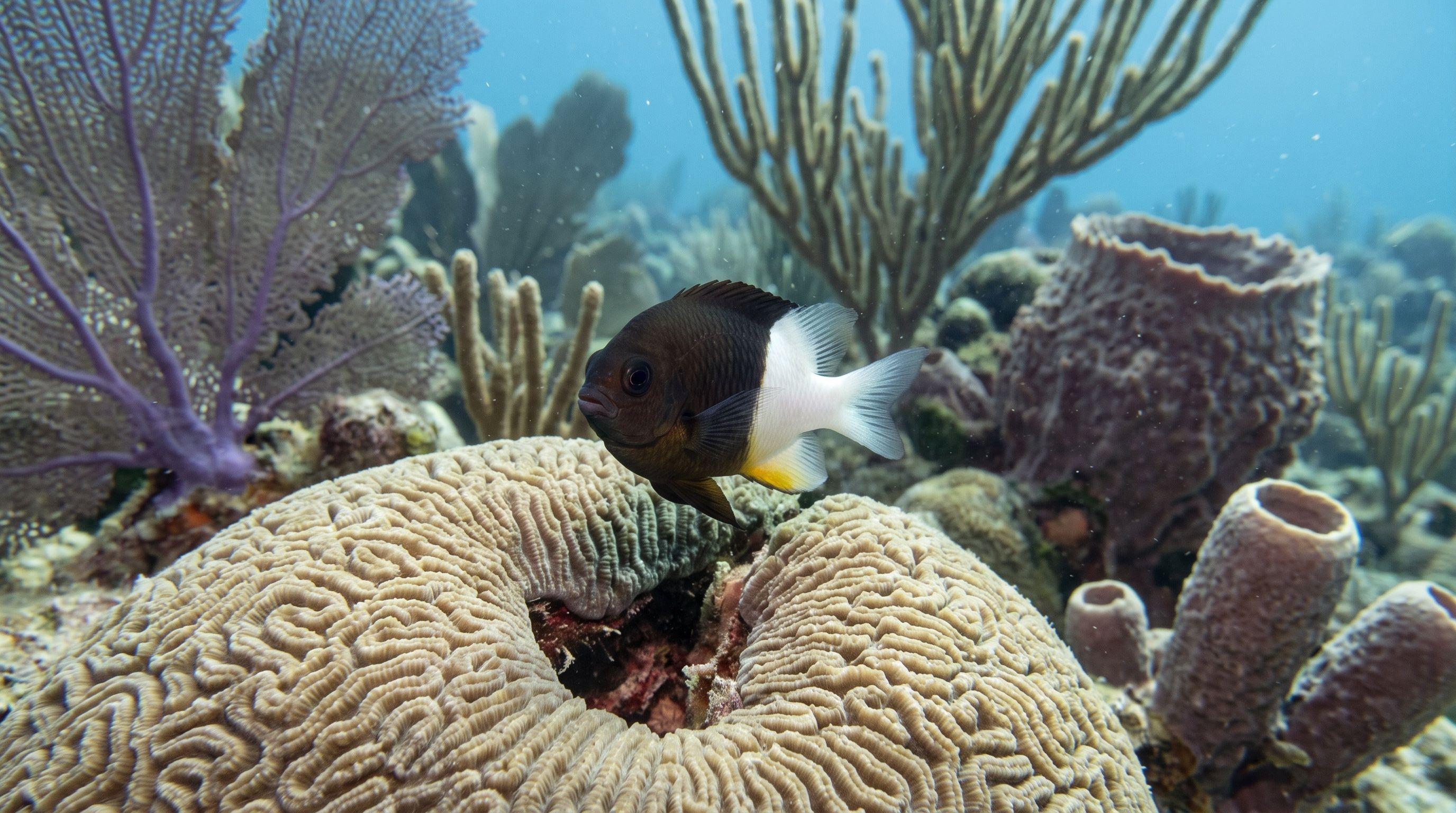
The Bicolor Damselfish, Stegastes partitus, is a striking and commonly observed reef fish recognized for its distinctive two-toned coloration. Typically, the anterior portion of its body, including the head, displays a dark hue, ranging from dark grey to black or deep brown, while the posterior half transitions abruptly to a pale, often pearly white or yellowish shade. This distinct division of color can vary significantly among individuals; in some cases, the dark area might cover only the upper head, extending past midbody, or even result in an entirely dark individual. The fins are generally pale and may exhibit a subtle bluish tint, with the pectoral fins often appearing yellowish.
This relatively small but robust fish typically reaches an average size of approximately 8 to 10 centimeters (3.1 to 3.9 inches) in length, with dominant males occasionally growing up to the maximum reported size of 10 cm (3.9 inches). Its body possesses a somewhat circular or fusiform shape, compressed laterally, giving it a characteristic damselfish profile. Notable anatomical features include a large dorsal fin equipped with 12 strong spines and 14 to 17 soft rays, complemented by a similarly proportioned anal fin featuring two spines and 13 to 15 soft rays. The preopercle, a bone in the gill cover, is serrated. Sexual dimorphism in Stegastes partitus is minimal, with males being only slightly larger than females, making visual distinction between the sexes challenging outside of breeding behaviors. Its vibrant yet straightforward coloration makes it a conspicuous inhabitant of its reef environments.
Where it lives.
The Bicolor Damselfish, Stegastes partitus, is predominantly found in the Western Atlantic Ocean, encompassing regions such as southern Florida, the Bahamas, the Caribbean Sea, and extending south to the coast of Brazil, as well as throughout the Gulf of Mexico. This species is a common resident of shallow coastal waters, particularly favoring rocky and coral reef ecosystems. It frequently inhabits areas characterized by coral rubble, live coral structures, and isolated patch reefs, often seeking refuge within the numerous crevices and formations these habitats provide. The seabed in their preferred territories typically consists of a mix of sand and rocks.
While most often observed in depths ranging from 0 to 15 meters (0 to 49 feet), the Bicolor Damselfish has a broad depth tolerance and can be found in a greater range, extending down to approximately 100 meters (330 feet). This wide depth distribution means they are present across various zones of the reef, from the sunlit shallows to deeper mesophotic reefs. These mesophotic populations can even contribute to the sustainability of shallower reef populations by acting as a source of offspring.
How it behaves.
The Bicolor Damselfish exhibits a fascinating array of behaviors, most notably its fierce territoriality. These fish are known to aggressively defend a small patch of rocky reef, especially against other territorial species and even against divers who approach too closely. This defense is crucial, particularly for males guarding nesting sites, where they prepare a cleaned surface for eggs and then diligently protect and aerate them until hatching. Interactions between dominant males can be intense, sometimes resulting in violent confrontations for control over territory, which may even lead to the death of one of the combatants.
Unlike many of its Stegastes genus relatives, which are primarily herbivorous algae farmers, the Bicolor Damselfish has a more omnivorous diet. Its feeding habits largely revolve around consuming plankton in the water column. However, it also supplements its diet with various benthic invertebrates such as polychaetes, hydroids, copepods, and ascidians. Socially, these fish are often observed living as couples or forming loose groups of up to twenty individuals, though solitary individuals and small groups with a dominant male are also common. They are non-migratory, remaining in their native home ranges year-round. Reproduction occurs year-round, with peak activity between April and November. An interesting aspect of their life cycle is their protandric successive hermaphroditism, meaning all individuals are born male and later transition to female.
Where to see it.
Evidence for bonaire · No dive sites
General range is not evidence of occurrence at a specific dive site.
No documented dive-site associations in this destination yet.
Gallery.
 AI-generated
 illustration
Image credit: AI-generated illustration · License unspecified · Source unspecified