Bigeye Trevally
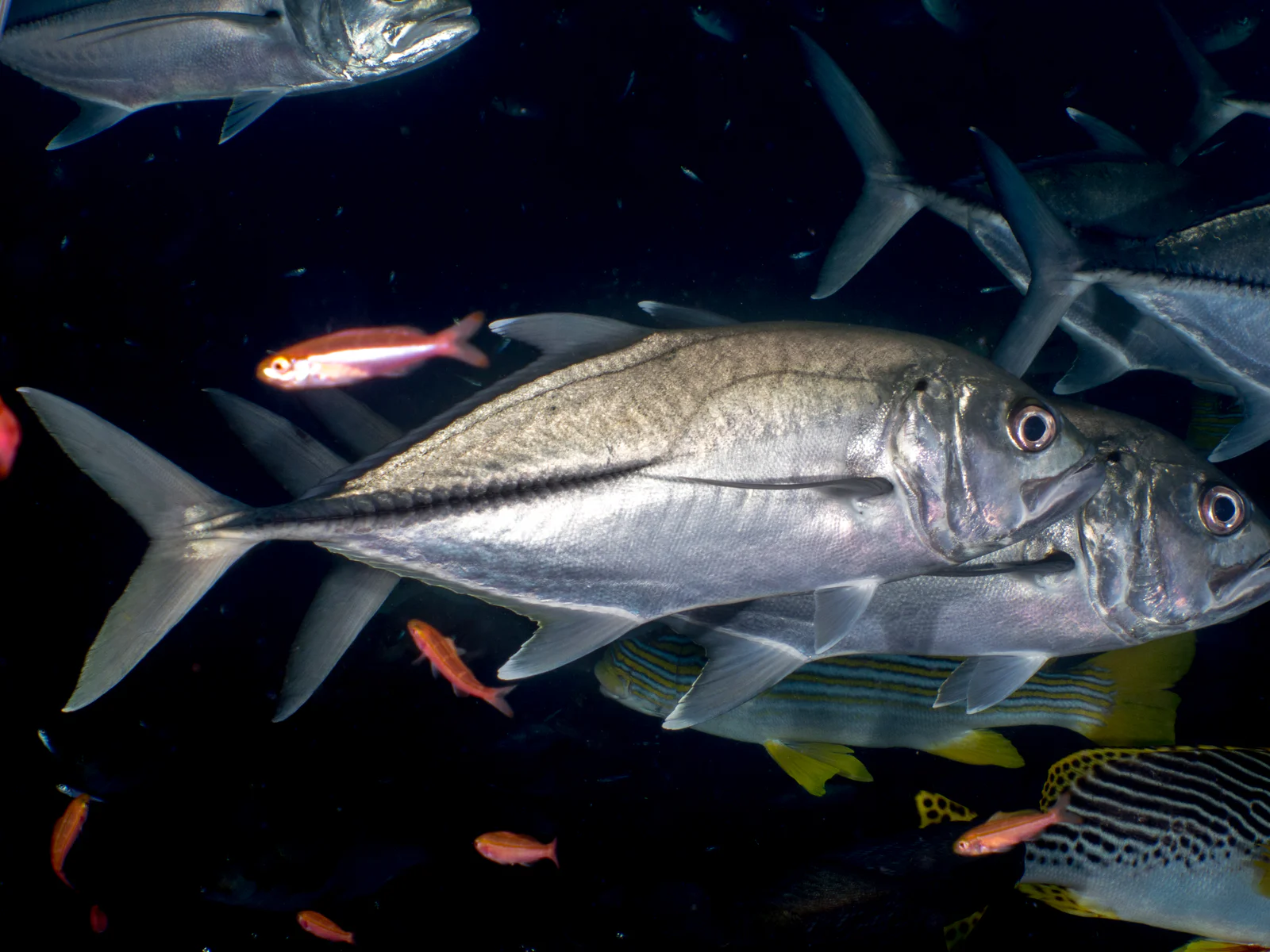
Image credit: Rickard Zerpe · CC BY 2.0 · Flickr via Wikimedia Commons, cropped by this page
Caranx sexfasciatus
About Bigeye Trevally.
The bigeye trevally (Caranx sexfasciatus) is a large silvery jack of Indo-Pacific and east Pacific reefs that schools by day and feeds at night.
The World Register of Marine Species (WoRMS) lists Caranx sexfasciatus Quoy & Gaimard, 1825 as an accepted species of the jack family Carangidae, in the order Carangiformes. Wikipedia gives bigeye jack, great trevally, six-banded trevally and dusky jack as other names, and says the species was described from a specimen collected off Waigeo, Indonesia, its epithet meaning "six banded" after the juvenile colouration.
Identification
FishBase gives a maximum length of 120 cm total length, a common length of 60 cm fork length, a maximum published weight of 18 kg and a maximum reported age of 11 years; Wikipedia gives the same length and weight. FishBase describes adults as silvery olive to iridescent blue-green above and silvery olive to whitish below, with a small blackish spot, much smaller than the pupil, at the upper corner of the gill cover, and a second dorsal fin that is olive to blackish with a white tip on its lobe that becomes more obvious as the fish grows. It counts 27 to 36 strong, dark scutes on the straight part of the lateral line.
Wikipedia says juveniles are silvery yellow to silvery brown with five or six dark vertical bands on the sides, which fade as the fish matures and are absent in adults, whose anal and caudal fins are yellow to black.
Conservation
FishBase shows the bigeye trevally as Least Concern on the IUCN Red List, assessed on 13 December 2018, and Wikipedia cites a 2019 Red List assessment. FishBase records reports of ciguatera poisoning and lists the species in commercial fisheries and as a gamefish. Wikipedia says scuba divers often photograph the large schools that mill around reefs during the day.
Where it lives.
The bigeye trevally lives over coral and rocky reefs in coastal and oceanic waters, and its juveniles enter estuaries and sometimes rivers.
Range
FishBase gives its range as the Indo-Pacific, from the Red Sea and East Africa to Hawaii, north to southern Japan and the Ogasawara Islands and south to Australia and New Caledonia, and the eastern Pacific, from the south-western coast of Baja California Sur and the Gulf of California to Ecuador and the Galapagos Islands. Wikipedia also names South Africa, Madagascar, the Persian Gulf, India, South East Asia and Indonesia.
Depth
FishBase gives a depth range of 0 to 146 m, and describes adults as pelagic at 1 to 96 m. Wikipedia says the species reaches depths of around 100 m.
Reef setting
FishBase says adults inhabit coastal and oceanic waters associated with reefs, and classes the species as tropical, giving 26 to 29 °C. Wikipedia says adults are found mostly over coral and rocky reef complexes and often move in small numbers into sandy bays and lagoons, that fish living offshore keep to deeper seamounts or the reefs of offshore islands, and that in some regions the species follows the tide into shallow lagoons and back to deeper reefs. It adds that the species has been reported milling around stationary buoys in the open ocean.
Juveniles
Wikipedia says juveniles live in shallower inshore water, in lagoons, on tidal flats, in mangrove zones and in estuaries, and have been reported far up rivers in several places. FishBase likewise says juveniles may be met in estuaries, occasionally entering rivers and penetrating well inland.
How often divers see bigeye trevally at a particular site, and the months when schools gather there, are not documented in these sources.
How it behaves.
The bigeye trevally mills in large, slow-moving schools over reefs by day and splits up at dusk to hunt fish, squid and crustaceans.
Schooling
FishBase says the species is often seen in large daytime schools, usually milling in stationary aggregations or forming slow-moving schools in the passes or outside the reef, and is solitary at night when feeding. Wikipedia says the aggregations can number more than 1500 fish, and that the species' abundance on the west coast of the Americas drops significantly during El Niño events.
Feeding
FishBase says adults feed mainly on fishes, squids and crustaceans. Wikipedia says the bigeye trevally is mostly inactive by day and feeds at dusk and through the night, the schools breaking up as fish hunt alone or in small groups, and that besides small fish it takes shrimps and other crustaceans, cephalopods, gastropods, jellyfish and open-ocean sea skaters. It cites a study in South African estuaries in which fish under 200 mm long still took many penaeid shrimps while larger fish ate small fish almost exclusively, and names sharks and larger jacks among its predators.
Reproduction
FishBase gives a length at first maturity of 42 cm, and Wikipedia says both sexes mature at around 42 cm. Wikipedia says spawning has been recorded between July and September in the eastern Pacific and from November to March in South Africa, that there is evidence it may take place around the new moon, and that pairs break away from a large pre-spawning school, the lower fish turning dark black and chasing off others, before returning to the school and their usual silver colour.
How closely schools let divers approach is not documented in these sources.
Where to see it.
Evidence for great barrier reef · 5 dive sites
General range is not evidence of occurrence at a specific dive site.
Around the Bend
Coral Sea
Site occurrence not yet documented
Season not yet documented
No dated observations available.
False Entrance
Coral Sea
Site occurrence not yet documented
Season not yet documented
No dated observations available.
Pixie Pinnacle
Ribbon Reefs
Site occurrence not yet documented
Season not yet documented
No dated observations available.
SS Yongala
Townsville
Site occurrence not yet documented
Season not yet documented
No dated observations available.
Steve's Bommie
Ribbon Reefs
Site occurrence not yet documented
Season not yet documented
No dated observations available.
Gallery.
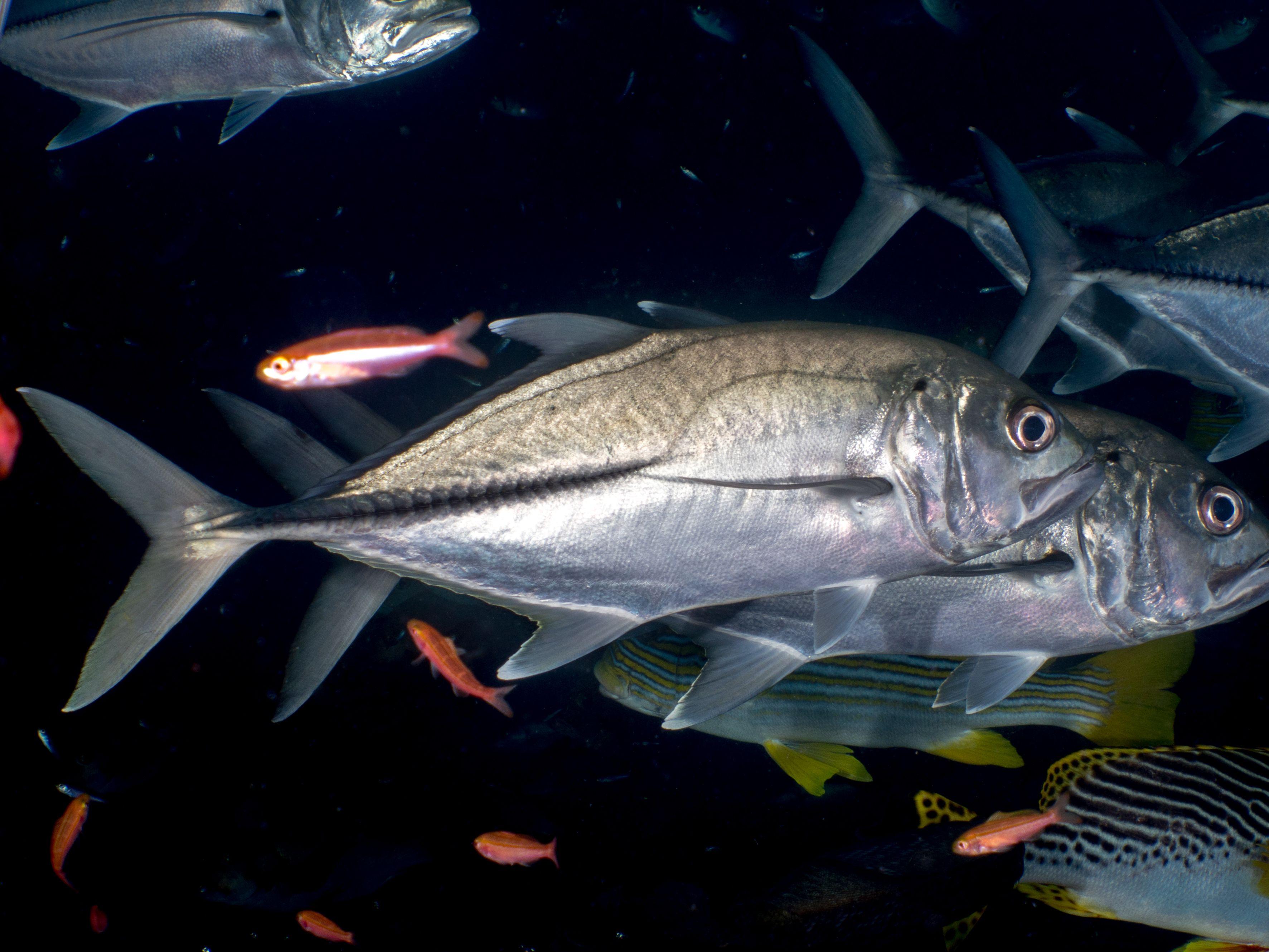
Two bigeye trevally (Caranx sexfasciatus) photographed by Rickard Zerpe on 5 January 2020, as its file page states. The identification is the one its file page gives. It illustrates the species and is not a sighting record. This page's frame crops the photograph.
Image credit: Rickard Zerpe · CC BY 2.0 · Flickr via Wikimedia Commons, cropped by this page
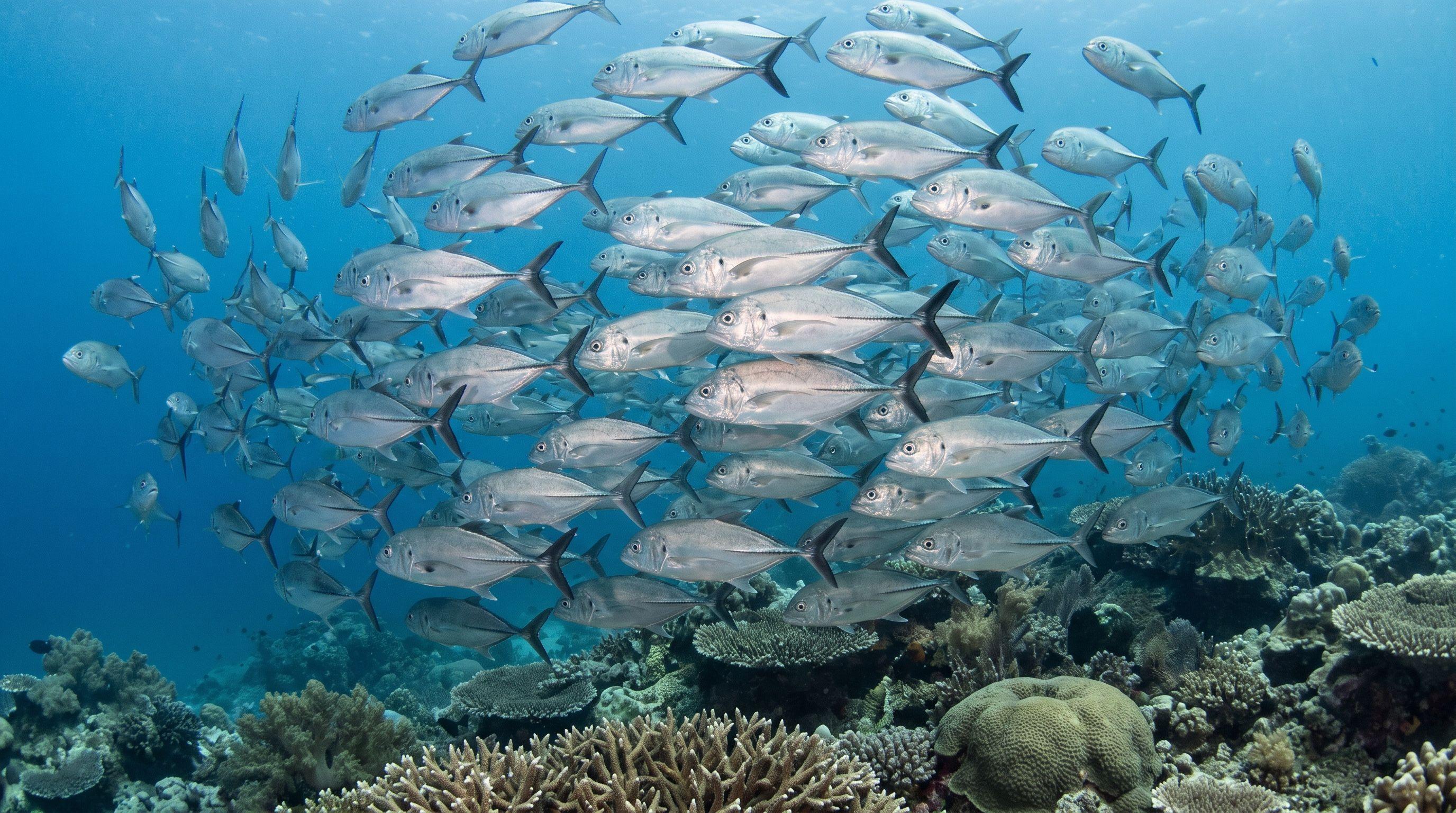 AI-generated
 illustration
Image credit: AI-generated illustration · Diveity
Related dive articles.
Best Wreck Dives in the World: 10 Wrecks Ranked
The SS Thistlegorm, SS Yongala and President Coolidge top the world's best wreck dives. Depths, certification levels and seasons for all 10.
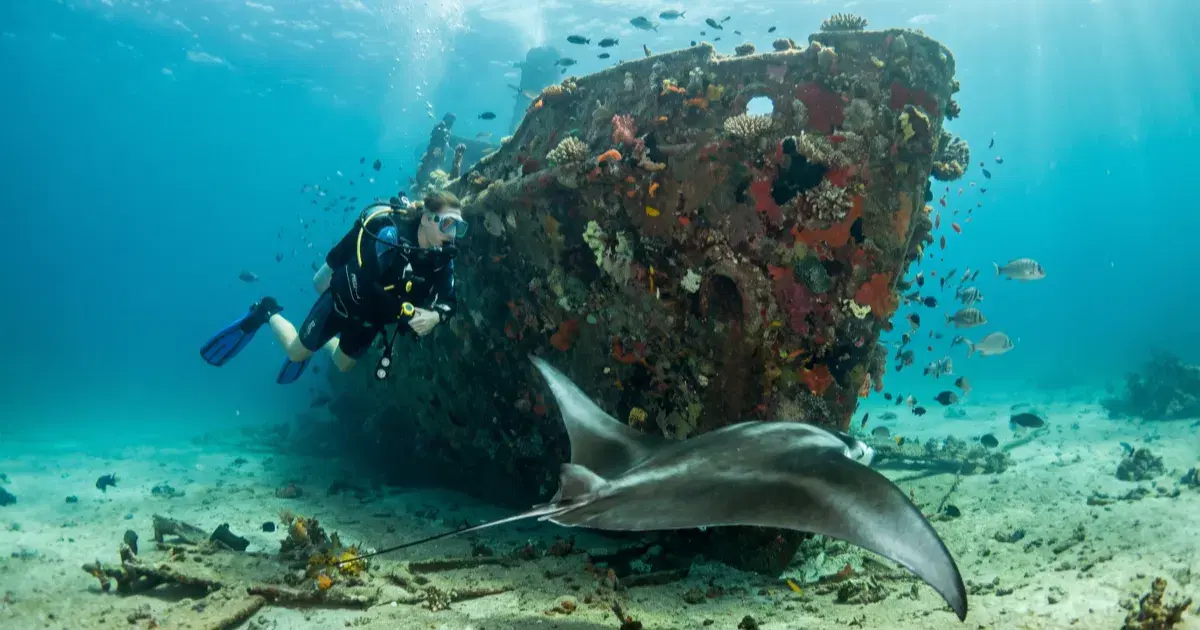
Diving the SS Yongala: Australia's Best Wreck Dive
SS Yongala dive guide: depth, marine life, certification requirements, and how to reach this Townsville wreck dive.
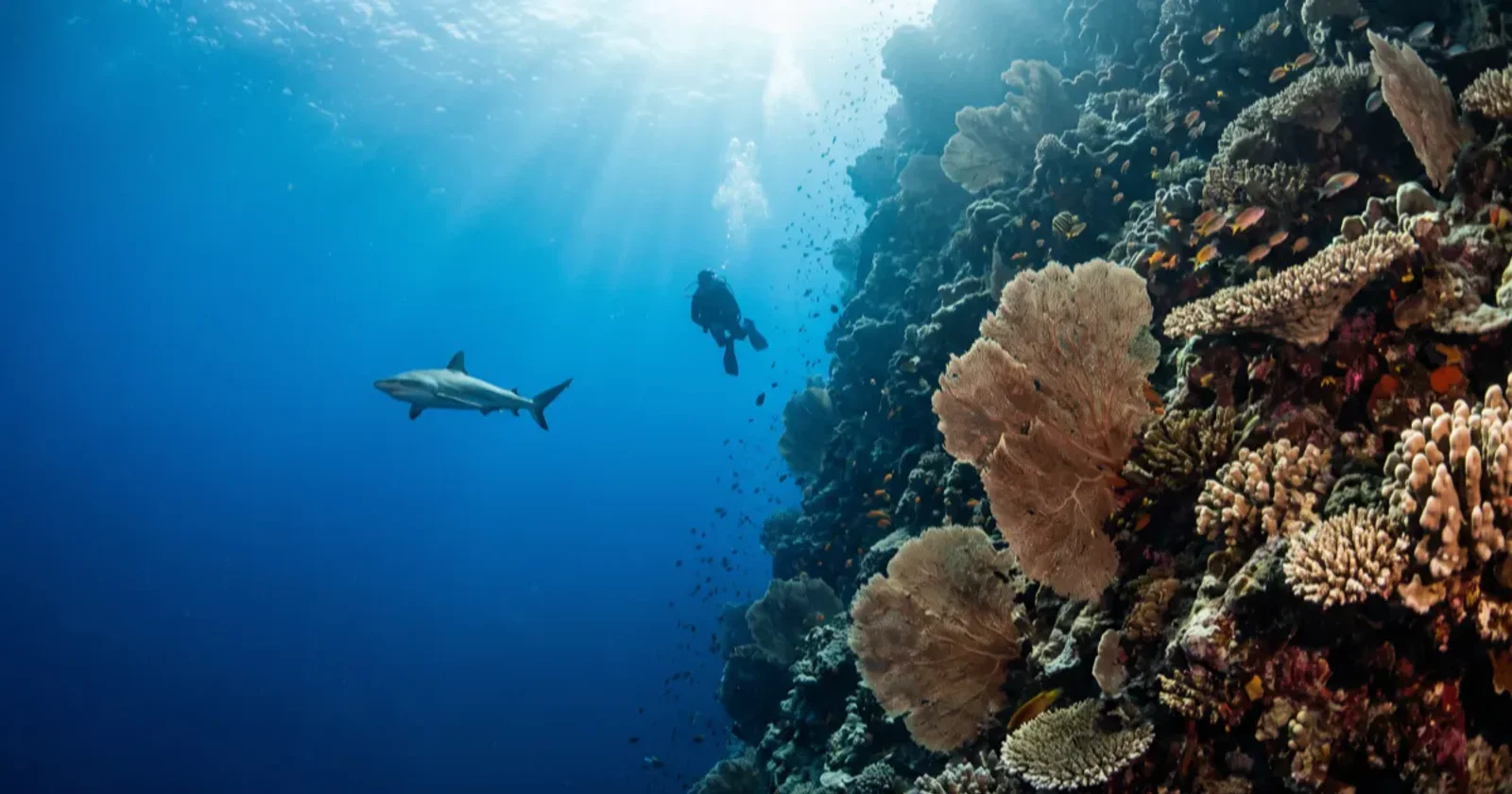
Coral Sea Diving: Osprey Reef and Australia's Remote Walls
Osprey Reef diving guide: liveaboard access, season window, shark diving at the North Horn, and how it differs from the Great Barrier Reef.