Bigfin Reef Squid
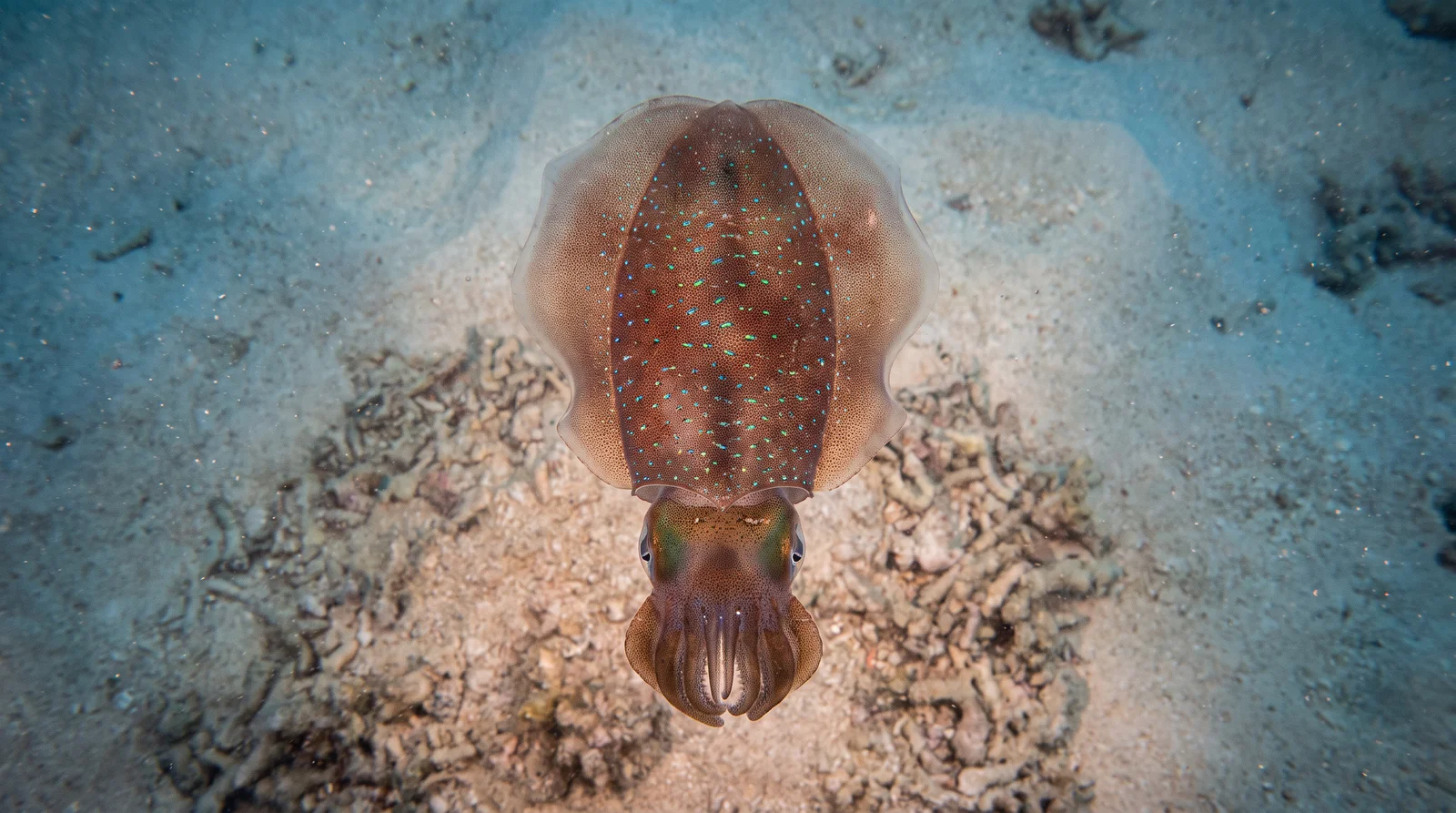 AI-generated
Image credit: AI-generated illustration · Diveity
Sepioteuthis lessoniana
About Bigfin Reef Squid.
The bigfin reef squid is an inshore squid of the Indian Ocean and western Pacific, recognised by the oval fin that runs along almost its whole mantle.
Names and classification
WoRMS, whose entry comes from MolluscaBase, accepts Sepioteuthis lessoniana in the family Loliginidae, order Myopsida, credits the name to Lesson, 1831, and places thirteen other names under it. SeaLifeBase and Wikipedia credit the name to Férussac, 1831; Wikipedia explains that Férussac described the species in Lesson's work and named it after him. Wikipedia lists other English names, among them tiger squid, oval squid and northern calamari. It also reports that studies from 1993 onwards found the squid of Okinawa and of Shark Bay in Australia to be more than one species, so that S. lessoniana is now thought to be a complex of several very similar species.
Identification
Wikipedia describes thick, muscular oval fins along 83 to 97% of the mantle, which can make the squid look like a cuttlefish, with a narrow blue or white line where they join the body. The mantle is cylindrical and ends in a blunt cone. The eyes are large and greenish at the base. Of the eight arms the third pair is the longest, and in males the left arm of the fourth pair is the hectocotylus used in mating. Living animals range from translucent creamy white through pale yellow to brownish pink and brownish violet, and change colour and pattern rapidly; iridophores, mostly on the head, give metallic green and red reflections under light. The species has no light organs.
Size
Wikipedia gives a usual mantle length of 4 to 33 cm in males and 3.8 to 25.6 cm in females, a maximum of 38 cm for both sexes and a maximum documented weight of 1.8 kg. SeaLifeBase gives a maximum mantle length of 40.1 cm. Wikipedia also reports one of the fastest growth rates recorded for a large marine invertebrate, 600 g in four months, and a lifespan of 161 to 315 days in captivity.
Conservation
SeaLifeBase quotes version 2025-2 of the IUCN Red List as Data Deficient, assessed on 2 July 2014, and records the species as not evaluated by CITES or the Convention on Migratory Species; Wikipedia also gives Data Deficient. Both describe a commercial fishery. SeaLifeBase names set nets, spears and jigs, and Wikipedia trawls, seines, fixed traps and jigging at night under bright lights, which draw the squid in.
Where it lives.
Bigfin reef squid live in warm coastal waters between East Africa, the Red Sea, Japan, Australia, New Zealand and Hawaii, down to about 100 m.
Range
SeaLifeBase describes an Indo-Pacific range from Japan to the coasts of Australia and New Zealand and from Hawaii to East Africa, north to the Red Sea and south to Madagascar, within 51°N to 48°S and 22°E to 155°W. Wikipedia gives 42°N to 42°S and 32°E to 154°W, and calls it the most widespread species of its genus. Both report it in the Mediterranean; Wikipedia says it was first documented there in 2002, in the Gulf of İskenderun, having arrived through the Suez Canal.
Depth and habitat
SeaLifeBase gives 0 to 100 m as its depth and calls it a demersal, neritic species that also enters brackish water, found among rocky reefs, seaweeds and estuaries. Wikipedia agrees on the depths and says it stays close to the shore, near rocks and reefs. SeaLifeBase calls it primarily active at night and Wikipedia slightly more active then; by day, both say, it moves deeper or takes cover, which SeaLifeBase lists as floating driftwood, reefs, rocks or seagrass. Wikipedia adds that large numbers of juveniles often hide beneath floating driftwood.
How it behaves.
Bigfin reef squid hunt prawns, other crustaceans and small fish, are more active at night, are drawn to light and court with elaborate colour displays.
Feeding
SeaLifeBase calls it a voracious and strictly carnivorous predator that eats mainly molluscs, fish and prawns, catching live prey with its two tentacles. Wikipedia names prawns, other crustaceans and fish as its main prey, and records captive animals eating one fish every 2 to 25 hours. Tuna, marlin, swordfish and other predatory fish eat it in turn, according to Wikipedia.
Groups and light
The two sources differ on how it lives. SeaLifeBase calls it often solitary and reports that it eats smaller animals of its own species. Wikipedia describes both schooling and shoaling, with very young squid keeping close together, and says that, unlike most squids, it is rarely cannibalistic, so a shoal can hold animals of different sizes; it adds that hatchlings are often cannibalistic, mostly on individuals already weakened or dead. Wikipedia reports a strong attraction to light, the squid halting other movement when a light comes on, and a photograph caption there says they are often drawn to divers' lights at night.
Courtship and eggs
Wikipedia describes two common mating signals. In "accentuated gonads" the rest of the body pales so that the gonads show bright white through the mantle; in "spread arms", mostly by males, the squid tilts head down with its arms raised and spread and its mantle darkened. Males mate in three known positions, smaller "sneaker" males may mate while a larger male courts the female, and some smaller males may mimic female patterns. The main spawning season usually begins in May, but eggs are laid all year and the timing varies by place. Females lay strands of gelatinous capsules, each holding two to nine eggs, on rocks, corals, plants and submerged branches, and die soon afterwards. The capsules take about three weeks to hatch, 15 to 16 days in the warmer waters of Indonesia.
Where to see it.
Evidence for visayas · 1 dive site
General range is not evidence of occurrence at a specific dive site.
Gallery.
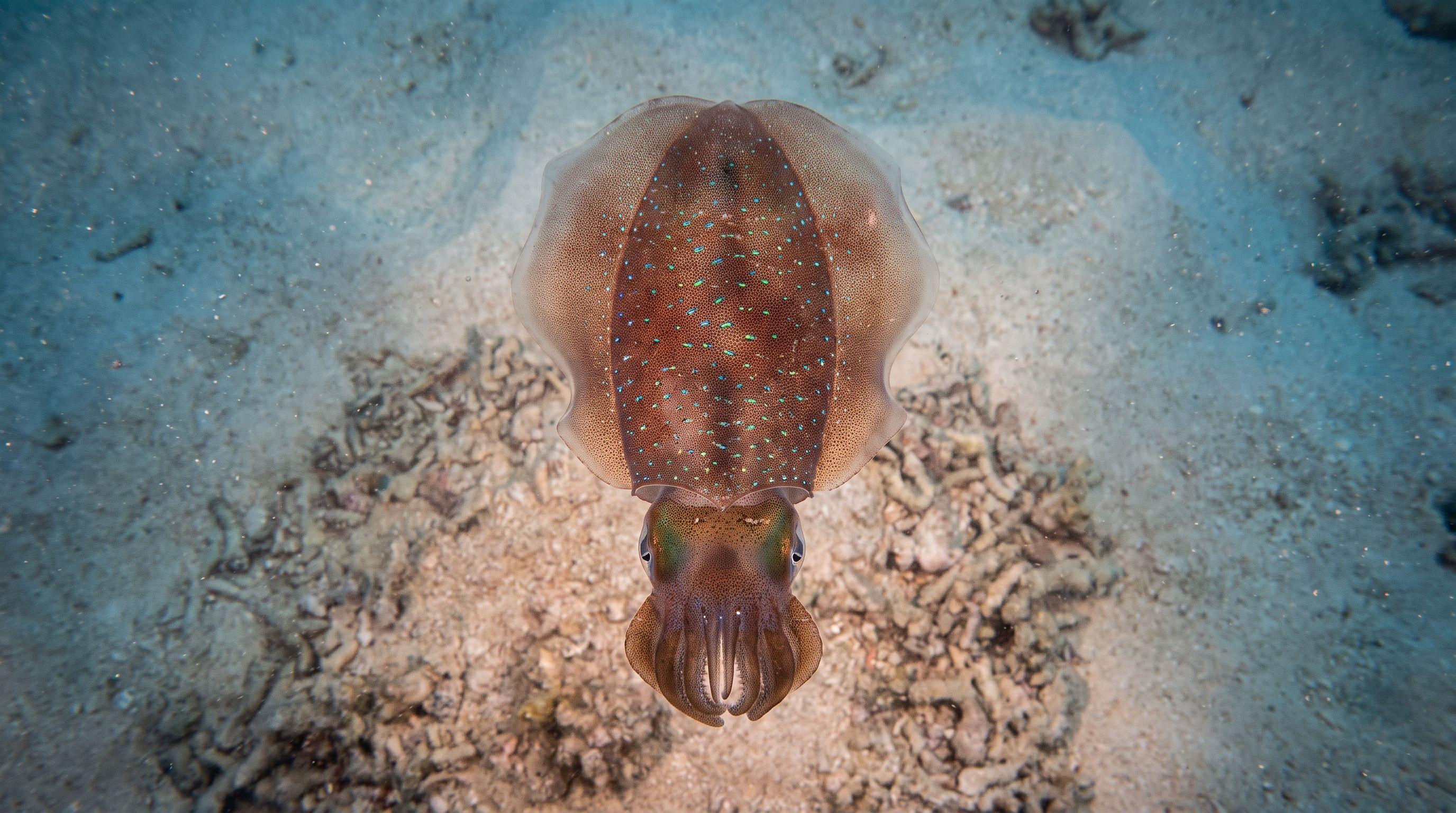 AI-generated
 illustration
Image credit: AI-generated illustration · Diveity