Blue Parrotfish
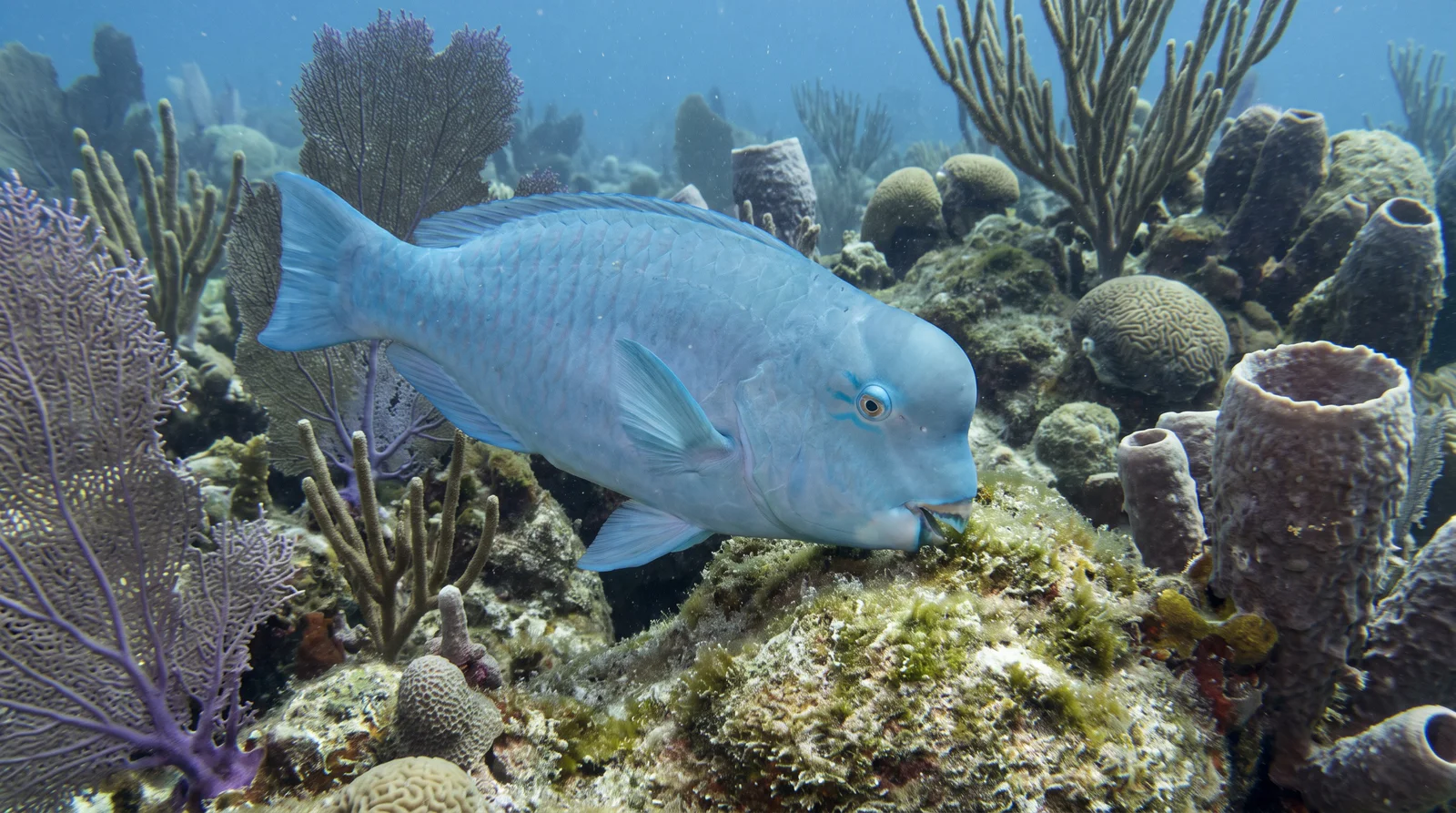 AI-generated
Image credit: AI-generated illustration · Diveity
Scarus coeruleus
About Blue Parrotfish.
The blue parrotfish (Scarus coeruleus) is an all-blue parrotfish of western Atlantic and Caribbean coral reefs, up to 1.2 m long, found at 3 to 25 m.
Names and classification
WoRMS accepts Scarus coeruleus (Edwards, 1771), first named Coryphaena coerulea, and places it in the wrasse family Labridae, order Labriformes. FishBase puts the genus in the subfamily Scarinae of that family, and Wikipedia also gives Labridae. FishBase's main reference for the species is a checklist by Parenti and Randall from 2000 whose title names two families, "the labroid fish families Labridae and Scaridae". Names WoRMS no longer accepts for it include Scarus loro and Calliodon gibbosus of Bloch and Schneider, 1801, and Scarus obtusus and Scarus nuchalis of Poey, 1860. FishBase traces the genus name to the Greek skaros, a fish that ancient writers described as a parrotfish.
Identification
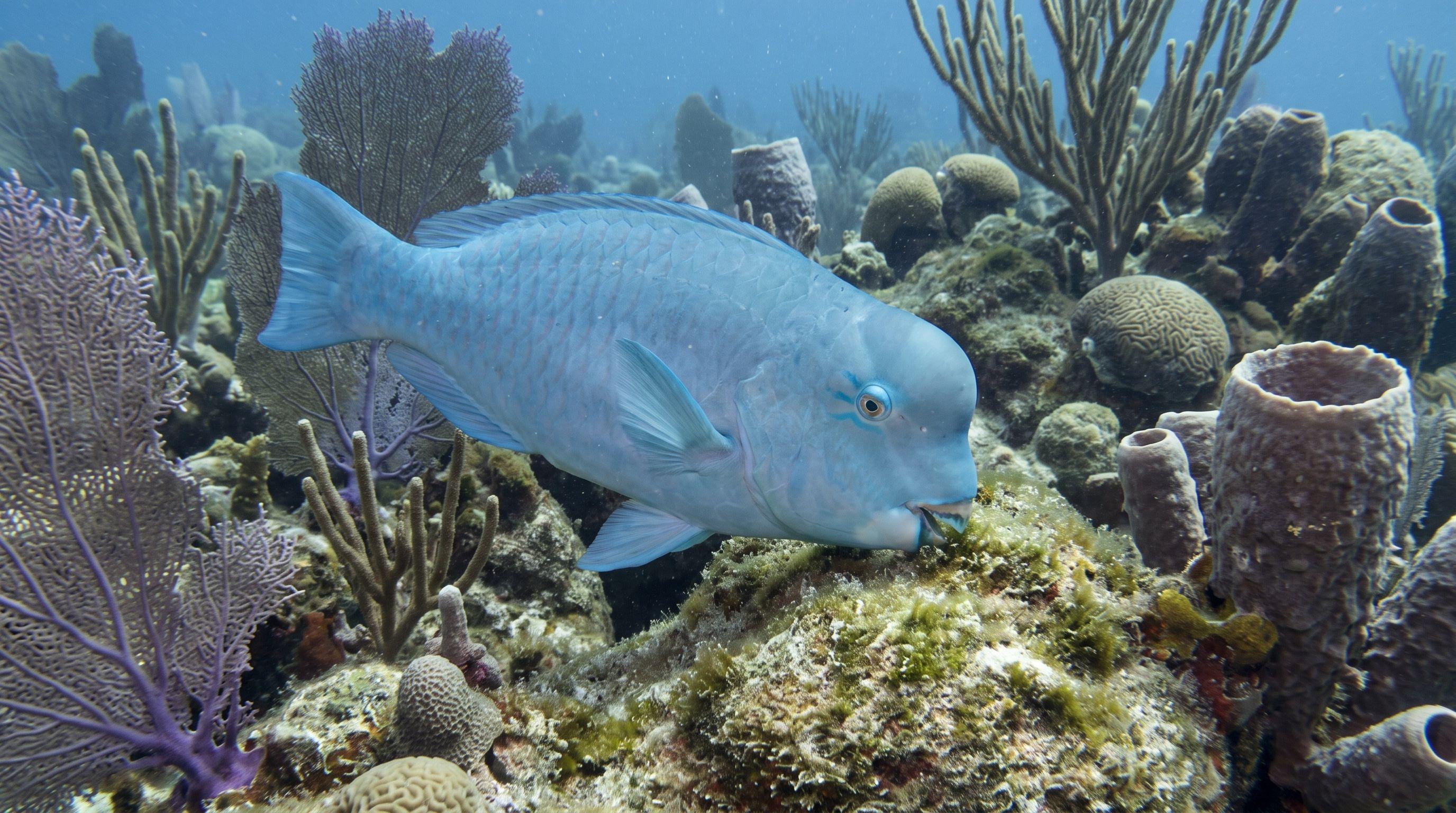
FishBase describes adults as uniformly blue, with a yellow area on top of the head that disappears in larger fish, and says that no other species has this uniform blue colour as an adult. Large fish develop a prominent bulging snout and extended upper and lower lobes of the tail fin. The body is fusiform, with 9 dorsal spines and 10 dorsal soft rays, 2 anal spines and 9 anal soft rays. Wikipedia mentions the yellow spot fading with age as well, and adds the large beak that, as in other parrotfishes, scrapes algae and small organisms from rock, and the pharyngeal teeth that grind swallowed rock into sand.
Size
FishBase and Wikipedia agree on a maximum length of 1.2 m. Wikipedia gives an average length of 30 to 75 cm and a weight of about 9.1 kg, while FishBase gives a common length of 35 cm total length.
Conservation and people
The species is listed as Least Concern on the IUCN Red List. FishBase (Red List version 2025-2) gives 17 September 2009 as the date of the assessment, while Wikipedia cites an assessment by Rocha and colleagues dated 2012. Wikipedia explains the listing by the wide range, the fish's abundance over much of it, the parts of it inside marine conservation areas and a population that seems stable overall, although fishermen target the larger fish. FishBase records minor commercial fisheries, use as a gamefish and in the aquarium trade, and reports of ciguatera poisoning.
Where it lives.
The blue parrotfish lives on coral reefs of the tropical western Atlantic and the West Indies at 3 to 25 m, and its young live in beds of turtle grass.
Range
FishBase and Wikipedia describe the same range: from Maryland in the United States, Bermuda and the Bahamas south to Brazil, which FishBase gives as Rio de Janeiro, including the West Indies but absent from the northern Gulf of Mexico. FishBase classes the species as tropical, between 39° N and 24° S.
Reef and turtle grass
Both sources give a depth range of 3 to 25 m. FishBase calls the species reef-associated and says it inhabits coral reefs, and Wikipedia describes it as a fish of coral reefs in shallow water that depends on reef systems for its food. Juveniles are found in beds of turtle grass (Thalassia testudinum), according to both. No capture names the dive sites, or the months, in which divers are most likely to see it.
How it behaves.
The blue parrotfish scrapes algae and small organisms from reef rock and forages over the sand around the reef, and it gathers in large groups to spawn.
Feeding
FishBase says it feeds on benthic plants and small organisms in the sand, and estimates its trophic level at 2.0. Wikipedia describes a diet of the small organisms living in the algae it scrapes off rock, says it also forages in the sandy areas that surround the reef, and states that it spends 80 percent of its time searching for food. The rock it swallows while feeding is ground into sand by its pharyngeal teeth, the article adds.
Spawning
FishBase records that it forms large spawning aggregations, and describes it as oviparous, with distinct pairing during breeding. According to Wikipedia, blue parrotfish gather in spawning groups in summer, and the females release their eggs into the water column; the eggs sink to the seabed and hatch after about twenty-five hours. The same article reports an annual group of immature fish that are all female, and says that females in groups of both sexes spawn with no seasonality. It gives the summer gatherings and the lack of seasonality side by side without reconciling them, and this page reports both as the article states them.
Where to see it.
Evidence from all destinations · 1 dive site
General range is not evidence of occurrence at a specific dive site.
Gallery.
 AI-generated
 illustration
Image credit: AI-generated illustration · Diveity