Blue Parrotfish
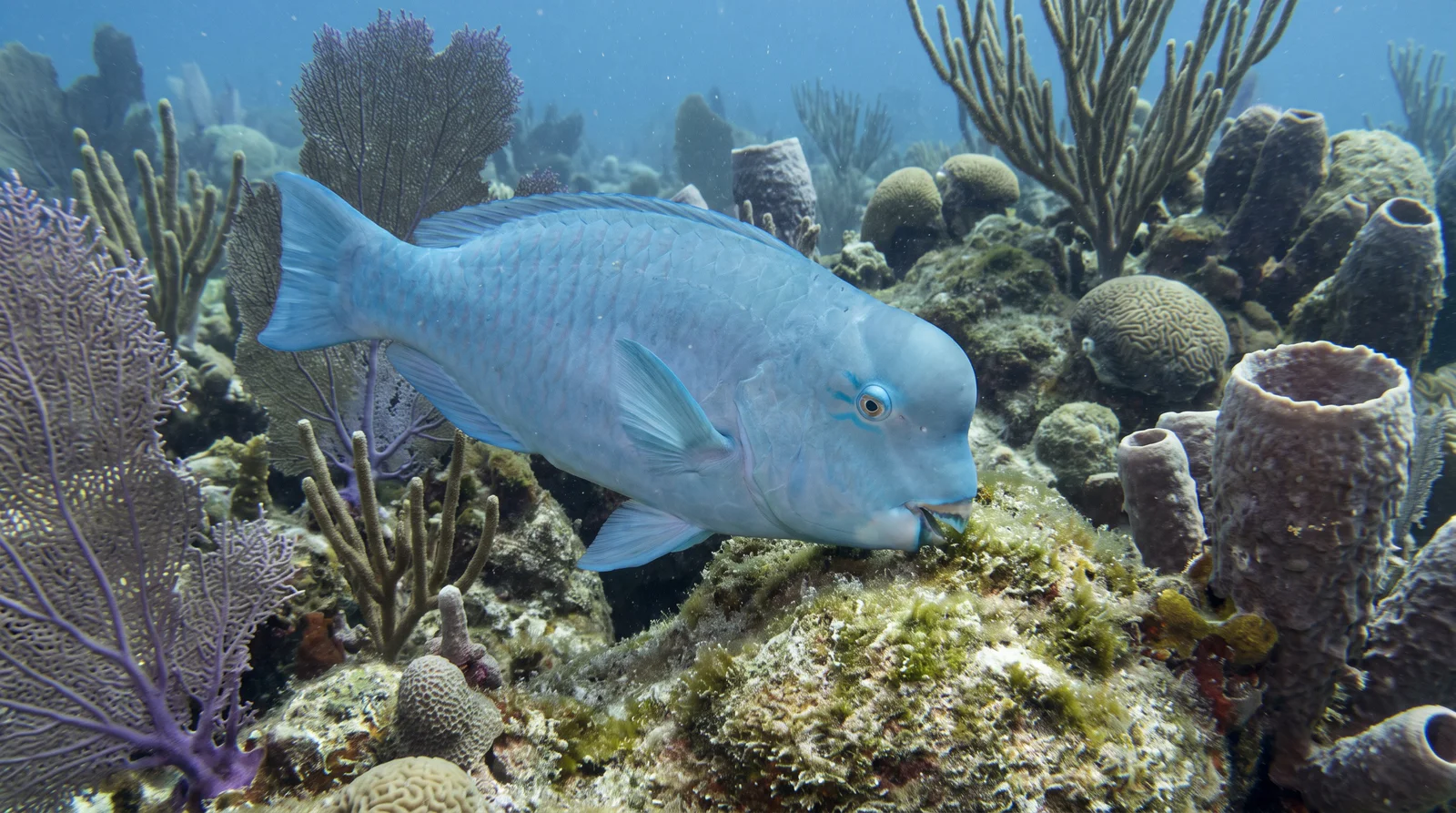 AI-generated
Image credit: AI-generated illustration · License unspecified · Source unspecified
Scarus coeruleus
About Blue Parrotfish.
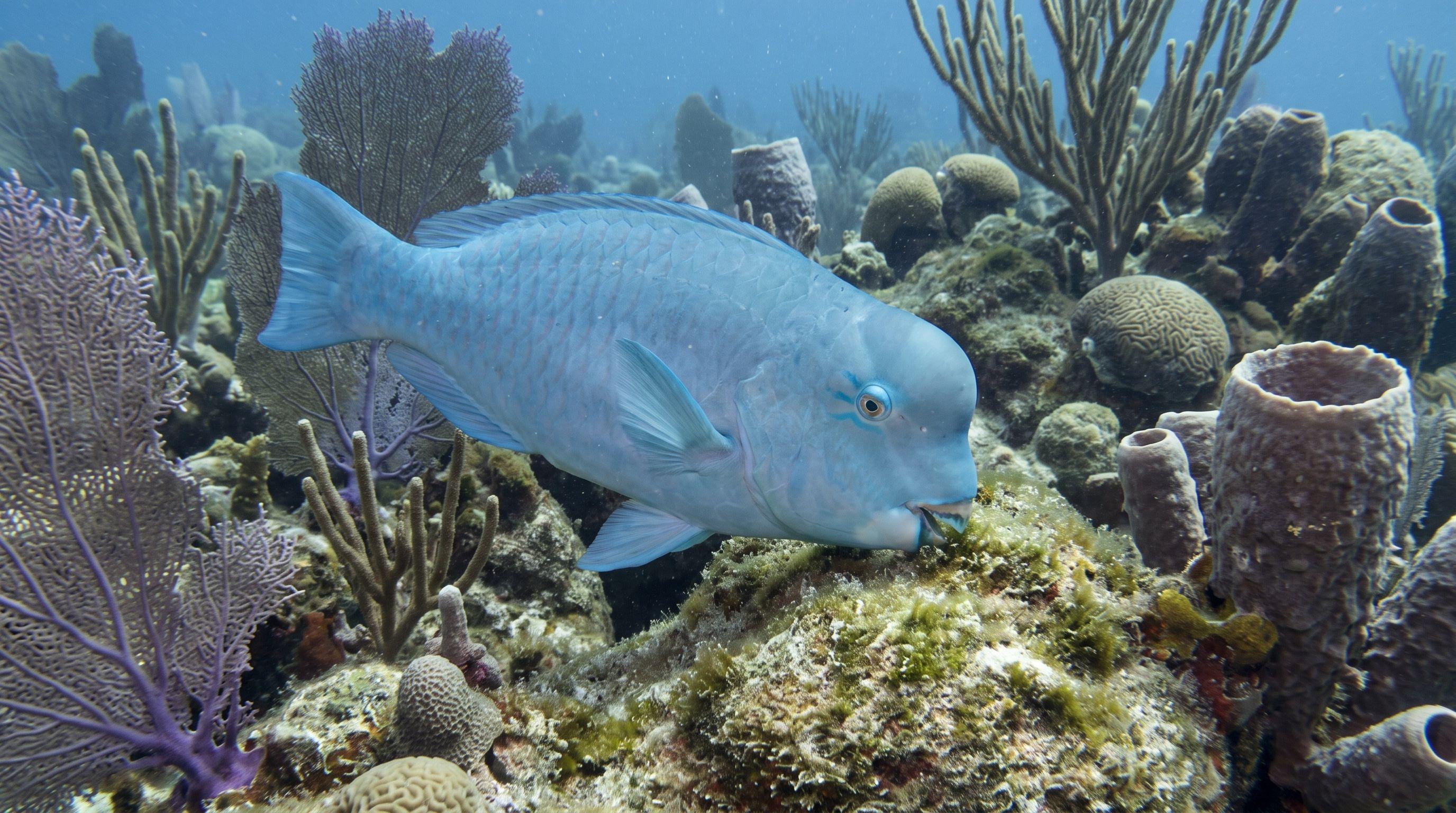
The Blue Parrotfish, Scarus coeruleus, is a distinctive and vibrant member of the parrotfish family, renowned for its striking, almost entirely turquoise-blue coloration as an adult. This uniform blue hue sets it apart from other parrotfish species in its range, making it easily identifiable underwater. Juveniles present a paler blue body adorned with yellow anal, dorsal, pectoral, and pelvic fins, often exhibiting a squarer head shape. As they mature, especially into the initial phase (IP) females, shades of blue become more pronounced, sometimes accompanied by a fading yellow spot on the top of their conical head. Terminal phase (TP) males display the most dramatic features, including a powder blue to deep blue-green body, broad gray markings on their cheeks, and a prominent, bulging forehead hump that develops with age. This cranial bump is a notable characteristic of larger males.
A defining anatomical feature of the Blue Parrotfish, shared with other members of its family, is its powerful, fused teeth. These teeth form a robust, beak-like structure, remarkably similar to a parrot's beak, which the fish utilizes to efficiently scrape algae and small organisms directly from the surfaces of coral and rocks. Further enhancing its unique feeding mechanism, the Blue Parrotfish possesses a second set of specialized pharyngeal teeth, located in its throat, designed to grind down ingested coral rock into fine sand. This species typically attains an average length of 30 to 75 centimeters (12 to 30 inches) but can grow considerably larger, reaching a maximum recorded size of 1.2 meters (3 feet 11 inches) and weighing approximately 9.1 kilograms (20 pounds). Its body is elongated, somewhat compressed laterally, and covered with large, smooth scales, allowing for graceful movement through its reef environment.
Where it lives.
The Blue Parrotfish (Scarus coeruleus) is a species primarily associated with shallow, tropical, and subtropical marine environments across the western Atlantic Ocean and the Caribbean Sea. Its geographical distribution spans from Maryland in the United States, extending southward through Bermuda and the Bahamas, and continuing along the coastlines to Rio de Janeiro, Brazil, encompassing the diverse islands of the West Indies. Notably, this species is typically absent from the northern regions of the Gulf of Mexico.
Adults of the Blue Parrotfish predominantly inhabit vibrant coral reefs and adjacent rubble flats, where they play a vital ecological role in maintaining the health of these complex ecosystems. Divers commonly encounter them cruising amidst the intricate structures of the reef. In contrast, juvenile Blue Parrotfish demonstrate a preference for different, more sheltered nursery habitats, including seagrass beds—particularly those dominated by Turtle Grass (Thalassia testudinum)—and mangrove areas. These calmer, shallower waters provide crucial protection and abundant food sources for the younger fish. This species is generally found within a depth range of approximately 3 to 25 meters (10 to 82 feet), thriving in the sunlit waters that foster the growth of the algae it consumes.
How it behaves.
The Blue Parrotfish exhibits a fascinating array of behaviors, particularly concerning its feeding habits and reproductive strategies. As diurnal foragers, these fish are active during daylight hours, dedicating a significant portion of their day—up to 80%—to the relentless search for food. Their diet primarily consists of benthic algae and various small organisms, which they meticulously scrape off rocky and coral surfaces using their distinctive, beak-like fused teeth. This continuous grazing activity is crucial for reef health, preventing algal overgrowth that could otherwise smother and damage corals.
A remarkable aspect of their feeding is the ingestion of coral rock itself; this material is then pulverized into fine sand by specialized pharyngeal (throat) teeth within their digestive system and subsequently excreted. This bioerosion process is a major natural contributor to the formation and maintenance of the iconic white sand beaches found throughout the Caribbean. Socially, Blue Parrotfish are often observed either singly, in small groups, or in larger schools, with significant aggregations forming specifically for spawning events. They are known to be protogynous hermaphrodites, meaning individuals typically begin life as females and can later transition into males. Reproduction involves large spawning groups where external fertilization occurs, and females release pelagic eggs into the water column. These eggs quickly settle to the seabed and typically hatch within about 24 to 25 hours. While specific interactions with divers are not widely documented as aggressive or particularly curious, their constant presence and feeding activities on coral reefs make them a common and observable species for underwater enthusiasts.
Where to see it.
Evidence for bonaire · No dive sites
General range is not evidence of occurrence at a specific dive site.
No documented dive-site associations in this destination yet.
Gallery.
 AI-generated
 illustration
Image credit: AI-generated illustration · License unspecified · Source unspecified