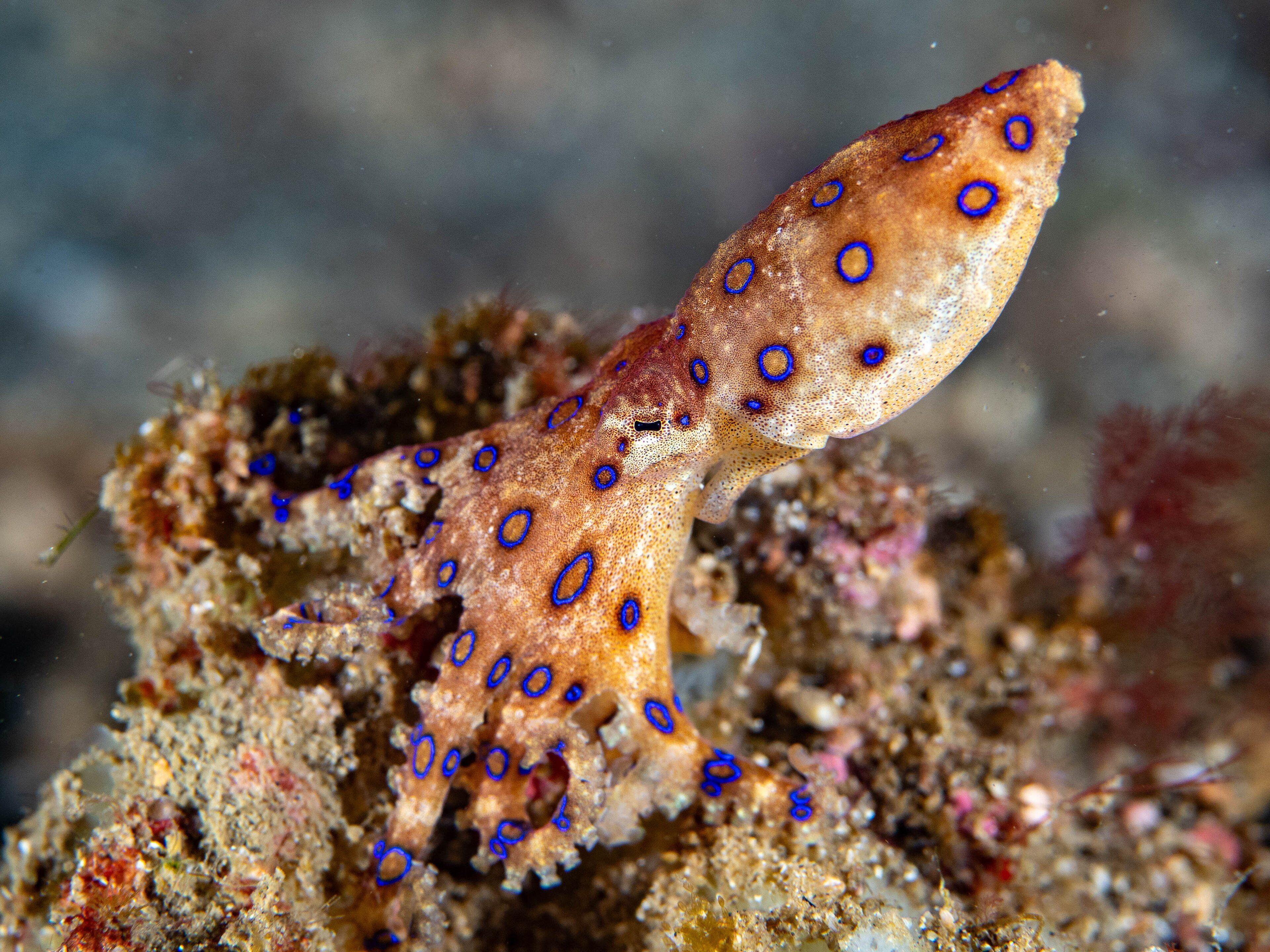
Blue-ringed Octopus
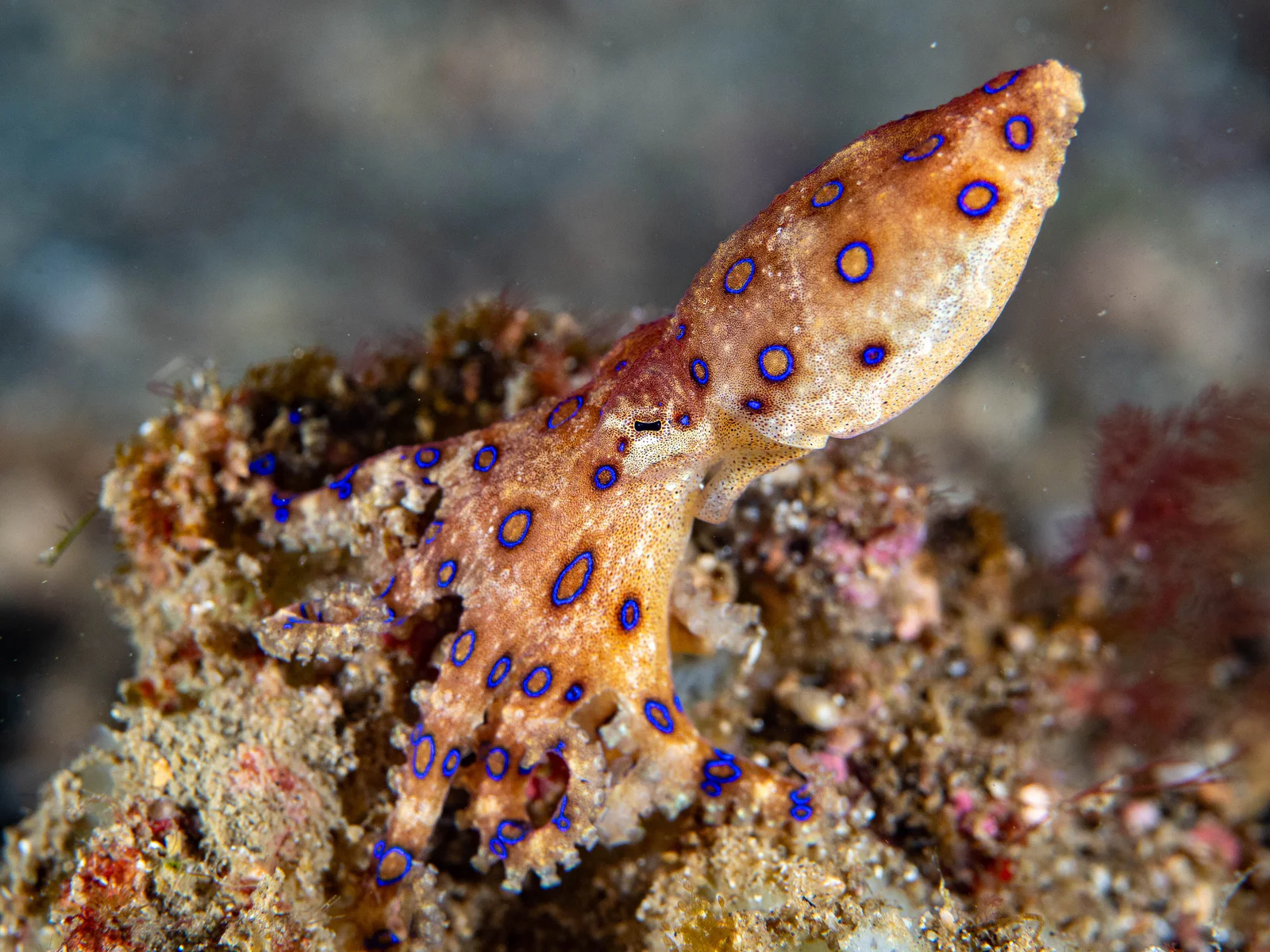
Hapalochlaena lunulata
About Blue-ringed Octopus.
The Blue-ringed Octopus (Hapalochlaena lunulata) is a captivating yet highly venomous cephalopod belonging to the family Octopodidae. Despite its small size, this species is renowned as one of the most toxic marine animals in the world, carrying enough potent neurotoxin to be lethal to humans. Its conservation status is currently listed as Least Concern.
Found throughout the tropical and subtropical waters of the Indo-West Pacific, its range extends from Sri Lanka to Japan, encompassing regions like northern Australia, Papua New Guinea, the Solomon Islands, Indonesia, and the Philippines. This shy and reclusive creature typically inhabits shallow coral reefs, tide pools, rocky crevices, seagrass beds, and clumps of algae, often found at depths of 0–20 m, though sometimes observed down to 50 m. It spends much of its time camouflaged, hiding in small crevices, empty shells, or even discarded bottles and cans. While generally docile, it will flash its distinctive blue rings as a warning when provoked or threatened. Divers may occasionally spot this species at dive sites such as Karang Makassar (Manta Point), Secret Bay, Sombrero Island, Beatrice Rock, and Sauwandarek Jetty.
Identification
- Size: This is a small octopus, reaching a maximum total length of approximately 12 cm (5 inches), including its arms. Its mantle (body) length is typically less than 5 cm, roughly the size of a golf ball at maturity.
- Body and Coloration: It possesses a soft, sac-like body and eight sucker-covered arms, lacking an external shell. When at rest or camouflaged, its background color can vary from tan to dark yellow, gray, or beige, often with brown patches. The skin may also appear rough due to numerous papillae.
- Blue Rings: The most distinctive feature is the presence of up to 25 faint, dark-edged blue rings, each about 7–8 mm in diameter, covering its dorsal surface, mantle, and extending onto its arms. These rings are usually inconspicuous when the octopus is calm.
- Warning Display: When agitated, threatened, or hunting, the octopus rapidly darkens its brown patches, causing the blue rings to become intensely vibrant and iridescent, appearing to "glow" as a clear warning signal. This dramatic color change serves as an aposematic display, signaling its extreme toxicity.
Where it lives.
The blue-ringed octopus, Hapalochlaena lunulata, is a fascinating inhabitant of the Indo-Pacific's warm, shallow coastal waters. Divers can encounter this species across a wide geographic range, extending from Northern Australia to Japan, and westward through Papua New Guinea, the Solomon Islands, the Philippines, Indonesia, and as far as Sri Lanka.
This small cephalopod is primarily a bottom dweller, favoring environments that offer ample opportunities for concealment and hunting. Its preferred habitats include:
- Coral Reefs: Often found in the intricate structures of shallow coral reefs, where it can blend seamlessly with its surroundings.
- Tide Pools and Reef Flats: Commonly observed in intertidal zones, including tide pools and reef flats, especially after storms when it may be foraging for prey.
- Rocky Areas: Seeks refuge and hunts among rocky outcrops and crevices.
- Seagrass and Algal Beds: Also inhabits areas rich in seagrass and clumps of algae, providing both cover and hunting grounds.
Hapalochlaena lunulata typically resides in shallow depths, most frequently encountered between 0–20 m. However, observations indicate they can occasionally be found in slightly deeper waters, down to 30 m or even 50 m. Given its secretive nature, this octopus spends much of its time hidden. It utilizes various natural and artificial structures for shelter, including rock crevices, under rocks, inside empty seashells, and even within discarded bottles and cans. These hiding spots are crucial for its survival, as it emerges primarily to hunt or seek a mate.
How it behaves.
The Blue-ringed Octopus (Hapalochlaena lunulata) is a captivating yet highly venomous cephalopod, renowned for its striking warning display. Despite its potent venom, this species is generally reclusive and non-aggressive, making encounters a special treat for divers who know where and how to look.
Underwater Encounter Behavior
Measuring up to 12 cm (5 in), the Blue-ringed Octopus is often challenging to spot due to its exceptional camouflage. Its skin typically appears beige or yellowish-brown, allowing it to blend seamlessly with sandy, rocky, or rubble environments. Divers often find them hiding in crevices, under rocks, inside discarded shells, or even in bottles and cans, at depths typically ranging from 0-20 meters in warm coastal waters.
When threatened or agitated, the octopus undergoes a dramatic transformation: its brown patches darken, and approximately 50-60 iridescent, electric blue rings or clumps of rings rapidly appear and pulsate across its mantle and arms. This vibrant display serves as a clear warning signal of its highly toxic nature. While generally docile, it will bite if provoked, handled, or accidentally stepped on. The venom, containing tetrodotoxin (TTX), is extremely potent and can cause paralysis, including respiratory failure, with no known antidote. Therefore, divers should always observe these creatures from a respectful distance and never attempt to touch or agitate them.
Feeding Habits
The Blue-ringed Octopus is a carnivorous ambush predator, primarily hunting small crabs, hermit crabs, and shrimp, and occasionally small fish. It hunts during the day and night, often luring prey by wiggling an arm tip like a worm. Once prey is captured with its arms, the octopus uses its sharp, parrot-like beak to pierce the exoskeleton or shell. It then injects venomous saliva, which contains TTX, to paralyze the victim. Enzymes in its saliva also begin to break down the prey's flesh, allowing the octopus to consume the softer parts.
Social Structure
Like most octopuses, *Hapalochlaena lunulata* is a solitary creature, only coming together to mate. They are territorial and typically occupy a specific den for extended periods, venturing out mainly for hunting or reproduction.
During mating, the male approaches the female and uses a modified arm, the hectocotylus, to transfer spermatophores into her mantle cavity. Females lay between 50-100 eggs, which they brood and guard by carrying them under their arms for approximately 30-50 days. During this brooding period, the female typically ceases feeding and dies shortly after the eggs hatch. Males also have a short lifespan and die after mating.
Notable Seasonal Patterns
Blue-ringed octopuses have a relatively short lifespan of about one to two years. Mating often occurs in autumn, with females guarding their eggs for several months. While specific seasonal visibility can vary by dive site and local conditions, their presence is generally tied to the availability of suitable shallow reef, rubble, or muck habitats. Divers may occasionally observe them at dive sites such as Secret Bay, Sombrero Island, Beatrice Rock, Karang Makassar (Manta Point), and Sauwandarek Jetty, though sightings are often rare or occasional due to their elusive nature.
Where to see it.
Evidence for philippines · 4 dive sites
General range is not evidence of occurrence at a specific dive site.
Beatrice Rock
Anilao
Site occurrence not yet documented
Season not yet documented
No dated observations available.
Boatyard
Puerto Galera
Site occurrence not yet documented
Season not yet documented
No dated observations available.
Secret Bay
Anilao
Site occurrence not yet documented
Season not yet documented
No dated observations available.
Sombrero Island
Anilao
Site occurrence not yet documented
Season not yet documented
No dated observations available.
Gallery.