Blue-ringed Octopus
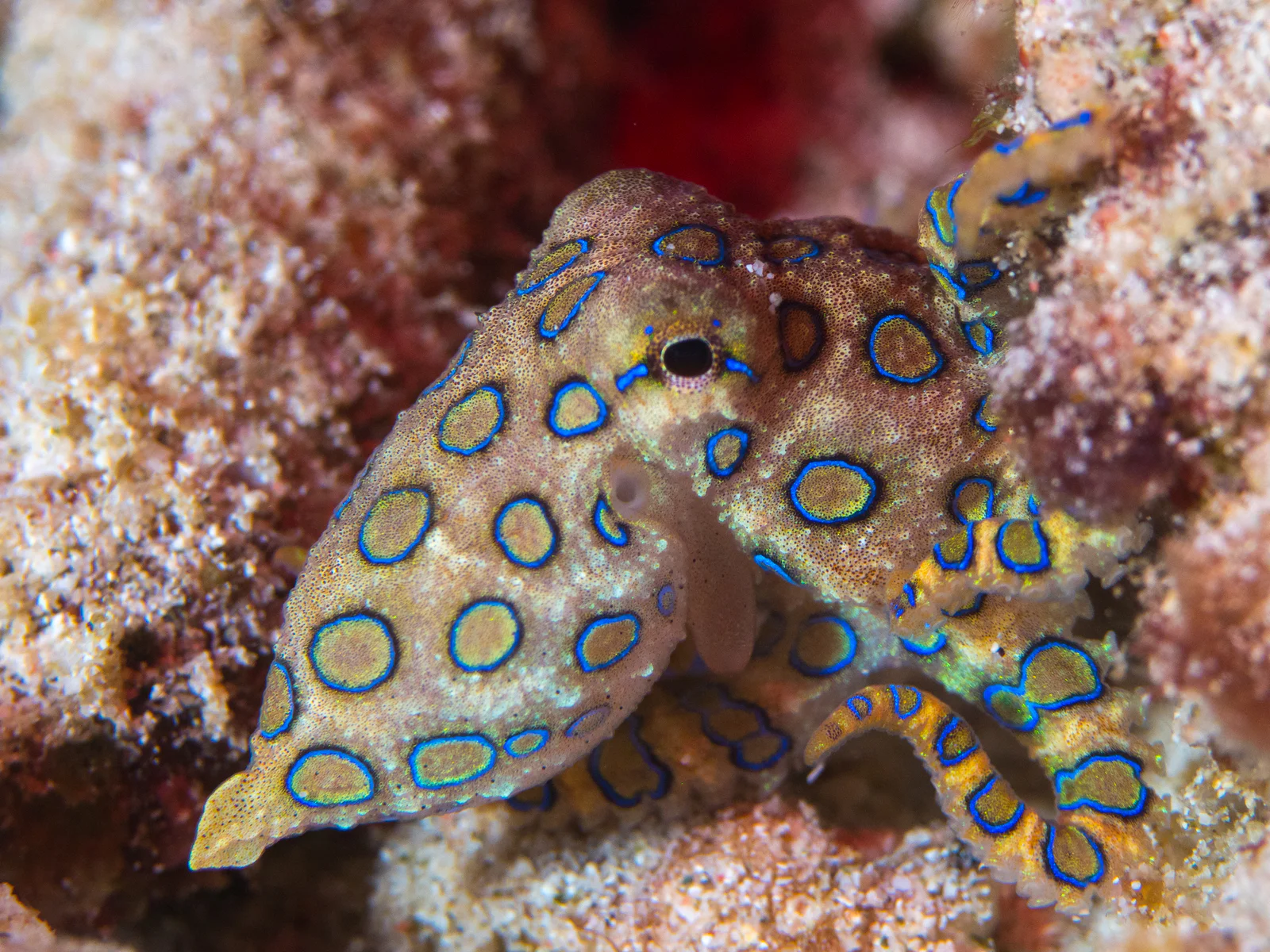
Image credit: Rickard Zerpe · CC BY 2.0 · Wikimedia Commons (from Flickr, krokodiver), cropped by this page
Hapalochlaena lunulata
About Blue-ringed Octopus.
The greater blue-ringed octopus (Hapalochlaena lunulata) is a small, highly venomous octopus of shallow Indo-West Pacific seabeds, recorded at 0 to 20 m.
Names and classification
WoRMS, drawing on MolluscaBase, accepts Hapalochlaena lunulata (Quoy & Gaimard, 1832) in the octopus family Octopodidae, order Octopoda, class Cephalopoda. Quoy and Gaimard first named it Octopus lunulatus, the original combination, which WoRMS lists as unaccepted. WoRMS and SeaLifeBase use the English name greater blue-ringed octopus, and Wikipedia counts it as one of four blue-ringed octopus species.
Identification
According to Wikipedia, "greater" in its name refers to the rings rather than the animal: at 7 to 8 mm across, its blue rings are larger than those of the other members of its genus and help to tell it apart. About 60 of them are spread over the skin, each set on a blotch darker than the ground colour and outlined in black. The ground colour follows the surroundings, from yellow ochre to light brown, and turns whitish when the animal is inactive; blue lines also run through the eyes. The article describes a head slightly flattened from front to back and eight relatively short arms. SeaLifeBase notes that the colour pattern advertises strong toxicity.
Size
SeaLifeBase gives a maximum of 12.0 cm total length and a mantle length of 5 cm. Wikipedia sets the upper limit lower, at 10 cm with the arms included, and gives an average weight of 80 g. The sources differ on the maximum, and neither figure is preferred here.
Warning display
Wikipedia says the octopus usually flashes its iridescent rings as a warning, each flash lasting about a third of a second. Citing a 2012 study in the Journal of Experimental Biology, it explains that the reflective cells sit in pouches of skin that muscles open to show the flash, while brown pigment cells on either side of each ring expand to sharpen the contrast.
Venom and handling
Wikipedia counts it among the most venomous marine animals. Its defensive venom is tetrodotoxin, secreted by the posterior salivary glands that connect to the beak, and its bite can kill a person. The bite itself is painless; symptoms appear from 15 minutes to four hours later, and death, when it follows, usually comes from paralysis of the breathing muscles. The article states that no antidote or antitoxin is known. SeaLifeBase advises that the species should not be handled directly.
Conservation
On the IUCN Red List the species is Least Concern according to SeaLifeBase and Wikipedia alike, though their assessment dates disagree: SeaLifeBase (Red List version 2025-2) gives 29 July 2014, while Wikipedia cites a 2018 assessment by Allcock, Taite and Allen. Under CITES and CMS, SeaLifeBase records it as Not Evaluated.
Where it lives.
The greater blue-ringed octopus lives on shallow mixed bottoms of rubble, reef and sand in the warm Indo-West Pacific, recorded at 0 to 20 m.
Range
SeaLifeBase gives the Indo-West Pacific as its range and classes the species as tropical. Wikipedia describes it as widespread in tropical and subtropical waters of that region, from Sri Lanka to the Philippines and from Australia to Papua New Guinea, the Solomon Islands and Vanuatu.
Depth and setting
SeaLifeBase records a benthic animal at 0 to 20 m. Wikipedia says it prefers shallow water over a mixed seabed of rubble, reefs and sandy patches and, like all octopuses, lives in a burrow that it leaves only to find food or a mate. Remains of its meals, such as empty shells and pieces of crab, litter the entrance and make the burrow easy to recognise. Neither source records it deeper than 20 m.
How it behaves.
The greater blue-ringed octopus lives alone in a burrow, preys on small crabs, shrimp and molluscs, and flashes its blue rings as a warning.
Feeding
Wikipedia, citing Animal Diversity Web, lists small crabs, shrimp and molluscs as its usual food and says it also takes small injured fish when it can catch them. It pounces, seizes the prey with its arms and pulls it to its mouth, then pierces a crab's or shrimp's shell with its horny beak and releases venom that paralyses it. The article separates two venoms in the genus, one that immobilises the crustaceans it eats and tetrodotoxin for defence, though it also says tetrodotoxin is thought to help in hunting.
Mating
Wikipedia describes a male that approaches a female, caresses her with his modified arm, the hectocotylus, sometimes climbs onto her back, and passes spermatophores under her mantle. It also reports a study in which males did not tell females from males until the hectocotylus was inserted: matings between a male and a female lasted about 160.5 minutes, contacts between two males about 30 seconds. SeaLifeBase gives the same outline for cephalopods in general, whose sexes are separate and whose adults usually die after spawning or brooding.
Eggs and life span
The breeding season varies by region, in Wikipedia's account. The female carries her eggs under her arms until they hatch and dies without feeding while she guards them; males die after mating. The article gives the clutch as 60 to 100 eggs in one passage and 50 to 100 in another, and the incubation as about a month in one passage and about 50 days in another. Both SeaLifeBase and Wikipedia say the hatchlings are planktonic before they settle on the bottom. Wikipedia adds that the young grow from about the size of a pea to that of a golf ball, mature quickly, begin mating the following autumn and live about two years on average.
Neither source documents how frequently divers encounter it at any one site, or in which months.
Where to see it.
Evidence for visayas · 1 dive site
General range is not evidence of occurrence at a specific dive site.
Gallery.
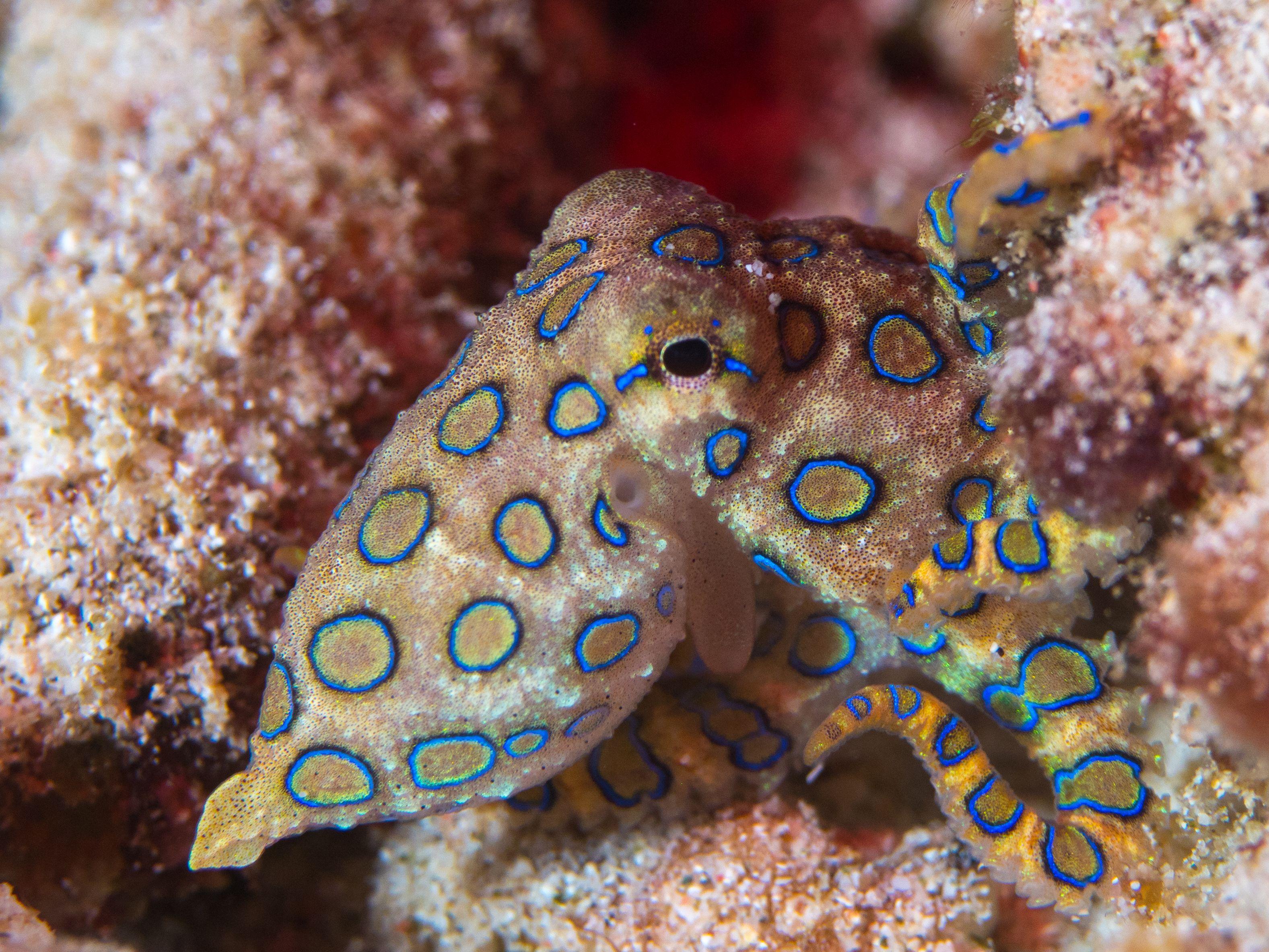
A greater blue-ringed octopus (Hapalochlaena lunulata) photographed at Rao, Morotai, Indonesia, on 7 June 2019, as its file page states. The species is the photographer's identification. It is not a sighting record of any Diveity dive site. This page's frame crops the photograph.
Image credit: Rickard Zerpe · CC BY 2.0 · Wikimedia Commons (from Flickr, krokodiver), cropped by this page
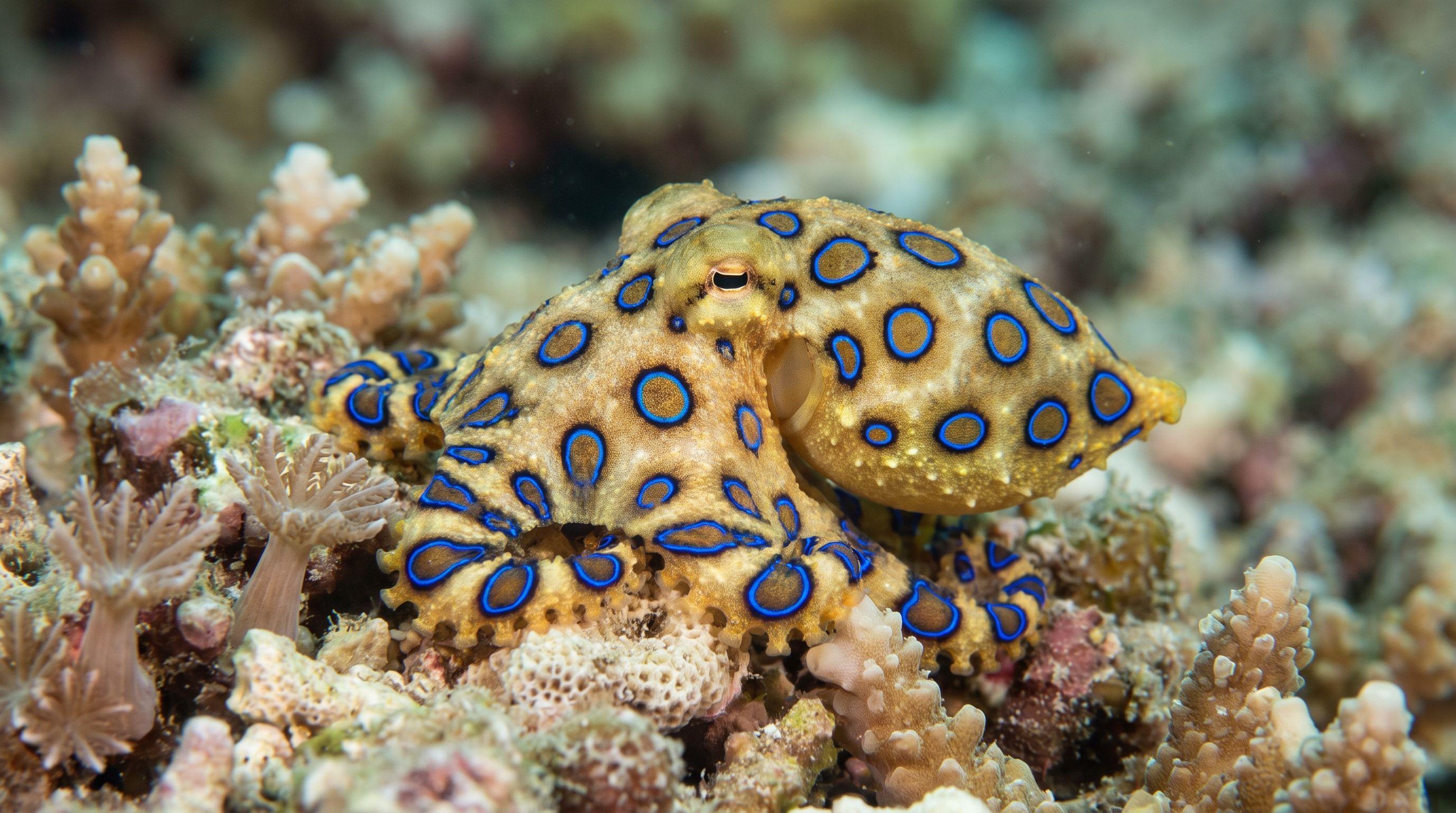 AI-generated
 illustration
Image credit: AI-generated illustration · Diveity