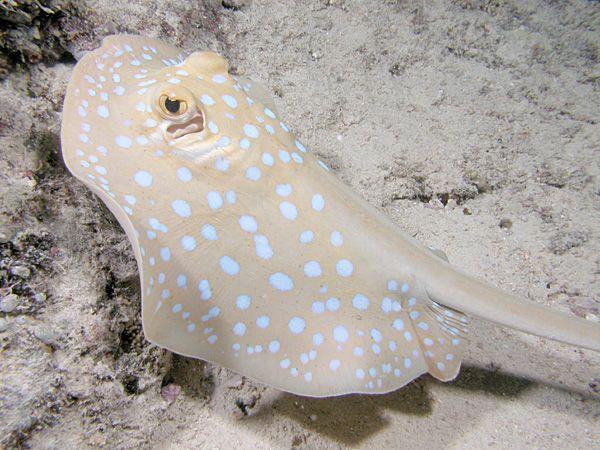
Blue-spotted Ribbontail Ray
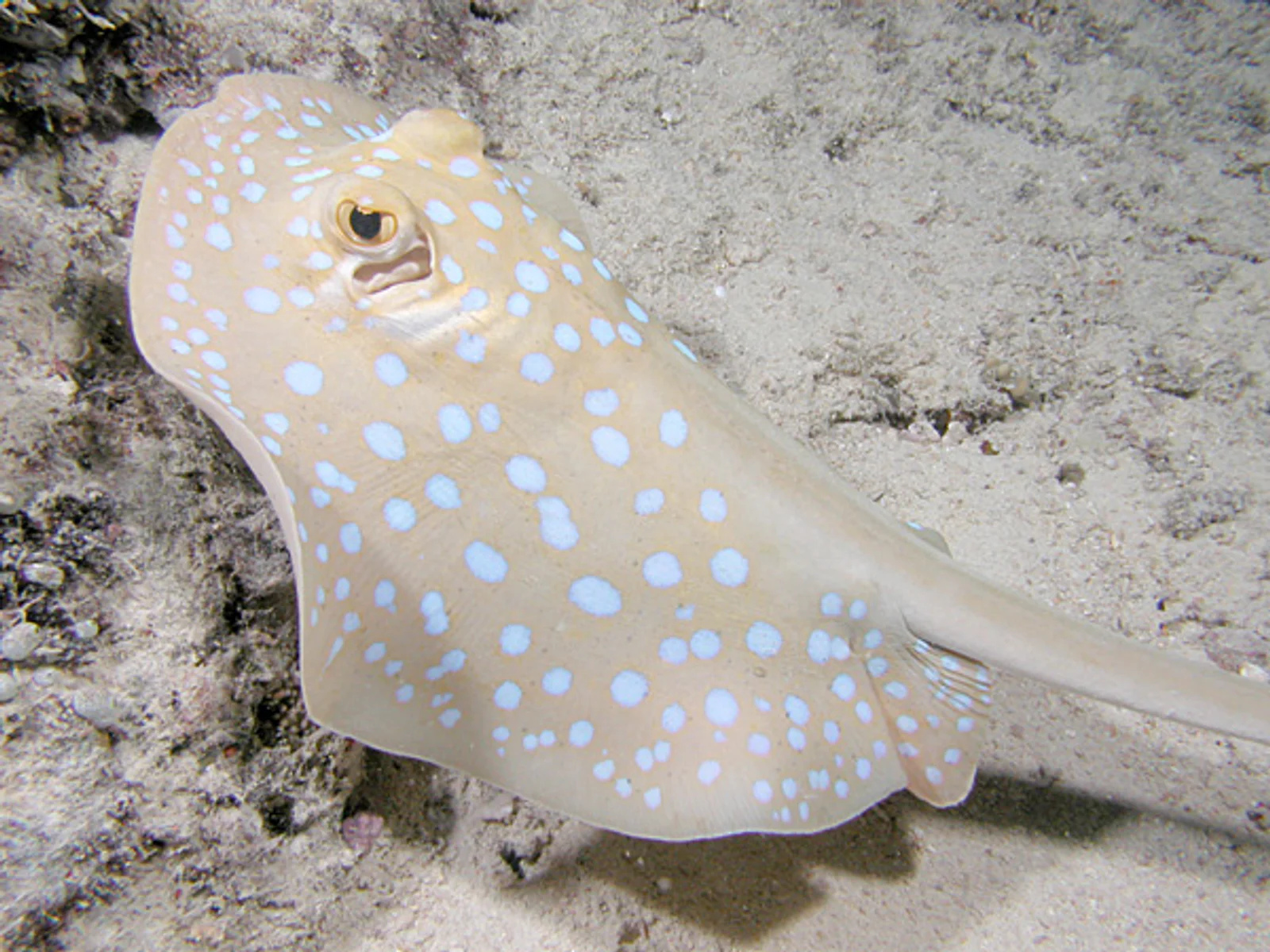
Taeniura lymma
About Blue-spotted Ribbontail Ray.
The Blue-spotted Ribbontail Ray, Taeniura lymma, is a small, vibrant ray that is a highlight for many divers across the Indo-West Pacific. Known for its striking coloration, this species is a common inhabitant of shallow coral reefs and sandy flats.
Despite its widespread distribution and commonality in many areas, the Blue-spotted Ribbontail Ray is currently listed as Least Concern by the IUCN. However, it faces ongoing threats from habitat degradation due to destructive fishing practices and coastal development, as well as capture for the marine aquarium trade.
These rays are primarily nocturnal, spending their days sheltered under ledges, in caves, or beneath table corals on the reef. At night, they become active, often migrating in small groups onto shallow sandy areas during rising tides to forage. They use an electroreceptor system, the ampullae of Lorenzini, to detect the subtle electrical fields produced by their prey, which include mollusks, worms, shrimps, crabs, and small benthic fish, even when buried in the sand. Divers frequently encounter this species at dive sites such as Siaba Besar, Marsa Abu Dabbab, and Batangas Channel, where they are commonly observed, and occasionally at Mainit Bubbles and Manta Sandy.
Identification
- Size: This is a relatively small ray, typically reaching a maximum disc width of about 35 cm (14 in). Its total length, including the tail, can reach up to 70 cm.
- Body and Coloration: The Blue-spotted Ribbontail Ray has a distinctive oval, elongated disc. Its dorsal (upper) surface is typically a vibrant yellowish, golden-brown, olive-green, or reddish-brown, adorned with numerous large, iridescent electric-blue spots. The ventral (underside) surface is uniformly white.
- Head: The snout is rounded and angular, with large, protruding yellow eyes. Behind each eye are prominent spiracles, which allow the ray to draw in water for respiration while resting on the seafloor.
- Tail: The stout, tapering tail is a key identification feature, often equal to or slightly less than the body length when intact. It is easily recognized by a pair of bright blue stripes running along each side. The tail also features a broad lower caudal finfold that extends to the tip.
- Spines: The tail is armed with one or two medium-sized venomous spines, located further back from the base than in many other stingrays. While generally shy, these spines are used for defense if the ray feels threatened.
- Disc Texture: The disc of the Blue-spotted Ribbontail Ray is mostly smooth, though adults may have small, flat denticles along the midback.
Where it lives.
The Blue-spotted Ribbontail Ray (Taeniura lymma) is a captivating inhabitant of the Indo-West Pacific's warm, shallow waters, making it a familiar sight for divers across numerous popular dive sites.
Habitat and Distribution:
- This species is widely distributed throughout the tropical and subtropical regions of the Indo-West Pacific. Its range extends from the Red Sea and East Africa, across to the Solomon Islands, north to southern Japan, and south to northern Australia, including areas from Ningaloo Reef to Bundaberg, Queensland.
- Blue-spotted Ribbontail Rays are predominantly found in nearshore, continental shelf environments. They thrive in waters with a preferred temperature range of 23–28°C.
Depth Range and Ecosystems:
- Divers can typically encounter these rays at depths ranging from the intertidal zone down to 30 m, though they are most commonly observed in shallower waters, usually within 20 m. Some observations extend to 50 m.
- They are strongly associated with vibrant coral reef ecosystems, where they often seek refuge. Beyond the reefs, they are also found in adjacent sandy flats, seagrass beds, and even mangrove areas.
- During the day, these rays are often observed resting and hiding alone within caves or beneath coral ledges and other debris, sometimes with only their distinctive tail visible. As the tide rises, particularly at night, small groups will migrate onto shallow sandy flats to forage for small benthic invertebrates and fish. While they prefer sandy or sedimentary substrates for feeding, they are noted to rarely bury themselves completely in the sand, unlike some other stingray species.
- Juvenile rays may utilize distinct nursery habitats such as warm, shallow intertidal seagrass, mangrove forests, or rocky shorelines to avoid larger predators.
Observed Dive Sites:
This species is commonly observed at dive sites such as Siaba Besar, Marsa Abu Dabbab, and Batangas Channel, and occasionally at Mainit Bubbles and Manta Sandy.
How it behaves.
Underwater Encounter Behavior
The Blue-spotted Ribbontail Ray is generally considered shy and peaceful. During the day, divers often spot these rays resting on sandy bottoms, under coral ledges, or inside small caves, sometimes with only their distinctive ribbon-like tail visible. While they may occasionally bury themselves in the sand, they are more commonly found seeking shelter in reef crevices. When approached by divers, they typically prefer to swim away rapidly, often in a zigzag pattern, rather than engage. However, if provoked or accidentally stepped on, they possess venomous spines on their tail, which they will use for defense. Divers are encouraged to maintain a respectful distance and avoid disturbing them.Feeding Habits
These rays are carnivorous bottom-dwellers with distinct feeding behaviors. They are primarily nocturnal feeders, becoming more active at dusk. During high tide, small groups of Blue-spotted Ribbontail Rays migrate into shallow sandy areas of tidal flats to forage. They use their flattened bodies to excavate sand pits, rooting for a diet consisting mainly of small benthic invertebrates such as sand worms, shrimps, hermit crabs, mollusks (like clams and mussels), and small bony fishes. Their mouth, located on the underside of their body, is equipped with crushing plates to process prey. They locate hidden prey using highly developed electro-sensory abilities (ampullae of Lorenzini), which detect slight electrical impulses in the water. Once prey is found, they pin it down with their disc and maneuver it into their mouth. At low tide, they typically recede back to the reef, often alone, to hide in coral crevices.Social Structure
Blue-spotted Ribbontail Rays can be found alone or in small groups, particularly when foraging in shallow waters during high tide. While they are not known to form large aggregations, these small groups are a notable social aspect of their feeding strategy. At other times, especially during low tide or daylight hours, they tend to be solitary, seeking individual shelters within the reef.Notable Seasonal Patterns Relevant to Divers
Blue-spotted Ribbontail Rays can generally be observed year-round in their tropical habitats across the Indo-Pacific, from the Red Sea to the Solomon Islands and northern Australia. They are commonly found in shallow continental shelf waters, coral reefs, lagoons, and sandy flats, typically encountered at depths of 1–30 m. While there isn't a strict seasonal migration pattern that significantly impacts diver encounters throughout their entire range, sightings may be more common during warmer months when their prey is abundant. Reproduction occurs from late spring through summer, with gestation periods ranging from 4 to 12 months, and females giving birth to up to seven live young. Dive sites such as Siaba Besar, Marsa Abu Dabbab, and Batangas Channel are known for common sightings of this species.Where to see it.
Evidence for philippines · 6 dive sites
General range is not evidence of occurrence at a specific dive site.
Batangas Channel
Puerto Galera
Site occurrence not yet documented
Season not yet documented
No dated observations available.
Dilumacad Island (Helicopter Island)
El Nido
Site occurrence not yet documented
Season not yet documented
No dated observations available.
Mainit Bubbles
Anilao
Site occurrence not yet documented
Season not yet documented
No dated observations available.
Nat-Nat
El Nido
Site occurrence not yet documented
Season not yet documented
No dated observations available.
The Atoll
Puerto Galera
Site occurrence not yet documented
Season not yet documented
No dated observations available.
Twin Rocks
El Nido
Site occurrence not yet documented
Season not yet documented
No dated observations available.
Gallery.