Bobbit Worm
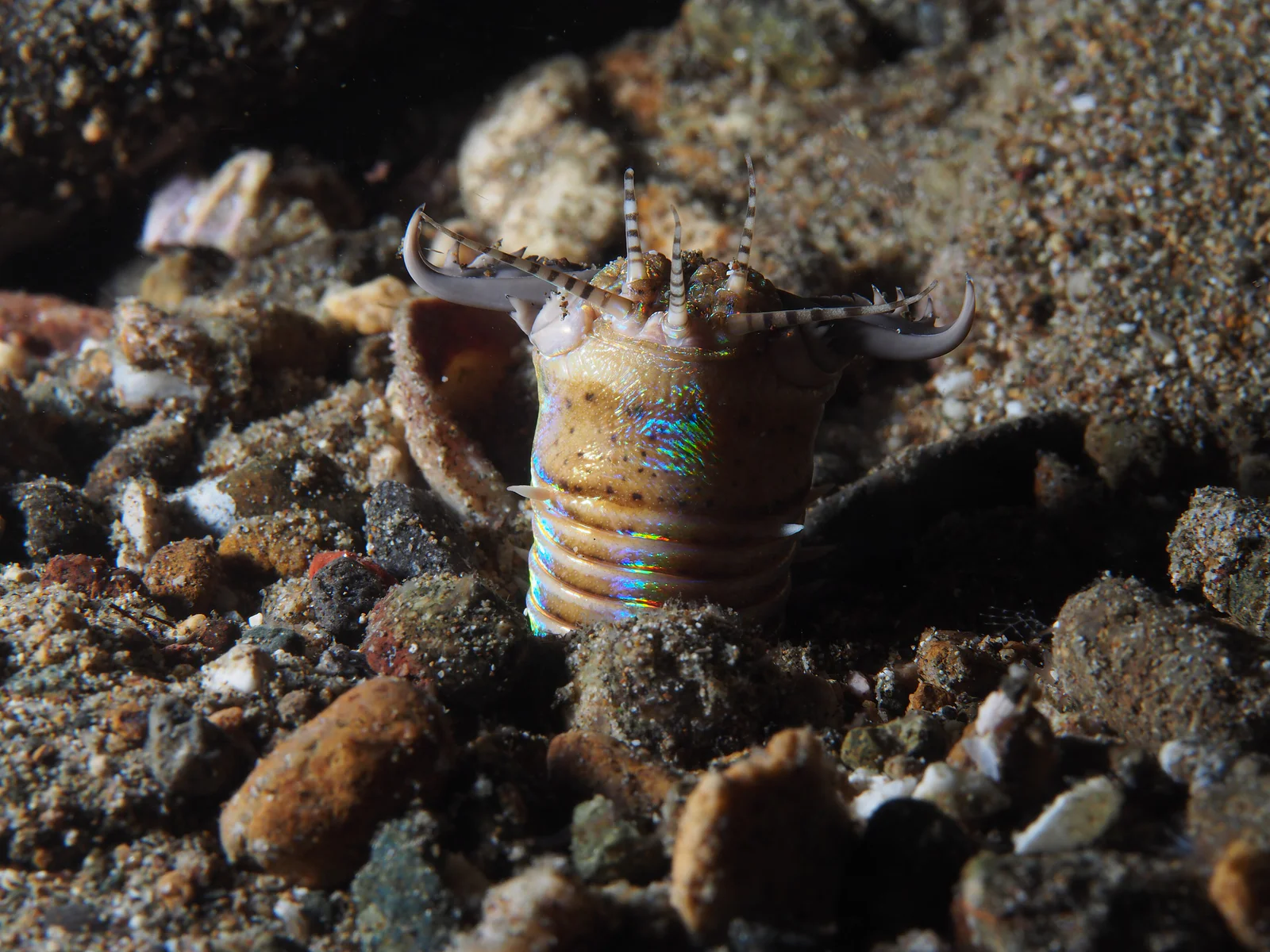
Image credit: Source unspecified · License unspecified
Eunice aphroditois
About Bobbit Worm.
The Bobbit Worm, scientifically known as Eunice aphroditois, is a formidable and fascinating member of the Eunicidae family, belonging to the class Polychaeta, commonly known as bristle worms. This impressive macro species is renowned for its ambush predatory tactics and can be a thrilling, albeit unnerving, encounter for divers. Often referred to as the "sand striker" or "trap-jaw worm," its common name, "Bobbit Worm," was coined by Dr. Terry Gosliner in 1996, referencing its scissor-like jaws and ability to sever prey.
Found primarily in the warm, tropical, and subtropical waters of the Indo-Pacific and Atlantic Oceans, the Bobbit Worm typically inhabits soft sediments such as sand, mud, and gravel, where it constructs deep burrows. It can also be found among coral reefs, coral rubble, and under rocks. Divers may encounter this species at depths ranging from 10–40 m, with observations recorded as deep as 95 m. As an omnivorous ambush predator, the Bobbit Worm primarily hunts small fish, crustaceans, and other worms, but will also consume detritus, seaweed, and macroalgae. It is predominantly nocturnal, lying in wait with only its sensory antennae exposed, ready to strike with astonishing speed. Its conservation status is currently listed as Data Deficient, highlighting the need for further research into its populations and ecological role.
For divers exploring dive sites like Anilao Pier and Basura, where this species is commonly observed, spotting a Bobbit Worm requires keen observation and patience.
Identification
- Size and Body: The Bobbit Worm is a truly massive polychaete, with reported lengths reaching up to 3 m (10 ft), though typical observed sizes are often between 1–3 m. Its body is long, slim, and segmented, potentially comprising up to 1500 segments. The body is covered in numerous bristles, or chaetae, which aid in traction and grip, both for movement and anchoring itself during an attack.
- Coloration: The worm's exoskeleton displays a wide range of colors, typically from deep purple to black, often with a stunning iridescent sheen or cuticle that can appear metallic.
- Head and Antennae: The most visible part of a buried Bobbit Worm is its head, featuring five prominent, beaded, and banded antennae. These antennae are crucial sensory organs, equipped with light and chemical receptors that detect passing prey. While it possesses two nearly blind eyes at the base of its antennae, these play a lesser role in hunting compared to its highly sensitive antennae.
- Jaws and Hunting Mechanism: The Bobbit Worm's most distinctive feature is its powerful, retractable pharyngeal jaws. These consist of two pairs of scissor-like serrated plates (mandibles and maxillae) that can be thrust out with incredible speed—up to 6 meters per second—to seize and often slice prey in half. It also injects a toxin to stun or kill its victims, allowing it to subdue prey much larger than itself before dragging it into its burrow.
- Behavioral Cues: When diving, look for only the antennae protruding from the sand or sediment. The worm is an ambush predator, remaining largely stationary for extended periods. If disturbed, it will rapidly retract into its burrow. Divers should avoid direct contact with the bristles, as they can cause irritation or numbness.
Where it lives.
The Bobbit Worm, Eunice aphroditois, is a fascinating and formidable macro invertebrate known for its ambush predatory tactics. This segmented bristle worm is primarily a burrow-dweller, inhabiting soft sediments across a wide range of marine environments.
- Habitat and Substrate: Bobbit worms are typically found in warm, tropical, and subtropical marine waters. They are masters of camouflage, burying their long bodies in soft substrates such as sand, muck, gravel, and silt. They can also be found in coral rubble and under rocks, often in association with reefs or seagrass beds. Their burrows can extend several meters deep, providing a stable ambush position from which only their anterior end, featuring five sensitive antennae, is exposed.
- Depth Range: While commonly observed in shallow coastal areas, Bobbit worms can be found at depths ranging from intertidal zones down to approximately 95 meters. Some sources indicate a typical range of 10–40 meters.
- Geographic Distribution: This species has a broad distribution across the Indo-Pacific, Indian, Atlantic, and Pacific Oceans. Key regions where they are well-documented include Indonesia (such as Bali, Lembeh), the Philippines (like Anilao), Fiji, New Guinea, Australia (east, south, and west coasts), and the Red Sea.
- Ecosystem Associations: As benthic predators, Bobbit worms play a significant role in their ecosystems. They are often associated with coastal and reef-associated habitats, thriving in areas with high prey availability. Their burrowing behavior not only provides them with a hidden hunting ground but also modifies the seafloor substrate, potentially creating new microhabitats for other organisms and contributing to nutrient cycling. While primarily carnivorous, feeding on fish and other invertebrates, they are also considered omnivores, consuming detritus, seaweed, and other macroalgae. Their presence can influence the distribution and behavior of fish species, as prey may adapt tactics to avoid these ambush predators.
- Dive Sites: Notable dive sites where Eunice aphroditois is commonly observed include Anilao Pier and Basura in the Philippines, as well as Secret Bay in Bali, Indonesia. Divers often encounter them in sandy or mucky areas during night dives, as they are mostly nocturnal hunters.
How it behaves.
- Underwater Encounter Behavior: The Bobbit Worm is primarily a nocturnal ambush predator, typically found buried in soft sediments like sand or mud, or among coral rubble and rocks, with only its head and five antennae exposed. These antennae are crucial sensory organs, equipped with light and chemical receptors that detect passing prey through vibrations and movement. When prey comes within striking distance, the worm launches itself with explosive speed from its burrow, grabbing the victim with its powerful, scissor-like mandibles. This strike is so rapid and forceful that it can often slice prey in half. The worm then quickly retracts, pulling its catch back into its burrow for consumption. Divers often encounter them during night dives, as this is when they are most active in hunting. If disturbed or illuminated by a dive light for too long, a Bobbit Worm will instantly retreat into its burrow, sometimes for an extended period. Patience and a steady approach are key for divers hoping to observe this elusive creature. While not aggressive towards humans, their bristles are venomous and can inflict a nasty sting, potentially causing permanent numbness, so direct contact should be avoided.
- Feeding Habits: *Eunice aphroditois* is an omnivorous predator. Its diet primarily consists of small fish, other worms, and crustaceans. They are also known to consume detritus, seaweed, and other macroalgae. The worm injects a narcotic toxin into its prey, which stuns or kills it, allowing the Bobbit Worm to subdue and consume prey much larger than itself. Common prey observed by divers include cardinalfish and pufferfish.
- Social Structure: Bobbit Worms are solitary creatures. There is no known social structure, and individuals typically live independently in their burrows. Reproduction occurs sexually through broadcast spawning, where males and females release sperm and eggs into the water column for external fertilization. There is no parental care.
- Notable Seasonal Patterns Relevant to Divers: Bobbit Worms inhabit warm tropical and subtropical waters across the Indo-Pacific, Indian, Atlantic, and Pacific Oceans. They are typically found at depths ranging from 10–40 meters, though they have been recorded deeper, up to 95 meters (312 ft). Given their wide distribution in tropical regions, there are no specific seasonal patterns that significantly impact their visibility or behavior for divers; they can be encountered year-round in suitable dive sites. Dive sites like Anilao Pier and Basura are known for common sightings. They thrive in areas with high prey availability.
Where to see it.
Evidence for philippines · 2 dive sites
General range is not evidence of occurrence at a specific dive site.
Gallery.
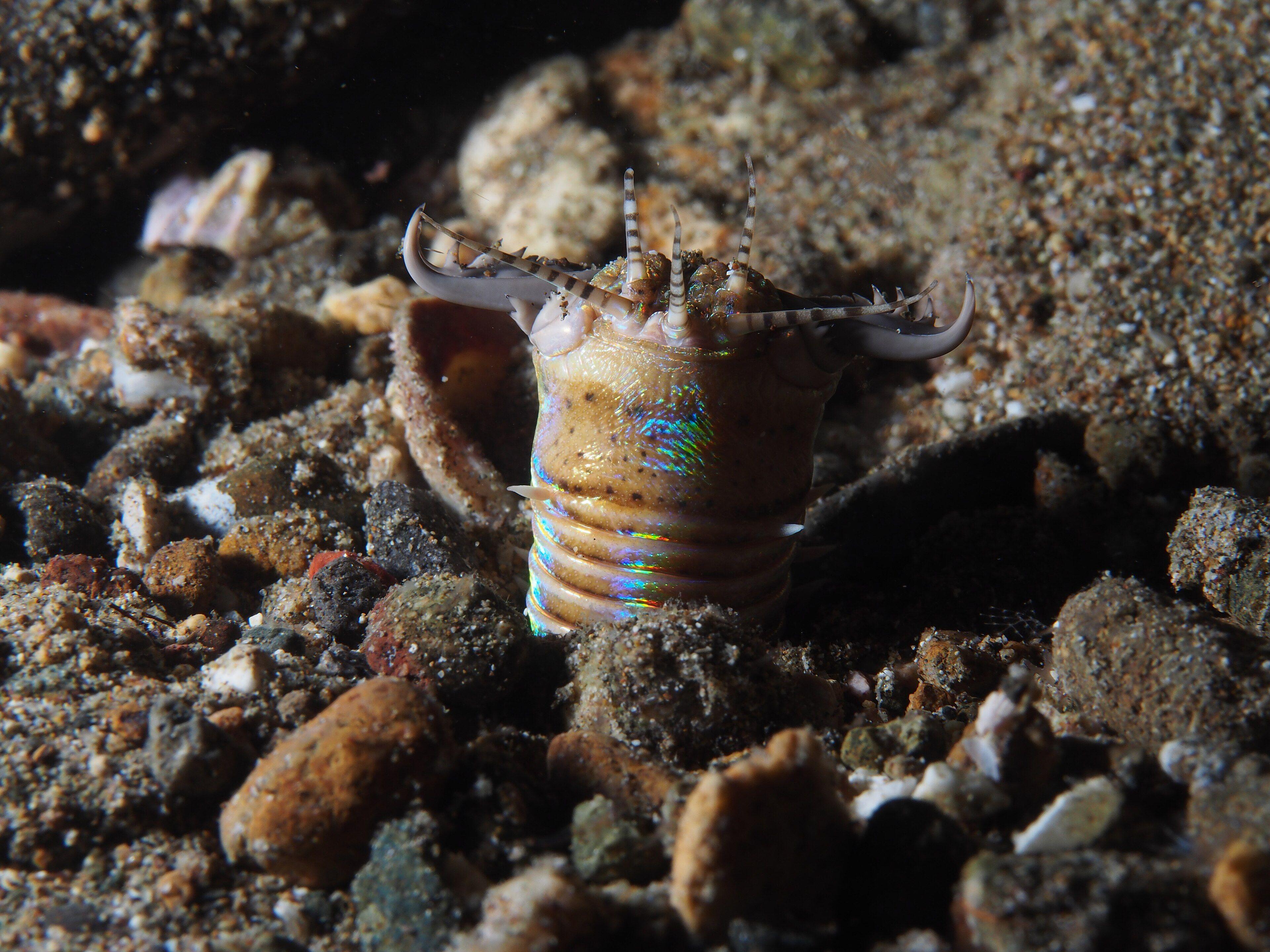
Photo: Rickard Zerpe / CC BY-SA 2.0 via Wikimedia Commons
Image credit: Source unspecified · License unspecified