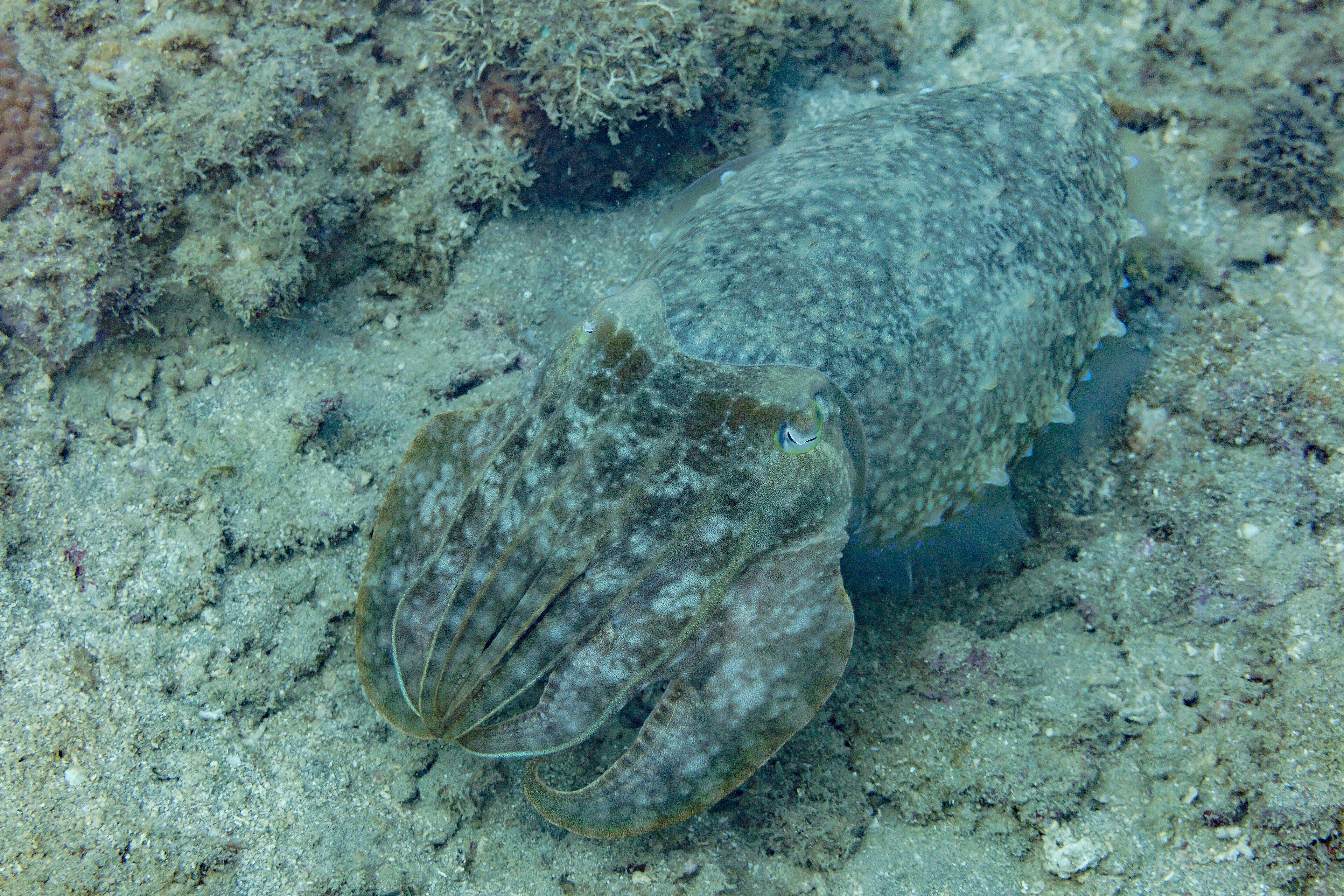
Broadclub Cuttlefish
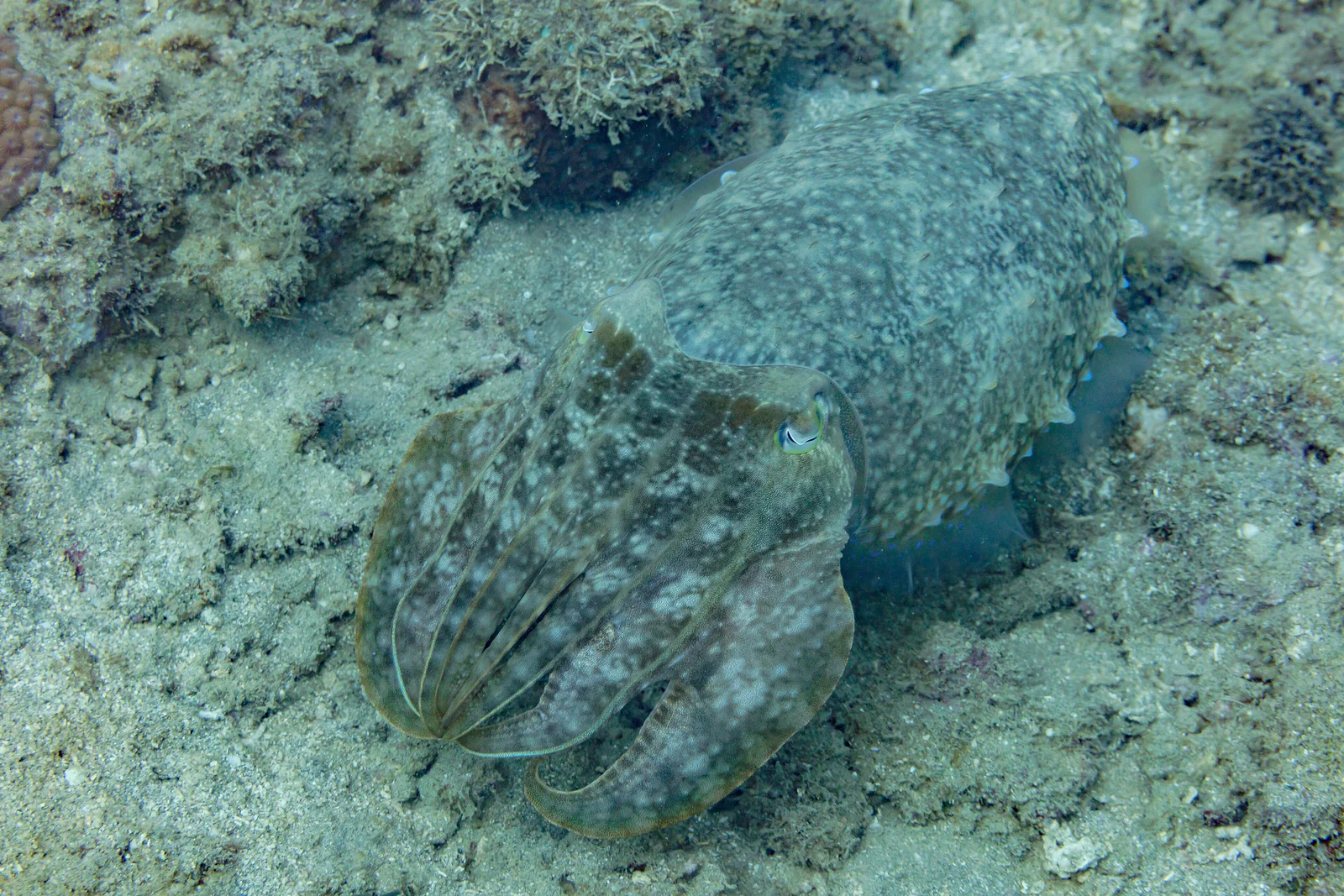
Sepia latimanus
About Broadclub Cuttlefish.
The Broadclub Cuttlefish (Sepia latimanus) is a captivating cephalopod renowned for its remarkable intelligence and dazzling displays of color and texture. As one of the largest cuttlefish species, reaching an impressive mantle length of up to 50 cm (20 in) and weighing up to 10 kg (22 lb), it is a prominent inhabitant of Indo-Pacific coral reefs. This species is currently listed as Least Concern in terms of conservation status.
Often encountered by divers, the Broadclub Cuttlefish is a master of disguise, utilizing millions of specialized pigment cells called chromatophores to rapidly change its skin color, pattern, and texture. This ability serves multiple purposes: sophisticated camouflage to blend seamlessly with its surroundings, communication with other cuttlefish, and mesmerizing displays to hypnotize prey. It is a diurnal hunter, actively seeking out small fish and crustaceans along reef systems and sandy seabeds during the day. When threatened, it can expel a cloud of ink, known as sepia, to confuse predators and facilitate an escape.
Divers frequently observe Broadclub Cuttlefish at various dive sites, including Tatawa Besar (occasional), Anilao Pier (common), Cars Wreck (Dauin) (common), Arco Point (occasional), and Cape Maeda (Blue Cave) (occasional). They typically reside in shallow waters, found at depths of 10–30 m, preferring warm tropical coral reef environments with water temperatures ranging between 16 and 30°C.
Identification
- Size and Shape: The Broadclub Cuttlefish possesses a robust, oval-shaped mantle with narrow, undulating fins that extend along its entire body, aiding in graceful movement. It is the second-largest cuttlefish species.
- Coloration and Patterns: While its base coloration is commonly light brown or yellowish with white mottled markings, this species can instantly transform its appearance. It can display a wide array of patterns, including bold white transverse stripes and spots, narrow brown transverse bands, and a saddle mark on its dorsal mantle. Males often exhibit irregular, transverse lines across their mantles, upper fins, and tentacles, particularly during courtship, sometimes appearing dark brown. Females may have elongated ocelli (eyespots) on their fins.
- Distinctive Features: Its common name is derived from the noticeably broad, crescent-shaped club-like limbs, or wide pads, located on the ends of its two feeding tentacles, which are used to capture prey. The eight arms also feature longitudinal white bands that can appear as broad white blotches when extended. A key identifying characteristic is the bright yellow rim or ventral margins around its large eyes. The skin is covered with papillae, which can be manipulated to alter its texture, mimicking surrounding rocks or coral.
Where it lives.
How it behaves.
Underwater Encounter Behavior
Broadclub Cuttlefish are masters of disguise, utilizing their chromatophores, iridophores, and papillae to rapidly change their skin color and texture to blend seamlessly with their surroundings or to communicate. Divers may observe them hovering gracefully just above the seafloor or within coral crevices, often displaying a mottled brown or yellowish pattern with white markings. When alarmed, they may tuck their arms under their heads, holding the tips of their middle arms upright. They can also propel themselves backward with a forceful stream of water from their siphon or release a cloud of ink (sepia) to confuse predators. While generally diurnal and active hunters during the day, they can be quite curious towards divers. Approaching slowly and without sudden movements may encourage a closer, non-threatening interaction, as they sometimes move closer to investigate.Feeding Habits
As opportunistic and ambush hunters, Broadclub Cuttlefish primarily feed on small fish and crustaceans, including shrimp and crabs. They are known for their mesmerizing hunting technique, where they use rapid, rhythmic pulsations of dark bands along their body and arms to hypnotize or distract their prey. Once prey is disoriented, they quickly extend their two specialized feeding tentacles to snatch it, injecting neurotoxic venom to paralyze it before using their beak-like mouth to consume it. They may also use jets of water to disturb sand and reveal hidden prey.Social Structure
While many cephalopods are considered solitary, Broadclub Cuttlefish adults are often observed traveling in small groups of two or more, particularly in areas like Wakatobi. However, they are most notably social during their breeding season. Males establish and defend territories, typically around coral heads (often *Porites* species), which serve as ideal egg-laying sites for females. Courtship involves highly ritualized visual displays, with males exhibiting specific color changes, such as a light grey body and the disappearance of transverse lines, to attract mates and display dominance. Males often engage in non-physical contests with rivals, using intimidating displays to ward them off. Mating occurs face-to-face, with the male transferring spermatophores to the female's buccal membrane. The male may then guard the female to prevent other males from mating with her before she lays her eggs.Notable Seasonal Patterns
Broadclub Cuttlefish typically have a short lifespan, often dying after maturation at the end of their spawning season, which can span from January to May in some regions. During this breeding season, divers are more likely to observe their elaborate courtship rituals and territorial displays. Females lay their large, transparent eggs deep within branching hard corals, where the eggs harden and are difficult for predators to remove. The eggs hatch in approximately 4 to 6 weeks, and the juveniles immediately seek refuge among corals and rubble, sometimes mimicking mangrove leaves for camouflage. Observations suggest the population may consist of two age groups (0-year and 1-year olds) that contribute to reproduction, with 1-year-old cuttlefish being more abundant at the beginning of the breeding season (around November). This makes the breeding season a particularly exciting time for divers to witness the full spectrum of Broadclub Cuttlefish behavior.Where to see it.
Evidence for philippines · 4 dive sites
General range is not evidence of occurrence at a specific dive site.
Anilao Pier
Anilao
Site occurrence not yet documented
Season not yet documented
No dated observations available.
Arco Point
Panglao
Site occurrence not yet documented
Season not yet documented
No dated observations available.
Cars Wreck (Dauin)
Dauin
Site occurrence not yet documented
Season not yet documented
No dated observations available.
The Hill
Puerto Galera
Site occurrence not yet documented
Season not yet documented
No dated observations available.
Gallery.