Common Sea Fan
 AI-generated
Image credit: AI-generated illustration · License unspecified · Source unspecified
Gorgonia ventalina
About Common Sea Fan.
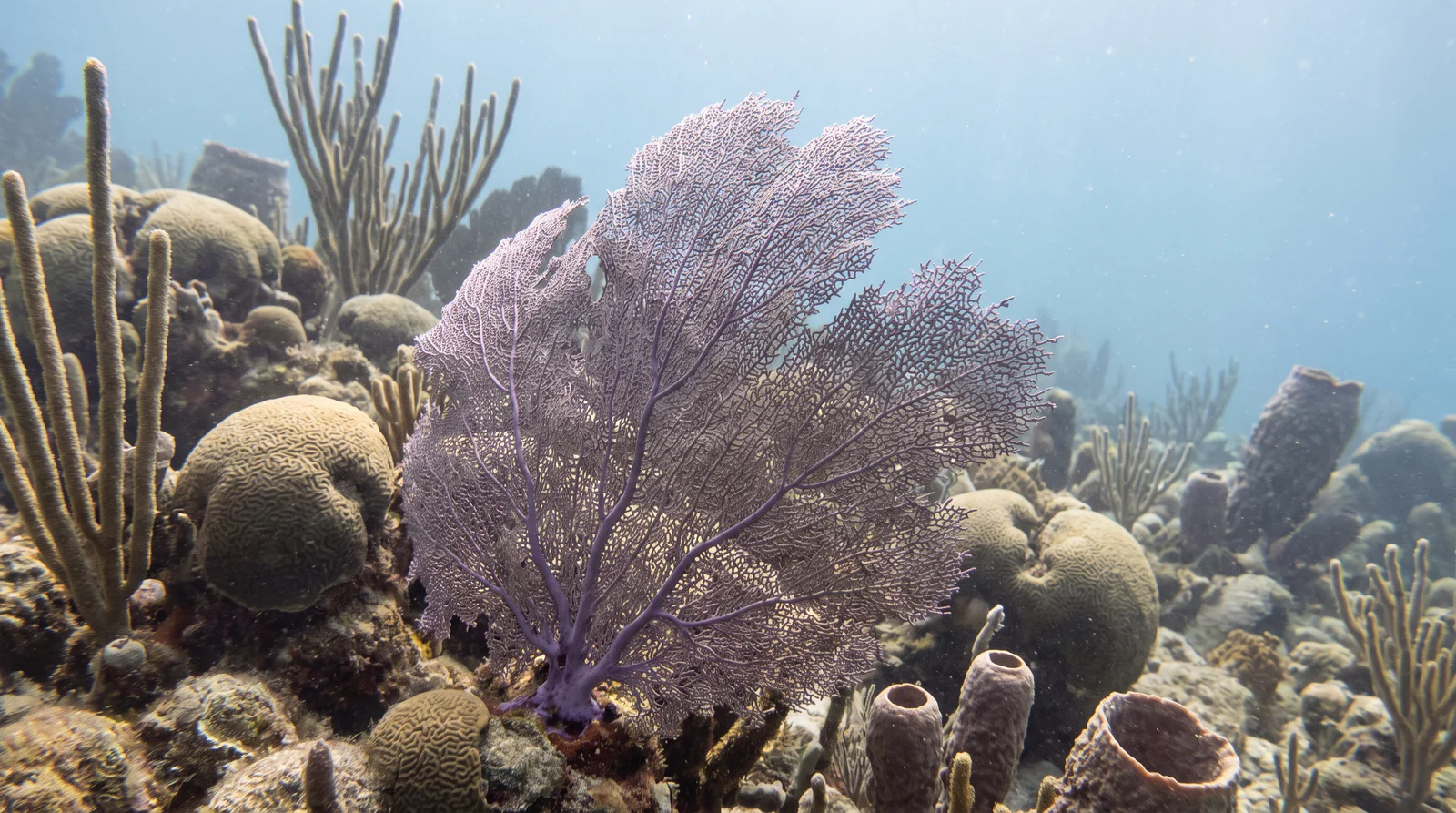
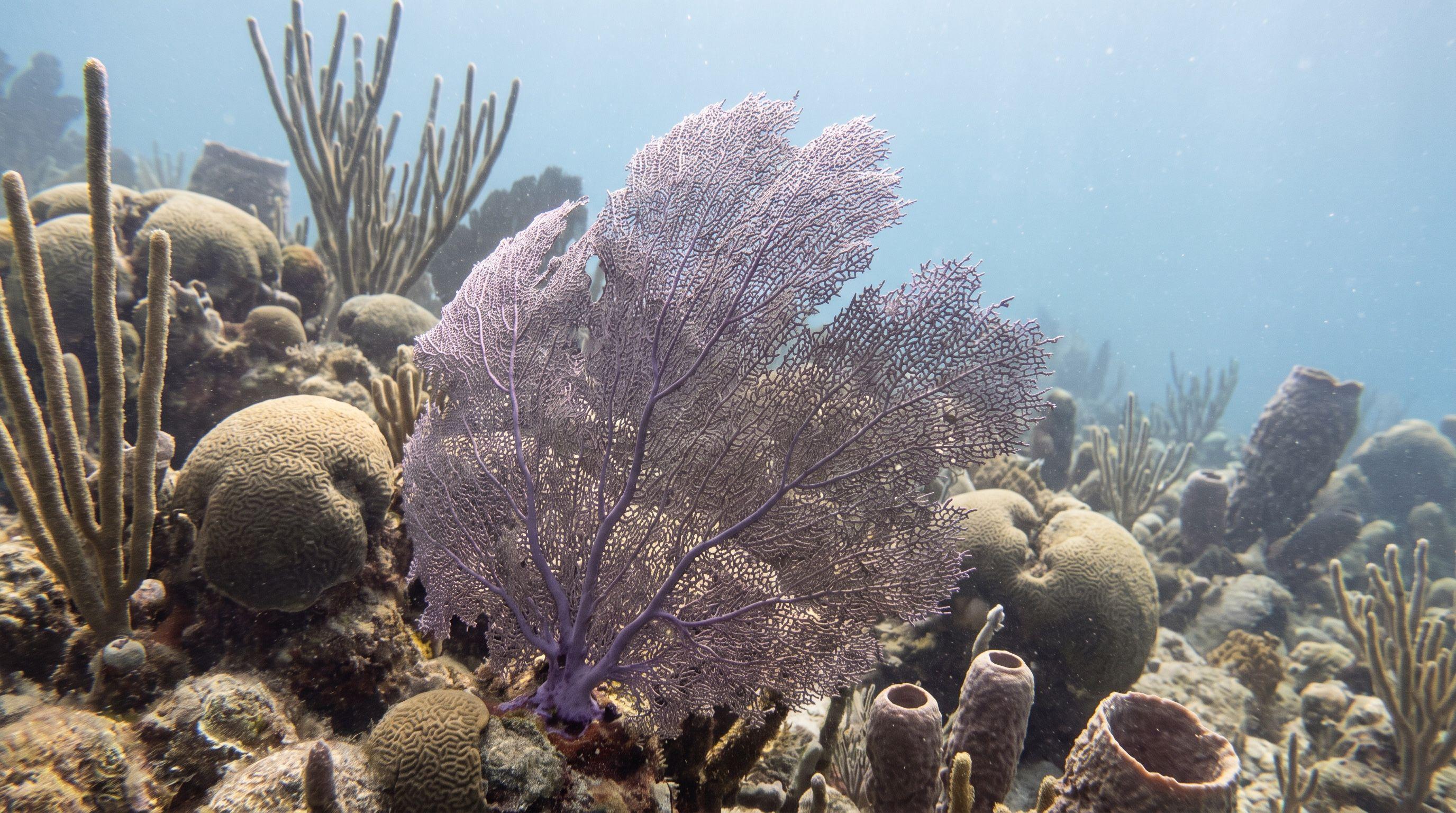
The Common Sea Fan, Gorgonia ventalina, is a striking soft coral easily recognized by its distinctive fan-shaped colony, which lends it the alternative common name, purple sea fan. This colonial organism forms a flattened, reticulated (net-like) structure composed of several main branches interconnected by smaller branchlets, creating a latticework appearance. The skeleton of the sea fan is a flexible, yet durable, framework made from a horny, collagen-like protein called gorgonin, along with calcite, which provides support for the living tissues. Individual polyps, the tiny animals that make up the colony, are typically arranged in two rows along the edges of the branches. Each polyp, often appearing as a fragile white 'flower,' is equipped with eight tentacles that it extends to capture microscopic prey.
While predominantly known for its vibrant purple or lavender hues, the Common Sea Fan can also display a variety of other colors, including whitish, yellow, brownish, or pale red. These colors are primarily due to chemical pigments embedded within the coral's spicules, which are small, needle-like structures of calcium carbonate. A notable distinguishing feature from similar species, such as the Venus sea fan (Gorgonia flabellum), is that many of the smaller branches of G. ventalina are compressed within the plane of the main fan. Colonies can also develop smaller accessory fans growing outwards at right angles from the primary structure.
The Common Sea Fan hosts millions of symbiotic dinoflagellate algae, known as zooxanthellae, within its tissues. These algae perform photosynthesis, producing organic carbon compounds that provide a significant portion of the coral's nutritional requirements and also contribute to its coloration. To deter predators, G. ventalina possesses hard sclerites within its tissues and produces unpalatable secondary metabolites. Despite these defenses, it is susceptible to diseases like aspergillosis, caused by the fungus Aspergillus sydowii, which can lead to characteristic purple lesions, galling, tissue necrosis, and ultimately, colony mortality. This fungal disease is often linked to environmental stressors such as warmer water temperatures.
Where it lives.
The Common Sea Fan, Gorgonia ventalina, is a prominent inhabitant of the warm tropical and subtropical waters of the Western Atlantic Ocean and the Caribbean Sea. Its geographic distribution spans from Bermuda and the southern parts of Florida, through the Bahamas, Cuba, the Dominican Republic, and the Gulf of Mexico, extending as far south as Belize, Curaçao, and the northern coasts of Colombia and Venezuela.
This species is commonly found in a variety of reef environments, including inshore and patch reefs, reef slopes, and outer reef edges. It exhibits a clumped, non-random distribution across coral reef habitats. A key requirement for G. ventalina is consistent water movement, as it thrives in areas exposed to moderate to strong currents and wave action, such as crests and seaward slopes. These currents are crucial for efficient feeding and respiration. While often found in shallow waters, the Common Sea Fan's depth range typically extends from about 2 meters (7 feet) to approximately 30 meters (98 feet), though it is chiefly found at depths of 2 to 10 meters (7-33 feet) and rarely below 15 meters (49 feet).
How it behaves.
The Common Sea Fan is a sessile invertebrate, meaning it remains anchored to a hard substrate, such as a rock or reef, and does not move. Its primary behavior revolves around its feeding strategy as a filter feeder. The fan-shaped colony is ingeniously oriented perpendicular to the prevailing current, maximizing its surface area exposure to passing water. This orientation allows its numerous polyps to efficiently strain plankton and other organic materials from the water column. Each polyp extends its eight tentacles, primarily during the night when feeding activity is at its peak, to capture microscopic prey, using stinging cells to immobilize them. Nutrients obtained by individual polyps are then shared throughout the interconnected colony.
Reproduction in G. ventalina occurs through both sexual and asexual means. Sexually, colonies release large quantities of eggs and sperm into the water, where fertilization takes place. The resulting free-swimming larvae eventually settle onto suitable substrates to establish new colonies. Asexually, the sea fan can reproduce through budding of new polyps within an existing colony or via fragmentation, where a detached piece can re-establish itself to grow into a new colony.
Due to its sessile nature, direct interaction with other similar species is limited. However, G. ventalina plays an important ecological role by providing habitat and refuge for various small fish and invertebrates. It is also preyed upon by specialized gastropods, such as flamingo tongue snails (Cyphoma gibbosum) and certain nudibranchs (e.g., Tritonia hamnerorum, Tritonia odhneri), which can consume its polyps. Notably, some nudibranch predators can even incorporate the sea fan's distasteful chemical compounds into their own tissues for defense against their predators. The filter-feeding activity of sea fans also contributes to maintaining water quality by removing suspended particles and plankton, which can benefit the clarity of the water for neighboring reefs.
Where to see it.
Evidence for bonaire · No dive sites
General range is not evidence of occurrence at a specific dive site.
No documented dive-site associations in this destination yet.
Gallery.
 AI-generated
 illustration
Image credit: AI-generated illustration · License unspecified · Source unspecified