Coral Trout
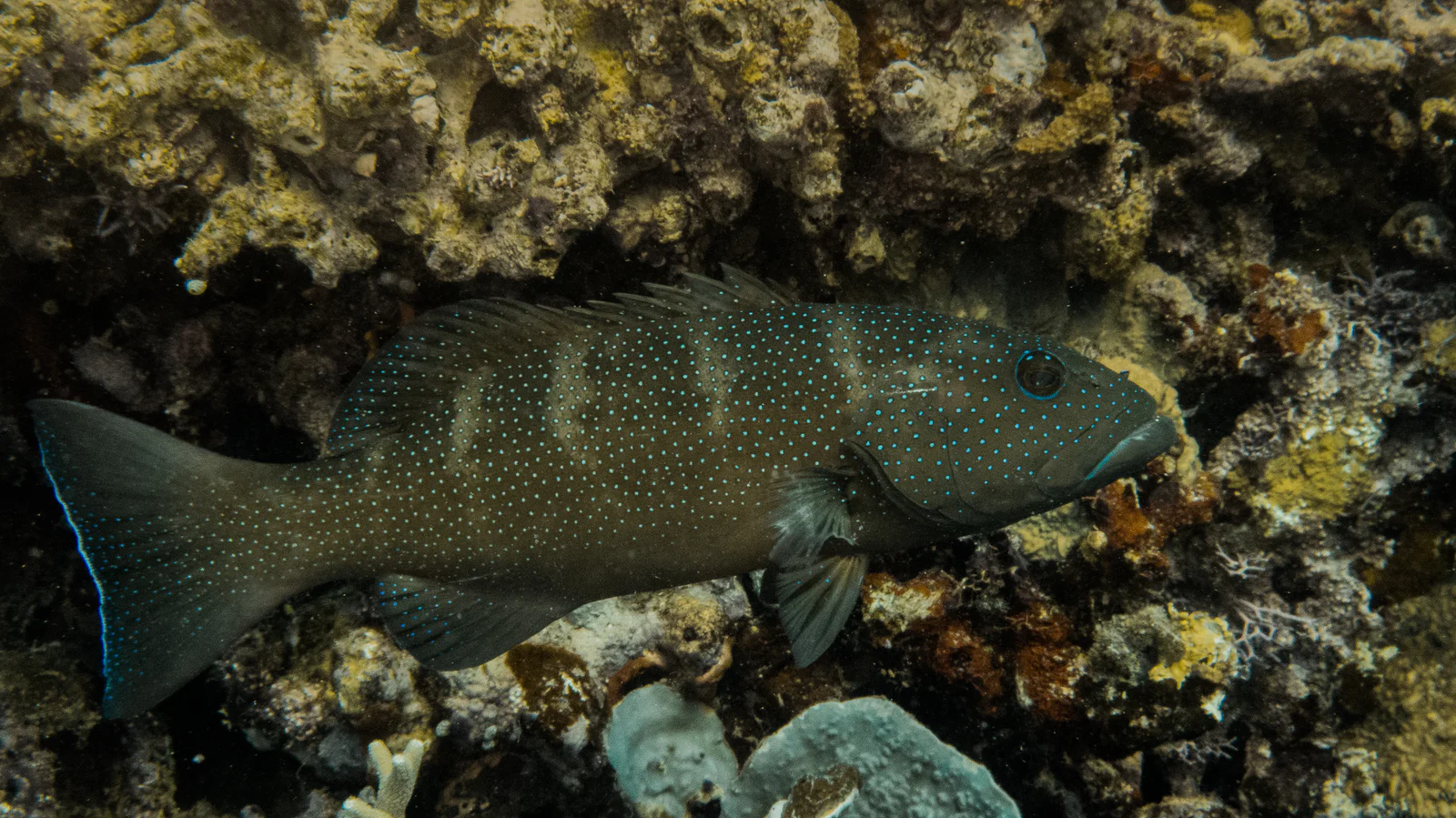
Image credit: jpdandretta · CC BY 4.0 · iNaturalist via Wikimedia Commons, cropped by this page
Plectropomus leopardus
About Coral Trout.
The coral trout or leopard coral grouper (Plectropomus leopardus) is a blue-spotted grouper of western Pacific coral reefs, found from 3 to 100 m.
Names and classification
WoRMS accepts Plectropomus leopardus (Lacepède, 1802) and files it in Epinephelidae, order Perciformes; FishBase and Wikipedia also use Epinephelidae, while the FAO groupers catalogue that both cite treats groupers as the subfamily Epinephelinae of Serranidae. Wikipedia lists common coral trout, leopard coral trout, blue-dotted coral grouper and spotted coral grouper as other English names, and says Lacépède first described it as Holocentrus leopardus, giving the type locality as the "Mer des Indes". FishBase warns that it is often misidentified as Plectropomus maculatus.
Identification
FishBase describes an elongate body whose greatest depth goes 2.9 to 3.6 times into the standard length; Wikipedia gives 2.9 to 3.9 times. Both count 7 to 8 dorsal spines with 10 to 12 soft rays, and 3 anal spines with 8 soft rays. FishBase calls the tail truncate to slightly emarginate and Wikipedia emarginate. FishBase adds a pair of large canine teeth at the front of the jaws and 1 to 4 large canines on each side of the lower jaw.
In FishBase's account the head, body and fins carry numerous blue spots on a red, pale grey or olive to dark brown ground, and the tail has a narrow white rear margin except near its corners. Wikipedia gives the ground colour as olive green to reddish brown or orange-red, with regularly spaced bright blue spots on the upper body and a blue ring, sometimes broken, around the eye. It adds that the fish can change colour quickly and often turns mottled while hunting.
Size and age
FishBase gives a maximum length of 120 cm and a common length of 35 cm, both as standard length; Wikipedia gives the same 120 cm as total length. Both record a maximum published weight of 23.6 kg, but Wikipedia considers that figure probably wrong, perhaps belonging to Plectropomus laevis, because the Australian spearfishing record for this species is 10.25 kg. FishBase's maximum reported age is 26 years and its Great Barrier Reef lifespan 14 years; Wikipedia cites research at Bramble Reef that found a maximum age of 16 years.
Conservation and fisheries
FishBase and Wikipedia both give the IUCN Red List category as Least Concern; FishBase dates the assessment to 20 November 2016 (Red List version 2025-2). Wikipedia describes it as a prized food fish sold live and chilled in a trade centred on Hong Kong, with live fish sourced mainly from Indonesia and the Philippines, where it is also caught with cyanide. Wikipedia says large fish can carry very high levels of ciguatoxin, and FishBase records reports of ciguatera poisoning. FishBase's model estimates rate its vulnerability to fishing as moderate to high (55 of 100) and to climate change as very high (85 of 100).
Where it lives.
The coral trout lives on coral-rich reefs of the western Pacific, from southern Japan to Australia, at depths of 3 to 100 m.
Range
FishBase gives a western Pacific range from Western Australia east to the Caroline Islands and Fiji and from southern Japan to Queensland, with a recent record from Tonga. Wikipedia describes it from southern Japan to Australia and from the east coasts of Thailand and Malaysia east to the Solomon Islands, the Caroline Islands and Fiji. In Australia Wikipedia names Beacon Island in Western Australia, the Ashmore and Cartier Islands in the Timor Sea and the tropical north coast as far south as Sydney, including reefs of the Coral Sea, Christmas Island, the Cocos (Keeling) Islands and Lord Howe Island.
Depth and setting
FishBase and Wikipedia agree on a depth range of 3 to 100 m on coral reefs. FishBase classes it as a tropical, reef-associated marine fish of coral-rich lagoon and mid-shelf reefs, with a lower water temperature of 24 °C and no upper figure. Its juveniles, according to FishBase, live close to the bottom in shallow reef habitats, especially around coral rubble.
How it behaves.
The coral trout is a solitary reef predator that hunts fish by day, hides under ledges at night and gathers in aggregations to spawn around the new moon.
Daily pattern
FishBase calls the species solitary and inactive at night, when it hides under ledges. Wikipedia says it feeds only in daylight, most often at dawn and dusk, usually once every 1 to 3 days, and can go many days without food. The captured sources describe no behaviour towards divers.
Hunting and diet
Wikipedia describes two methods: lying still among the coral to ambush fish that pass near the bottom, and prowling slowly towards schooling fish higher in the water before attacking at speed. It says the main prey are damselfish, especially the spiny chromis (Acanthochromis polyacanthus), with parrotfish and hardyheads in the southern Great Barrier Reef and damselfish and fusiliers further north, and that adults also eat young of their own species. Wikipedia records cooperative hunting with the giant moray (Gymnothorax javanicus), the humphead wrasse (Cheilinus undulatus) and the big blue octopus (Octopus cyanea). FishBase says adults feed mainly on fish, and juveniles on small fish and invertebrates such as crustaceans and squid; Wikipedia names prawns as the main food of young juveniles.
Reproduction
Both sources describe a protogynous hermaphrodite that starts life as a female. FishBase notes that the species was described as monandric but has since been confirmed as diandric, meaning that some males are born male, and estimates the change of sex at 32.1 cm total length and 16 years of age. Wikipedia instead gives sex change at 23 to 62 cm, 42 cm on average.
FishBase says several spawning aggregations form on a reef around the new moon, and that the eggs float just below the surface. Wikipedia places the aggregations on reef slopes at about 10 to 15 m, peaking at the new moon, with spawning at dusk on strong, especially ebbing, tides over 30 to 40 minutes. It gives the season as September to December on the northern Great Barrier Reef and October to February in the cooler south, as the water warms from 25.0 to 26.5 °C. Wikipedia describes the male tilting onto its side and quivering beside a female before the pair rush to the surface to release eggs and sperm.
Where to see it.
Evidence for great barrier reef · 3 dive sites
General range is not evidence of occurrence at a specific dive site.
Bait Reef — Stepping Stones
Whitsundays
Site occurrence not yet documented
Season not yet documented
No dated observations available.
Cod Hole
Ribbon Reefs
Site occurrence not yet documented
Season not yet documented
No dated observations available.
Michaelmas Cay
Cairns
Site occurrence not yet documented
Season not yet documented
No dated observations available.
Gallery.
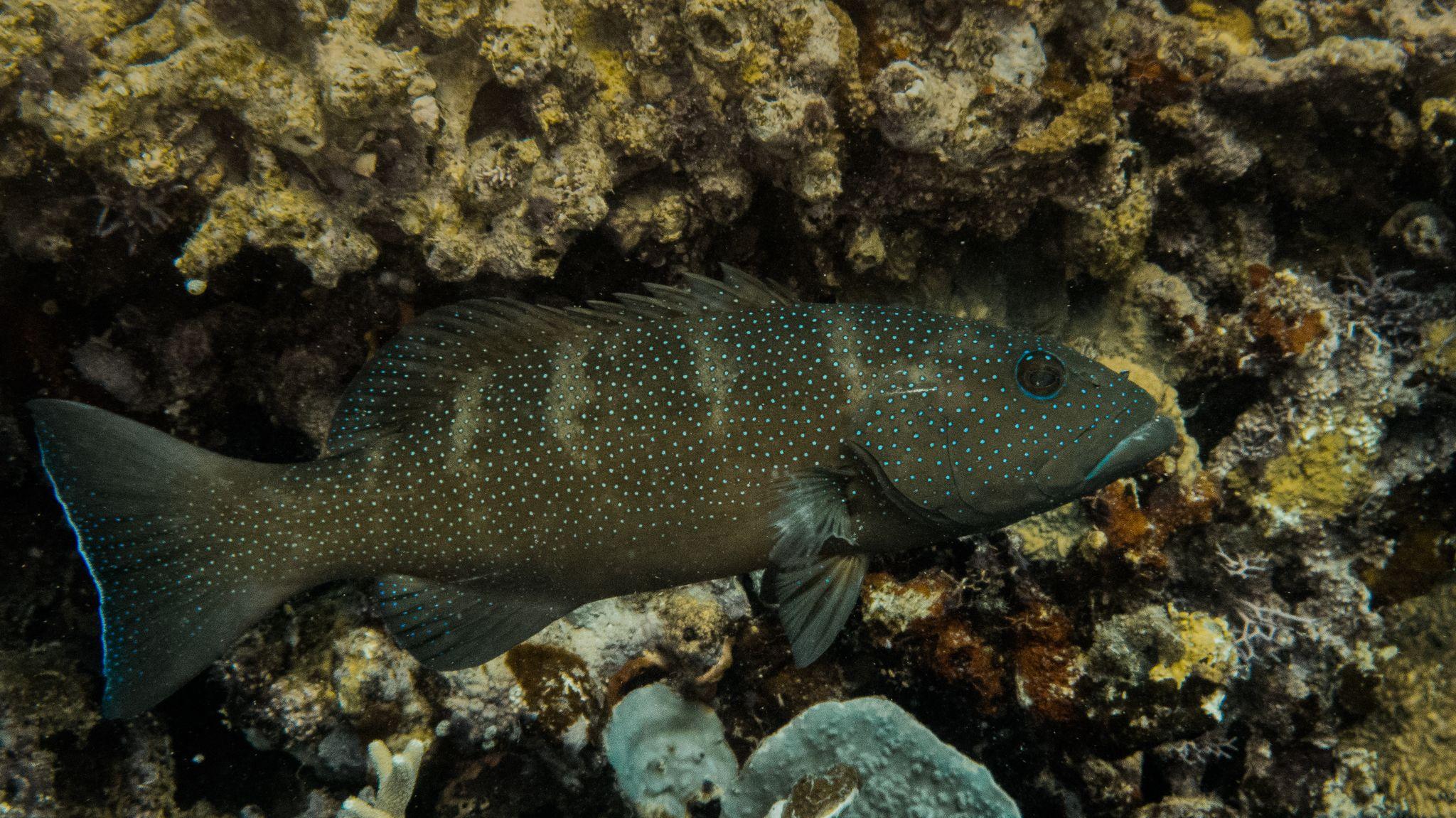
A coral trout (Plectropomus leopardus) photographed by jpdandretta on 21 December 2017 on the Great Barrier Reef, Queensland, Australia, as its file page states. The identification is the one its file page gives. It illustrates the species and is not a sighting record. This page's frame crops the photograph.
Image credit: jpdandretta · CC BY 4.0 · iNaturalist via Wikimedia Commons, cropped by this page
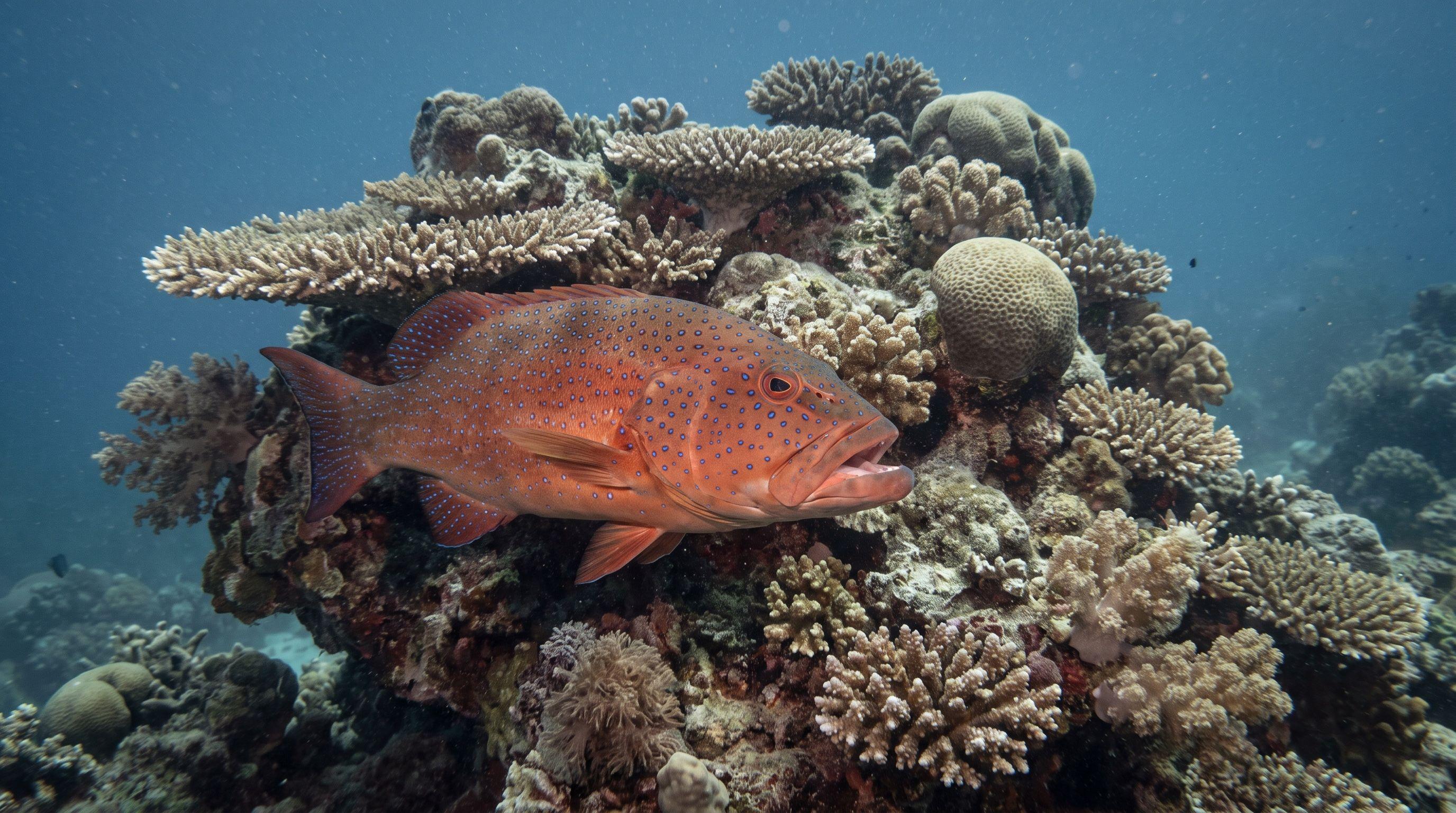 AI-generated
 illustration
Image credit: AI-generated illustration · Diveity