Crocodile Needlefish
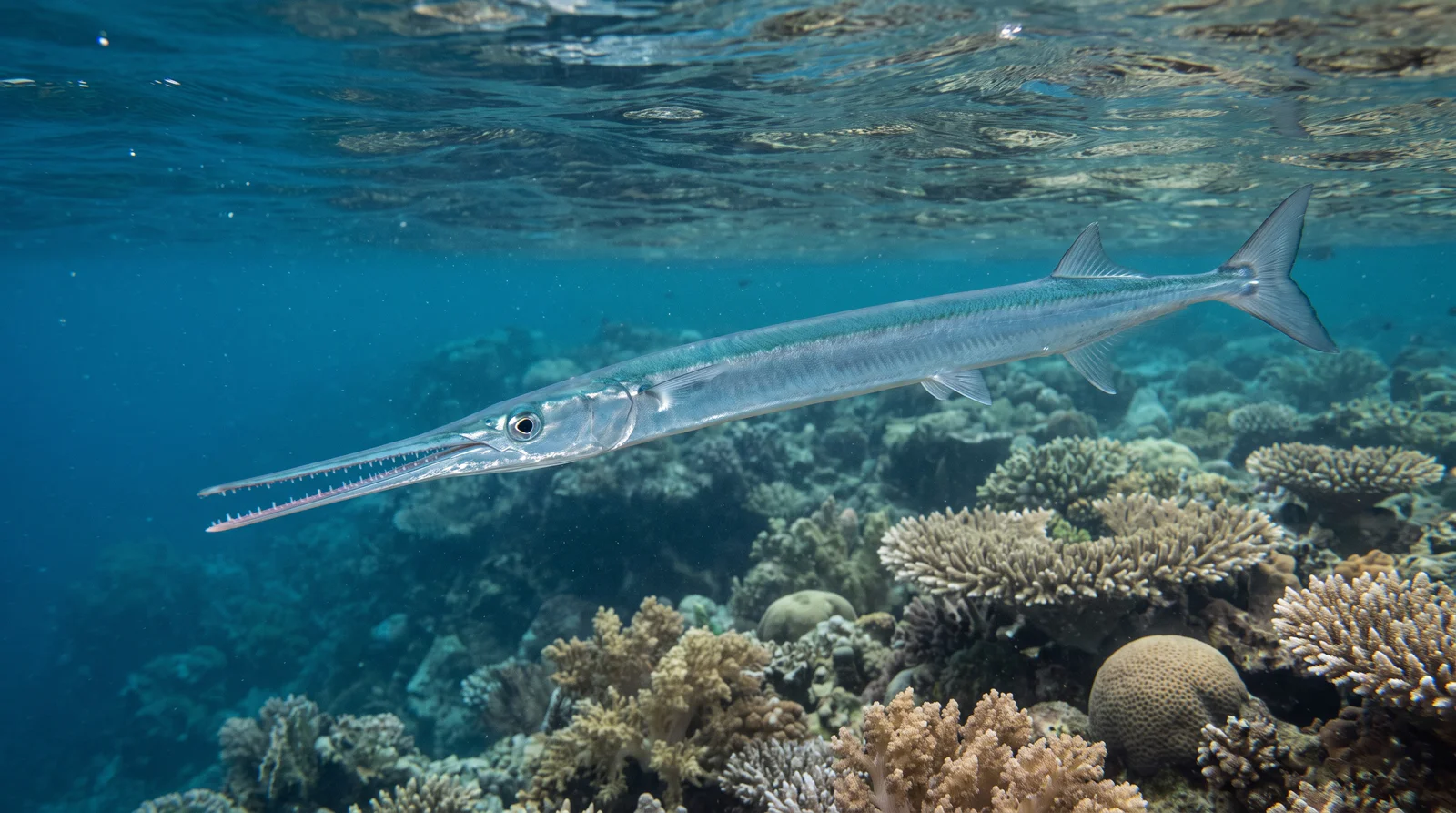 AI-generated
Image credit: AI-generated illustration · Diveity
Tylosurus crocodilus
About Crocodile Needlefish.
The crocodile needlefish, or houndfish, is a slender, blue-backed and silvery hunter of tropical seas with a long toothed beak, reaching 150 cm.
Names and classification
In the World Register of Marine Species the accepted name is Tylosurus crocodilus (Péron & Lesueur, 1821), a needlefish of the family Belonidae in the order Beloniformes; the register's common names for it are houndfish in English and agujón lisero in Spanish. FishBase calls the species the hound needlefish, and Wikipedia uses both houndfish and crocodile needlefish. François Péron and Charles Alexandre Lesueur described it in 1821 with Mauritius as the type locality, Wikipedia records. The encyclopedia names two subspecies that used to be recognised, T. c. crocodilus and T. c. fodiator, and says FishBase now treats the second as a species in its own right, the Mexican needlefish Tylosurus fodiator. FishBase's own species summary, however, still divides the species into two subspecies and has Tylosurus crocodilus fodiator taking its place in the eastern Pacific.
Identification
FishBase describes a long body, round in cross-section, and jaws drawn out into a stout beak set with very sharp teeth. The tail fin is deeply notched, its lower lobe much longer than the upper, and each side of the tail stalk carries a distinct black keel. In the database's account the fish is dark bluish green above and silvery below, and even its scales and bones are green; young fish up to about 20 cm body length have a raised black lobe at the back of the dorsal fin, which disappears as they grow. Wikipedia tells it apart from the rest of its genus by the teeth of the young, which point forward, whereas those of the other species are straight at every age, and by a stouter, more cylindrical body and a shorter head than other needlefishes; it describes a dark blue back, silvery white sides and a plain white belly. Both sources say it has no fin spines. FishBase counts 21 to 24 soft rays in the dorsal fin, 19 to 22 in the anal fin and 75 to 80 vertebrae, where Wikipedia has 21 to 25, 19 to 22 and 80 to 86.
Size
The longest fish on record measured 150 cm, a total length in FishBase and the same figure in Wikipedia, which calls the species the biggest of its family. FishBase adds 90 cm standard length as a common size, 6.4 kg as the heaviest published weight and a length at first maturity of about 52 cm, within a range of 50 to 55 cm. Wikipedia's figures for weight disagree with each other: 6.35 kg in its description section and 4.5 kg in its opening paragraph. The angling world record it reports from the International Game Fish Association is 4.88 kg, caught off Goulding Cay in the Bahamas in 2013.
Conservation and people
The IUCN Red List rates the crocodile needlefish as Least Concern. FishBase, quoting list version 2025-2, dates the assessment 21 August 2012; Wikipedia cites an assessment published in 2015 by Collette and three co-authors. FishBase lists it in commercial fisheries and as a game fish, caught by casting or trolling lures at or just below the surface, and also in purse seines and drift nets. It is sold fresh and considered good to eat, but both sources say its market is small because the flesh is green.
Where it lives.
The crocodile needlefish lives in open water over lagoons and seaward reefs of tropical seas, recorded from the surface to a depth of 13 m.
Range
FishBase's range runs through the Indo-West Pacific from the Red Sea, South Africa and the Persian Gulf east to French Polynesia, north to Japan and south to New South Wales in Australia. In the western Atlantic it lists New Jersey to Brazil, and in the eastern Atlantic Fernando Poo, Cameroon, Liberia, Ascension Island, Senegal, Guinea and Cape Verde, along with a record from the Mediterranean. Wikipedia covers the same span and explains the Mediterranean record: the fish reached the eastern Mediterranean from the Red Sea through the Suez Canal, as part of the movement of species known as the Lessepsian migration. In the eastern Pacific, according to both, another needlefish takes its place, which Wikipedia names as the Mexican needlefish.
Water and depth
FishBase records it as a marine, reef-associated fish that migrates within the sea (oceanodromous), in tropical water of 26 to 29 °C and at depths of 0 to 13 m, and as a pelagic species found over lagoon and seaward reefs. WoRMS lists it as marine only, with no brackish or freshwater records. Wikipedia also calls it pelagic and places it over lagoons and seaward reefs.
How it behaves.
The crocodile needlefish hunts smaller fish alone or in small groups, and it can leap out of the water when alarmed or drawn to lights at night.
Feeding and groups
FishBase and Wikipedia both describe it as a fish eater living alone or in small groups; Wikipedia specifies mainly smaller fishes. From diet studies FishBase puts it at trophic level 4.4, plus or minus 0.4.
Breeding
It lays eggs, and FishBase and Wikipedia both say the eggs fix themselves to objects in the water with tendrils on their surface.
Leaping
FishBase classes the species as traumatogenic: fishers fear it because, when alarmed or attracted to lights at night, it can jump out of the water and cause puncture wounds with its sharp snout. Wikipedia describes the same danger and reports two injuries: a woman snorkelling in the Florida Keys who was stabbed in the neck by a leaping houndfish in April 2000, and a woman kayaking at sea who was struck in the back in October 2010 and treated for a collapsed lung.
Where to see it.
Evidence for visayas · 2 dive sites
General range is not evidence of occurrence at a specific dive site.
Dolphin House
Moalboal
Documented site occurrence
Season not yet documented
Source reviewed on 2026-10-03 · Source: Master Liveaboards — Dolphin House; itinerary publication date unknown · Observation date not documented
Tongo Point
Moalboal
Documented site occurrence
Season not yet documented
Source reviewed on 2026-10-03 · Source: Master Liveaboards — Tongo Point; itinerary publication date unknown · Observation date not documented
Gallery.
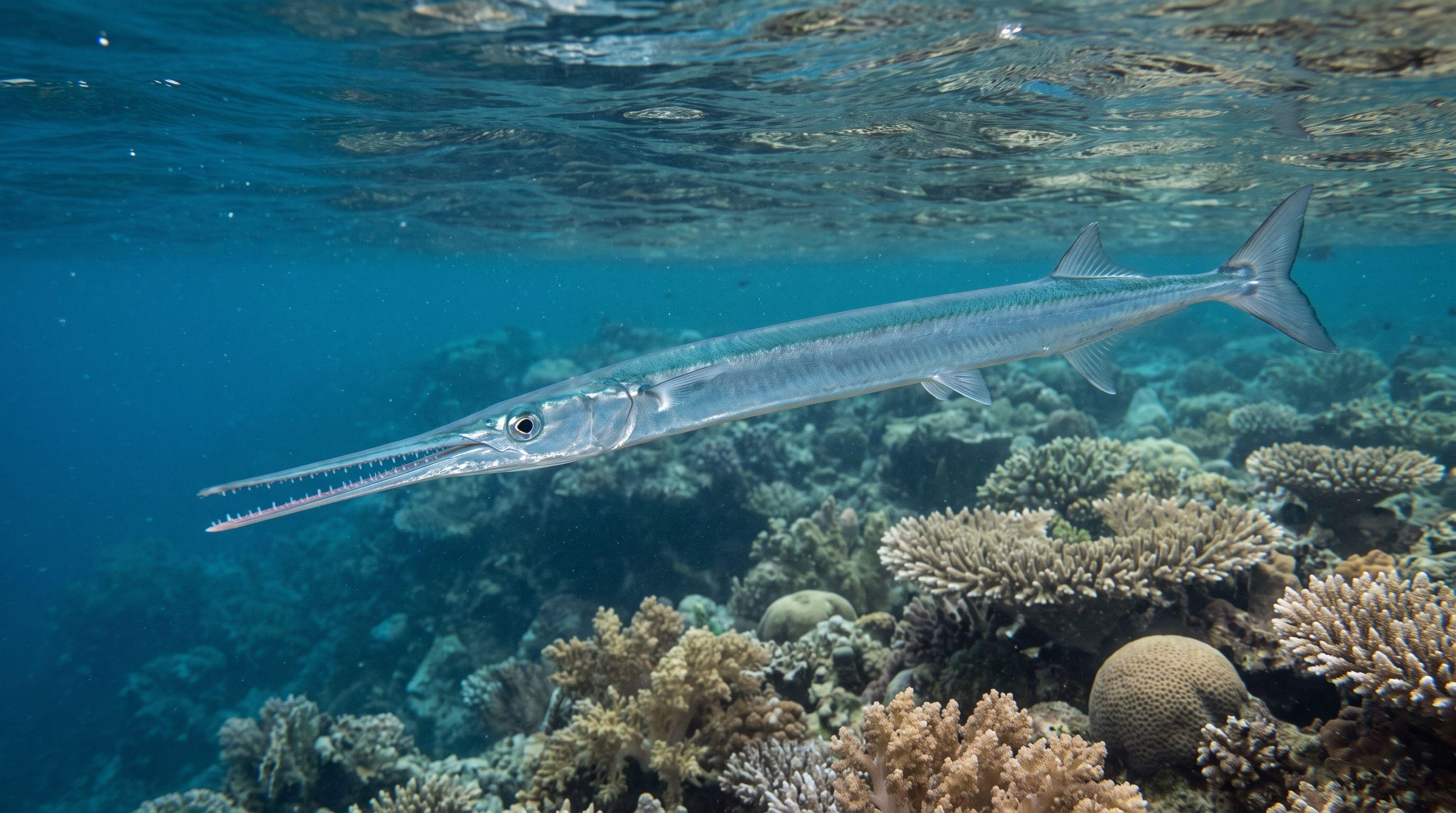 AI-generated
 illustration
Image credit: AI-generated illustration · Diveity