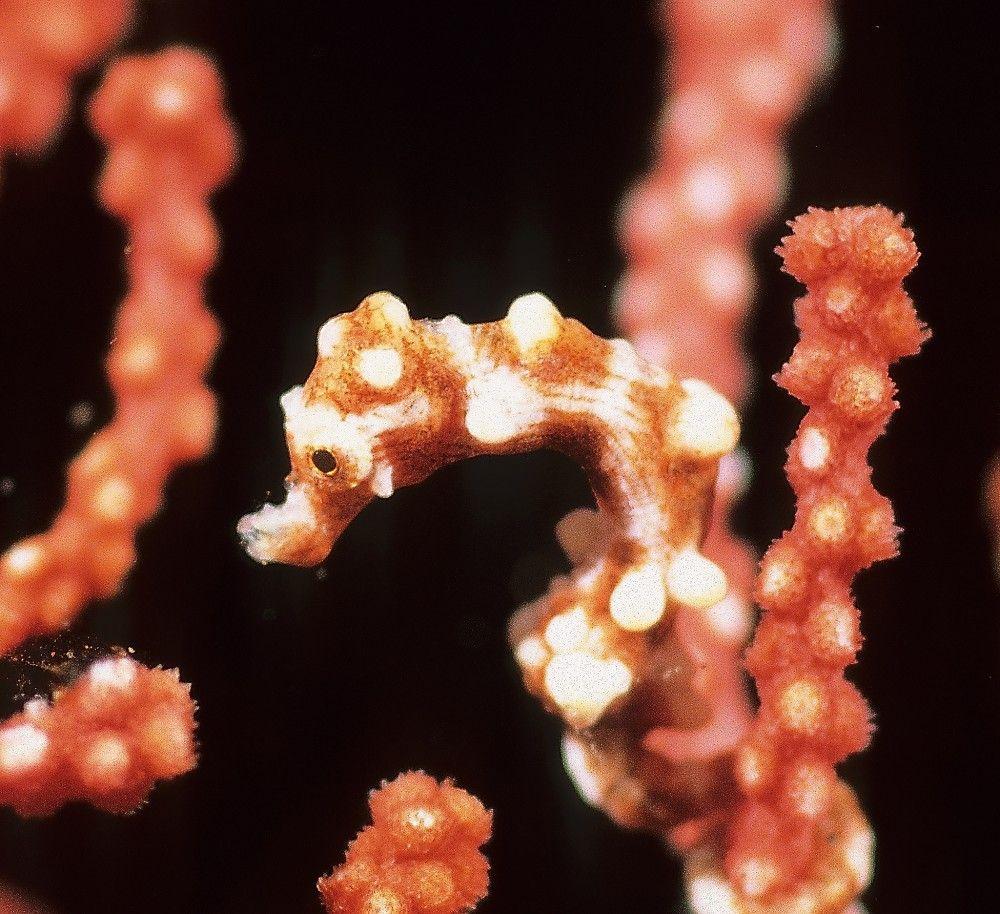
Denise's Pygmy Seahorse
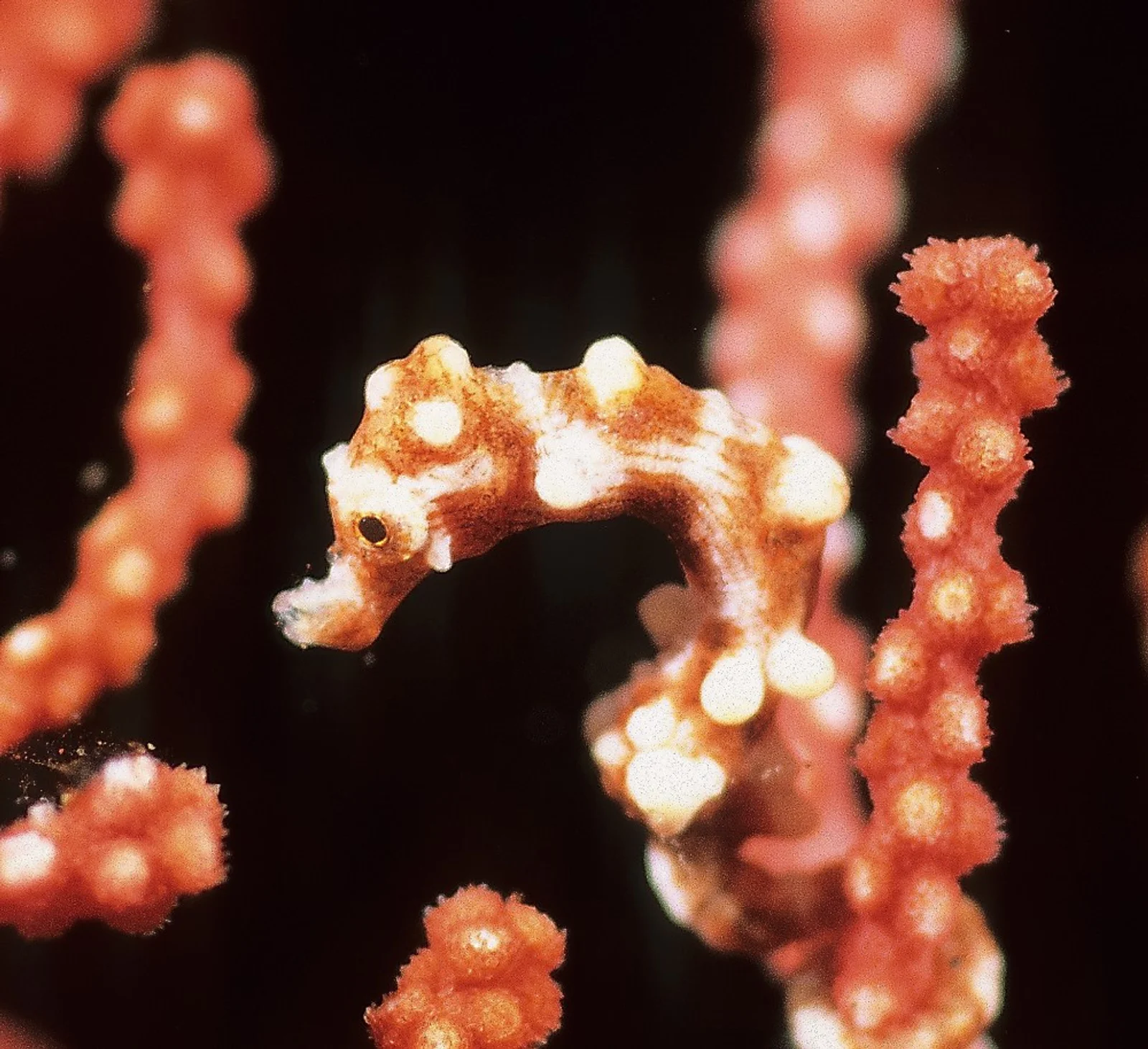
Hippocampus denise
About Denise's Pygmy Seahorse.
The diminutive Hippocampus denise, commonly known as Denise's Pygmy Seahorse, is a captivating member of the Syngnathidae family, renowned for its extraordinary camouflage and elusive nature. This macro species is a true master of disguise, blending seamlessly with its gorgonian coral hosts across the Indo-Pacific. Its discovery in 2003 brought to light one of the ocean's most enchanting hidden treasures, named in honor of marine life photographer Denise Tackett who first brought it to scientific attention.
Denise's Pygmy Seahorse inhabits a wide range of gorgonian seafans, including species from the genera Annella, Muricella, and Echinogorgia, showcasing a greater habitat versatility than its close relative, Bargibant's Pygmy Seahorse. These tiny seahorses are typically found at depths of 7–102 m, though they are commonly observed by divers between 13–90 m. They are widespread throughout the Western Pacific, with observations reported from Indonesia, Malaysia, the Philippines, Papua New Guinea, the Solomon Islands, Vanuatu, Micronesia, and northeast Australia. Notable dive sites where this species has been observed include the walls of Anilao and Dauin, as well as Kirby's Rock, Boo Windows, and Nudi Rock.
Despite their widespread distribution, Denise's Pygmy Seahorse is classified as "Data Deficient" by the IUCN Red List, indicating a lack of sufficient information to assess its population trends and conservation status. It is also listed in Appendix II of CITES, which means trade must be controlled to prevent overexploitation. Their reliance on healthy gorgonian corals makes them vulnerable to habitat degradation caused by climate change and ocean acidification.
Identification
- Size: Denise's Pygmy Seahorse is one of the smallest seahorse species, reaching a maximum length of approximately 2.4 cm.
- Body Shape: This species possesses a slender, relatively thin, and fleshy body with a short snout and a prehensile tail. Unlike some other seahorse species, it has a rounded nuchal plate without an elevated coronet and lacks spines above the eye.
- Coloration: A master of adaptive camouflage, its coloration is highly variable, ranging from vibrant yellow and orange to pink, red, brownish, and even white. It perfectly matches the color of its host gorgonian coral, often exhibiting small dark spots or darker bands around its tail.
- Body Texture: A key distinguishing feature from the related Bargibant's Pygmy Seahorse (Hippocampus bargibanti) is its smoother body. Denise's Pygmy Seahorse has considerably fewer and less developed polyp-like tubercles, giving its skin a much smoother appearance. The presence and size of these small prominences can vary, often adapting to match the texture of its specific host gorgonian, appearing bumpy on bumpy fans and smooth on smooth fans.
- Habitat Specificity: While both pygmy seahorse species are found on gorgonian corals, H. denise is known to inhabit at least ten different genera of gorgonians, making it a more generalist species compared to the highly specialized H. bargibanti, which typically resides exclusively on Muricella gorgonians.
Where it lives.
Habitat and Depth:
- Denise's Pygmy Seahorse is a habitat specialist, living in an obligate relationship with gorgonian corals, often referred to as sea fans.
- While the fact sheet mentions Annella sea-fans, research indicates they are found on at least ten different gorgonian genera, making them a relative habitat generalist among pygmy seahorses. These include Annella reticulata, Muricella spp., Echinogorgia spp., Verrucella spp., Acanthogorgia spp., Melithaea spp., Villogorgia spp., and Ellisella spp..
- They inhabit outer-reef walls, slopes, and drop-offs, typically in clear-water environments where gorgonian corals are dominant.
- The typical depth range for this species is between 13 and 102 m, though they are frequently observed by divers at depths of 10–50 m. Observations have been made as deep as 102 m on Osprey Reef in the Coral Sea.
- Water temperatures in their natural habitat generally range from 24–28°C.
Ecosystem Associations and Substrate Preference:
- The seahorse's body coloration and texture, with its small, polyp-like tubercles, perfectly mimic the branches and polyps of its host gorgonian, providing exceptional camouflage from predators.
- They are often found in areas with strong currents, which facilitate the flow of plankton and other organic particles that their host gorgonians feed upon. It is thought that pygmy seahorses also feed on zooplankton that drift past their host sea fans.
- The presence of Hippocampus denise is often an indicator of healthy coral reef ecosystems, as they require pristine water conditions and thriving gorgonian populations to survive.
- Common dive sites where this species has been observed include Kirby's Rock, Boo Windows, and Nudi Rock. Other notable locations include the Rowley Shoals in Western Australia, Holmes Reef, Osprey Reef, and various sites in Indonesia (such as Bali, Tulamben, Seraya, Amed, and Romblon Island).
How it behaves.
The Denise's Pygmy Seahorse (Hippocampus denise) is a captivating macro species renowned for its diminutive size and extraordinary camouflage, making it a prized discovery for divers exploring the coral reefs of the Indo-West Pacific. Measuring up to 2.4 cm (1 inch), this tiny seahorse is a master of blending seamlessly into its environment.
Underwater Encounter Behavior
- Camouflage and Habitat: Denise's Pygmy Seahorse exhibits exceptional adaptive camouflage, perfectly mimicking the color and texture of its gorgonian seafan hosts, such as Annella reticulata, Muricella sp., and Echinogorgia sp. Its body is often plain orange or yellow, sometimes with small dark spots or darker bands on its prehensile tail, allowing it to become virtually invisible against the polyps and stems of the coral.
- Sedentary Nature: These seahorses are largely sedentary, typically remaining on the same gorgonian coral for their entire adult lives. Their movements are slow and deliberate, making them difficult to spot unless a diver is actively searching and has keen eyesight or the assistance of an experienced dive guide.
- Diver Interaction: Encounters require patience, excellent buoyancy control, and often macro photography equipment. Divers are advised to maintain a respectful distance, avoid touching the seahorse or its delicate host coral, and minimize disturbance from lights or strobes to ensure the well-being of these fragile creatures.
- Depth and Temperature: Hippocampus denise can be found at various depths, typically encountered between 7–100 m, though often observed by divers in the range of 13–90 m, and sometimes as shallow as 10–20 m in protected areas. They inhabit tropical waters, generally in temperatures of 24–28°C.
Feeding Habits
- Denise's Pygmy Seahorse is a carnivorous species, employing a "sit-and-wait" ambush predation strategy. It grasps onto its gorgonian host with its prehensile tail and waits for small planktonic organisms, such as tiny crustaceans and other zooplankton, to drift by. Using its tubular snout, it creates a powerful suction to capture its minute prey.
Social Structure
- This species is generally found living in pairs or small groups on a single gorgonian seafan. Research indicates that Denise's Pygmy Seahorses are often monogamous, with pairs forming lifelong partnerships and remaining together on their chosen coral colony. Courtship rituals involve intricate dances and subtle color changes, though these behaviors are rarely witnessed due to their minuscule scale.
Notable Seasonal Patterns
- Reproduction: Hippocampus denise is ovoviviparous, meaning the male carries the developing eggs in a specialized brood pouch located on his trunk. The female transfers her eggs to the male's pouch after a courtship ritual. Inside the pouch, villi rich in capillaries surround each fertilized egg, forming a placenta-like structure that nourishes the embryos.
- Gestation and Birth: The gestation period is remarkably short, typically around 11 days. Males have been observed giving birth to 6–16 live young, often at dawn, and are capable of carrying out multiple sequential pregnancies.
- Juvenile Development: The newly hatched fry are miniature, autonomous versions of the adults, measuring only 2-3 mm long. They are expelled from the pouch and spend approximately two to three weeks floating freely in the water column before settling onto a gorgonian of their own. While a general breeding season for seahorses can extend from April to October, linked to environmental temperature, the rapid and continuous reproductive cycle of H. denise suggests that breeding can occur year-round given suitable conditions.
Where to see it.
Evidence for philippines · 1 dive site
General range is not evidence of occurrence at a specific dive site.
Gallery.