Dogtooth Tuna
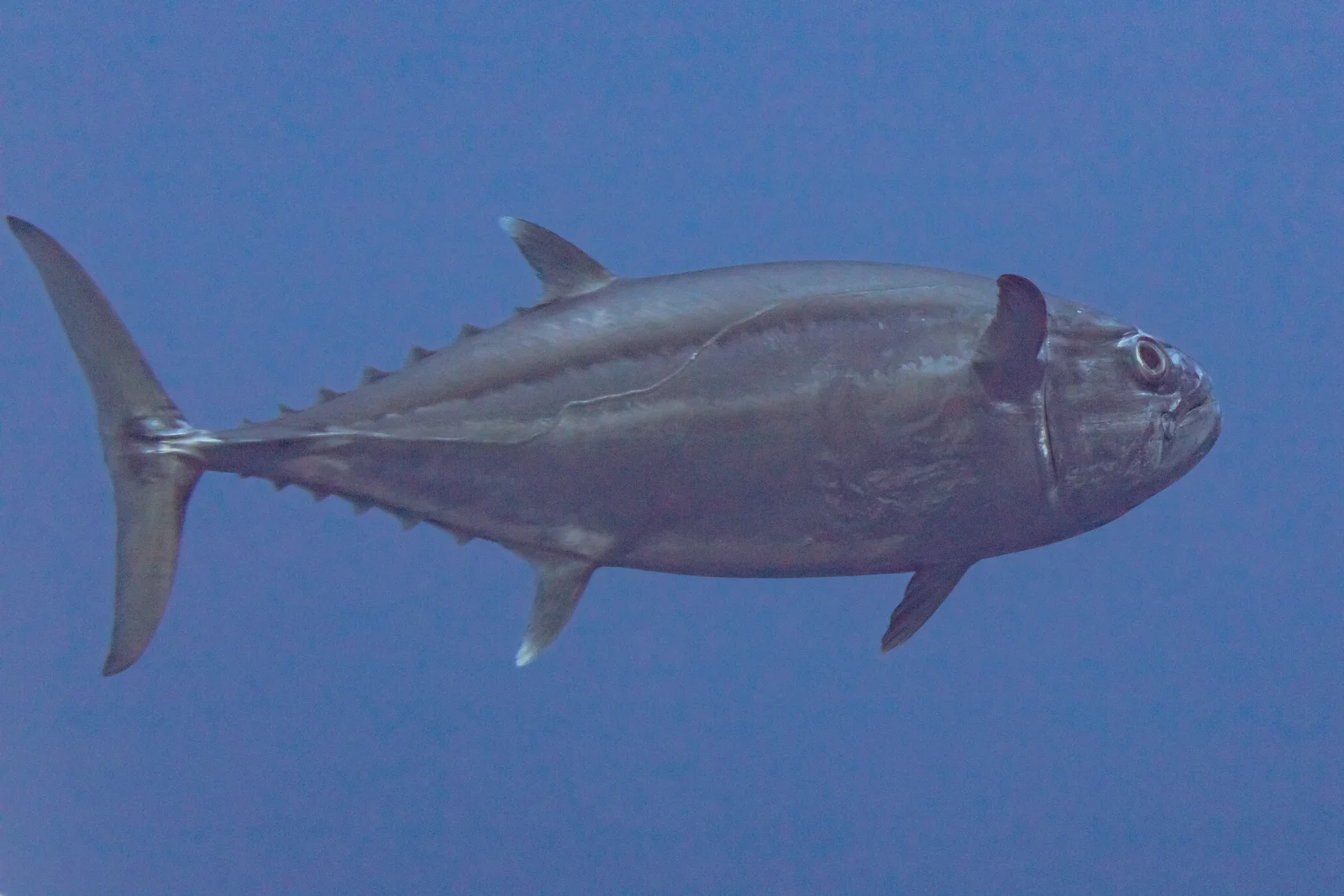
Image credit: Diego Delso · CC BY-SA 4.0 · Wikimedia Commons, own work of the photographer (delso.photo), cropped by this page
Gymnosarda unicolor
About Dogtooth Tuna.
The dogtooth tuna (Gymnosarda unicolor) is a large, big-toothed scombrid of Indo-Pacific coral reefs, up to 248 cm long, at depths of 0 to 250 m or more.
Names and classification
WoRMS accepts Gymnosarda unicolor (Rüppell, 1836) in the family Scombridae, order Scombriformes, and FishBase places it in the subfamily Scombrinae. The name Rüppell gave it in 1836, Thynnus unicolor, is one of four unaccepted names in WoRMS, together with Gymnosarda nuda, Pelamys nuda and Scomber vau. Wikipedia gives white tuna as a second English name and says that, despite the name, the fish is not actually a tuna but a bonito. FishBase derives Gymnosarda from the Greek gymnos, naked, and sarde, sardine. According to Wikipedia, two fossil species suggest that the genus has existed since the Early Eocene, and in the Eocene it was widespread in the Atlantic region, where it is no longer found.
Identification
FishBase describes an elongate, moderately compressed body and a fairly large mouth whose upper jaw reaches the middle of the eye, with 14 to 31 large conical teeth in the upper jaw and 10 to 24 in the lower. Behind the corselet the body is naked except along the lateral line, the dorsal-fin base and the caudal keel; the lateral line undulates strongly, and the slender caudal peduncle has a well-developed keel between two smaller keels on each side. The counts it gives are 13 to 15 dorsal spines, 12 to 14 dorsal soft rays, 12 or 13 anal soft rays and 25 to 28 pectoral rays, with 6 or 7 finlets after the second dorsal fin and 6 after the anal fin. In its words the back and upper sides are brilliant blue-black and the lower sides and belly silvery, with no lines, spots or other markings on the body, a dark front tip on the first dorsal fin and greyish other fins. Wikipedia instead describes a brilliant blue-green back, silvery sides and a whitish belly, with two white tips on the two back fins near the caudal peduncle; it says the upper jaw reaches the eye and that the fish always swims with open jaws.
Size and age
The largest specimen in FishBase measured 248 cm fork length; it gives 190 cm as a common length and 131.0 kg as the heaviest published weight. Wikipedia's figures are 190 to 248 cm for males, 130 kg, and an average length commonly observed of about 40 to 120 cm. It also cites preliminary estimates of a maximum observed age of at least 20 years.
Red List and fisheries
Its Red List category is Least Concern. Wikipedia's infobox supports the category with a 2011 assessment by Collette and four co-authors; the record in FishBase carries a later date, 1 March 2022, from list version 2025-2. FishBase calls it a minor commercial fish and a game fish, caught mainly by pole-and-line and marketed canned and frozen, and lists reports of ciguatera poisoning: adults may be ciguatoxic. Wikipedia describes it as a fine food fish across most of its range and a game fish sought by anglers and spearfishermen.
Where it lives.
The dogtooth tuna is an offshore fish found mainly around coral reefs, deep drop-offs, seamounts and steep walls in tropical Indo-Pacific seas.
Range
FishBase gives the Indo-Pacific from the Red Sea and East Africa to French Polynesia, north to Japan and south to Australia, between 31° N and 30° S and from 32° E to 130° W. It classes the species as tropical, in water of 20 to 28 °C. Wikipedia describes the same span from the eastern coast of Africa, the Red Sea included, to French Polynesia and the oceanic islands of the Pacific, with Hawaii excluded.
Reefs and depth
FishBase calls it a marine, reef-associated and oceanodromous species, offshore and found mainly around coral reefs, at depths of 0 to 250 m. Wikipedia gives 10 to 300 m, citing the IUCN Red List, and says smaller fish are more common near shallow reef areas while larger ones haunt deep reef drop-offs, seamounts and steep underwater walls. The two depth ranges differ, and both are given here. Which reefs give divers the best chance of an encounter, and at what time of year, both sources leave open.
How it behaves.
The dogtooth tuna hunts small schooling fishes near reefs, and is generally seen alone or in small schools of six or fewer.
Feeding
FishBase names small schooling fishes such as Decapterus, Caesio, Cirrhilabrus and Pterocaesio, and squids, as its prey. Wikipedia calls it an aggressive opportunistic predator capable of taking a wide variety of prey, and says that in most areas its diet probably rests mainly on pelagic schooling fish near reefs, mainly Caesio, Cirrhilabrus and Pterocaesio, carangids such as rainbow runners and Decapterus, mackerel scad and scombrids.
Groups and movement
FishBase describes it as generally solitary or in small schools of six or less, and classes it as oceanodromous. Wikipedia likewise says it is usually solitary or in small schools. No source read here describes how or when it breeds.
Where to see it.
Evidence for visayas · 2 dive sites
General range is not evidence of occurrence at a specific dive site.
Doljo Point
Panglao
Site occurrence not yet documented
Season not yet documented
No dated observations available.
Yapak
Boracay
Documented site occurrence
Season not yet documented
Source reviewed on 2026-10-14 · Source: WaterColors Boracay Dive Resort, Dive Sites & Map page · Observation date not documented
Gallery.
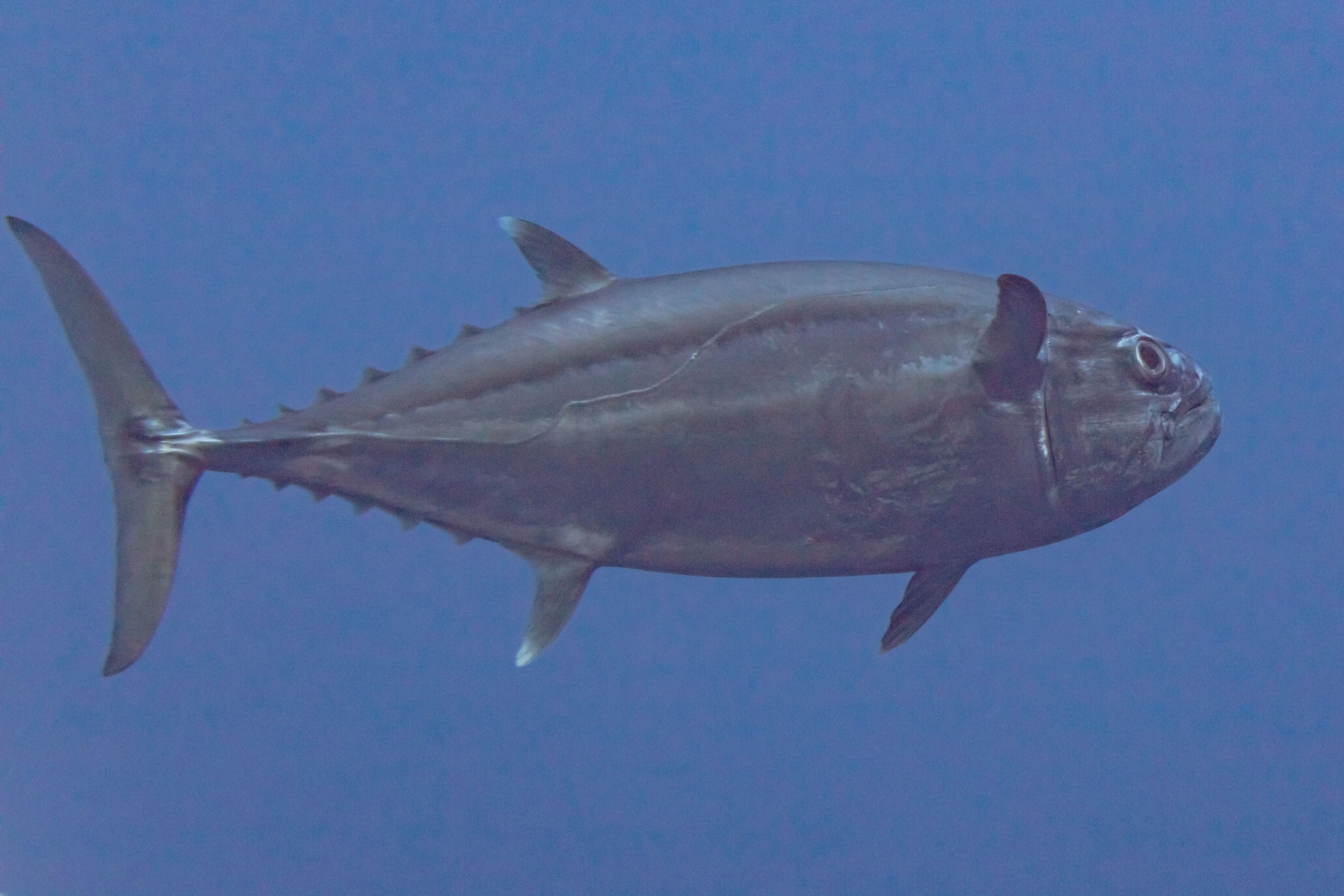
A dogtooth tuna (Gymnosarda unicolor) photographed in the Red Sea, Egypt, on 15 April 2023, as its file page states. The species is the photographer's identification. It illustrates the species and is not a sighting record. This page's frame crops the photograph.
Image credit: Diego Delso · CC BY-SA 4.0 · Wikimedia Commons, own work of the photographer (delso.photo), cropped by this page
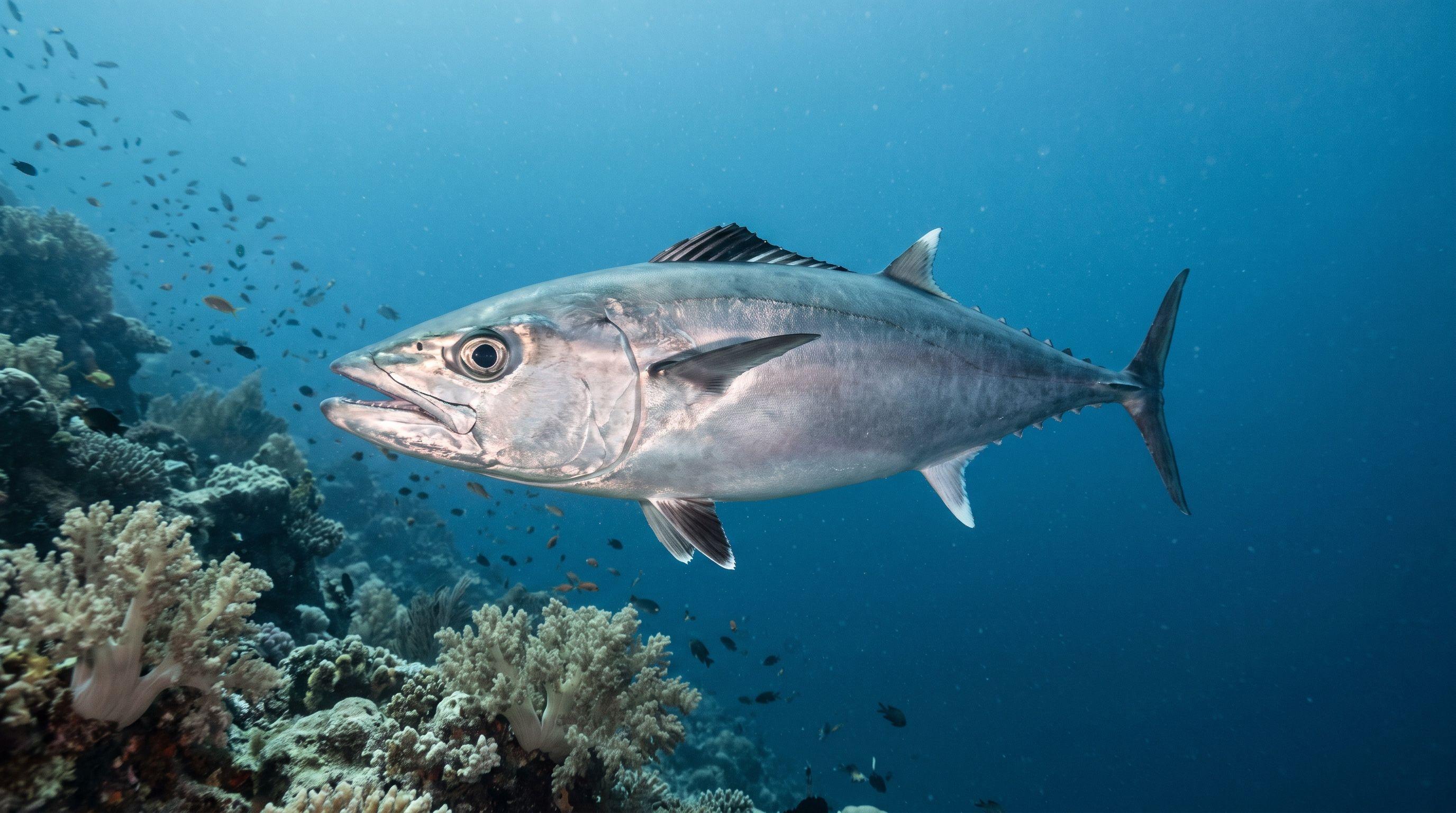 AI-generated
 illustration
Image credit: AI-generated illustration · Diveity