Dwarf Minke Whale
 AI-generated
Image credit: AI-generated illustration · License unspecified · Source unspecified
Balaenoptera acutorostrata subsp.
About Dwarf Minke Whale.
The Dwarf Minke Whale (Balaenoptera acutorostrata subsp.) is a captivating and relatively undescribed dwarf form of the minke whale, belonging to the family Balaenopteridae. These magnificent whales are renowned for their exceptionally curious and prolonged in-water encounters with divers, particularly along Australia's northern Great Barrier Reef.
Each austral winter, typically from June to September, Dwarf Minke Whales undertake a predictable migration to the warmer, tropical waters of the Great Barrier Reef, offering a unique opportunity for divers to interact with these gentle giants. While the broader species *Balaenoptera acutorostrata* is listed as Least Concern by the IUCN, the Dwarf Minke Whale subspecies itself is classified as Data Deficient. This specific conservation status reflects the insufficient population estimates and the challenges in distinguishing this subspecies from other minke whales during surveys.
As baleen whales, they are filter feeders, primarily consuming krill and small schooling fish, which they filter from the water using comb-like plates in their mouths instead of teeth.
Identification
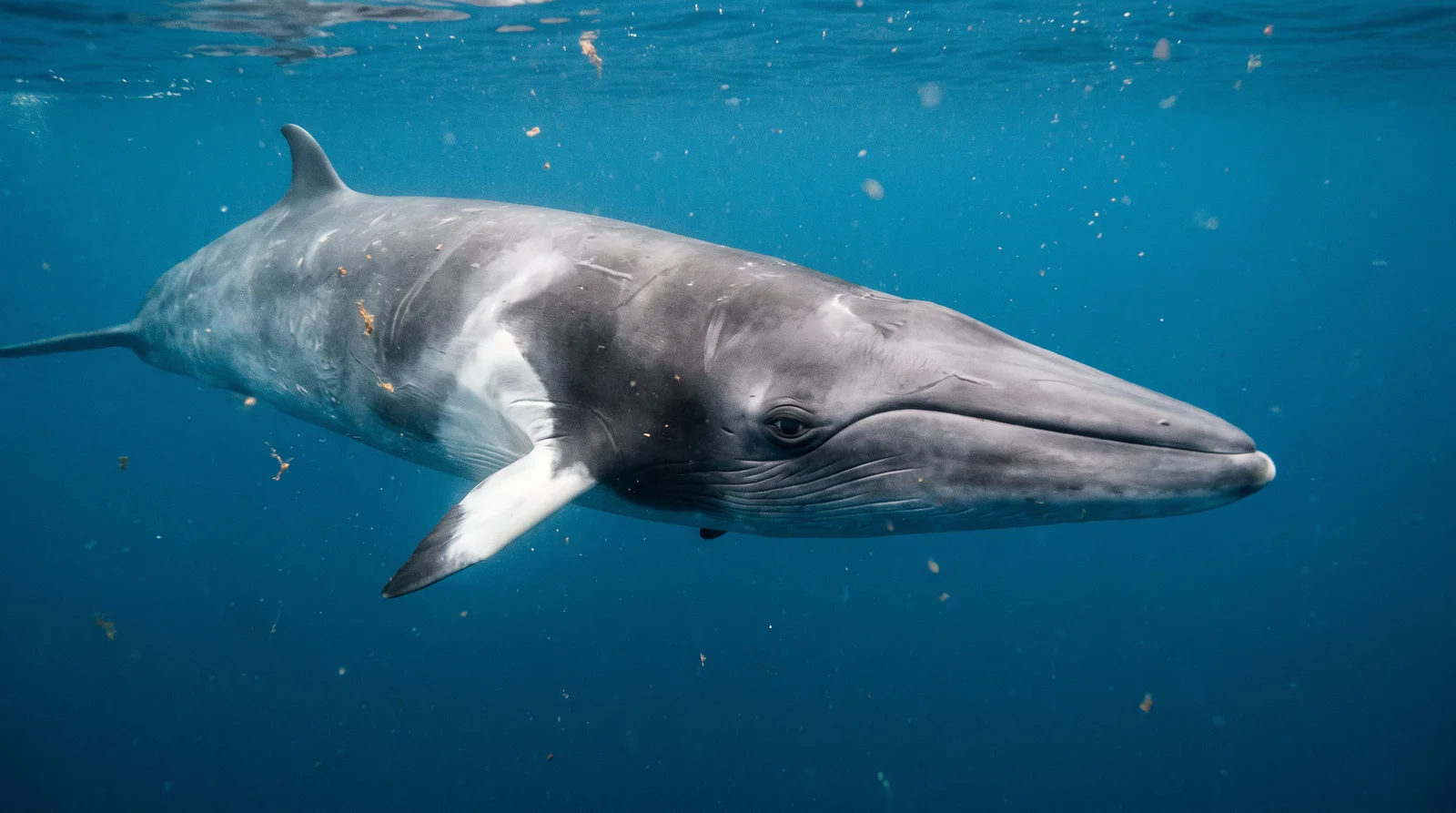
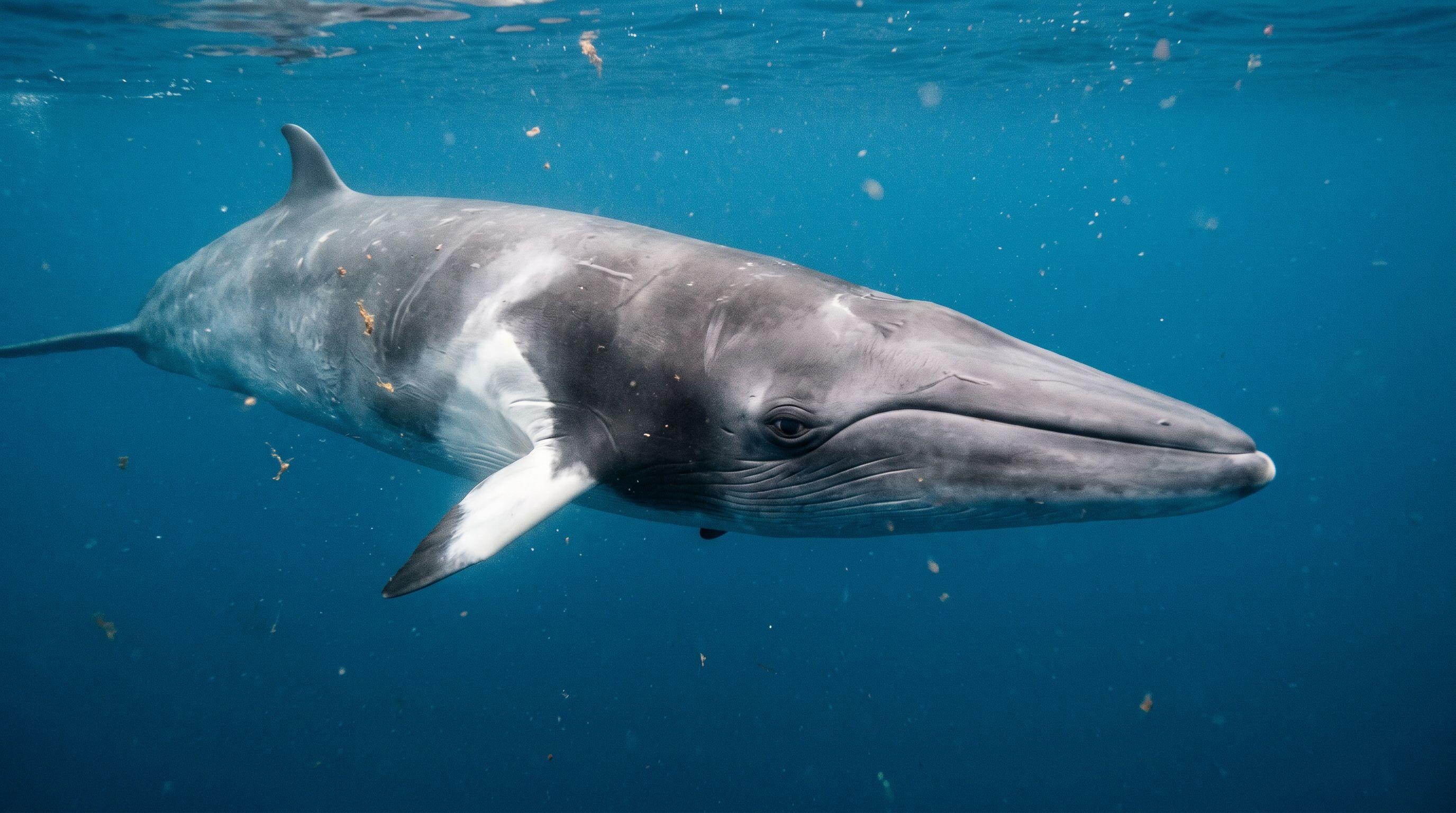
Dwarf Minke Whales are among the smallest baleen whales, reaching a maximum size of approximately 7.8 m (26 ft). Their streamlined bodies are typically dark grey to black on the dorsal side, contrasting with a white belly. They possess a distinctively pointed, triangular rostrum (snout).
Their coloration is considered the most complex of any baleen whale, featuring several key identification markers:
- A prominent dark band of colour extends across the neck, between the mouth and the flipper, continuing as a dark throat patch that reaches well down onto the throat.
- The flippers are dark at the tip but uniquely white at the base, with this white coloration extending as a distinctive white shoulder patch around much of the flipper. This white shoulder/flipper patch is a crucial identifying feature.
- A light grey, roughly triangular thorax patch is visible, extending up each side of the animal from just above the white shoulder patch and flipper.
- Individual whales often exhibit unique white and grey markings on their sides, akin to human fingerprints, which are used for photo-identification by researchers.
- Their dorsal fin is fairly tall and sickle-shaped, positioned about two-thirds down their back.
- Unlike some other whale species, Dwarf Minke Whales typically do not raise their flukes out of the water when diving.
For divers, their highly inquisitive nature is a significant behavioral identifier. They frequently approach boats and divers, sometimes for extended periods, displaying behaviors such as lateral rolls, belly presentations, and bubble releases.
While sightings are rare or occasional, Dwarf Minke Whales have been observed at dive sites including Steve's Bommie, Lighthouse Bommie, Challenger Bay, and Blue Wonder.
Where it lives.
The Dwarf Minke Whale (Balaenoptera acutorostrata subsp.) is a highly migratory baleen whale primarily found throughout the Southern Hemisphere. This intriguing subspecies inhabits a broad range of marine environments, from the nutrient-rich polar and sub-Antarctic waters to the warmer tropical and temperate zones of the South Atlantic, South Pacific, and Indian Oceans.
Their distribution spans approximately 7°S to 65°S, with seasonal movements dictating their presence in different regions. During the austral summer (December to March), Dwarf Minke Whales are often observed in higher latitudes, including sub-Antarctic waters between 53°S and 62°S, where they engage in feeding. As winter approaches (March to October), they undertake extensive migrations to warmer, lower latitudes (typically 7°S to 35°S), believed to be for mating and calving.
Key aggregation areas during the austral winter include the northern Great Barrier Reef off Australia, particularly around the Ribbon Reefs, where they are frequently encountered by divers between March and October, with peak sightings in June and July. Other notable regions where they are regularly reported include the coasts of South Africa and South America.
Dwarf Minke Whales are adaptable, utilizing both open oceanic waters and more coastal or inshore habitats. While some studies suggest a preference for coastal waters in certain areas, they have also been documented in deep oceanic environments and over continental shelves. They are generally considered shallow divers, typically remaining within the upper 100–200 m of the water column. Observations indicate they commonly swim at depths of 20–40 m, though they can be found in waters ranging from 4 m over continental shelves to potentially 140 m or deeper.
As filter feeders, Dwarf Minke Whales play a vital role in their ecosystems, preying on a variety of small schooling fish, plankton, and crustaceans such as krill and myctophid fish. They are often found in areas where these prey items are abundant, sometimes associating with seabirds that are also feeding on concentrated schools of fish. While they do not exhibit a specific substrate preference, their presence in coastal areas, such as the outer reef waters of the Great Barrier Reef (e.g., Steve's Bommie, Lighthouse Bommie, Challenger Bay, Blue Wonder), indicates an association with diverse seafloor environments that support their prey base. They prefer a wide range of water temperatures, from cooler feeding grounds to warmer breeding areas.
How it behaves.
The Dwarf Minke Whale (Balaenoptera acutorostrata subsp.) is a fascinating and often curious baleen whale, particularly known for its engaging interactions with divers and snorkelers in specific aggregation areas.
Underwater Encounter Behavior
Dwarf Minke Whales are renowned for their inquisitive nature, frequently approaching divers and snorkelers. These interactions are typically initiated by the whales themselves, with a strict protocol of passive observation in place for human participants. Divers are encouraged to remain still and calm, often holding onto a line, allowing the whale to determine the closeness and duration of the encounter.
Encounters can range from a few minutes to extended periods, with whales sometimes circling and investigating individuals. While close approaches (within 3 meters) occur occasionally, very close approaches (1 meter or less) are rare but have been observed in longer interactions where the whales' confidence appears to increase. These whales exhibit a strong exploratory drive, and their inquisitive behavior is considered an important part of their ecology, potentially related to finding mates, food, or avoiding predators. Behaviors such as belly presentations and bubble releases have been documented, particularly in larger groups, suggesting social and investigative functions. Despite their large size (up to 7.8m / 26ft), they are not aggressive towards humans; observed behaviors like bubble blasts or jaw gapes are rarely seen and are not associated with aggression.
Feeding Habits
Dwarf Minke Whales are filter feeders, primarily consuming small schooling fish, krill, and plankton. They employ a feeding technique known as "side-lunging," where they gulp large amounts of water and prey, filtering it through their baleen plates. In the Southern Hemisphere, their diet specifically includes krill and myctophid fish. While they feed in high latitudes during the summer, they are not typically observed feeding in the northern Great Barrier Reef, suggesting they subsist on energy reserves during their migration to warmer waters.
Social Structure
Dwarf Minke Whales are generally considered a predominantly solitary oceanic species. However, they can be sighted individually, in pairs, or in small groups of two to three. Larger aggregations, sometimes up to 400 animals, have been observed in feeding areas closer to the poles where food is concentrated. During human-whale encounters, they sometimes congregate in larger groups. There is evidence to suggest a complex social and population structure, though less is known about the dwarf minke whale in the Southern Hemisphere compared to their Northern Hemisphere counterparts. They may also exhibit segregation by age and sex, with females potentially staying closer to shore and males further out to sea.
Notable Seasonal Patterns Relevant to Divers
Dwarf Minke Whales undertake long-distance seasonal migrations. They are found in sub-Antarctic and Antarctic waters, particularly between December and March, where they engage in feeding. They then migrate to warmer, lower latitude waters, such as the northern Great Barrier Reef, during the austral winter months. This migration to tropical and subtropical waters is presumed to be for mating and calving, though direct observation of these activities is rare. Small calves have been recorded in Australian waters from May to July.
For divers, the most significant seasonal pattern is their aggregation in the northern Great Barrier Reef. Dwarf Minke Whales are sighted in this region from March to October, with the peak season for encounters occurring in June and July. During this peak, approximately 90% of sightings occur, particularly around the Ribbon Reefs, including dive sites like Lighthouse Bommie and Challenger Bay. Water temperatures in these areas during the season can be around 24°C. Dive operators in this region offer specialized expeditions during these months, providing unique opportunities for certified divers to experience passive interactions with these curious whales.
Where to see it.
Evidence for australia · No dive sites
General range is not evidence of occurrence at a specific dive site.
No documented dive-site associations in this destination yet.
Gallery.
 AI-generated
 illustration
Image credit: AI-generated illustration · License unspecified · Source unspecified