Eagle Ray (assorted)
 AI-generated
Image credit: AI-generated illustration · License unspecified · Source unspecified
Aetobatidae and Myliobatidae spp.
About Eagle Ray (assorted).
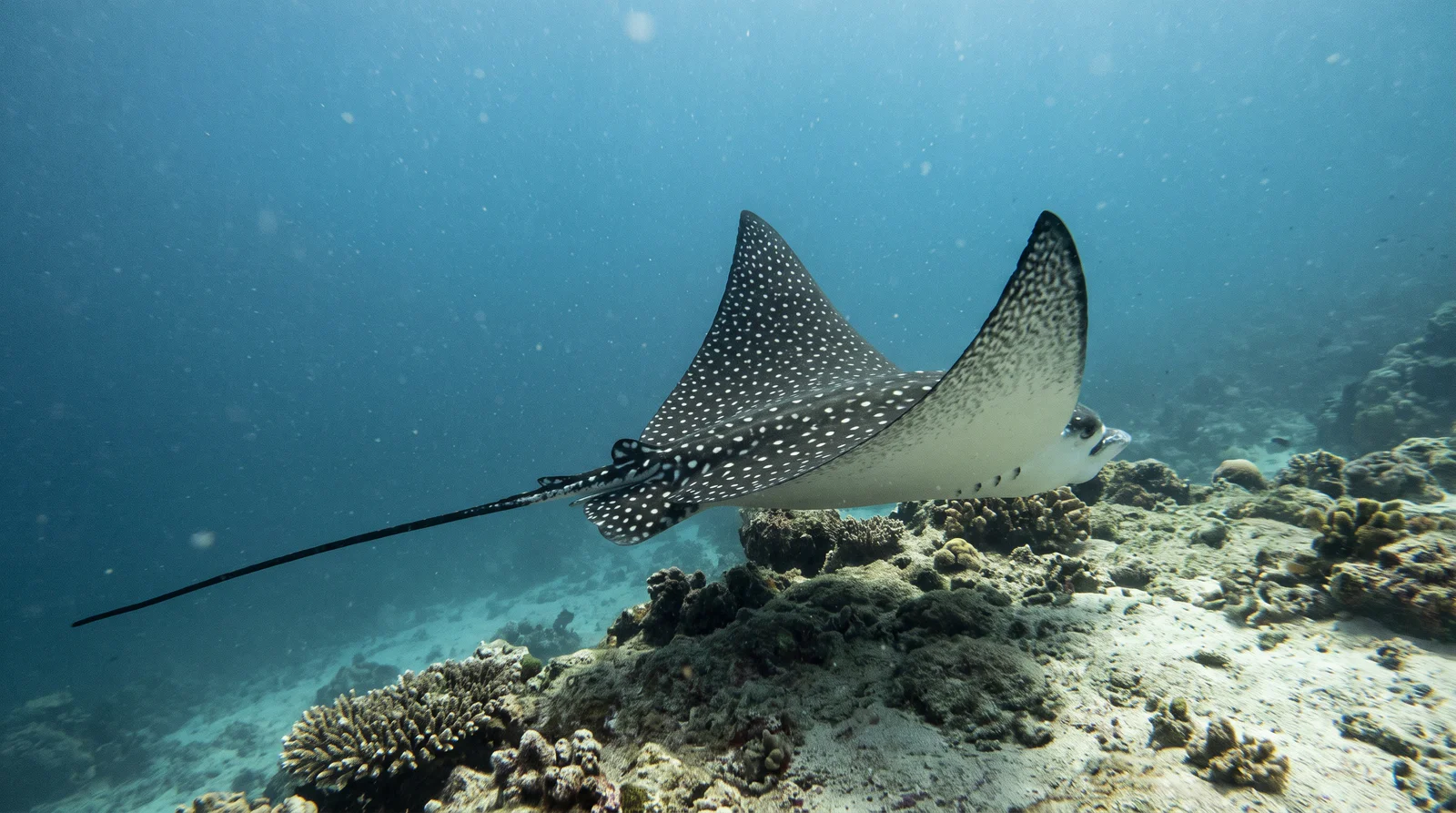
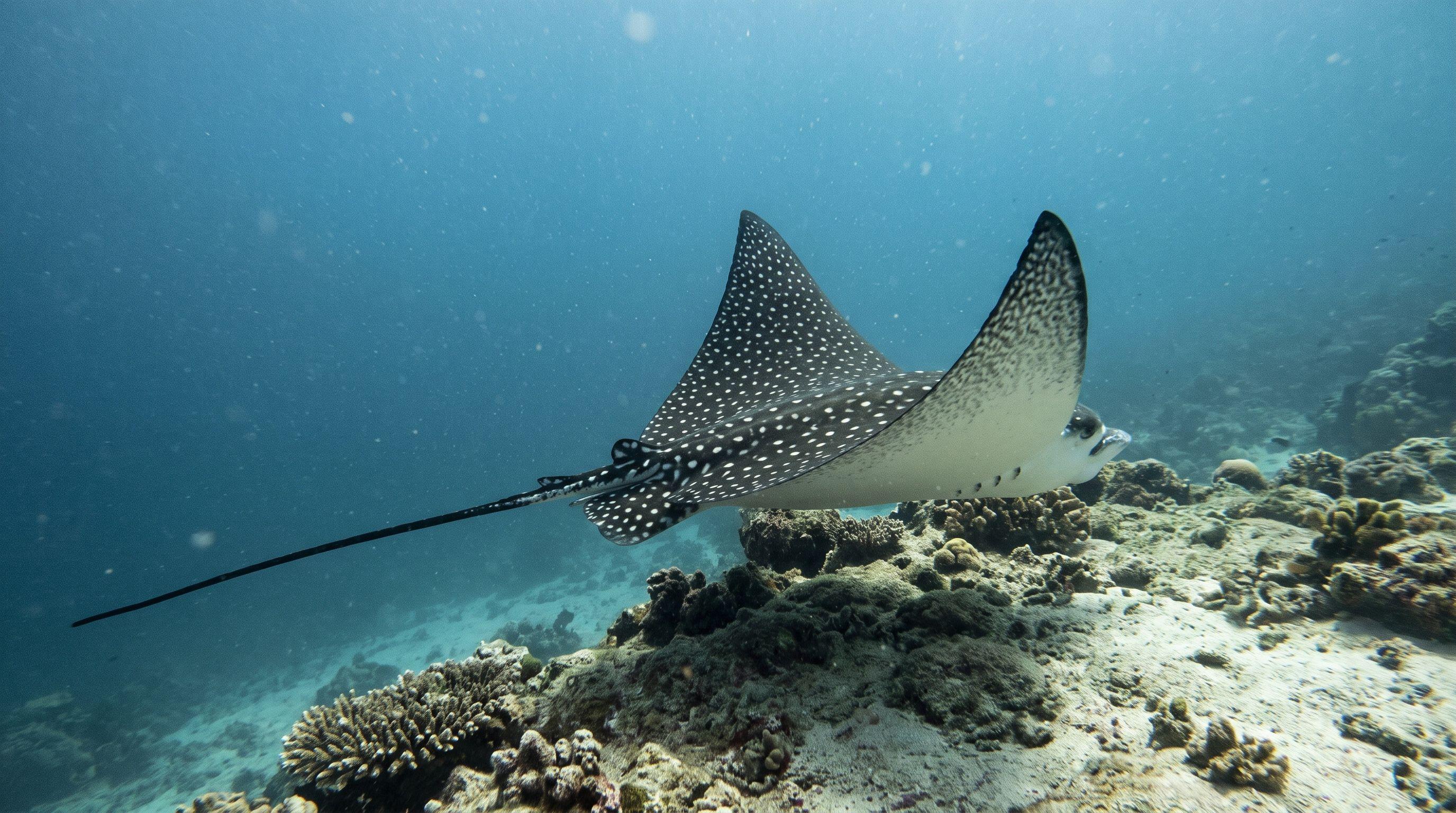
"Eagle Ray (assorted)" is a group entry for eagle rays recorded without a confirmed species. It covers the pelagic eagle rays of the family Aetobatidae (genus Aetobatus) and the eagle rays of the family Myliobatidae (including Aetomylaeus and Myliobatis). Divers usually recognise them by a broad, wing-like disc, a narrow head that projects forward and sits raised above the disc, and a long, whip-like tail that is much longer than the body.
The taxonomy of this group has changed in recent years. Aetobatus was formerly placed in Myliobatidae, and the World Register of Marine Species (WoRMS) now accepts it in its own family, Aetobatidae. The white-spotted eagle ray of the Indo-West Pacific is now treated as a separate species, Aetobatus ocellatus: FishBase notes that Indo-Pacific records once attributed to the spotted eagle ray (Aetobatus narinari) refer to A. ocellatus, while A. narinari is listed for the western and probably the eastern Atlantic. Use this group entry when a source simply says "eagle ray" and the species cannot be confirmed.
Identification
- Disc: Rhomboidal and wing-like, with a broad, thick trunk; adults of the larger species reach at least 3 m across.
- Head: Narrow, raised above the disc and projecting forward, with a broad mouth on the underside.
- Tail: Long and whip-like, usually with one or more stinging spines behind the small dorsal fin; most Aetomylaeus species lack a sting.
- Pattern: The white-spotted eagle ray shows pale spots or rings on a dark back; colour and pattern vary among the other species.
Not a Manta or Devil Ray
Manta and devil rays (family Mobulidae) are also large, wing-shaped rays, but they have paired cephalic lobes beside a wide mouth at the front of the head, and they filter zooplankton from the water. Eagle rays have no cephalic lobes, carry the mouth underneath the head and feed mainly on animals living on or in the seabed.
Conservation status varies by species. As verified examples, the IUCN Red List assesses both the ocellated eagle ray (A. ocellatus, assessed 2023) and the spotted eagle ray (A. narinari, assessed 2020) as Endangered.
Where it lives.
Eagle rays as a group are found in many tropical and warmer temperate seas. The species divers meet most often in the Indo-West Pacific, the ocellated eagle ray (Aetobatus ocellatus), ranges from East Africa and the Red Sea to the Hawaiian Islands and French Polynesia, while the spotted eagle ray (A. narinari) is recorded from the Atlantic. Records from the eastern Pacific are attributed by FishBase to yet another species, A. laticeps.
Typical Settings
- Coastal waters: FishBase describes Aetobatus species as benthopelagic fish of coastal habitats that also enter brackish water and estuaries.
- Reef edges and sand: Divers commonly see them along reef edges and over nearby sandy bottoms, swimming either near the surface or close to the seabed.
- Depth: FishBase gives 1–100 m for A. ocellatus (usually 20–25 m) and 1–80 m for A. narinari.
- Feeding grounds: Soft bottoms where buried molluscs, crustaceans and worms can be found.
When and Where to Look
Eagle rays are mobile and can cover large areas, so sightings are never guaranteed. Scan both the open water off a reef edge and the sand below it. A ray seen at a distance can often be identified later from photographs of the head shape and the pattern on its back, so a quick record shot is worthwhile even if the animal does not come close.
Because the largest individuals exceed 3 m across, an eagle ray seen in poor visibility can be mistaken for a manta. Check for the narrow head projecting forward and the long, whip-like tail, both of which mantas lack.
How it behaves.
Eagle rays are active swimmers that appear to fly through the water with slow beats of their wide pectoral fins. They may be seen alone or in groups, and divers usually meet them as they pass along a reef edge or over sand rather than resting in one place.
Feeding
FishBase records the ocellated eagle ray feeding mainly on hard-shelled bottom invertebrates such as hermit crabs, whelks, oysters and clams, as well as other crustaceans, worms, octopuses and fishes. The spotted eagle ray eats polychaete worms, bivalves, snails, cephalopods, shrimps and small fishes. The underside of the mouth carries large patches of sensory pores, and a feeding ray may be seen working the sand with its head, raising puffs of sediment as it digs out prey.
Reproduction
Eagle rays give birth to live young. In A. ocellatus the embryos first feed on yolk and are later nourished partly by uterine fluid. Litters usually number four pups or fewer, occasionally up to ten, and pups are born at about 18–50 cm disc width. FishBase gives maturity at about 100–130 cm disc width for males and 150–160 cm for females.
Underwater Encounter Behavior
- Wariness: Eagle rays generally keep their distance and turn away from divers who swim straight at them.
- Passing encounters: Most sightings are brief passes, so be ready before the ray arrives rather than following it.
Diver Tips
- Stay calm and low: Hover near the reef edge and let the ray pass; chasing almost always ends the encounter.
- Respect the tail: The tail spines are a defence. Never touch or grab a ray, and keep clear of the tail.
- Photograph for identification: Pictures of the back pattern and head shape help others confirm the species later.
- Protect the seabed: Keep good buoyancy and avoid stirring up sand near a feeding ray.
Where to see it.
Evidence for philippines · 2 dive sites
General range is not evidence of occurrence at a specific dive site.
Virgin Drop
Boracay
Documented site occurrence
Season not yet documented
Source reviewed on 2026-10-14 · Source: New Wave Divers Boracay (dive-site page) · Observation date not documented
Yapak
Boracay
Documented site occurrence
Season not yet documented
Source reviewed on 2026-10-14 · Source: New Wave Divers Boracay (dive-site page) · Observation date not documented
Gallery.
 AI-generated
AI-generated illustration
Image credit: AI-generated illustration · License unspecified · Source unspecified