Feather Star (assorted)
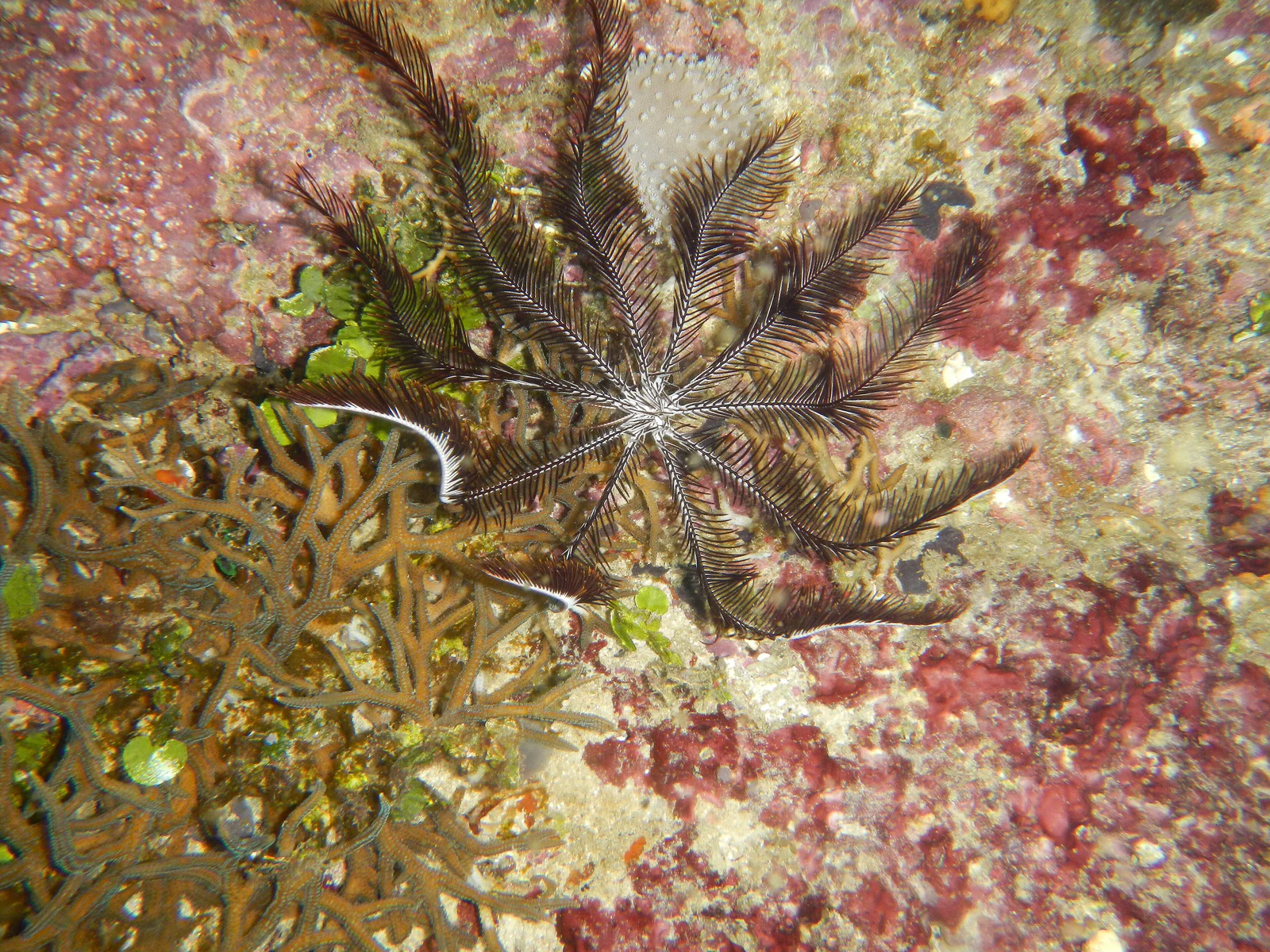
Comatulida spp. (feather stars)
About Feather Star (assorted).
Feather stars are crinoids of the order Comatulida: unstalked echinoderms whose feathery arms filter plankton on reefs in tropical and temperate seas. This group entry covers sightings where the species was not recorded. The World Register of Marine Species (WoRMS) lists Comatulida (Clark, 1908) as an accepted order in the class Crinoidea, phylum Echinodermata.
Wikipedia says most feather stars have no stalk as adults, although the larvae settle on a stalk that breaks away at metamorphosis. It describes a cup-shaped body with the mouth facing upwards, five often divided rays with feathery side branches called pinnules, and a ring of claw-like cirri underneath that grip the substrate. It says most begin with 10 arms, that a broken arm is replaced by at least two, and its crinoid article says the arms of feather stars may branch until there are up to 200 branches. Wikipedia also says a 2011 study proposed placing the stalked sea lilies of Bourgueticrinina inside Comatulida as a suborder; this entry is for the free-living feather stars.
A conservation status is not given here, because this entry covers a whole order.
Where it lives.
Wikipedia says comatulids live on the seabed and on reefs in tropical and temperate waters, and that many live in crevices, under corals or inside sponges, with only some of their arms showing. Its crinoid article says crinoids as a whole live from shallow water to depths over 9,000 m, that stalked crinoids gradually retreated to deeper waters, and that most modern crinoids are the free-moving feather stars.
Where Divers Find Them
In Lombok, Bottles-Up Diving describes the slope at Gili Renggit Timur, on the east side of Gili Renggit, as covered in colourful soft corals and feather stars. A 2001 trip report on Taucher.net says the seaward side of Shark Point off Senggigi has a great many feather stars in many colours. Neither source says which species, how often they are seen or in which months.
How it behaves.
Wikipedia says comatulids are suspension feeders: they hold their arms out to the current, and tube feet on the pinnules catch plankton and pass it along mucus-lined grooves to the mouth. It says some come out at night and perch on raised points to feed, that many can crawl on their arms and many can swim with them, but that most are largely sedentary. It says they are about 80% calcium carbonate and unappetising to most predators, that some fish pull off single arms, which regrow, and that many other invertebrates live as commensals among their arms. Its crinoid article says crinoids swim in short bursts of up to half a minute, and that in the comatulid Florometra serratissima swimming was seen only after mechanical stimulation or as an escape from a predator.
Underwater Encounter Behavior
The sources cited here do not describe how feather stars react to divers.
Where to see it.
Evidence from all destinations · 4 dive sites
General range is not evidence of occurrence at a specific dive site.
Angel's Window
Lembeh Strait
Documented site occurrence
Season not yet documented
Source reviewed on 2026-11-20 · Source: Dive The World · Observation date not documented
Gili Renggit East
Lombok
Documented site occurrence
Season not yet documented
Source reviewed on 2026-11-19 · Source: Bottles-Up Diving · Observation date not documented
Mari Mabuk
Wakatobi
Documented site occurrence
Season not yet documented
Source reviewed on 2026-11-25 · Source: Wakatobi Dive Resort · Observation date not documented
Shark Point (Senggigi)
Lombok
Documented site occurrence
Season not yet documented
Source reviewed on 2026-11-19 · Source: Taucher.net · Observation date not documented
Gallery.
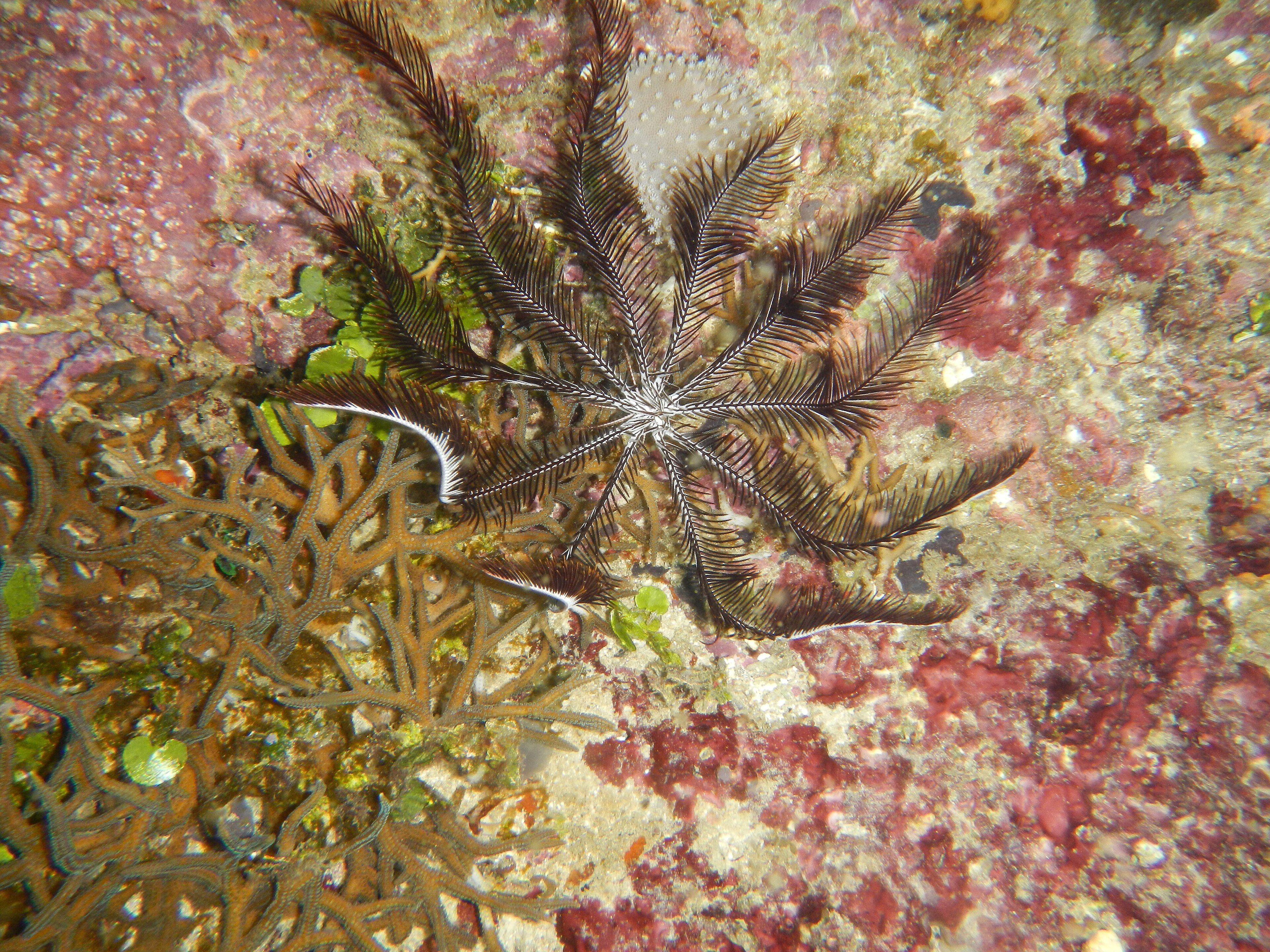
A feather star (order Comatulida), identified only to order, on a reef at Raja Ampat, West Papua, Indonesia; the file is dated 26 October 2013. It stands for the feather stars as a group, and this photograph is not from Lombok. This page's frame crops the photograph.
Image credit: pete Weis · CC BY 2.0 · Wikimedia Commons (from Flickr), cropped by this page