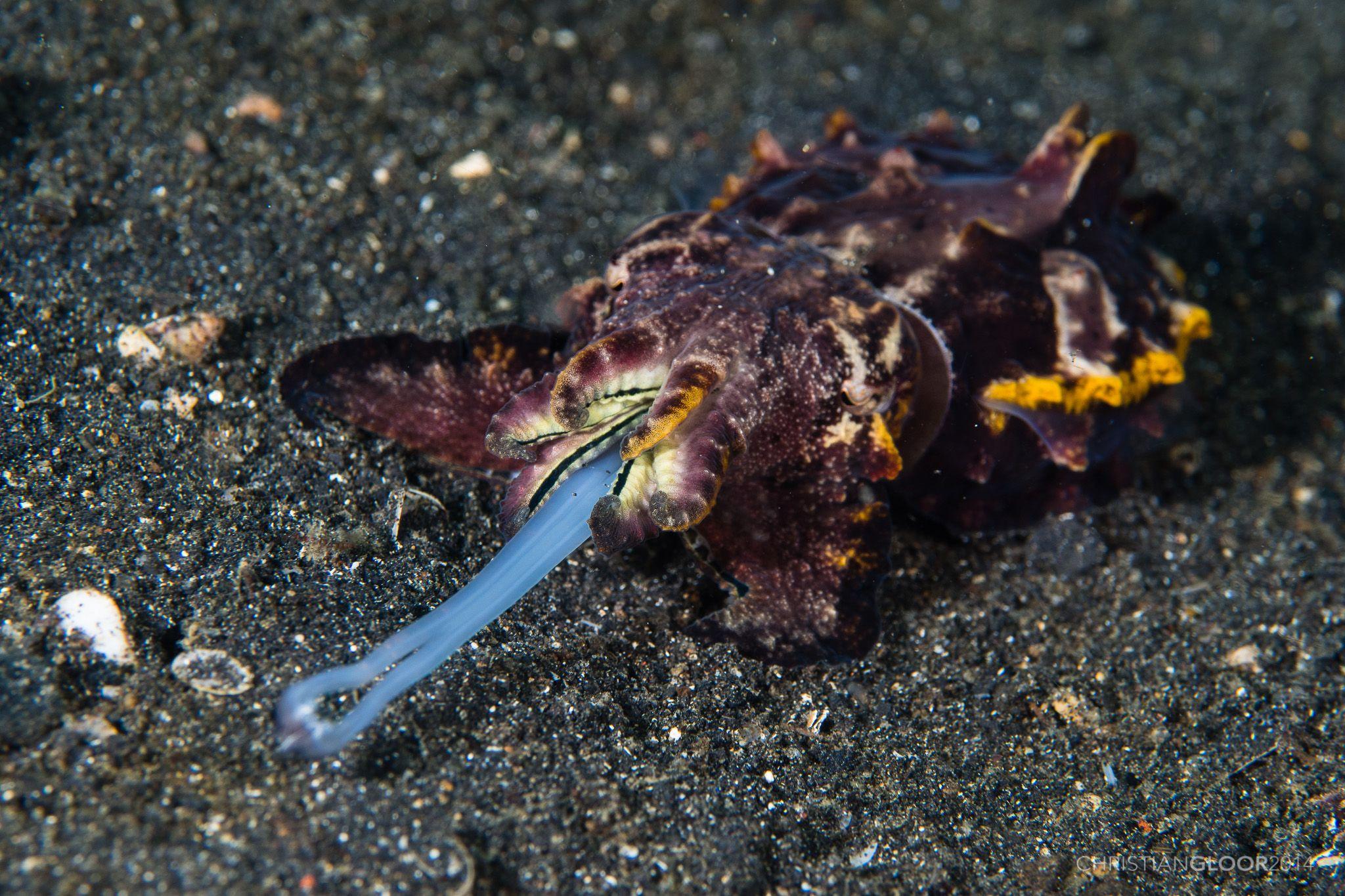
Flamboyant Cuttlefish
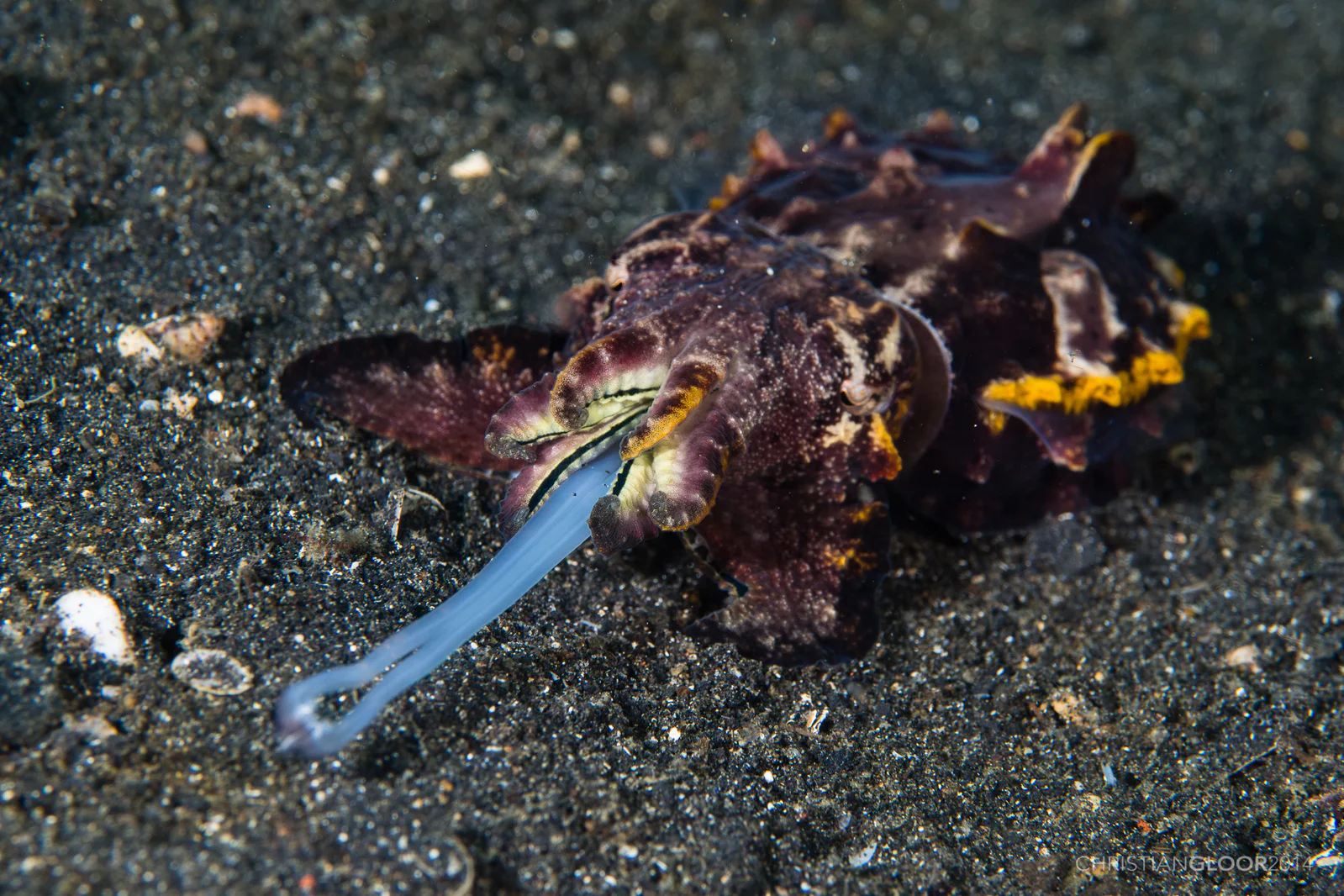
Metasepia pfefferi
About Flamboyant Cuttlefish.
The Flamboyant Cuttlefish (Metasepia pfefferi) is a captivating cephalopod belonging to the family Sepiidae, renowned for its extraordinary color displays and unique locomotion. Despite its small size, this species is a highlight for many divers in the Indo-Pacific, often sought after for its mesmerizing patterns and behaviors. It is currently listed as Data Deficient in terms of conservation status, highlighting the need for further research into its populations and ecological role.
Unlike most other cuttlefish species that primarily swim, the Flamboyant Cuttlefish is predominantly a bottom-dweller, preferring to "walk" across the seafloor using its specialized lower arms and ventral fins. This diurnal species is an active hunter, preying on small crustaceans and fish during the day. Found in tropical waters, typically around 25°C, it inhabits sandy and muddy substrates, often in areas with coral rubble, at depths of 3–86 meters. This cuttlefish is also notable for being one of the few known toxic cephalopods; its flesh contains a potent toxin comparable in lethality to that of the blue-ringed octopus. When threatened, instead of fleeing, it boldly flashes its vibrant warning colors.
Divers may encounter this fascinating creature at various dive sites, including Siaba Besar (rare), Secret Bay (occasional), Kalipayan (rare), and Sabang Wrecks (rare). It is also frequently observed in the Lembeh Strait.
Identification
- Size: The Flamboyant Cuttlefish is a relatively small species, with females reaching a maximum mantle length of up to 8 cm (3 in), while males are typically slightly smaller, around 4-6 cm.
- Coloration and Pattern: While often camouflaged in dull purple-brown, mottled grey, or dark brown to blend with its sandy or muddy environment, its most striking feature is its ability to rapidly change color and display a dazzling array of hues. When agitated, threatened, or during courtship, it exhibits pulsating patterns of bright purple, yellow, red, pink, orange, maroon, black, and white. These vibrant flashes serve as a clear warning to potential predators of its toxicity. Younger individuals often display more intense coloration.
- Body Shape and Texture: It possesses a broad, oval, and dorsoventrally flattened mantle, often adorned with flap-like papillae that contribute to its camouflaged appearance. The cuttlefish can also change its skin texture and shape to further blend into its surroundings. It has eight broad arms equipped with suckers and two specialized, transparent feeding tentacles that can be rapidly extended to capture prey.
- Locomotion: A key identification feature is its distinctive "walking" gait. Unlike other cuttlefish that rely heavily on jet propulsion, the Flamboyant Cuttlefish uses its lower arms and undulating fins to amble across the seafloor. Its small, diamond-shaped cuttlebone limits its ability to float for extended periods, reinforcing its preference for a benthic lifestyle.
Where it lives.
The Flamboyant Cuttlefish (Metasepia pfefferi) inhabits the warm, tropical waters of the Indo-Pacific region, making it a sought-after species for divers exploring this vibrant marine biodiversity hotspot. Its geographic range extends across northern Australia, western Australia, southern New Guinea, and numerous islands throughout Indonesia, the Philippines, and Malaysia.
This captivating cephalopod is primarily a bottom-dweller, preferring environments characterized by soft substrates. Divers will typically encounter Metasepia pfefferi on sandy and muddy bottoms, often in what are known as "muck" dive sites, which are rich in unique macrofauna. While commonly found in these silty areas, they can also be observed in coastal regions and sometimes associated with reef rubble zones.
The Flamboyant Cuttlefish is found at depths ranging from shallow waters of 3 meters down to approximately 86 meters. Unlike many other cuttlefish species, Metasepia pfefferi rarely swims, instead utilizing its lower arms and specialized flaps to "walk" across the seafloor. This unique mode of locomotion makes them a fascinating subject for underwater photographers and observers at dive sites such as Siaba Besar, Secret Bay, Kalipayan, and Sabang Wrecks.
How it behaves.
The Flamboyant Cuttlefish (Metasepia pfefferi) is a captivating cephalopod renowned for its striking color displays and unique locomotion. Reaching a maximum mantle size of 8 cm (3 in), this small species is a highlight for divers in the Indo-Pacific, particularly in areas with sandy or muddy substrates, such as the dive sites of Siaba Besar, Secret Bay, Kalipayan, and Sabang Wrecks.
Underwater Encounter Behavior
Unlike most other cuttlefish that primarily swim, the Flamboyant Cuttlefish is a benthic species that predominantly "walks" along the seafloor using its specialized arms and ventral mantle flaps. This distinctive ambling gait allows it to slowly creep across the bottom, making it a fascinating subject for divers and underwater photographers.
While often observed in vibrant hues, the Flamboyant Cuttlefish typically maintains a camouflaged, mottled brown or grey appearance to blend with its environment. However, when threatened by a predator or approached too closely by a diver, it rapidly transforms its coloration in a dazzling aposematic display. This involves flashing brilliant patterns of white, yellow, red, and dark brown, often accompanied by undulating waves of color and pulsing fins. This flamboyant show serves as a warning, signaling its highly toxic nature—its muscle tissue contains a toxin as lethal as that of the blue-ringed octopus, making it the only known venomous cuttlefish species. Divers should observe these creatures respectfully from a distance to avoid stressing them and provoking this defensive display. If agitated, it may also squirt a small cloud of ink to disorient a potential threat.
Feeding Habits
The Flamboyant Cuttlefish is a diurnal, carnivorous hunter, actively foraging during the day. It employs an ambush predation strategy, using its excellent camouflage to stalk unsuspecting prey. Its diet primarily consists of small crustaceans, such as crabs and shrimp, and small bony fish. When prey is detected, it rapidly extends two long, transparent feeding tentacles to capture its meal, which are then brought to its beak for consumption.
Social Structure and Reproduction
Flamboyant Cuttlefish are generally solitary, but interactions become more frequent during breeding periods. Mating involves an elaborate courtship ritual where the smaller male approaches a camouflaged female, performing flamboyant displays that include "waves" (rapid arm movements) and "kisses" (brief arm touches). Males may also compete aggressively for females, sometimes displaying flamboyant colors on one side of their body while showing aggression to a rival male on the other. Mating occurs face-to-face, with the male using a specialized hectocotylus arm to transfer spermatophores (sperm packets) into the female's buccal area. This process is often very quick, lasting only a few seconds.
After internal fertilization, the female lays her eggs individually, typically attaching them to the roofs of hidden crevices, under ledges, or even inside discarded coconut shells for protection. The eggs are initially white but become translucent as the embryos develop. There is no parental care; both males and females typically die shortly after spawning.
Notable Seasonal Patterns
Flamboyant Cuttlefish enter their breeding season for approximately six to eight weeks in the spring. During this time, divers may have a higher chance of observing courtship rituals, mating, and egg-laying behaviors. Their lifespan is relatively short, estimated to be between 18 and 24 months. While they can be found year-round in their tropical Indo-Pacific habitat, increased activity related to reproduction may make them more conspicuous at certain times.
Where to see it.
Evidence for philippines · 6 dive sites
General range is not evidence of occurrence at a specific dive site.
Boatyard
Puerto Galera
Site occurrence not yet documented
Season not yet documented
No dated observations available.
Kalipayan
Panglao
Site occurrence not yet documented
Season not yet documented
No dated observations available.
Masaplod North
Dauin
Site occurrence not yet documented
Season not yet documented
No dated observations available.
Paradise Beach
El Nido
Site occurrence not yet documented
Season not yet documented
No dated observations available.
Sabang Wrecks
Puerto Galera
Site occurrence not yet documented
Season not yet documented
No dated observations available.
Secret Bay
Anilao
Site occurrence not yet documented
Season not yet documented
No dated observations available.
Gallery.