Flamboyant Cuttlefish
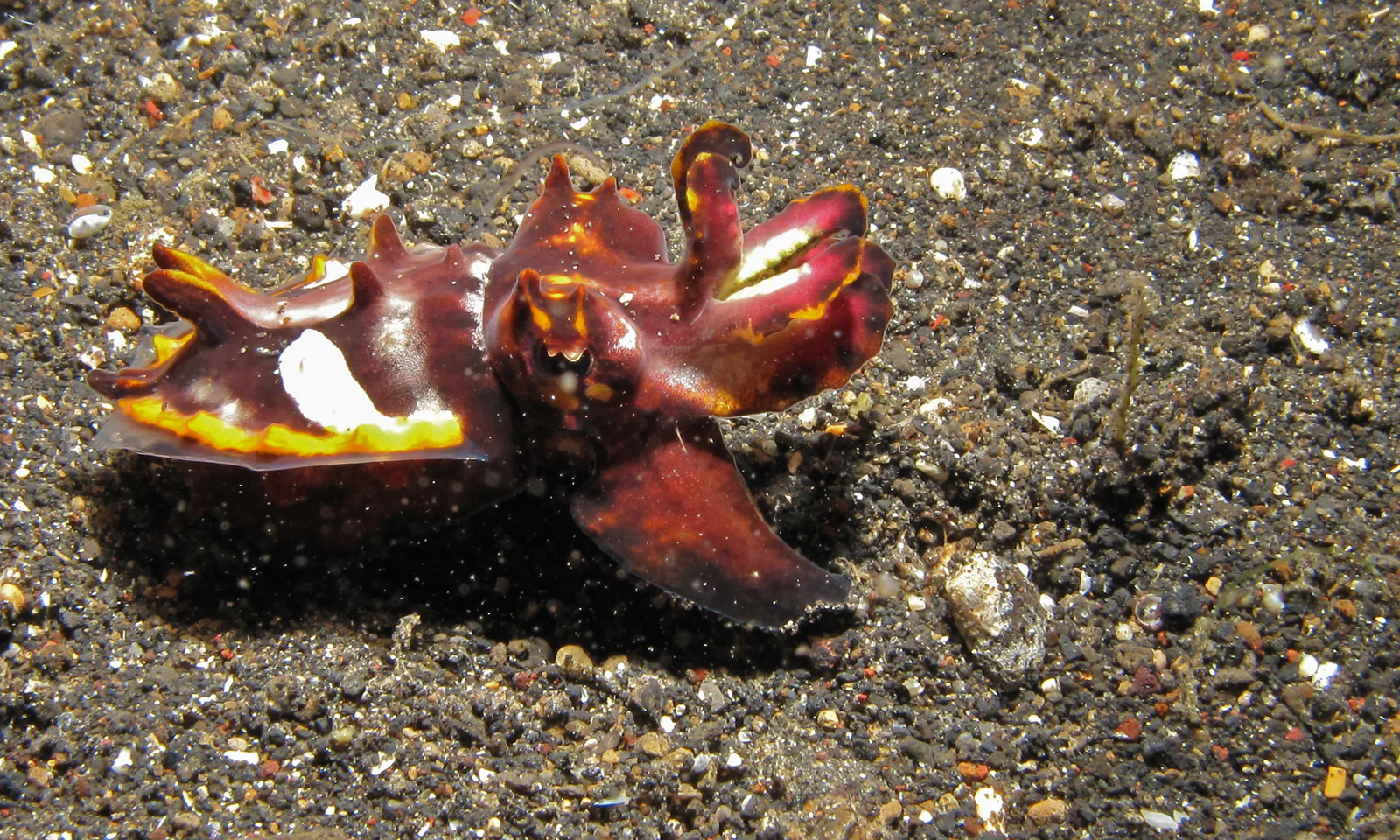
Image credit: Bernard Dupont · CC BY-SA 2.0 · Wikimedia Commons, cropped by this page
Metasepia pfefferi
About Flamboyant Cuttlefish.
The flamboyant cuttlefish is a small, broad-bodied cuttlefish of Indo-Pacific sand and mud, with a mantle of about 8 cm and a diamond-shaped cuttlebone.
Names and classification
WoRMS, drawing on MolluscaBase, accepts the name Ascarosepion pfefferi (Hoyle, 1885) in the family Sepiidae, and treats Metasepia pfefferi, the name under which the species is listed here, as a superseded combination. According to Wikipedia, the species was moved into Ascarosepion in 2023, which leaves the genus Metasepia obsolete, and its type specimen, a female, was collected in the Arafura Sea at a depth of 51 m during the Challenger expedition in 1874. The Western Australian Museum still lists it as Metasepia pfefferi, under the name Pfeffer's flamboyant cuttlefish.
Identification
The Western Australian Museum describes a squat, robust body patterned in chocolate brown and white, a prominent white bar on each side of the upper mantle, and a diamond-shaped cuttlebone that lacks a spine. Wikipedia gives a very broad, oval mantle, broad, blade-like arms with four rows of suckers, three pairs of large, flat, flap-like papillae on the upper mantle with more over the eyes, and a rhomboidal cuttlebone two-thirds to three-quarters as long as the mantle.
Size
The Western Australian Museum gives a mantle length of up to 8 cm. Wikipedia writes that most sources agree on 8 cm, while others give a maximum mantle length of 6 cm.
Conservation and people
The Western Australian Museum and Wikipedia, which cites Barratt and Allcock's assessment of 2012, both place it in the IUCN Red List category Data Deficient. The museum records no commercial impact. Wikipedia says that fisheries take no interest in the species because of its potential toxicity, and that public aquariums sometimes show animals from captive breeding.
Where it lives.
The flamboyant cuttlefish lives on shallow sand and mud from northern Australia and southern New Guinea to Indonesia, Malaysia and the Philippines.
Range
Wikipedia gives tropical Indo-Pacific waters off northern Australia and southern New Guinea and around numerous islands of the Philippines, Indonesia and Malaysia, with records from Sulawesi and the Maluku Islands and as far west as the Malaysian islands of Mabul and Sipadan. For Australia, the Western Australian Museum, citing Norman and Reid (2000), reports it from Shark Bay in Western Australia across to Mooloolaba in Queensland.
Depth and bottom
Wikipedia records it on sand and mud in shallow water at depths of 3 to 86 m. The Western Australian Museum describes shallow water over sand and mud as where it is often encountered.
How it behaves.
The flamboyant cuttlefish hunts fish and crustaceans by day, camouflages itself to stalk them and, when disturbed, shows warning colours as it walks.
Hunting and colour
The Western Australian Museum and Wikipedia both describe it hunting fish and crustaceans, and Wikipedia adds that it is active during the day. In the museum's account its camouflage may help it stalk prey or mimic distasteful animals. Wikipedia gives dark brown as its usual colour: an animal that is disturbed or attacked quickly changes to a pattern of black, dark brown and white with yellow patches around the mantle, arms and eyes, and its arm tips often show bright red.
Walking
Wikipedia writes that its small cuttlebone lets it float only for a short time, and that animals in the warning pattern walk along the sea floor on their lower arms while rhythmically waving the wide membranes of their arms. The display supposedly advertises poisonous flesh. Wikipedia reports a toxicology finding by Mark Norman of Museum Victoria that the muscle tissue is highly toxic, and preliminary results from Georgia Southern University and Utah State University–Uintah Basin that found only trace amounts of tetrodotoxin, too little to be toxic to vertebrates.
Eggs and young
The female lays her eggs one at a time in crevices or on ledges of coral, rock or wood, as both the Western Australian Museum and Wikipedia describe. In Wikipedia the eggs are white when laid and slowly turn translucent, and the hatchlings can produce the adults' camouflage patterns from the moment they emerge, without any care from their parents.
Where to see it.
Evidence for visayas · 10 dive sites
General range is not evidence of occurrence at a specific dive site.
Cars Wreck (Dauin)
Dauin
Documented site occurrence
Season not yet documented
Source reviewed on 2026-10-02 · Sources: Bongo Bongo Divers — undated named-site description; not a recent sighting record, Dauin Diving Center — undated named-site description; not a recent sighting record · Observation date not documented
Chocolate Island
Malapascua
Documented site occurrence
Season not yet documented
Source reviewed on 2026-09-28 · Sources: Evolution Diving Resort, Thresher Shark Divers · Observation date not documented
Kalipayan
Panglao
Site occurrence not yet documented
Season not yet documented
No dated observations available.
Lamanok
Anda
Documented site occurrence
Season not yet documented
Source reviewed on 2026-10-03 · Source: Nigel Marsh / Diveplanit · Observation date not documented
Lighthouse Reef
Malapascua
Documented site occurrence
Season not yet documented
Source reviewed on 2026-10-05 · Source: Little Mermaid Dive Resort (operator guide; sighting date unknown) · Observation date not documented
Masaplod North
Dauin
Site occurrence not yet documented
Season not yet documented
No dated observations available.
Sahara
Dauin
Documented site occurrence
Season not yet documented
Source reviewed on 2026-10-02 · Source: La Tortue Diving Center — Sahara Deep section; undated description, not a recent sighting record · Observation date not documented
San Miguel
Dauin
Documented site occurrence
Season not yet documented
Source reviewed on 2026-10-02 · Source: La Tortue Diving Center — undated named-site description; not a recent sighting record · Observation date not documented
Secret Corner
Dauin
Documented site occurrence
Season not yet documented
Source reviewed on 2026-09-28 · Sources: Dauin Diving Center, DivePhotoGuide / Daniel Geary · Observation date not documented
Tapilon Wreck
Malapascua
Documented site occurrence
Season not yet documented
Source reviewed on 2026-10-05 · Source: Thresher Shark Divers (operator guide; sighting date unknown) · Observation date not documented
Gallery.
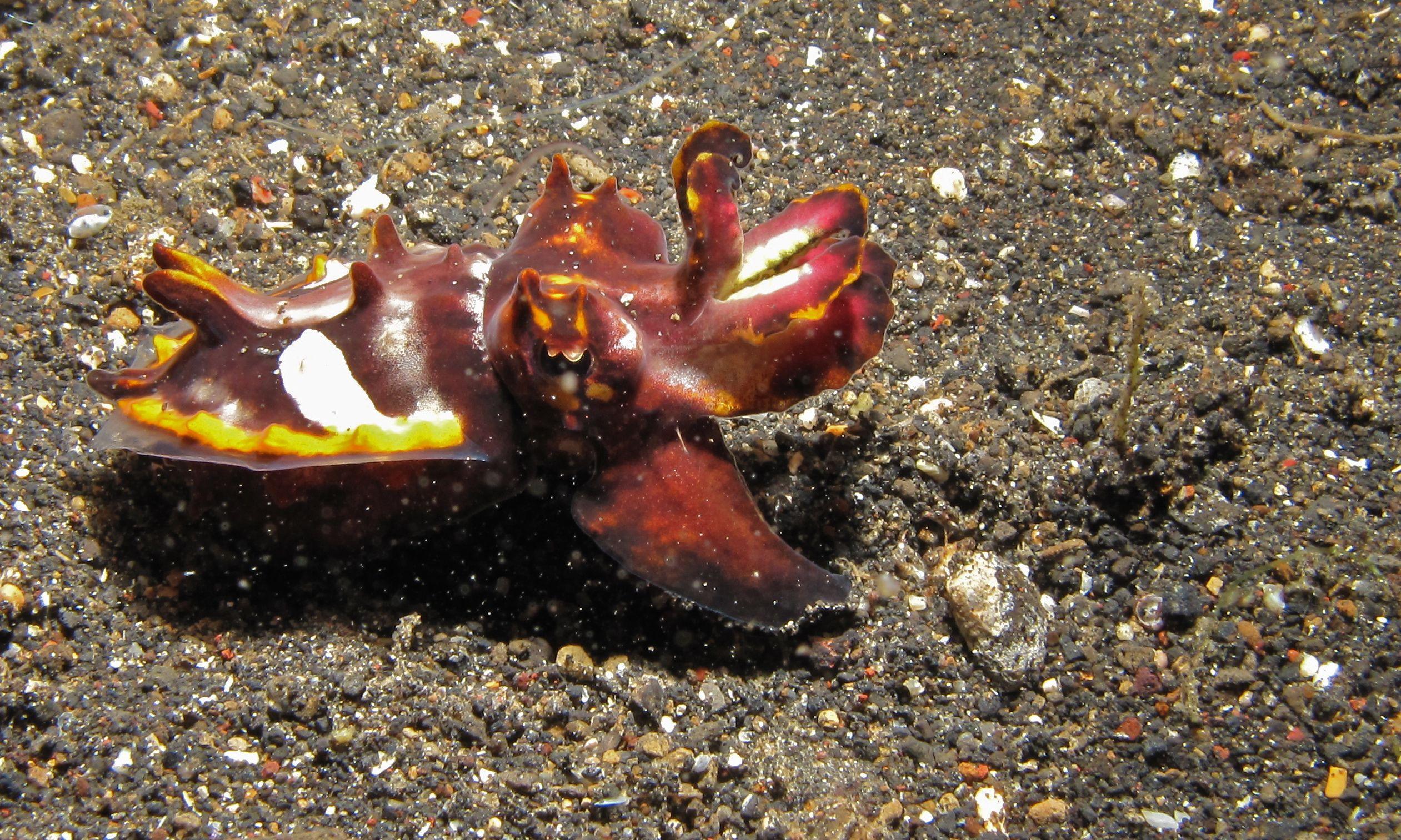
A flamboyant cuttlefish on dark sand. The photographer, Bernard Dupont, gives the place as Makawide in the Lembeh Strait and the date as 14 October 2009 on its Wikimedia Commons file page, which names it Ascarosepion pfefferi; this guide uses Metasepia pfefferi. It illustrates the species; it is not a sighting record for Makawide or any other dive site in this guide. This page's frame crops the photograph.
Image credit: Bernard Dupont · CC BY-SA 2.0 · Wikimedia Commons, cropped by this page
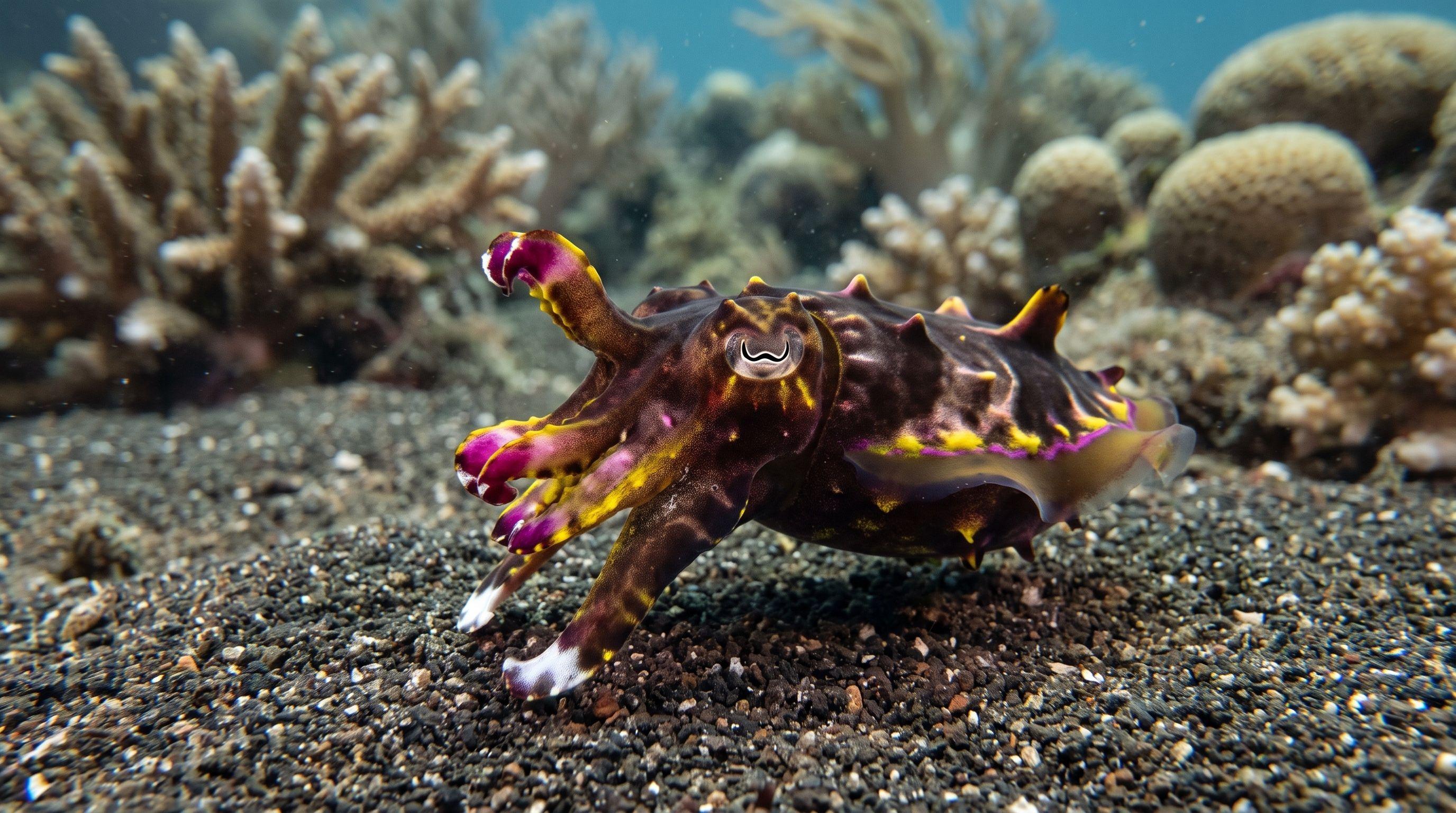 AI-generated
 illustration
Image credit: AI-generated illustration · Diveity