Flathead (assorted)
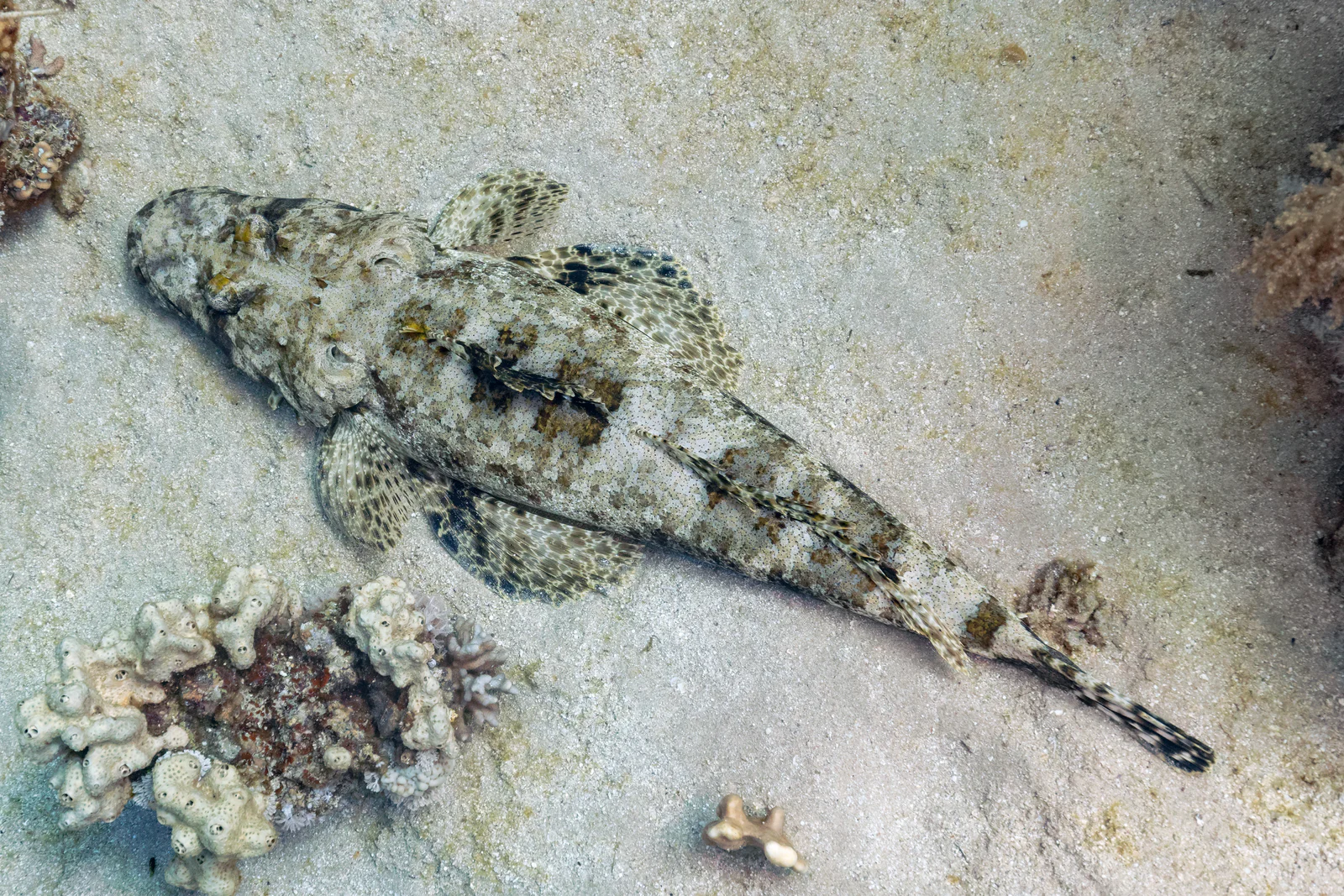
Image credit: Diego Delso, delso.photo · CC BY-SA 4.0 · Wikimedia Commons, cropped by this page
Platycephalidae spp.
About Flathead (assorted).
Flathead is a common name for the family Platycephalidae, not a single species. The World Register of Marine Species (WoRMS) lists Platycephalidae Swainson, 1839 as an accepted family, and Wikipedia gives 17 genera with about 86 species. This group entry covers sightings where the species was not recorded; the crocodilefish (Cymbacephalus beauforti), a flathead, has its own entry.
Wikipedia says their most distinctive feature is the head: triangle-shaped and flattened from top to bottom, like a trowel, with the eyes on its upper surface. They have two dorsal fins, the first supported by six to nine strong spines. Most species are small, reaching an average of 10 cm, but a few species of Platycephalus grow to over 1 m.
A conservation status is not given here, because this entry covers a whole family.
Where it lives.
Wikipedia says flatheads are found in coastal waters throughout the Indo-Pacific, with a few species reaching the eastern Mediterranean from the Red Sea through the Suez Canal. They are mostly marine bottom-dwellers, often resting directly on the seabed and sometimes partly buried in sand or mud, at depths from 10 m to the edge of the continental shelf at about 300 m.
Where Divers Find Them
At Padang Bai, Bali, Waterworx says flatheads, nudibranchs, flounders and stonefish are commonly encountered at the Blue Lagoon, on its Temple section, where coral outcrops grow along a sandy slope. It does not say which species.
How it behaves.
Wikipedia says flatheads are carnivorous ambush predators that feed on small fish and crustaceans. They lie buried in the sand with only their eyes showing and strike rapidly when prey comes close, engulfing it in their large mouth. Adults are expected to be fairly sedentary, though research has shown that part of the population of some species makes long-distance movements or spawning migrations.
Underwater Encounter Behavior
The sources cited here do not describe how flatheads react to divers.
Where to see it.
Evidence from all destinations · 3 dive sites
General range is not evidence of occurrence at a specific dive site.
Bat Cave
Menjangan
Documented site occurrence
Season not yet documented
Source reviewed on 2026-11-13 · Source: ScubaGo · Observation date not documented
Blue Lagoon
Padang Bai
Documented site occurrence
Season not yet documented
Source reviewed on 2026-11-11 · Source: Waterworx · Observation date not documented
Close Encounters
Pemuteran
Documented site occurrence
Season not yet documented
Source reviewed on 2026-11-14 · Source: Abyss Ocean World · Observation date not documented
Gallery.
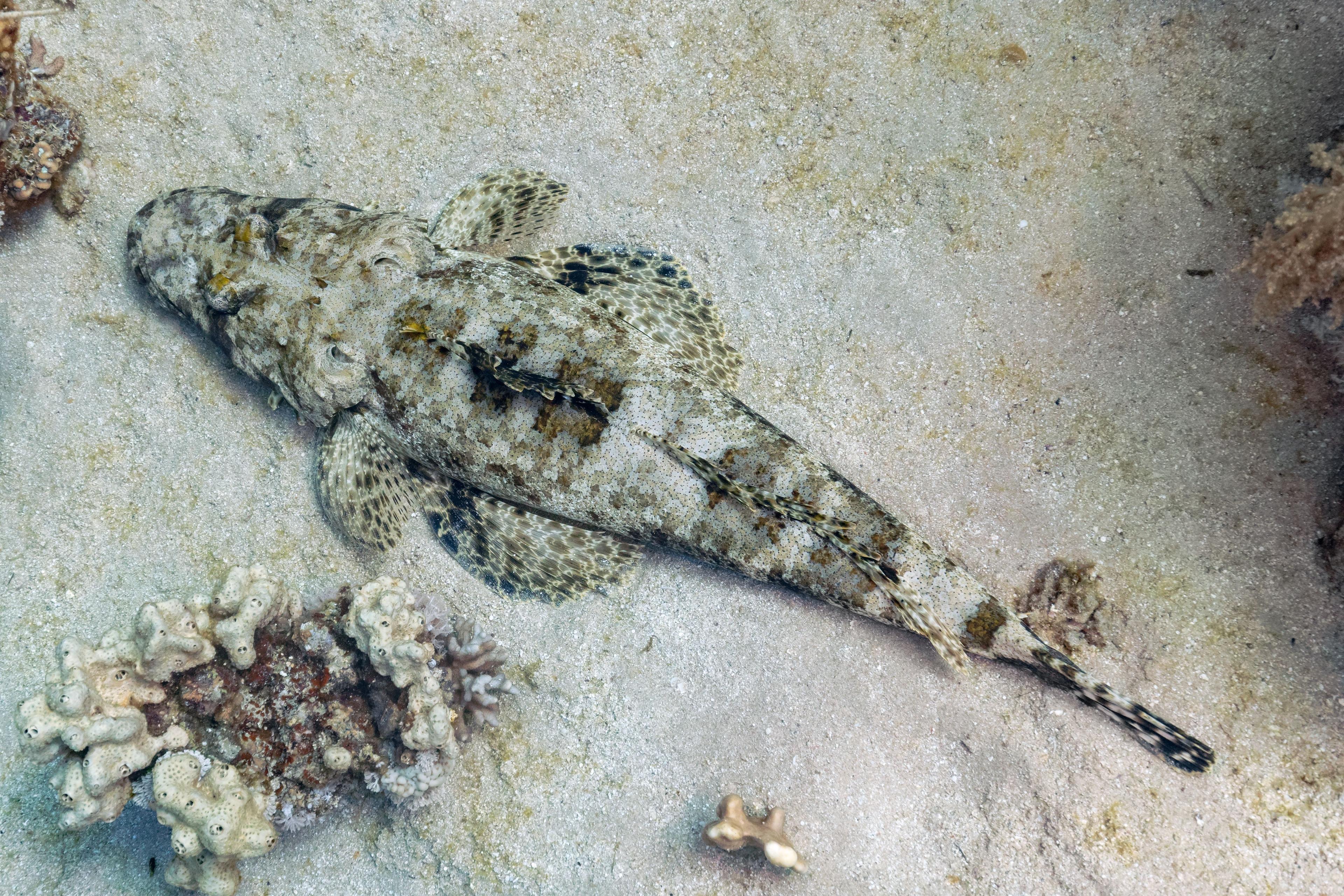
A tentacled flathead, Papilloculiceps longiceps (called crocodilefish on its Commons page; not the crocodilefish Cymbacephalus beauforti, which has its own entry), one species of the flathead family Platycephalidae, seen from above on sand in Ras Muhammad National Park, Red Sea, Egypt, photographed on 2022-03-27 and named by the photographer on its Commons page. This photograph is not from Padang Bai, and the source for Padang Bai's sighting names the fish only as a flathead, without a species. This page's frame crops the photograph.
Image credit: Diego Delso, delso.photo · CC BY-SA 4.0 · Wikimedia Commons, cropped by this page