Flounders (assorted)
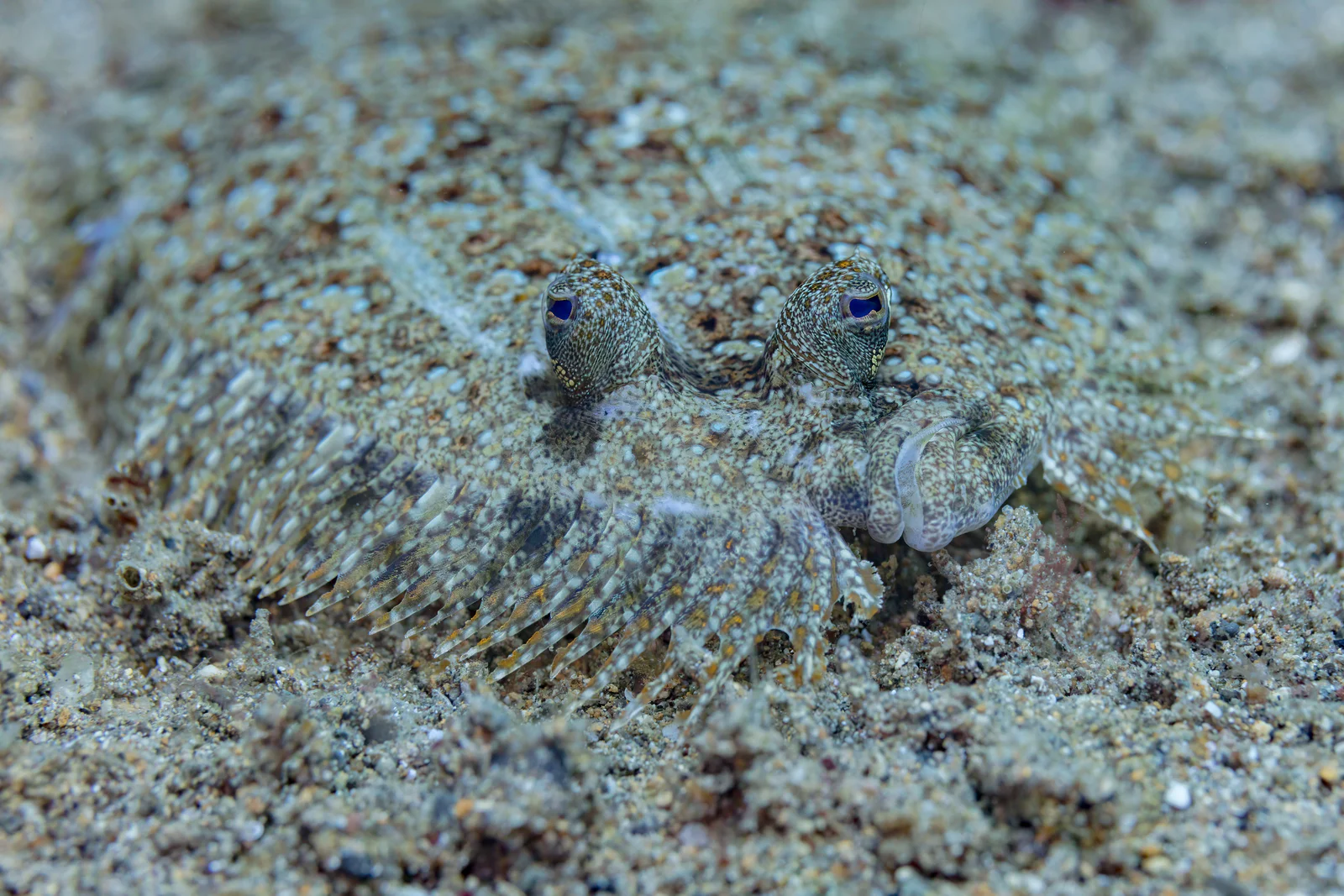
Image credit: Diego Delso, delso.photo · CC BY-SA 4.0 · Wikimedia Commons, cropped by this page
Pleuronectoidei spp. (flounders)
About Flounders (assorted).
Flounders are flatfishes, and the name does not mean one species. Wikipedia says it is used for several only distantly related species, all in the suborder Pleuronectoidei, in the families Achiropsettidae, Bothidae, Pleuronectidae, Paralichthyidae and Samaridae. This group entry covers sightings where the species was not recorded. The peacock flounder (Bothus lunatus) has its own entry. The World Register of Marine Species (WoRMS) lists Pleuronectoidei as an accepted suborder of the order Pleuronectiformes; Wikipedia places it in the order Carangiformes.
Wikipedia says an adult flatfish has both eyes on the side of the head that faces upwards, because one eye migrates towards the other during metamorphosis, and that the side facing the seabed is usually colourless or very pale. In the lefteye flounders (Bothidae), most species lie on the bottom on their right side with both eyes on the left. Wikipedia counts more than 160 species in that family, from 4.5 cm to 1.5 m long. Its article on flounders gives a typical length of 22 to 60 cm and up to 95 cm.
No conservation status applies to the group as a whole.
Where it lives.
Wikipedia describes flounders as demersal fish, found at the bottom of oceans around the world, and says some species also enter estuaries. It says they feed at soft muddy areas of the sea bottom, near bridge piles, docks and coral reefs. The sources cited here do not say which flounders live in Bali.
Where Divers Find Them
At Pyramids in the Amed area of Bali, Amed Jepun Divers says "the sandy areas reveal flounders, stingrays, and the occasional leaf scorpionfish", and SSI lists "Flounder fish" among the fish of the site. Neither names the species or says how often they are seen.
How it behaves.
Wikipedia says flounders ambush their prey and that their diet consists mainly of fish spawn, crustaceans, polychaetes and small fish. It says flatfishes generally rely on camouflage to avoid predators, and that some can change their pigmentation to match the background.
Underwater Encounter Behavior
The sources cited here do not describe how flounders react to divers.
Where to see it.
Evidence from all destinations · 1 dive site
General range is not evidence of occurrence at a specific dive site.
Gallery.
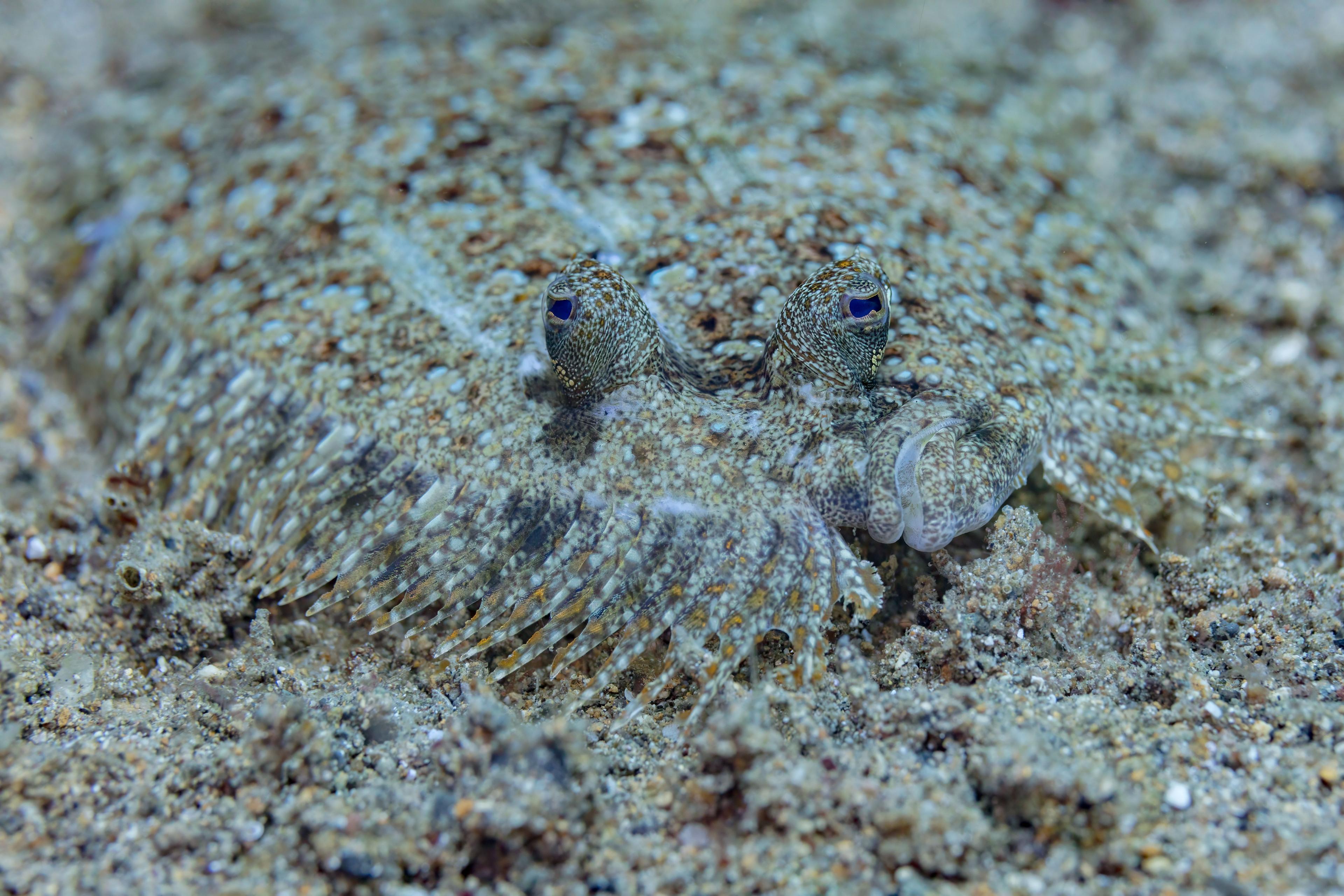
A leopard flounder, Bothus pantherinus, one of the lefteye flounders (family Bothidae), photographed at Anilao, Philippines, in 2023 and identified by the photographer, lying on sand with both raised eyes on the upper side of its head. This photograph is not from Amed, and the sources for Amed's sightings name the fish only as flounders, without a family or species. This page's frame crops the photograph.
Image credit: Diego Delso, delso.photo · CC BY-SA 4.0 · Wikimedia Commons, cropped by this page