Flying Gurnard (assorted)
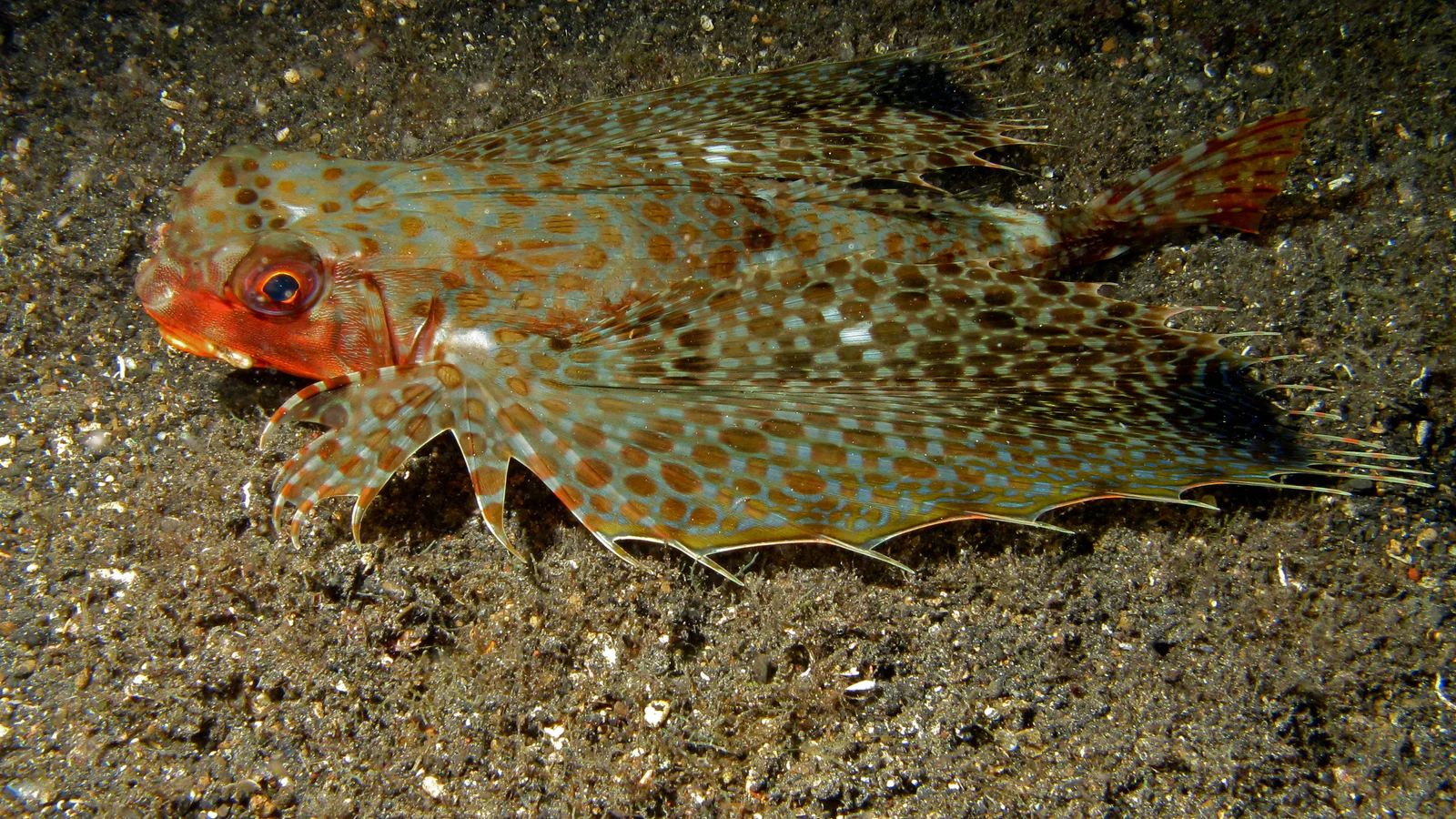
Image credit: Bernard DUPONT · CC BY-SA 2.0 · Wikimedia Commons, cropped by this page
Dactylopteridae spp.
About Flying Gurnard (assorted).
Flying gurnard is a common name for the family Dactylopteridae, not a single species. The World Register of Marine Species (WoRMS) lists Dactylopteridae Gill, 1861 as an accepted family. Wikipedia says most species are in the Indo-Pacific genus Dactyloptena, while the single member of Dactylopterus is from warmer parts of the Atlantic. This group entry covers sightings where the species was not recorded.
Wikipedia says the family is notable for greatly enlarged pectoral fins, whose undersides are brightly coloured, perhaps to startle predators, and that the fish have heavy, protective scales. Because they cannot fly or glide in the air, some authors prefer the name helmet gurnards. Wikipedia notes that recent molecular classifications place the family in the order Syngnathiformes, near the trumpetfishes and cornetfishes; most authors formerly placed it in the order Scorpaeniformes.
A conservation status is not given here, because this entry covers a whole family.
Where it lives.
Wikipedia says the adults live on the sea bottom, while many species have an extended larval stage that floats freely in the oceans. Most species are from the Indo-Pacific. The sources cited here give no depth range for the family.
Where Divers Find Them
At Padang Bai, Bali, Waterworx names the flying gurnard among the species divers may encounter at Tanjung Jepun, and flying gurnards among the creatures of the Jetty at Tanah Ampo, a muck-diving site. Neither passage says which species, or how often.
How it behaves.
Wikipedia says flying gurnards have been observed to "walk" along sandy sea floors on their pelvic fins while looking for crustaceans, other small invertebrates and small fish. Like the true gurnards, to which they may be related, they have a two-lobed swim bladder and a drumming muscle that can beat against it to produce sounds.
Underwater Encounter Behavior
The sources cited here do not describe how flying gurnards react to divers.
Where to see it.
Evidence from all destinations · 3 dive sites
General range is not evidence of occurrence at a specific dive site.
Pemuteran Jetty
Pemuteran
Documented site occurrence
Season not yet documented
Source reviewed on 2026-11-14 · Source: Abyss Ocean World · Observation date not documented
Tanah Ampo Jetty
Padang Bai
Documented site occurrence
Season not yet documented
Source reviewed on 2026-11-11 · Source: Waterworx · Observation date not documented
Tanjung Jepun
Padang Bai
Documented site occurrence
Season not yet documented
Source reviewed on 2026-11-11 · Source: Waterworx · Observation date not documented
Gallery.
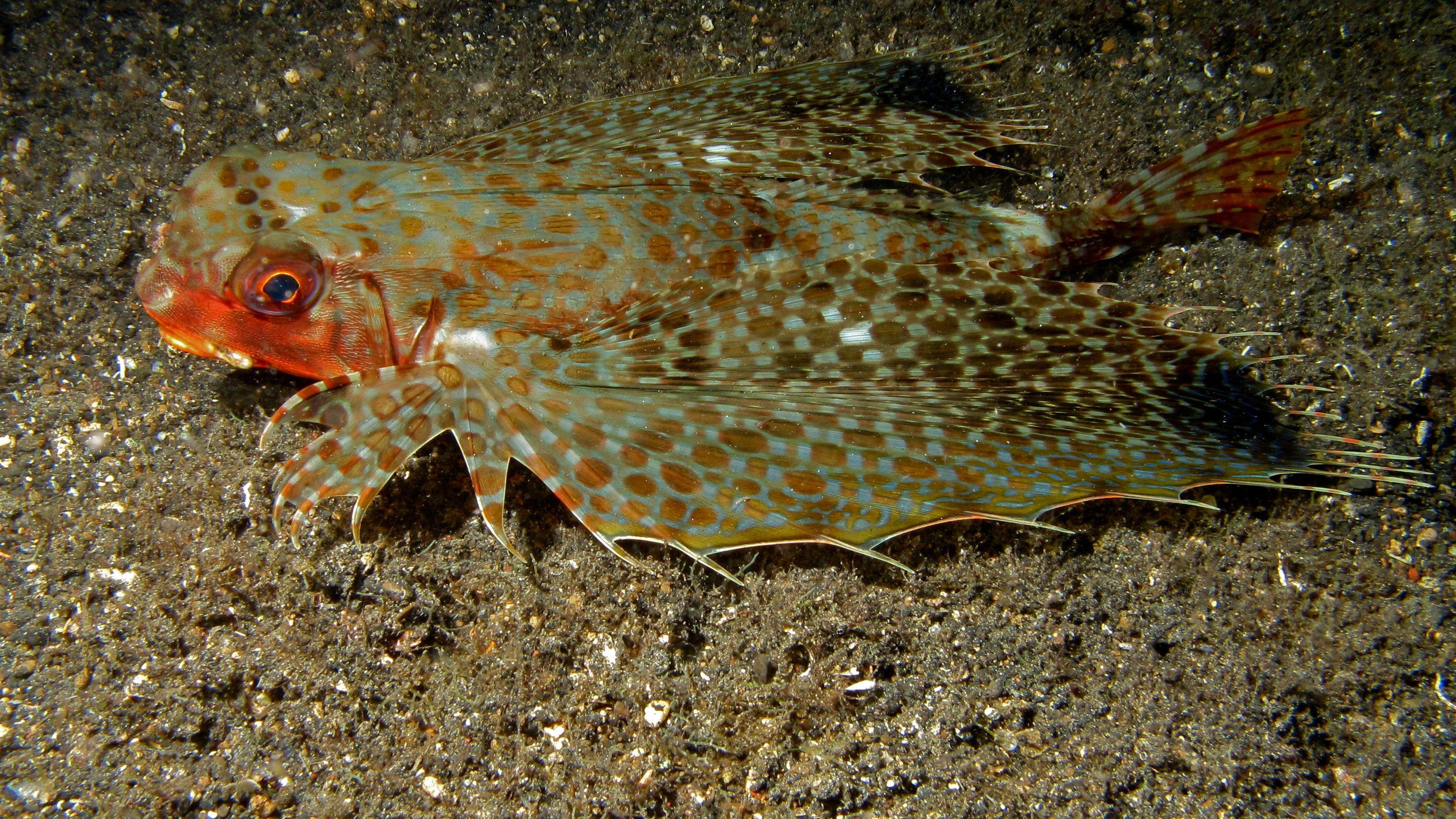
An oriental flying gurnard, Dactyloptena orientalis, one species of the flying gurnard family Dactylopteridae, on dark sand at Makawide, Lembeh Strait, Sulawesi, Indonesia, photographed on 2009-10-14 and named by the photographer on its Commons page. This photograph is not from Padang Bai, and the source for Padang Bai's sightings names the fish only as a flying gurnard, without a species. This page's frame crops the photograph.
Image credit: Bernard DUPONT · CC BY-SA 2.0 · Wikimedia Commons, cropped by this page