Fusilier (schooling)
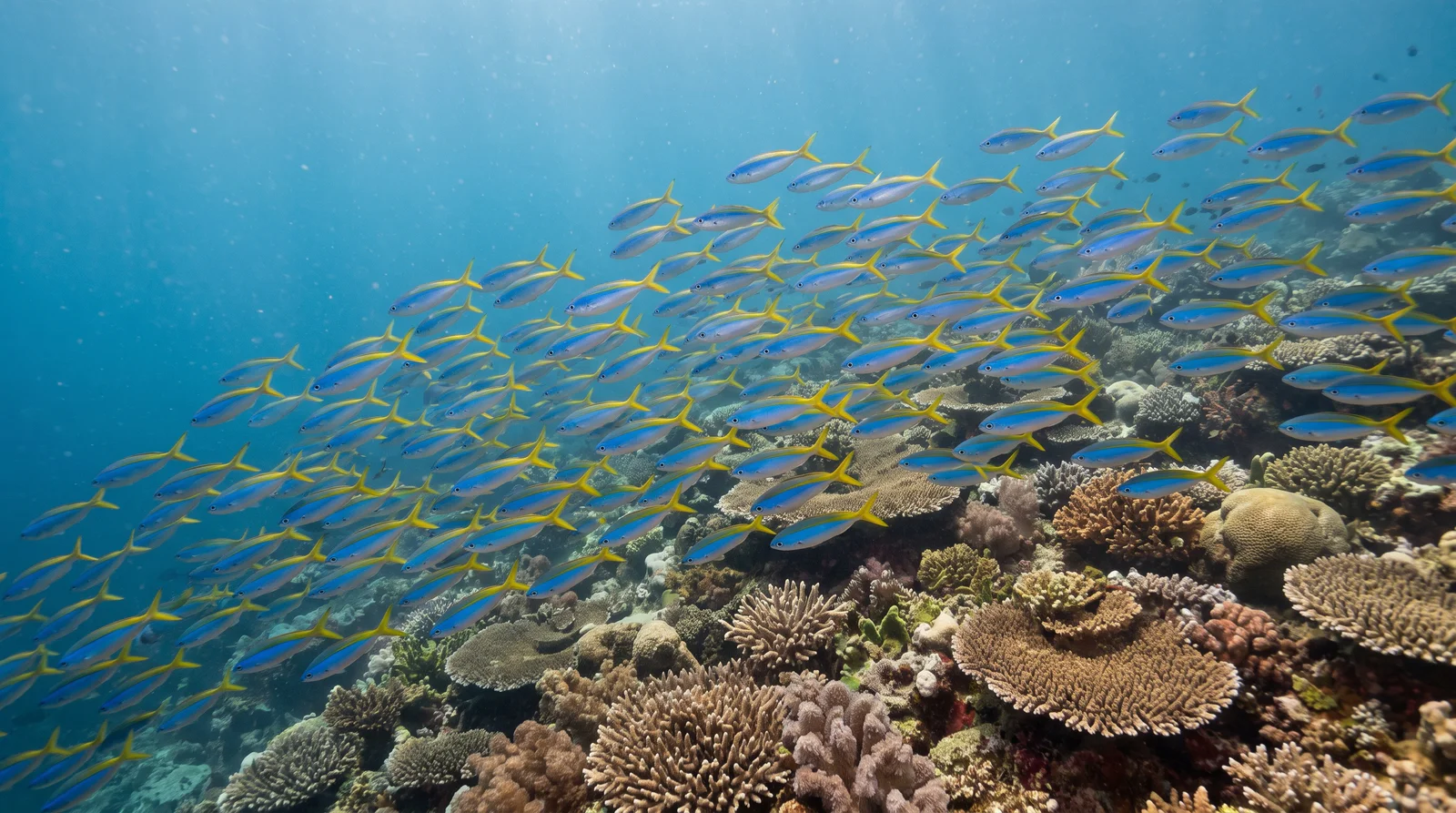 AI-generated
Image credit: AI-generated illustration · Diveity
Caesio spp.
About Fusilier (schooling).
Caesio fusiliers are spindle-shaped schooling fish of Indo-Pacific coral reefs, often blue with yellow, that feed on zooplankton in midwater.
Names and classification
WoRMS, whose genus entry comes from FishBase, accepts Caesio Lacepède, 1801 in the family Caesionidae and lists ten accepted species. FishBase's current species list also has ten; the newest, C. idreesi, was described in 2023 from the Laccadive archipelago of India. Wikipedia's article on the genus, last edited in May 2026, recognises nine without it and groups them, "according to some authorities", into three subgenera, Caesio, Flavicaesio and Odontonectes. The family is disputed. WoRMS keeps Caesionidae; FishBase's species pages place the genus in the snapper family Lutjanidae as the subfamily Caesioninae; and Wikipedia puts the fusiliers in Lutjanidae, subfamily Lutjaninae, because studies found the old family nested within the snappers. Wikipedia says the name means "blue", and FishBase derives it from the Latin caesius, bluish-grey. FishBase's English names are blue and gold fusilier (C. caerulaurea), redbelly yellowtail fusilier (C. cuning), lunar fusilier (C. lunaris), striated fusilier (C. striata), Suez fusilier (C. suevica), yellow and blueback fusilier (C. teres), variable-lined fusilier (C. varilineata), goldsash fusilier (C. xanthalytos) and yellowback fusilier (C. xanthonota); C. idreesi has none there. WoRMS gives タカサゴ属 as the genus's Japanese name.
Identification
Wikipedia, drawing on FAO's 1988 catalogue of the fusiliers, describes a fairly high, elongate, spindle-shaped body that is moderately compressed, a continuous dorsal fin of 10 spines and 13 to 16 soft rays, and an anal fin of 3 spines and 10 to 13 soft rays, both scaled, with 17 to 23 rays in each pectoral fin. Some species are plain and others carry one or more lengthwise stripes, and the tail may bear black marks, typically spots on the lobe tips or lines along the middle of the lobes. Its article on the snapper subfamily adds that fusiliers have small, protrusible mouths, a deeply forked tail with angular lobe tips and, in every species, a black pectoral-fin axil.
FishBase's accounts separate the species by colour. The blue and gold fusilier is bluish above and white to pale blue below, with one yellow or golden stripe just above the lateral line and a black streak along the middle of each tail lobe. The redbelly yellowtail is deep-bodied, yellow or greyish blue above with a white or pinkish belly, a large yellow tail and no prominent black marks on it. The yellow and blueback is blue with bright yellow on the tail, the tail base and the rear of the body; in large fish, particularly in the western Pacific, the yellow reaches less far forward. The yellowback is bright yellow on its upper third and tail, blue in the middle and white below. The lunar fusilier is bluish with black tail-lobe tips and a black pectoral axil, its tail blue except in juveniles, where it is often yellow. The Suez fusilier is light to silvery blue with a black blotch, bordered by a white band, at the tip of each tail lobe.
Size
FishBase's species list gives maximum lengths from 14.4 cm total length for C. idreesi to 60 cm total length for the redbelly yellowtail. Between them are the blue and gold at 45.4 cm fork length, the yellowback at 41.8 cm standard length, the lunar, yellow and blueback and variable-lined fusiliers at 40 cm total length, the Suez at 35 cm and the striated at 25 cm, both total length, and the goldsash at 22 cm standard length. Its account of the redbelly yellowtail gives 35 cm as a usual length. Wikipedia says fusiliers as a group reach up to 60 cm, though most species grow to only about half that.
Conservation and fisheries
In the IUCN Red List entries that FishBase quotes (version 2025-2), nine of the ten species are Least Concern, assessed between 2009 and 2018, and C. idreesi is not evaluated. FishBase calls every species harmless to people. Wikipedia describes the genus as of some importance to inshore fisheries, which take it with drive-in nets, gill nets, traps, trawls and handlines and sell it fresh or salted, and says the juveniles of some species are caught as bait for tuna fishing.
Where it lives.
Caesio fusiliers live on tropical coasts between the Red Sea and the Line Islands, mostly over coral reefs, down to about 60 m.
Range
Wikipedia puts the genus in coastal areas in the Indian and Pacific Oceans, the Red Sea included, and FishBase sets the limits species by species. The blue and gold fusilier lives between the Red Sea and East Africa in the west and Samoa in the east, reaching southern Japan and New Caledonia, and is absent from the Persian Gulf. The yellow and blueback runs from East Africa to the Line Islands but does not occur in the Red Sea or the Persian Gulf. The lunar fusilier reaches the Solomon Islands and southern Japan from the Red Sea, the Persian Gulf and East Africa, and the redbelly yellowtail from Sri Lanka to Vanuatu and from southern Japan to northern Australia.
The others are Indian Ocean fish. The variable-lined fusilier extends to western Indonesia from East Africa, the Red Sea and the Persian Gulf, and the yellowback from East Africa to Indonesia; FishBase treats yellowback records from the Marshall Islands and Australia as probable misidentifications of the yellow and blueback. The striated and Suez fusiliers live from the Red Sea to the Arabian Sea. The goldsash is known from Kenya and Tanzania to KwaZulu-Natal and southern Madagascar, with a newer record from the Laccadive archipelago, and C. idreesi from India. Wikipedia reports that the variable-lined fusilier has been recorded in the eastern Mediterranean, probably by way of the Suez Canal.
Depth and habitat
FishBase's depth ranges run from 0 to 50 m for the lunar and yellowback fusiliers, 1 to 60 m for the blue and gold and the redbelly yellowtail, and 5 to 60 m for the yellow and blueback. The goldsash is given 8 to 40 m, the striated 2 to 30 m, the Suez and the variable-lined 2 to 25 m, and C. idreesi down to 24 m. Wikipedia's article on the snapper subfamily says fusiliers live from close to the surface down to about 60 m.
FishBase describes most of the species as reef-associated fish of coastal waters, found around coral reefs, in deep lagoons and along seaward reefs. The lunar fusilier is more common along steep seaward reefs than in lagoons, and the yellow and blueback prefers coralline lagoons. The redbelly yellowtail usually lives over rocky and coral reefs, often in silty water with low visibility at 1 to 30 m. On Wikipedia's account, the genus lives mainly on coral reefs.
How it behaves.
Caesio fusiliers swim in schools, often mixed with other fusiliers, feed on zooplankton in midwater and shed many small eggs into open water.
Feeding and schools
Wikipedia describes the genus as sociable fish that gather in schools, frequently mixed with other fusilier species, and feed mainly on zooplankton in midwater. Its article on the snapper subfamily adds that fusiliers are active by day, feeding in large aggregations in the middle of the water column over reefs, along steep outer reef slopes and around deep-water pinnacles in lagoons. They pick zooplankton with extensible upper jaws, often pause to feed or to visit cleaner-fish stations, and shelter in the reef at night.
FishBase's accounts agree on midwater feeding on zooplankton and name mixed schools for the blue and gold, the yellow and blueback and the variable-lined fusiliers. FishBase reports the lunar fusilier forming large aggregations on the upper edge of steep slopes and around patch reefs, and the goldsash seen together with the variable-lined fusilier in large shoals off northern KwaZulu-Natal.
Spawning
Wikipedia says Caesio fusiliers reach sexual maturity quickly and the females are highly fecund; they lay numerous small pelagic eggs, spawn through much of the year, and form spawning aggregations at times set by the lunar cycle. FishBase reports that mature yellow and blueback fusiliers move to chosen places around the reef to spawn near the surface at the entrances of deep channels on outgoing tides, following the lunar cycle, and that their mass spawning has been seen only around sunset at or near full moon.
For the blue and gold fusilier, FishBase describes six stages of mating: nuzzling, several males joining the courtship, a spiralling rise towards the surface, pair spawning, sperm release by sneaker males, and the period after spawning. In nuzzling, which begins about an hour to an hour and a half before spawning, one or two males peck and push the female's swollen belly with their snouts. Eggs of the goldsash have been abundant in plankton samples off Park Rynie in KwaZulu-Natal, which FishBase reads as a sign of prolific spawning there.
Where to see it.
Evidence for visayas · 8 dive sites
General range is not evidence of occurrence at a specific dive site.
Camia II Wreck
Boracay
Documented site occurrence
Season not yet documented
Source reviewed on 2026-10-14 · Source: New Wave Divers Boracay (article "Camia Wreck") · Observation date not documented
Channel Drift
Boracay
Documented site occurrence
Season not yet documented
Source reviewed on 2026-10-14 · Source: DiveGurus Boracay · Observation date not documented
Diniwid
Boracay
Documented site occurrence
Season not yet documented
Source reviewed on 2026-10-14 · Source: New Wave Divers Boracay (dive-site page) · Observation date not documented
Punta Bunga
Boracay
Documented site occurrence
Season not yet documented
Source reviewed on 2026-10-14 · Source: DiveGurus Boracay · Observation date not documented
Santa Rosa
Mactan
Documented site occurrence
Season not yet documented
Source reviewed on 2026-10-14 · Source: Asia Dive Site, Olango Island page · Observation date not documented
Talima Marine Sanctuary
Mactan
Documented site occurrence
Season not yet documented
Source reviewed on 2026-10-14 · Source: Bohol-Philippines.com, Olango Island dive sites (Polaris Dive Center text; Wayback snapshot 2024-11-08) · Observation date not documented
Virgin Drop
Boracay
Documented site occurrence
Season not yet documented
Source reviewed on 2026-10-14 · Source: New Wave Divers Boracay (dated dive log) · Observation date not documented
Yapak
Boracay
Documented site occurrence
Season not yet documented
Source reviewed on 2026-10-14 · Source: New Wave Divers Boracay (dated dive log) · Observation date not documented
Gallery.
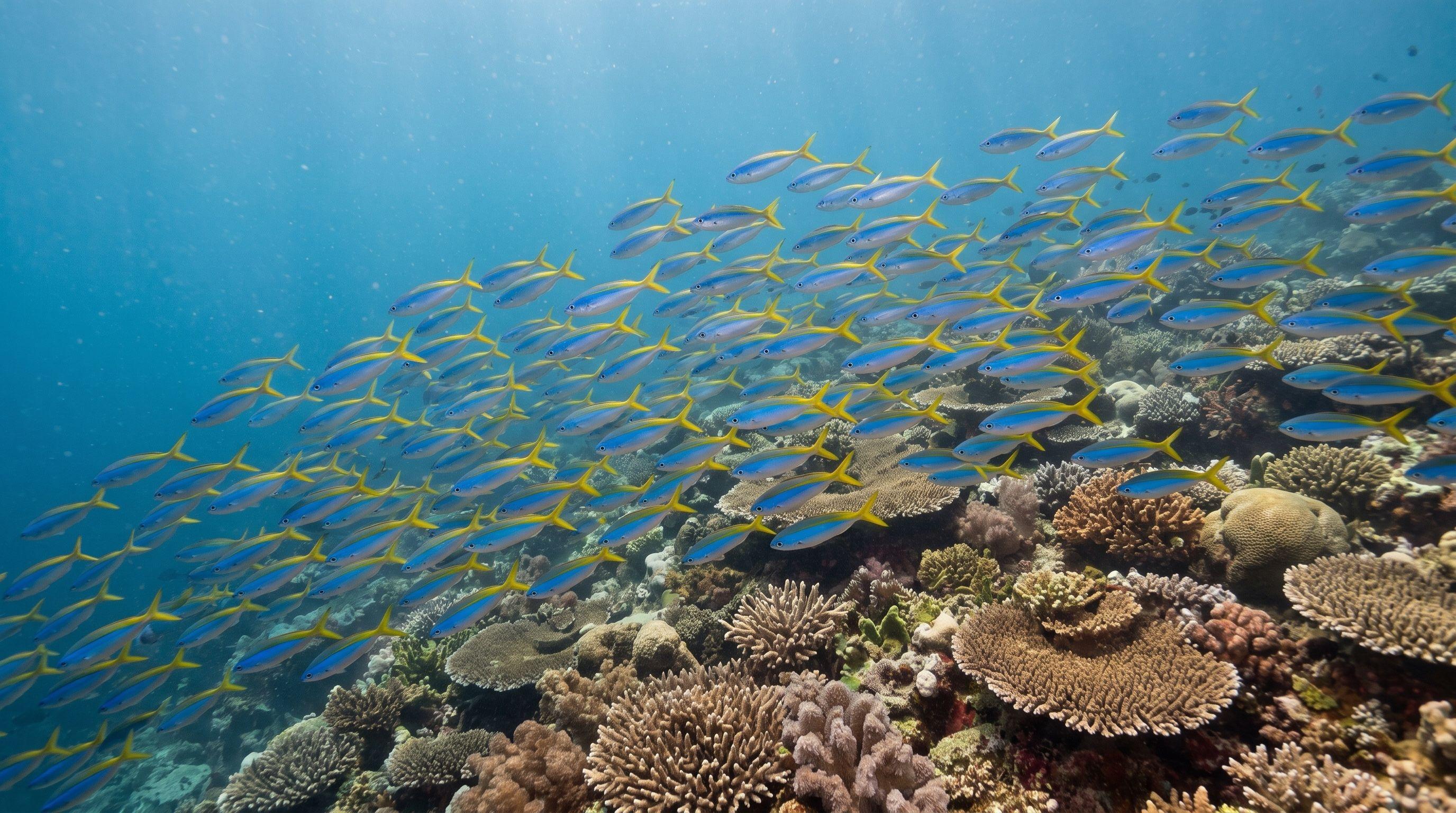 AI-generated
 illustration
Image credit: AI-generated illustration · Diveity