Spotted Garden Eel
 AI-generated
Image credit: AI-generated illustration · License unspecified · Source unspecified
Heteroconger hassi
About Spotted Garden Eel.
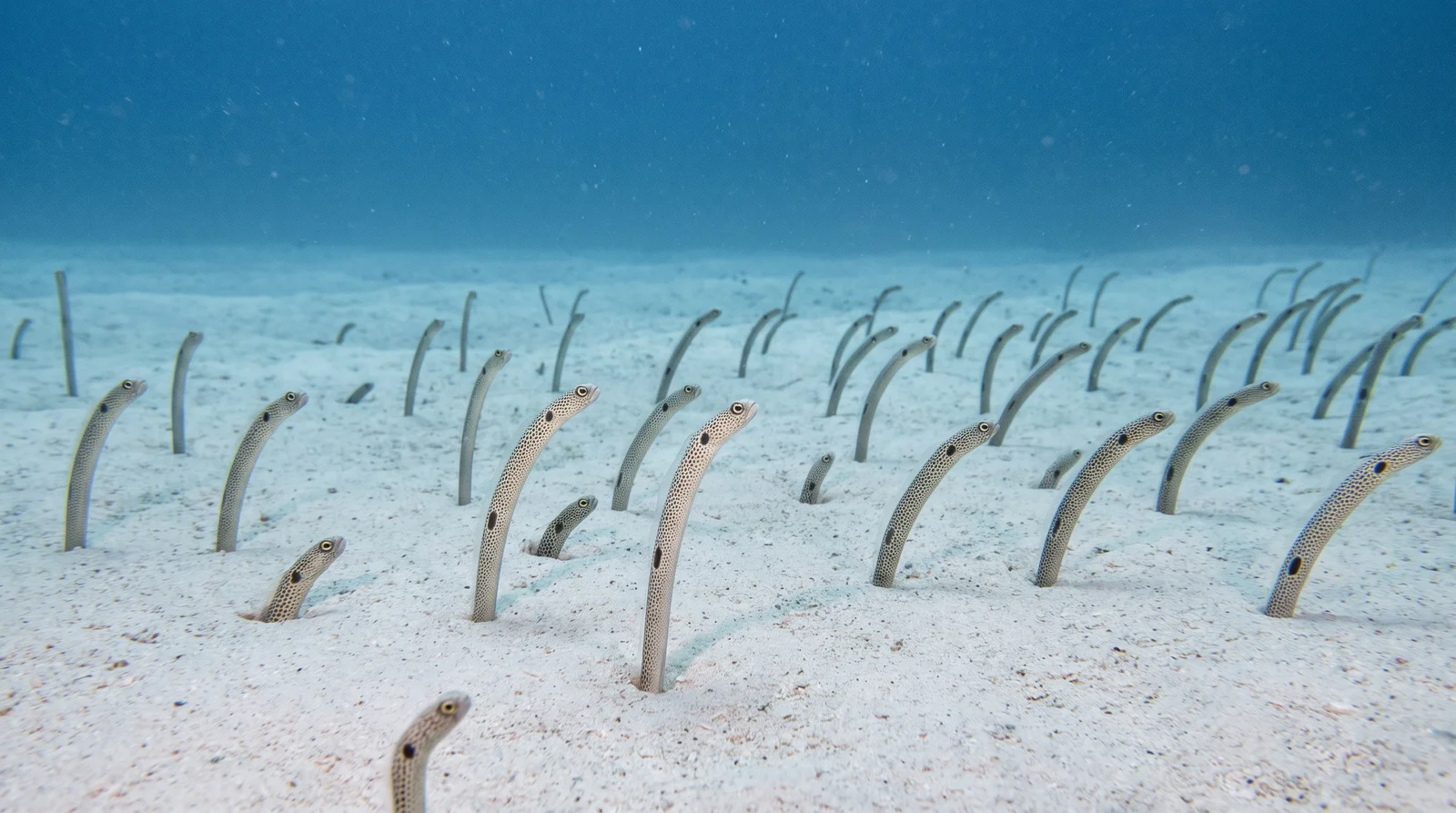
The Spotted Garden Eel (Heteroconger hassi) is a captivating and often-photographed inhabitant of sandy seafloors across the Indo-Pacific. Belonging to the family Congridae, these slender fish are renowned for their unique communal lifestyle and graceful, swaying movements, which can easily be mistaken for marine vegetation. With a conservation status of "Least Concern," they are a common and welcome sight for divers in suitable habitats.
These fascinating eels thrive in the tropical and subtropical waters of the Indo-Pacific, ranging from the Red Sea and East Africa across to Polynesia, and from Japan south to New Caledonia. They establish vast colonies on sandy flats and slopes that border coral reefs, sometimes utilizing areas dense with seagrass for additional camouflage. Spotted Garden Eels are typically found at depths of 5–50 m, though they are more commonly observed below 15 m, in waters of 24–28°C.
Living in colonies that can number from dozens to thousands of individuals, each Spotted Garden Eel constructs and maintains its own vertical burrow in the sand. They use their pointed tails to dig and then secrete a special mucus to cement the burrow walls, preventing collapse. With only about a third of their body extended from their sandy homes, they face into the prevailing current, patiently plucking tiny planktonic animals (zooplankton) from the water column as food. Highly timid, they will rapidly retract tail-first into their burrows at the slightest sign of danger, only to slowly re-emerge once they perceive the threat has passed. Individuals rarely leave their burrows, even for reproduction. During mating season, adjacent males and females will extend their bodies to entwine, with their tails remaining anchored. They are pelagic spawners, releasing fertilized eggs into the open water, which then drift until hatching. Interestingly, females have been observed to change sex if there are not enough males in the area.
This species has been abundantly observed at dive sites such as Shotgun (The Cauldron), Golden Passage, and Admiralty Anchor, and is common at Challenger Bay.
Identification
- Size and Shape: The Spotted Garden Eel is a slender, eel-like fish, reaching a maximum length of 40 cm (16 in). Its body has a circular cross-section, typically around 1.3–1.4 cm (0.5 in) in diameter.
- Coloration: Adults exhibit a whitish, beige, or yellowish body.
- Markings: The body is densely covered with numerous small black spots. A key identification feature is the presence of three larger, distinctive black patches along the body: one located at the gill opening, often encompassing the tiny pectoral fins; a second prominent patch in the central part of the body; and a third surrounding the anus.
- Head Features: They possess large, prominent yellow eyes and an upturned mouth, giving their head a somewhat shortened appearance. Small nostrils are positioned in the center of the upper lip.
- Juveniles: Younger Spotted Garden Eels are entirely black.
- Sexual Dimorphism: Males are generally larger than females and have a more protruding jaw.
- Behavioral Cues: Their characteristic behavior of swaying in unison from individual sand burrows, often facing into the current, and their rapid retraction when approached, are strong indicators for identification.
Where it lives.
These eels are widely distributed throughout the tropical and subtropical Indo-Pacific region, extending from the Red Sea and East Africa across to Polynesia, and from Japan south to New Caledonia and northwestern Australia. They are commonly observed in Micronesia and on dive sites along the Great Barrier Reef.
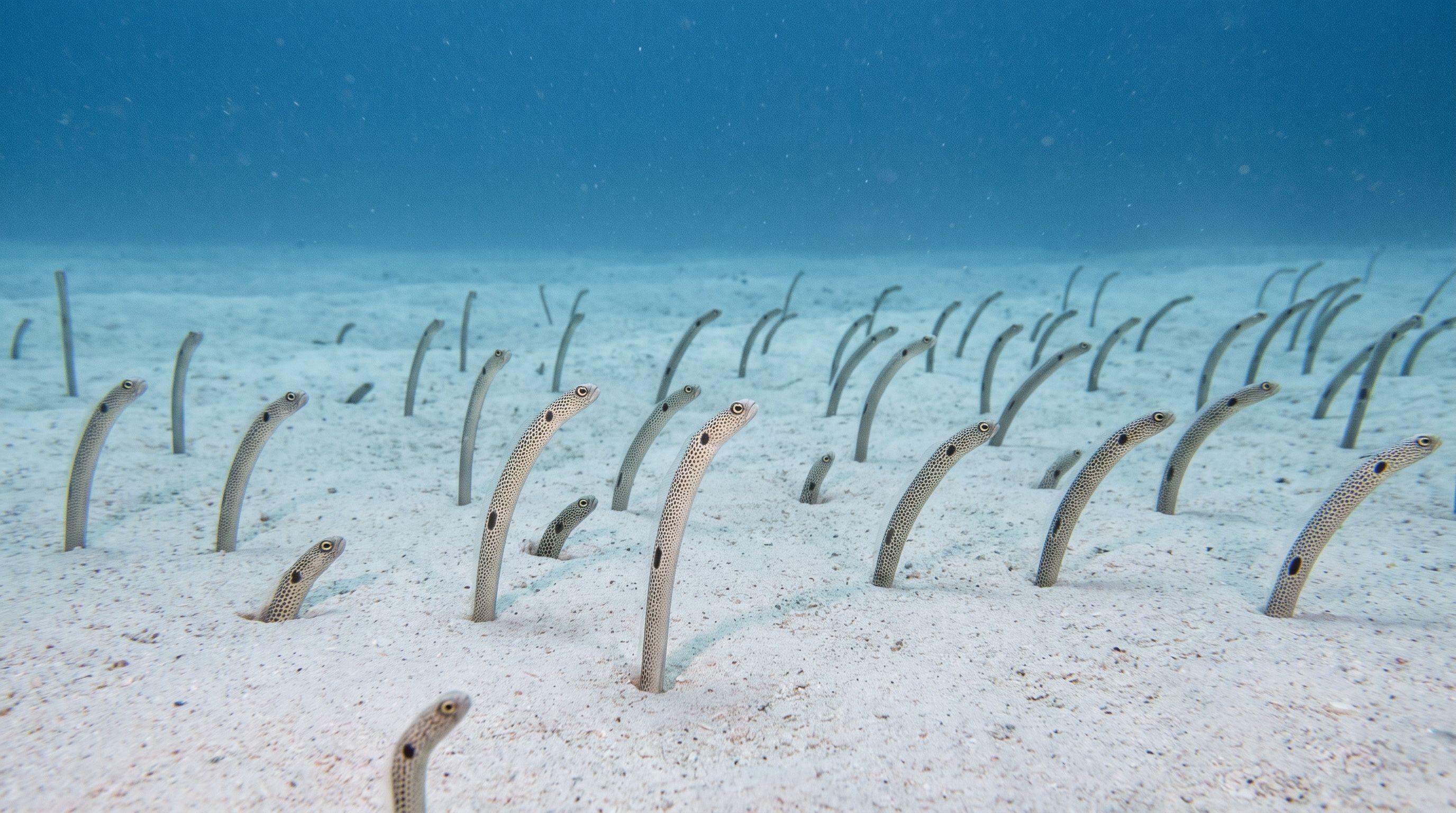
Spotted Garden Eels exclusively inhabit sandy flats and slopes, typically bordering coral reefs. They prefer areas with moderate to strong currents, which are crucial for bringing them their primary food source: zooplankton. Divers often find them in large colonies, sometimes numbering hundreds to thousands of individuals, creating an illusion of an underwater "garden" as they sway in unison.
Their typical depth range is between 7–50 m, though they are often found below 15 m. They construct individual burrows in deep, clean sandy substrates, using their stiff, muscular tails to dig and secreting a protective mucus to cement the burrow walls and prevent collapse. While primarily associated with sandy areas near reefs, they can also be found living among seagrass beds, which provide additional camouflage.
The water temperature in their habitat typically ranges from 25–29°C. When approached by divers or sensing danger, these shy eels rapidly retreat tail-first into their burrows, slowly re-emerging once the perceived threat has passed.
How it behaves.
Underwater Encounter Behavior
When encountered by divers, Spotted Garden Eels present a captivating display. They typically extend up to two-thirds of their bodies vertically from individual burrows dug into the sandy seabed, swaying gently with the current, resembling an underwater "garden". Their large, yellow eyes are constantly scanning for both food and potential threats. As divers approach, these eels exhibit a characteristic shyness; they will rapidly retract tail-first into their mucus-lined burrows, often disappearing completely in an instant. The closer a diver gets, the deeper and faster they retreat. Patience and slow, deliberate movements are key to observing them for extended periods. They are found on sandy flats and slopes, often bordering coral reefs or in areas with dense seagrass, at depths typically ranging from 7 to 45 m (23–150 ft). They thrive in tropical and subtropical waters, with preferred temperatures between 23°C and 29°C (74–84°F).Feeding Habits
Spotted Garden Eels are primarily planktivores, meaning their diet consists of tiny planktonic animals that drift past in the water current. With their upturned mouths, they face into the prevailing current, making rapid strikes at zooplankton such as copepods, fish eggs, and crab and shrimp larvae. They are opportunistic feeders, constantly sifting the water for passing food throughout daylight hours. An eel will only extend far enough to catch food while keeping a portion of its body securely within its burrow.Social Structure
These eels are highly colonial, living in large groups that can number from dozens to hundreds, or even thousands, of individuals. Each eel constructs and inhabits its own permanent, vertical burrow, which it rarely leaves. The burrows are dug using their pointed tails and reinforced with a self-secreted slime that cements the sand walls, preventing collapse. While individual eels maintain their personal burrows, they live in close proximity, creating a dense "garden" effect. This colonial living may offer some collective security, as the rapid retreat of one eel can signal danger to its neighbors.Notable Seasonal Patterns
Spotted Garden Eels exhibit specific behaviors during their breeding season. While they generally remain in their burrows, males and females will move their burrows closer together to facilitate mating. During this time, males may become territorial, defending a chosen female from rival males. Mating involves the male and female entwining their upper bodies while their tails remain anchored in their respective burrows, a process that can last for hours. They are pelagic spawners, meaning the female releases fertilized eggs directly into the water column, where they float until hatching. The juvenile eels then have a planktonic stage before settling onto the sandy bottom to create their own burrows once they are large enough. There is no specific seasonal pattern identified for their reproduction, but mating occurs when conditions are favorable. Observing a colony of Spotted Garden Eels is a highlight for many divers, offering a glimpse into a unique and synchronized marine existence.Where to see it.
Evidence for philippines · No dive sites
General range is not evidence of occurrence at a specific dive site.
No documented dive-site associations in this destination yet.
Gallery.
 AI-generated
AI-generated illustration
Image credit: AI-generated illustration · License unspecified · Source unspecified