Giant Basket Star
 AI-generated
Image credit: AI-generated illustration · License unspecified · Source unspecified
Astrophyton muricatum
About Giant Basket Star.
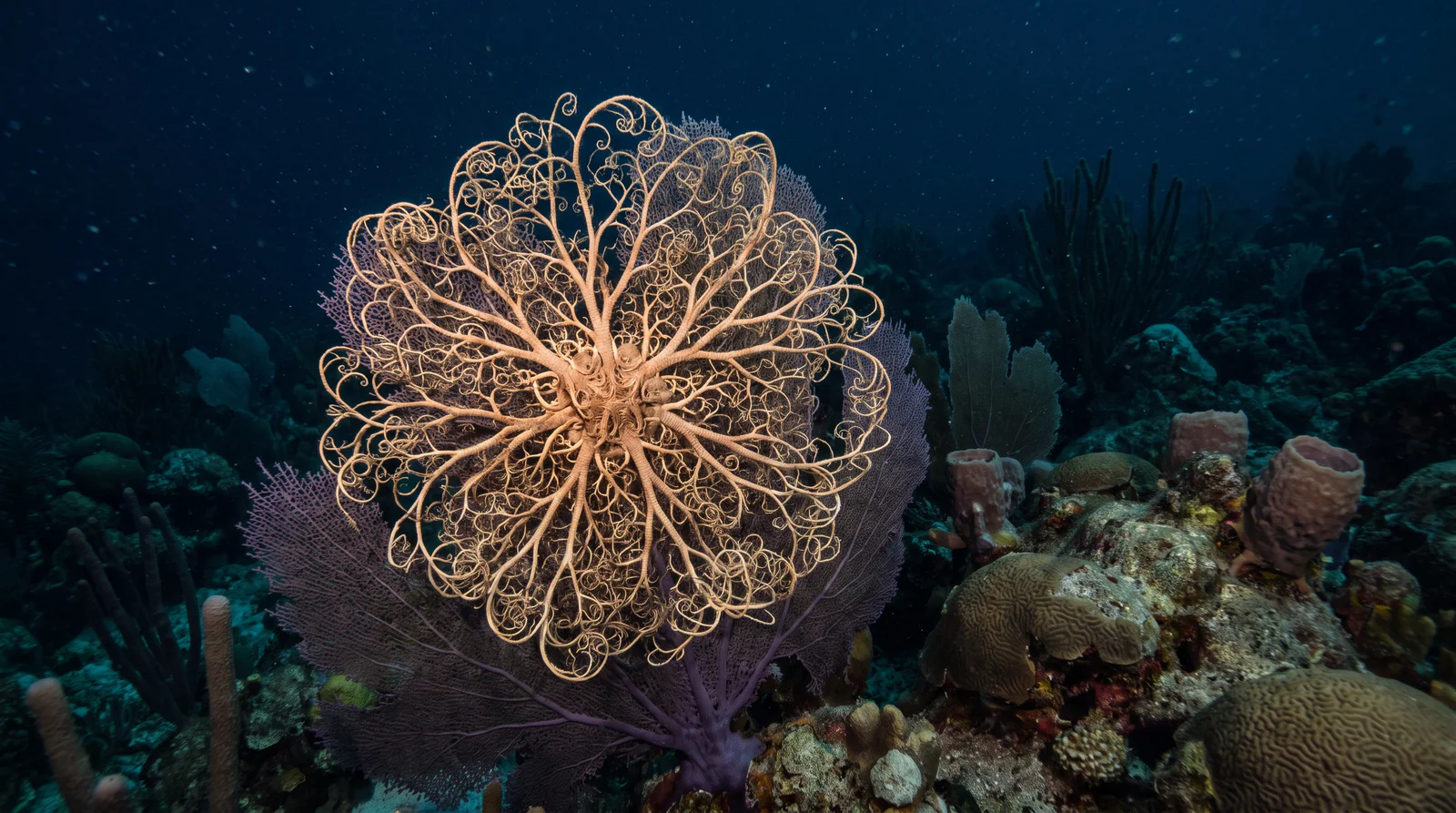
The Giant Basket Star, Astrophyton muricatum, is a truly mesmerizing and unique echinoderm, closely related to brittle stars, yet distinct in its remarkable appearance and behavior. This large marine invertebrate is characterized by a relatively small central disc from which radiate five primary arms. However, these arms do not remain simple; they undergo repeated, intricate subdivisions, branching out hundreds of times into a spectacular, complex network of finer, curling tendrils. When fully unfurled, this elaborate web of arms can create a diameter far wider than the animal's central body, forming a delicate, basket-like structure that is a signature sight of Caribbean night dives. The overall coloration of the Giant Basket Star typically ranges from various shades of brown to black, allowing it to blend seamlessly with its reef environment.
During daylight hours, this fascinating creature exhibits a starkly different form. It typically coils its highly branched arms into a tight, compact ball, resembling a tangled knot of cord, often hidden within reef crevices or nestled securely onto its chosen gorgonian or sponge perch. This coiled posture serves as a protective mechanism, shielding it from potential predators and allowing it to remain inconspicuous until the safety of night falls. A notable anatomical feature of the basket star, shared with other echinoderms, is its lack of a centralized brain, instead relying on a complex nerve ring to coordinate its intricate movements and responses. Its unique morphology and dramatic transformation from a daytime ball to a nocturnal feeding net make it one of the most captivating macro species for divers to observe. The delicate, branching arms, though appearing fragile, are remarkably adept at capturing microscopic prey.
Where it lives.
The Giant Basket Star, Astrophyton muricatum, thrives in the warm tropical and subtropical waters of the western Atlantic Ocean, making its home throughout the Caribbean Sea and the Gulf of Mexico. Its geographical range extends notably along the Florida coast, southward to approximately 20°S off the coast of Brazil. This species is typically found in association with coral reefs, where it seeks out elevated perches to optimize its feeding strategy. Preferred substrates for attachment include various types of gorgonians, such as sea plumes, sea rods, and sea whips, as well as sponges. These locations provide both elevation for filter-feeding and protective camouflage during its inactive daytime phase.
While commonly observed on coral reefs, the Giant Basket Star can also be found on the tops of boulders or even in seagrass meadows, demonstrating some adaptability in its choice of substrate, as long as a suitable elevated position is available. Its depth range is quite broad, generally observed by divers between 20 to 90 feet (approximately 6 to 27 meters). However, it can extend to depths down to about 30 meters (98 feet), and some sources even indicate occurrences in the mesopelagic zone, down to 500 meters, although shallow reef environments are where divers are most likely to encounter this species. The prevalence of suitable perches and plankton-rich currents are key determinants of its distribution within these habitats.
How it behaves.
The Giant Basket Star, Astrophyton muricatum, is a strictly nocturnal filter feeder, exhibiting a fascinating daily cycle of activity. During the daylight hours, it employs a remarkable camouflage and protective strategy: it remains tightly coiled into a compact, fist-sized ball. In this state, it typically hides within the branches of a gorgonian, a sponge, or a crevice in the reef structure, effectively shielding itself from diurnal predators. As dusk approaches and the sun sets, the basket star undergoes a dramatic transformation. It slowly unfurls its intricate network of highly branched arms, ascending to an elevated position on its chosen perch to orient itself optimally into the prevailing current.
This unfurled "net" is its primary tool for capturing food. The numerous fine branches of its arms create a large, efficient mesh that traps zooplankton, such as copepods, phytoplankton, rotifers, and other small planktonic organisms drifting in the water column. When a food particle comes into contact with an arm, the smallest branches swiftly curl around it, forming a small ball which is then conveyed towards the central mouth. Basket stars are highly sensitive to light; if a diver shines a light on an unfurled basket star at night, it will typically begin to coil back into its defensive ball shape, taking several minutes to complete the process. They are generally peaceful creatures, posing no threat to divers or other reef-safe marine life. Their feeding behavior is adapted to moderate currents; in very strong currents, they may keep their arms folded to avoid damage.
Where to see it.
Evidence for bonaire · No dive sites
General range is not evidence of occurrence at a specific dive site.
No documented dive-site associations in this destination yet.
Gallery.
 AI-generated
 illustration
Image credit: AI-generated illustration · License unspecified · Source unspecified