Giant Clam (assorted)
 AI-generated
Image credit: AI-generated illustration · License unspecified · Source unspecified
Tridacninae spp.
About Giant Clam (assorted).
"Giant Clam (assorted)" covers giant clams of the subfamily Tridacninae, in the genera Tridacna and Hippopus, when a record does not name the species. Older references place these clams in their own family, Tridacnidae; the World Register of Marine Species (WoRMS) now accepts Tridacninae as a subfamily of the cockle family Cardiidae. Confirmed records of the largest species belong in the single-species entry "Giant Clam" (Tridacna gigas).
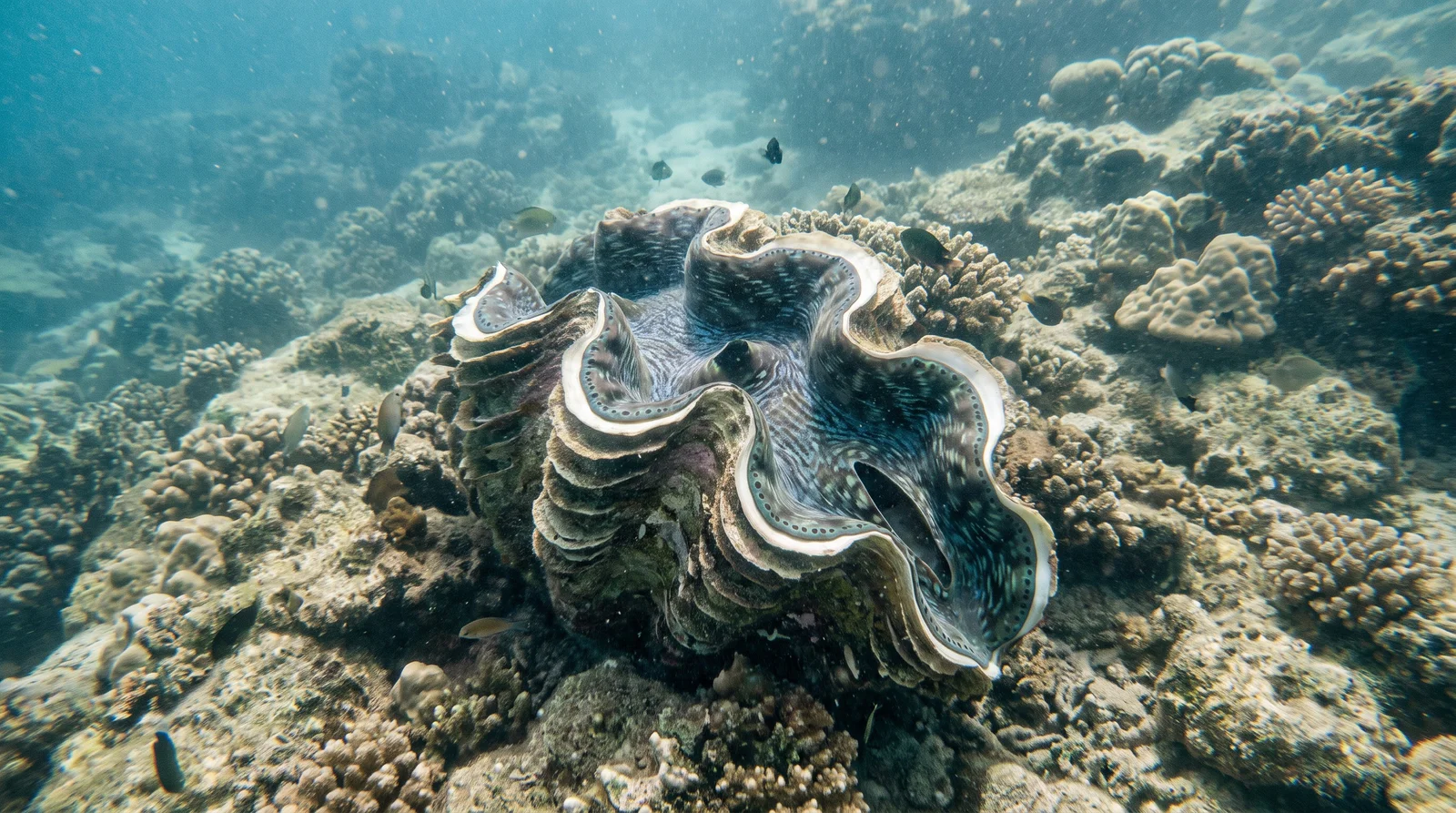
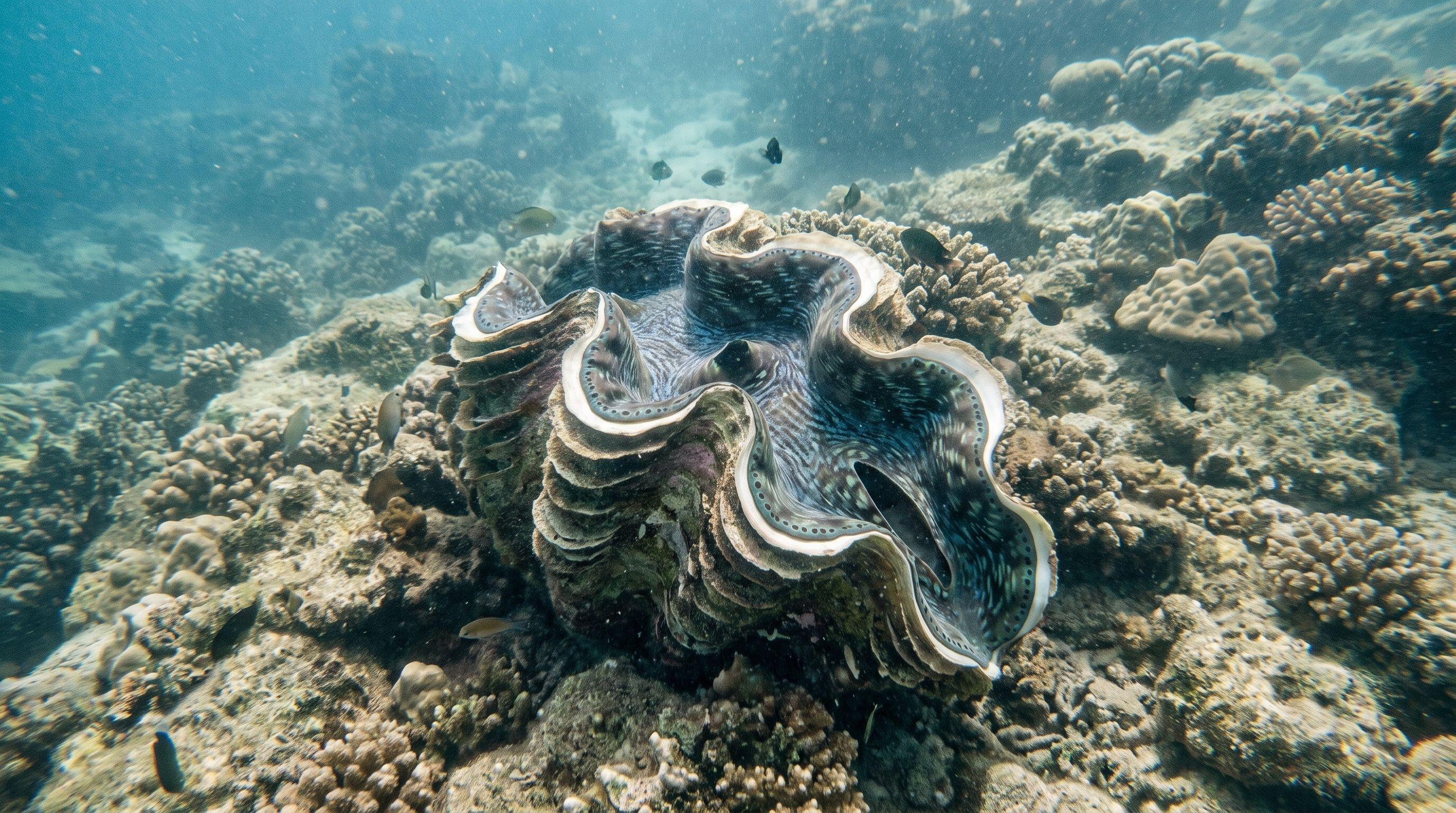
Giant clams are large bivalve molluscs of shallow tropical waters. They host symbiotic single-celled algae (zooxanthellae) in their tissues and obtain much of their nutrition from them, supplemented by filtering plankton from the water. By day they rest with the shell open, exposing a fleshy and often brightly coloured mantle.
Identification
- Shell: Two heavy valves, often with strong radiating ribs, sitting with the opening facing upward.
- Mantle: Coloured in blues, greens, browns or mottled yellow-green, and variable even within one species.
- Size: From about 15 cm shell length in the crocus giant clam (T. crocea) to 137 cm in T. gigas, the largest known bivalve.
- Bear paw clam: Hippopus hippopus has thick, heavy, triangular valves, often reddish-spotted and encrusted, and a mottled yellow-green mantle.
Conservation and the "Man-Eater" Myth
Conservation status varies by species. As verified examples, the IUCN Red List assesses T. gigas as Critically Endangered and H. hippopus as Vulnerable, while T. crocea is Least Concern (all assessed in 2024). Species including T. crocea, T. maxima and H. hippopus are listed on CITES Appendix II, which regulates international trade. Despite old stories, National Geographic notes that no account of a human death by giant clam has ever been substantiated, and that their shell-closing muscles move far too slowly to take a swimmer by surprise.
Because mantle colours overlap between species, shell shape and size are more useful for identification than colour. Records without a clear photograph of the shell are best kept in this group entry.
Where it lives.
Giant clams live in warm, clear waters of the tropical Indo-Pacific. Ranges differ by species: the small giant clam (T. maxima) is the most widespread, from the central Pacific to the Red Sea, while T. gigas occurs from Myanmar east to Wallis and Futuna, north to Japan and south to Australia.
The ranges of the different species overlap widely, so more than one species can occur in the same area. The crocus giant clam, for example, is recorded from the Andaman Islands to Fiji, north to Japan and south to New Caledonia and Queensland.
Typical Settings
- Shallow reefs and lagoons: NOAA describes T. maxima on shallow coral reefs and in atoll lagoons; H. hippopus occurs in lagoons and on barrier and fringing reefs.
- Reef flats: Smaller species such as T. crocea are found on corals in intertidal areas.
- Depth: SeaLifeBase gives 0–35 m for T. gigas, 0–30 m for H. hippopus and 0–20 m for T. crocea.
- Temperature: These species are listed from tropical waters of about 23–30 °C.
Why They Stay Shallow
Because their symbiotic algae need sunlight, giant clams live where light reaches the bottom, which is why most encounters happen on shallow reefs and in lagoons. The largest species are sedentary: National Geographic notes that once T. gigas attaches to a spot on the reef, it stays there for the rest of its life. Overharvesting for meat and shell has nearly eliminated T. gigas from part of its range, and aquaculture is being used to restock reefs.
How it behaves.
Giant clams are sessile, but they are not inactive. By day they open the shell and spread the mantle toward the light, allowing the algae in their tissues to photosynthesise and share sugars and proteins with the clam. They also draw water through a siphon to filter plankton, and SeaLifeBase notes that H. hippopus can take up dissolved matter through its outer tissue. This daily rhythm means clams are most often seen fully open in good light, and a photograph of the open mantle is the most common diver record.
Reproduction
Giant clams are broadcast spawners that release eggs and sperm into the water. Embryos develop into free-swimming trochophore larvae and then into veliger larvae before settling. T. gigas becomes a simultaneous hermaphrodite as it ages, and its spawning is seasonal, varying with latitude. Slow population growth, with a minimum doubling time of 4.5–14 years given for T. gigas and H. hippopus, makes them slow to recover from overharvesting.
People have long used giant clams: SeaLifeBase notes that T. gigas is exploited for its meat and shell, H. hippopus is collected for food and for shellcraft, and T. crocea is used in fisheries and aquaculture.
Underwater Encounter Behavior
- Withdrawal: A clam may pull in its mantle and partly close when disturbed, then reopen once the disturbance has passed.
- Slow closing: Closing is slow; National Geographic notes that the adductor muscles move far too slowly to take a swimmer by surprise.
Diver Tips
- Look, don't touch: Keep hands and fins away from the mantle and shell, and never place objects inside an open clam.
- Mind your fins: Clams sit among shallow corals that are easily damaged by careless finning.
- Approach slowly: Move in gently from the side so the mantle stays open for observation and photography.
- Protected animals: International trade is regulated under CITES; never collect live clams or shells.
Where to see it.
Evidence for philippines · 2 dive sites
General range is not evidence of occurrence at a specific dive site.
Eva's Point
Sipalay
Documented site occurrence
Season not yet documented
Source reviewed on 2026-10-14 · Source: cbartazo.com "Seeking Sipalay" trip report (2017-10-28, single diver, Artistic Diving guest) · Observation date not documented
Shangri-La Marine Sanctuary
Mactan
Documented site occurrence
Season not yet documented
Source reviewed on 2026-10-14 · Source: 7 Seas Dive Center Cebu, dive sites page (Wayback snapshot 2024-06-14) · Observation date not documented
Gallery.
 AI-generated
AI-generated illustration
Image credit: AI-generated illustration · License unspecified · Source unspecified