Giant Clam
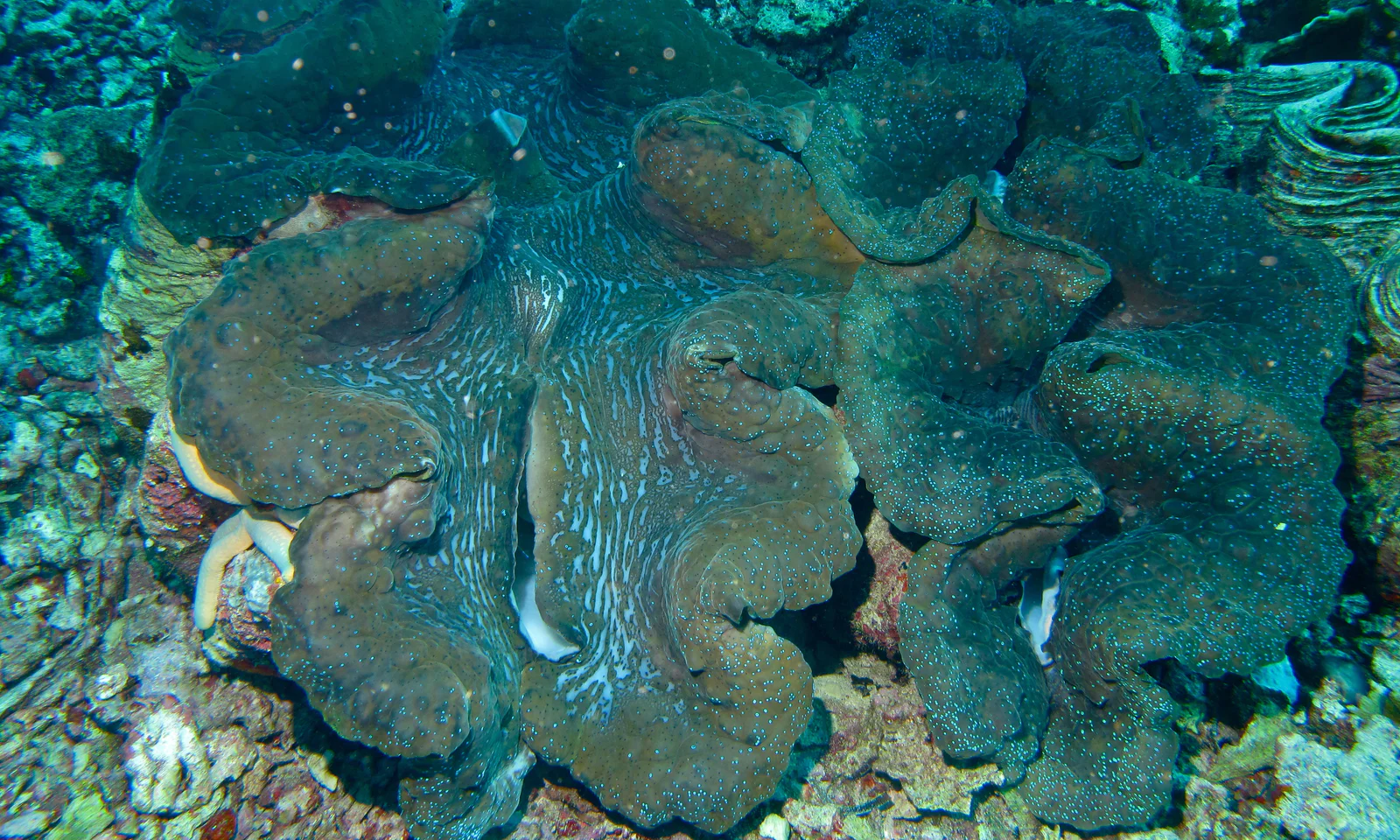
Image credit: Bernard Dupont · CC BY-SA 2.0 · Wikimedia Commons, from Flickr (berniedup), cropped by this page
Tridacna gigas
About Giant Clam.
The giant clam (Tridacna gigas) is the largest living bivalve, a Critically Endangered clam of shallow Indo-Pacific coral sand and rubble.
The World Register of Marine Species (WoRMS) lists Tridacna gigas (Linnaeus, 1758) as an accepted species of the family Cardiidae, in the order Cardiida of the bivalves. Wikipedia calls it the best-known species of the genus Tridacna, says giant clams are the largest living bivalve molluscs, and adds that several other Tridacna species are often misidentified as T. gigas.
Identification
SeaLifeBase gives a maximum shell length of 137 cm, a common length of 80 cm and a maximum published weight of 500 kg. Wikipedia says the species may weigh more than 200 kg and measure up to 120 cm across. It describes the largest known specimen, found around 1817 on the north-western coast of Sumatra, as 137 cm long and 230 kg dead, and a heavier one, found off the Japanese island of Ishigaki in 1956, as 115 cm long and 333 kg dead.
Wikipedia says the shell has four or five vertical folds, which tell it apart from the similar T. derasa with six or seven, and that adults are the only giant clams unable to close their shells completely, so part of the brownish-yellow mantle stays visible. Young T. gigas, it says, are difficult to distinguish from other giant clams. SeaLifeBase describes the shell as white and fan-shaped with deep radiating ribs.
Conservation
SeaLifeBase shows the giant clam as Critically Endangered on the IUCN Red List, assessed on 23 May 2024, and Wikipedia cites the same 2024 assessment by Neo and Li. Both say it is listed in Appendix II of CITES; Wikipedia says this means international trade is regulated, and SeaLifeBase describes international trade as monitored. SeaLifeBase says over-collecting for its meat and shell has made it nearly extinct within an important part of its range. Wikipedia says wild numbers have been greatly reduced by harvesting for food and the aquarium trade, and that it has been reported as locally extinct in peninsular Malaysia.
Where it lives.
The giant clam lives on shallow Indo-Pacific coral reefs, on flat coral sand or broken coral.
Range
SeaLifeBase gives its range as the Indo-Pacific from Myanmar east to Wallis and Futuna, north to Japan and south to western Australia, between about 38°N and 29°S, and says it has been introduced beyond Wallis and Futuna in the Pacific. Wikipedia names the Philippines and the coral reefs of Malaysia in the South China Sea, and says populations are diminishing quickly and the species has become extinct in many areas where it was once common.
Depth and water
Wikipedia says the giant clam is generally found at depths of 6 to 65 ft (about 2 to 20 m) and may be found as deep as 20 m. SeaLifeBase gives a depth range of 0 to 35 m and a tropical water temperature range of 23 to 30 °C.
How often divers see giant clams at a particular site is not documented in these sources.
How it behaves.
The giant clam is fixed to the reef as an adult and gets most of its food from algae in its mantle, which it spreads out in daylight.
Feeding
Wikipedia says giant clams are filter feeders, yet 65 to 70 percent of their nutritional needs are supplied by zooxanthellae, single-celled algae living in the mantle tissue. By day the clam opens its shell and extends its mantle so that the algae receive the sunlight they need. SeaLifeBase also describes this symbiosis, which it says allows the clam to survive.
Divers and the mantle
Wikipedia says the mantle border carries several hundred to several thousand pinhole eyespots about 0.5 mm across, which let the clam partly close its shell when the light dims or changes direction, or when an object moves. It says stories of giant clams trapping people are myths: the slow contraction of the adductor muscle, and the need to force water out of the shell while closing, prevent a giant clam from trapping a human.
Reproduction and growth
Wikipedia says T. gigas is a hermaphrodite that cannot fertilise itself and reproduces by broadcast spawning, releasing eggs and sperm into the water. An adult can release more than 500 million eggs at a time, and spawning seems to coincide with incoming tides near the second, third and fourth quarters of the moon. SeaLifeBase says it becomes a simultaneous hermaphrodite in its later years and spawns seasonally, depending on the northern and southern limits of its range, and gives a length at first maturity of 25 to 35 cm.
Wikipedia says the larvae are planktonic and settle at roughly one week old, that a clam is considered a juvenile at 20 cm long, and that laboratory-reared giant clams have been observed to grow 12 cm a year. It gives an average lifespan in the wild of more than 100 years.
Where to see it.
Evidence for great barrier reef · 4 dive sites
General range is not evidence of occurrence at a specific dive site.
Challenger Bay
Ribbon Reefs
Site occurrence not yet documented
Season not yet documented
No dated observations available.
Flynn Reef
Cairns
Site occurrence not yet documented
Season not yet documented
No dated observations available.
Hastings Reef
Cairns
Site occurrence not yet documented
Season not yet documented
No dated observations available.
Michaelmas Cay
Cairns
Site occurrence not yet documented
Season not yet documented
No dated observations available.
Gallery.
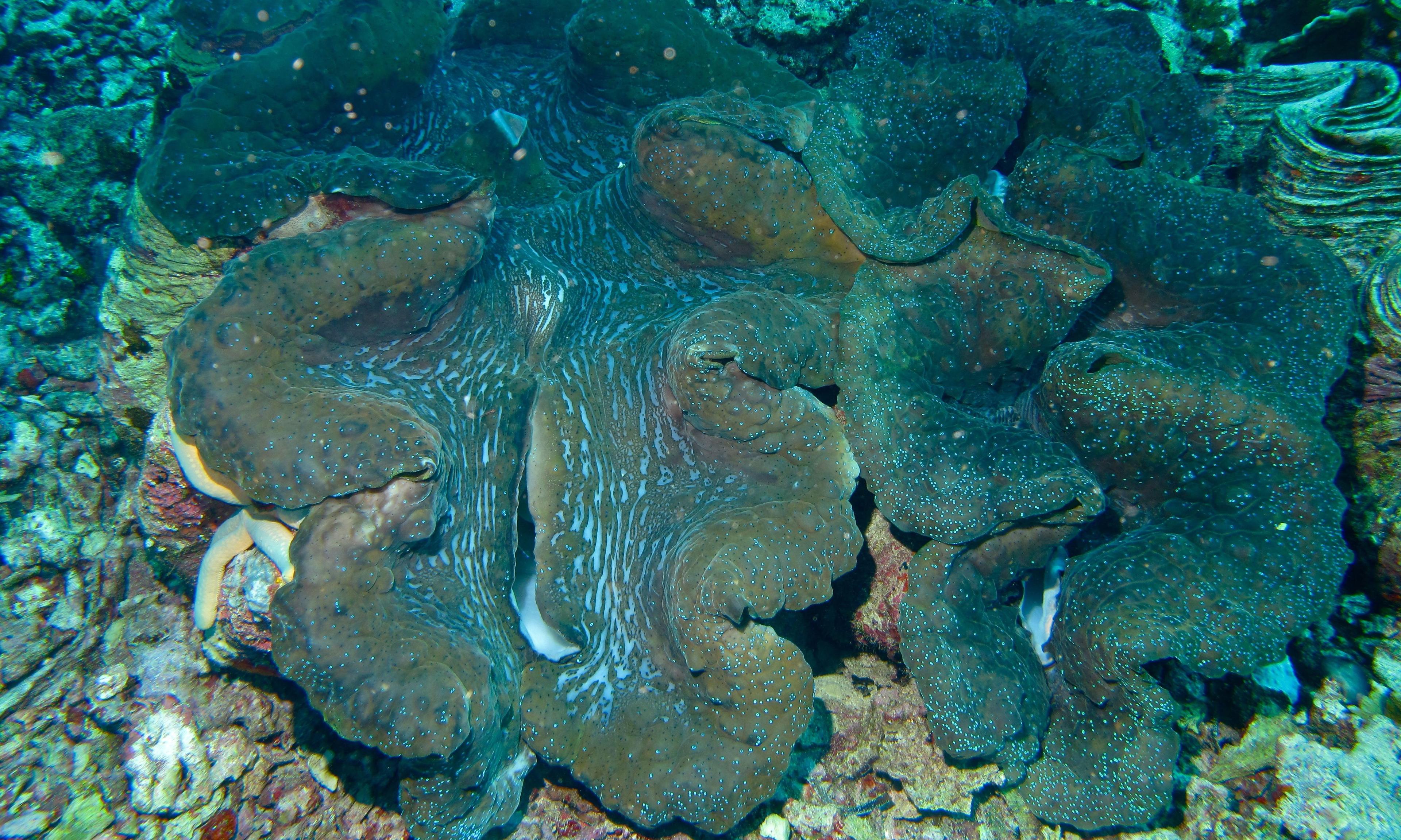
A giant clam (Tridacna gigas) with its mantle open on the reef at Fukui, off Bunaken Island, North Sulawesi, Indonesia, photographed on 6 October 2009. The species is the photographer's identification. It illustrates the species and is not a sighting record. This page's frame crops the photograph.
Image credit: Bernard Dupont · CC BY-SA 2.0 · Wikimedia Commons, from Flickr (berniedup), cropped by this page
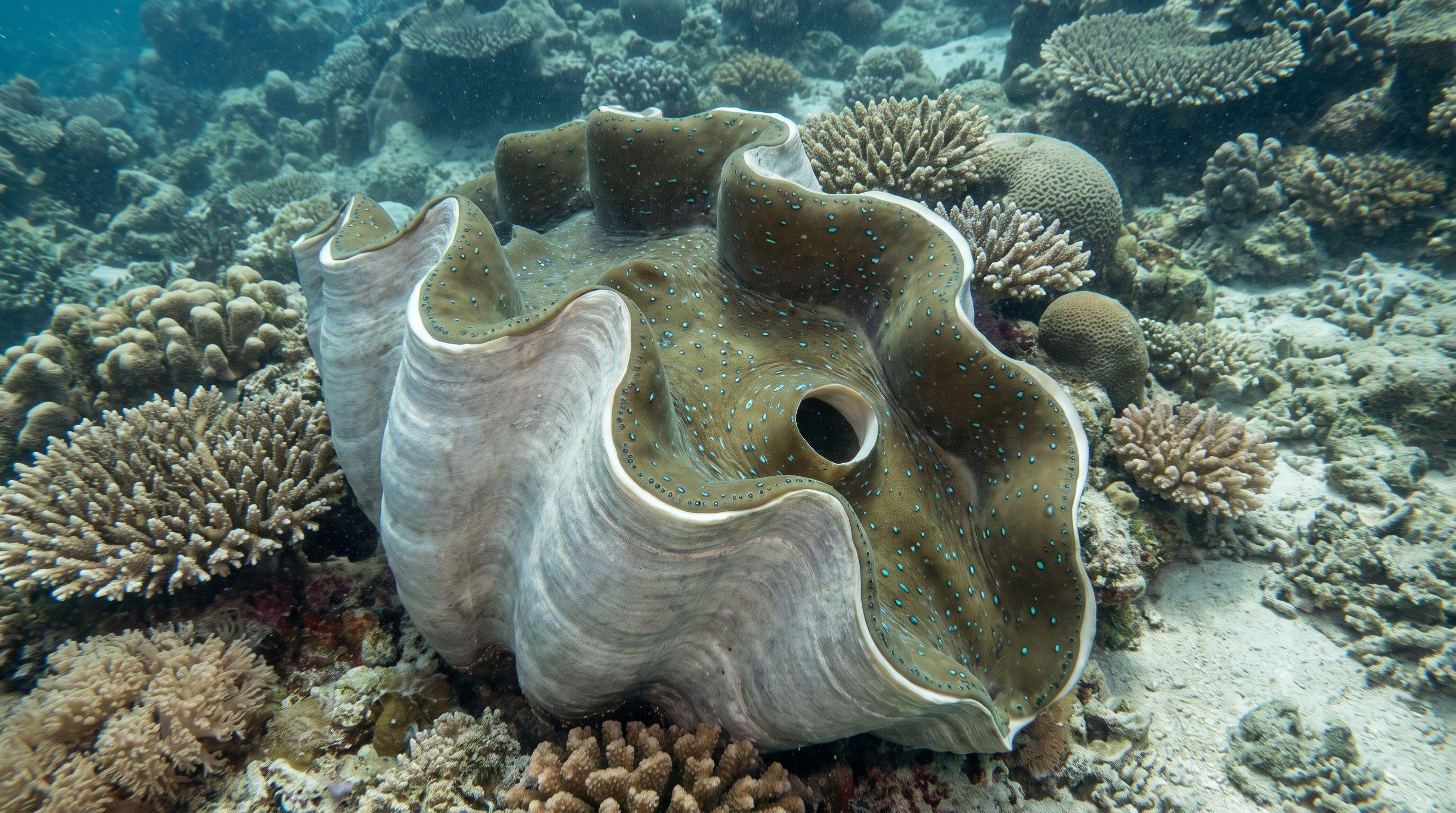 AI-generated
 illustration
Image credit: AI-generated illustration · Diveity