Giant Frogfish
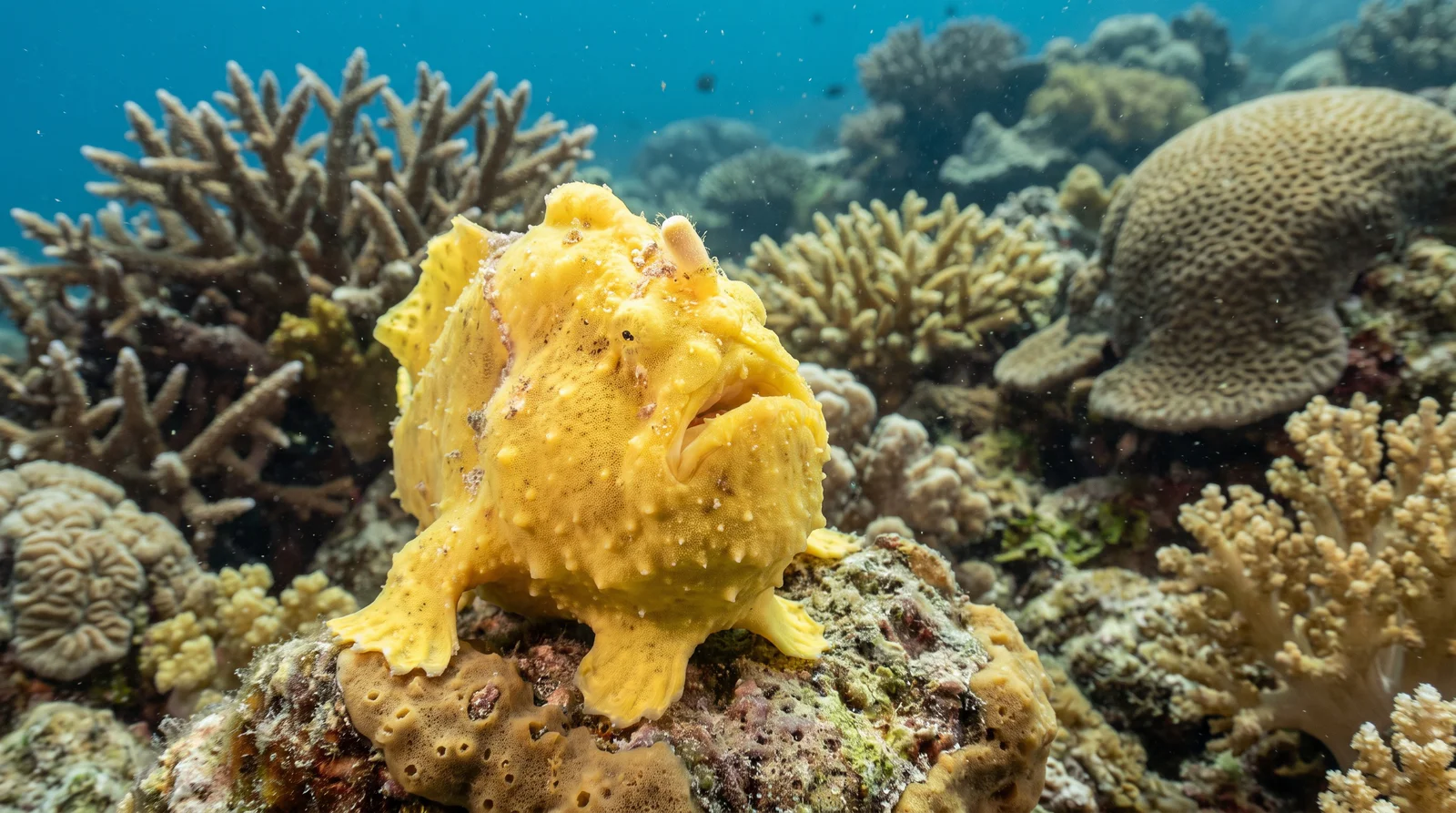 AI-generated
Image credit: AI-generated illustration · Diveity
Antennarius commerson
About Giant Frogfish.
The giant or Commerson's frogfish is a large, globular frogfish of Indo-Pacific reefs, lagoons and jetties, reaching about 38 to 45 cm.
Names and classification
WoRMS accepts Antennarius commerson (Lacepède, 1798) in the frogfish family Antennariidae, order Lophiiformes, and lists the same name credited to Latreille, 1804 as unaccepted; its one Japanese name is オオモンカエルアンコウ. Wikipedia gives both Commerson's frogfish and giant frogfish as English names. The species dates from Lacépède's description of 1798, in the genus Lophius, with Mauritius as its type locality, according to the same encyclopedia; the name honours the French naturalist Philibert Commerçon, whose note Lacépède used, and is often wrongly credited to Latreille. Wikipedia files it with Antennarius pictus and its relatives in that species' group. FishBase adds that some authors have referred to it as Antennarius moluccensis.
Identification
Wikipedia describes a globular, extensible body and soft skin covered with small dermal spinules, with a few small wart-like bumps, scab-like blotches and a few small eye spots that recall the holes of a sponge. The large mouth is prognathous, its jaw jutting forward, and the frogfish can swallow prey as large as itself. In the same article the fish tends to match the shades around it, ranging between grey and black by way of cream, pink, yellow, red and brown, usually with circular spots or blotches darker than the background, and an individual can change colour within a few weeks; FishBase names yellow, orange, green, brown and black. FishBase counts 3 dorsal spines, 12 or 13 dorsal soft rays and 8 anal soft rays. Wikipedia adds that juveniles are easily confused with Antennarius maculatus and Antennarius pictus.
The lure
The first dorsal spine, the illicium, serves as a fishing rod with a lure, the esca, at its tip. Wikipedia describes the esca as looking like a small fish or shrimp, pinkish to brownish, and the illicium as twice the length of the second dorsal spine and often darkly banded. FishBase describes the esca as a small tuft of flattened appendages and gives the bony part of the illicium as about equal in length to the second dorsal spine.
Size
The largest giant frogfish in FishBase measures 45 cm from snout to tail tip, and the database counts the species among the biggest frogfishes. Wikipedia gives up to 38 cm total length.
Conservation and people
On the IUCN Red List the giant frogfish is a species of Least Concern, assessed on 30 April 2021 by the date FishBase takes from the list's 2025-2 edition; the assessment that Wikipedia points to was written by T. Pietsch and appeared in 2022. FishBase says the species is of no interest to fisheries.
Where it lives.
The giant frogfish lives on lagoon and seaward reefs, often on sponges, ropes and jetty pillars, from the surface to about 70 m and usually above 20 m.
Range
FishBase gives the Indo-Pacific and eastern Pacific, from the Red Sea and South Africa to Panama, north to southern Japan and the Hawaiian Islands and south to Lord Howe Island and the Society Islands, in tropical waters between 32° N and 32° S. In Wikipedia's account its warm-water range stretches across the Indian Ocean and the Pacific as far as the Pacific's eastern shores; the type locality of its first description is Mauritius.
Depth and bottom
FishBase describes it as a marine, reef-associated fish of lagoon and seaward reefs, often found on jetties, solitary and frequently among sponges. Its depth figures differ by reference: one has the fish from the surface to 70 m and mostly no deeper than 20 m, another between 1 and 50 m and mostly shallower than 20 m. Wikipedia places it in lagoons and on sheltered rocky and coral reefs, usually with large sponges, on underwater ropes, on jetty pillars or on any structure down to 70 m, with an average depth of 20 m.
How it behaves.
The giant frogfish lies in wait alone on the bottom and uses the lure on its first dorsal spine to attract fish and small shrimps.
Feeding
Wikipedia calls it a greedy predator, as frogfishes in general are: it strikes at any small animal that comes close enough, above all fish, occasionally including other members of its genus, and its wide mouth can take prey as big as the frogfish itself. FishBase lists fish and small shrimps as its food and, from what is known of its diet, places it at trophic level 4.2.
Movement
The picture caption of Wikipedia's article says that the frogfish uses its pelvic fins to walk on the bottom and to keep a stable position for an ambush.
Living alone and breeding
Wikipedia says it lives on the bottom and alone; they come together to mate, then stop putting up with one another once the eggs are fertilised, and the female can kill or eat the male if he stays close. FishBase adds that its eggs come wrapped together in a ribbon of mucus or a jelly-like mass, the so-called egg raft or veil.
Where to see it.
Evidence for visayas · 13 dive sites
General range is not evidence of occurrence at a specific dive site.
Balicasag Sanctuary (Rico's Wall)
Panglao
Site occurrence not yet documented
Season not yet documented
No dated observations available.
Balinghai Wall
Boracay
Documented site occurrence
Season not yet documented
Source reviewed on 2026-10-14 · Source: Wicked Squid Divers Boracay (Wayback snapshot 2026-03-12 of /boracay-dive-sites/) · Observation date not documented
Diver's Heaven
Panglao
Site occurrence not yet documented
Season not yet documented
No dated observations available.
Gorgonian Wall
Cabilao Island
Site occurrence not yet documented
Unverified: Jan, Feb, Mar, Apr, May, Jun, Jul, Aug, Sep, Oct, Nov, Dec
No dated observations available.
Kontiki Reef
Mactan
Documented site occurrence
Season not yet documented
Source reviewed on 2026-10-14 · Source: Divernet, "Don't Miss Mactan" by Henley Spiers (2018-11-18) · Observation date not documented
Lamanok
Anda
Documented site occurrence
Season not yet documented
Source reviewed on 2026-10-03 · Source: Nigel Marsh / Diveplanit · Observation date not documented
Mamsa Point
Apo Island
Documented site occurrence
Season not yet documented
Source reviewed on 2026-10-02 · Source: Bongo Bongo Divers — undated named-site description; not a recent sighting record · Observation date not documented
Napaling Reef
Panglao
Site occurrence not yet documented
Season not yet documented
No dated observations available.
Napantao Marine Sanctuary
Southern Leyte
Documented site occurrence
Season not yet documented
Source reviewed on 2026-10-02 · Source: Peter’s Dive Resort — undated named-site description; not a recent sighting record · Observation date not documented
Pescador Island (The Cathedral)
Moalboal
Documented site occurrence
Season not yet documented
Source reviewed on 2026-10-02 · Source: Aggressor Adventures — Cathedral, June 29, 2022 voyage log (historical record) · Observation date not documented
Pyramids
Dauin
Documented site occurrence
Season not yet documented
Source reviewed on 2026-10-02 · Source: Bongo Bongo Divers — undated named-site description; not a recent sighting record · Observation date not documented
Sardine Run
Moalboal
Regional evidence — occurrence at this site is not confirmed
Season not yet documented
Source reviewed on 2026-10-02 · Source: Master Liveaboards — Panagsama Beach; broader beach context, not exact sardine-run footprint · Observation date not documented
Snappers
Anda
Site occurrence not yet documented
Unverified: Jan, Feb, Mar, Apr, May, Jun, Jul, Aug, Sep, Oct, Nov, Dec
No dated observations available.
Gallery.
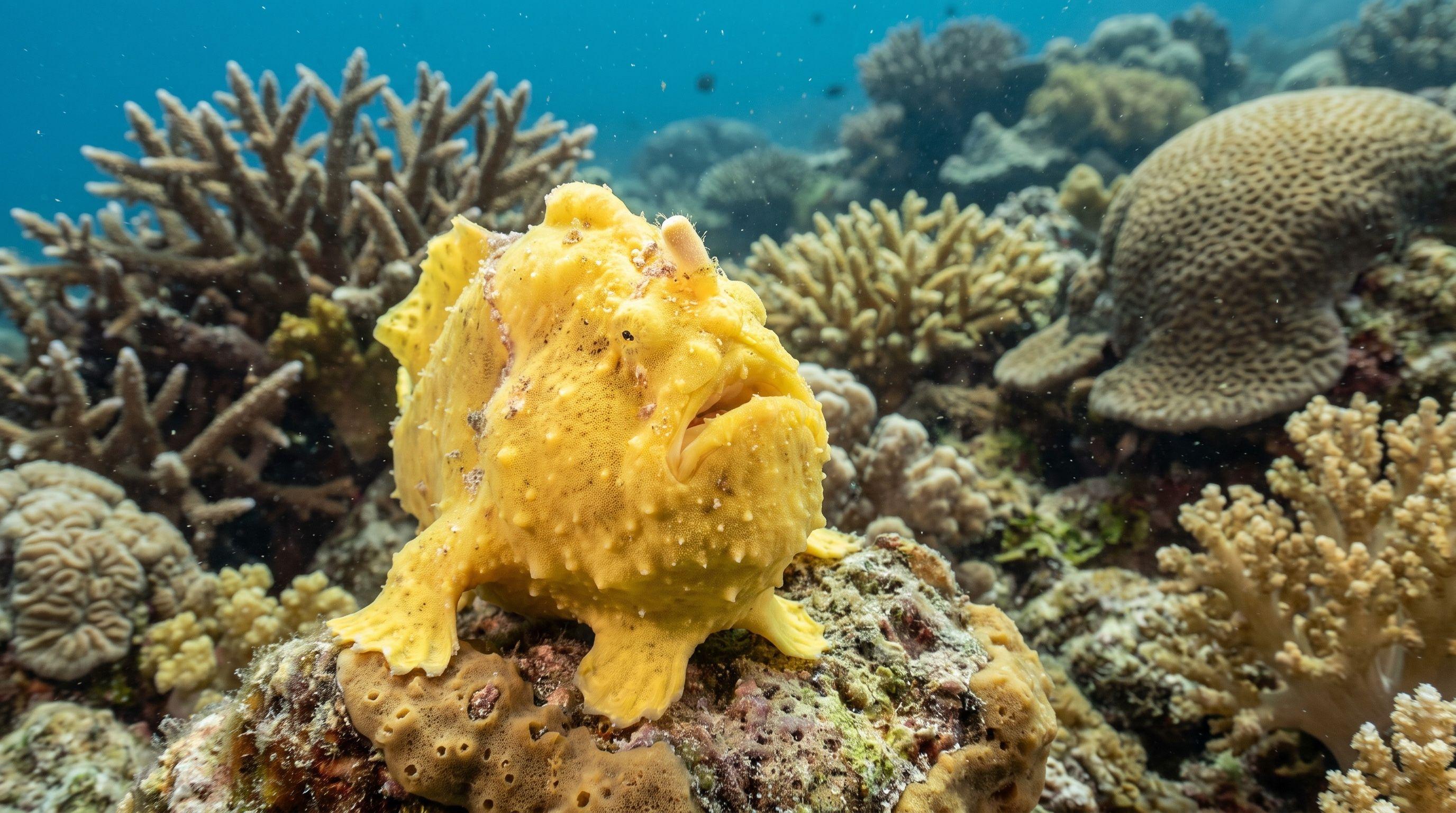 AI-generated
 illustration
Image credit: AI-generated illustration · Diveity