Giant Moray
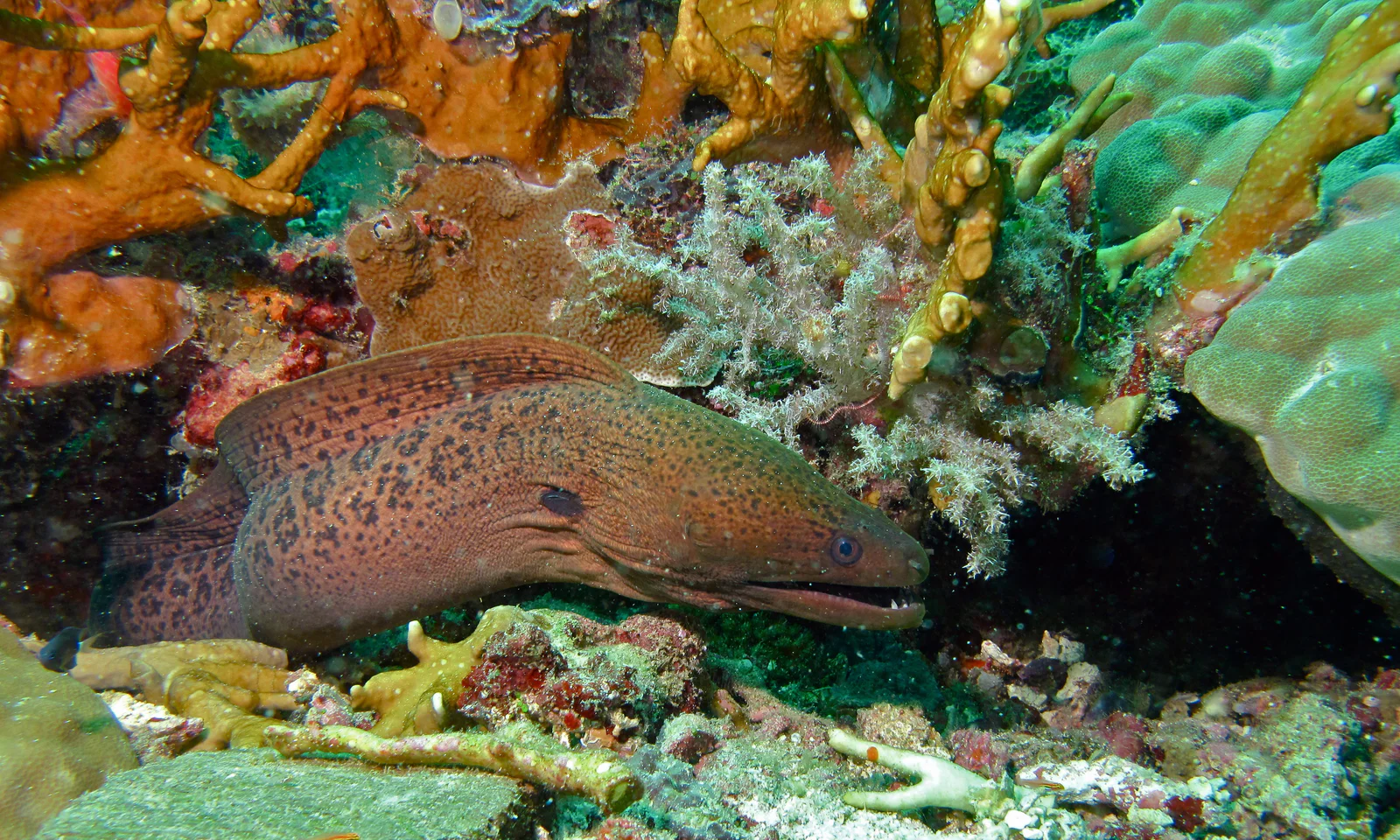
Image credit: Bernard DUPONT · CC BY-SA 2.0 · Wikimedia Commons, from Flickr (berniedup), cropped by this page
Gymnothorax javanicus
About Giant Moray.
The giant moray (Gymnothorax javanicus) is a large brown moray eel with leopard-like spots, living in Indo-Pacific lagoons and on reefs down to about 50 m.
The World Register of Marine Species (WoRMS) lists Gymnothorax javanicus (Bleeker, 1859) as an accepted species of the moray family Muraenidae, in the order Anguilliformes. Wikipedia says it is the largest moray eel by body mass, while the slender giant moray is the longest, and FishBase calls it the largest Indo-Pacific moray eel.
Identification
FishBase gives a maximum length of 300 cm total length and a maximum published weight of 30 kg, and says the species perhaps reaches 3 m. It describes juveniles as tan with numerous large black spots, and adults with black specks that grade into leopard-like spots behind the head and a black area surrounding the gill opening. Wikipedia describes the elongated body as brownish. FishBase gives an eel-like body with no dorsal or anal spines and 137 to 143 vertebrae.
Conservation
FishBase shows the giant moray as Least Concern on the IUCN Red List, assessed on 17 August 2011, and Wikipedia cites a 2019 Red List assessment, also Least Concern. FishBase records reports of ciguatera poisoning and lists subsistence fisheries and public aquariums among its human uses.
Where it lives.
The giant moray lives on Indo-Pacific coral reefs, in lagoons and on seaward reefs, and shelters by day in reef holes and crevices.
Range
FishBase gives its range as the Indo-Pacific, from the Red Sea and East Africa to the Marquesas and Oeno Atoll in the Pitcairn Group, north to the Ryukyu and Hawaiian islands and south to New Caledonia and the Austral Islands, between about 30°N and 25°S. Wikipedia gives a similar range and also names southern Japan and Fiji.
Depth
FishBase gives a depth range of 0 to 50 m. Wikipedia says that by day the giant moray sits sheltered in crevices between 1 and 50 m deep.
Reef setting
FishBase describes the species as reef-associated and benthic, found in lagoon and seaward reefs and solitary in reef holes. It says the giant moray is commonly seen along deep drop-offs and slopes in Indonesian waters, and that juveniles are more secretive and occur on intertidal reef flats. Wikipedia says it lives in lagoons and on the outer slopes of coral reefs.
How often divers see giant morays at a particular site, and the water temperatures they prefer, are not documented in these sources.
How it behaves.
The giant moray shelters in reef crevices by day and hunts inside the reef at night, feeding mainly on fish.
Feeding
Wikipedia describes the giant moray as carnivorous and nocturnal, hunting its prey within the reef, and FishBase says it feeds primarily on fishes and occasionally on crustaceans. Wikipedia reports that it was recently identified as a natural predator of the lionfish Pterois miles in the Red Sea, and that its very small optic tectum suggests it hunts mainly by smell rather than by sight.
Hunting with groupers
Wikipedia, citing a 2006 Red Sea study by Bshary and colleagues, says the giant moray hunts cooperatively with the roving coral grouper (Plectropomus pessuliferus). An eel hunting inside the reef may scare prey out into the open, where the grouper can take it, and a grouper hunting above the reef may drive prey into the reef, where the moray may ambush it.
Divers and hazards
Wikipedia says the giant moray is not usually aggressive but may bite if it is threatened, cornered or in the presence of food, and FishBase says it attacks humans when provoked. Both say that, at the top of the reef food chain, it can carry ciguatera toxins.
Reproduction
FishBase records prespawning behaviour in which a pair lay entwined around one another on the bottom of the reef. Its summary gives no length at maturity, and spawning seasons are not documented in these sources.
Where to see it.
Evidence for visayas · 6 dive sites
General range is not evidence of occurrence at a specific dive site.
Arco Point
Panglao
Site occurrence not yet documented
Season not yet documented
No dated observations available.
Balicasag Sanctuary (Rico's Wall)
Panglao
Site occurrence not yet documented
Season not yet documented
No dated observations available.
Cathedral
Panglao
Site occurrence not yet documented
Season not yet documented
No dated observations available.
Cervera Shoal
Panglao
Site occurrence not yet documented
Season not yet documented
No dated observations available.
Napaling Reef
Panglao
Site occurrence not yet documented
Season not yet documented
No dated observations available.
Rudy's Rock
Panglao
Site occurrence not yet documented
Season not yet documented
No dated observations available.
Gallery.
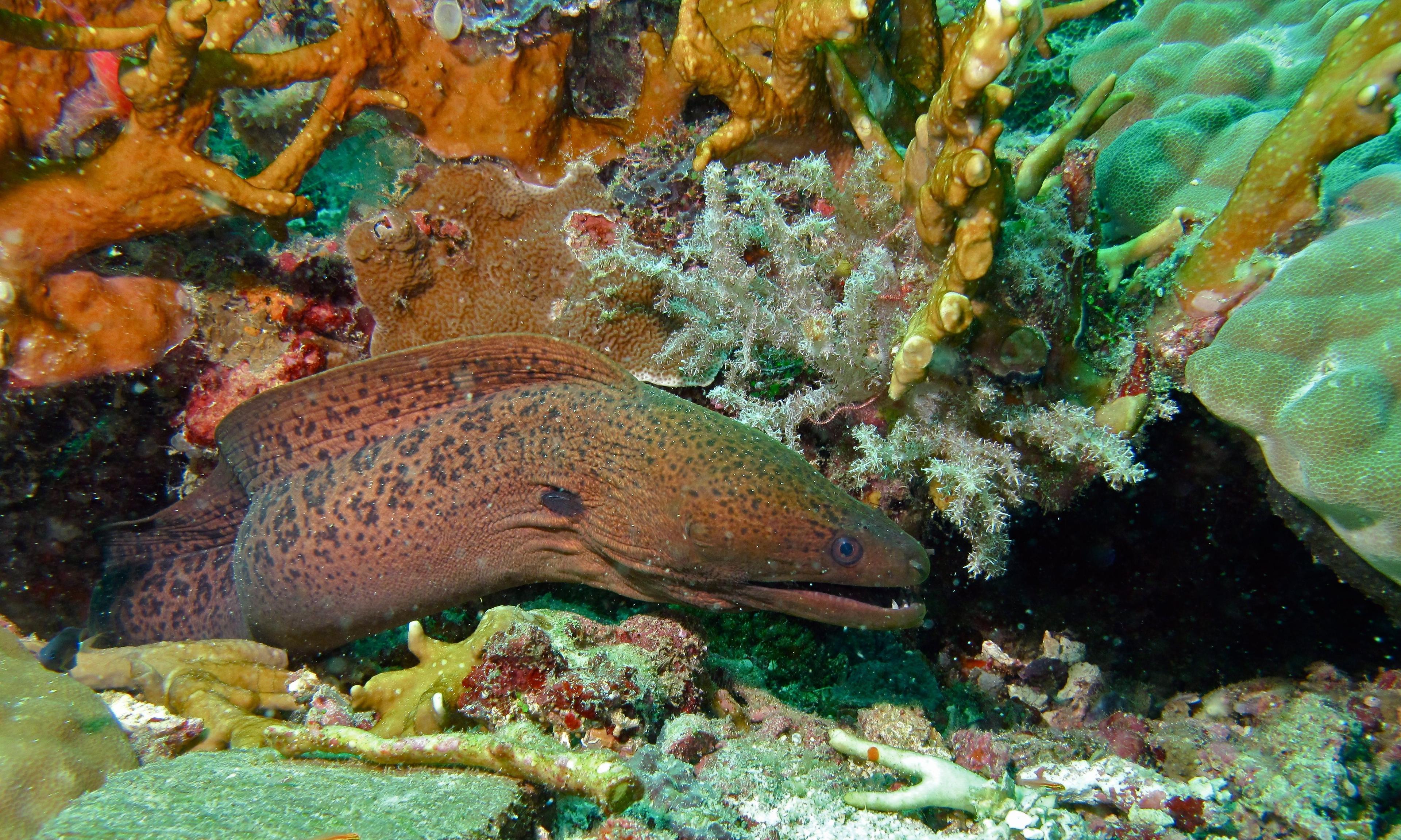
A giant moray (Gymnothorax javanicus) partly out of a coral crevice at Barracuda Point, Pulau Sipadan, Sabah, Malaysia, photographed on 25 January 2010, as its file page states. The species is the photographer's identification. It illustrates the species and is not a sighting record. This page's frame crops the photograph.
Image credit: Bernard DUPONT · CC BY-SA 2.0 · Wikimedia Commons, from Flickr (berniedup), cropped by this page
 AI-generated
 illustration
Image credit: AI-generated illustration · Diveity