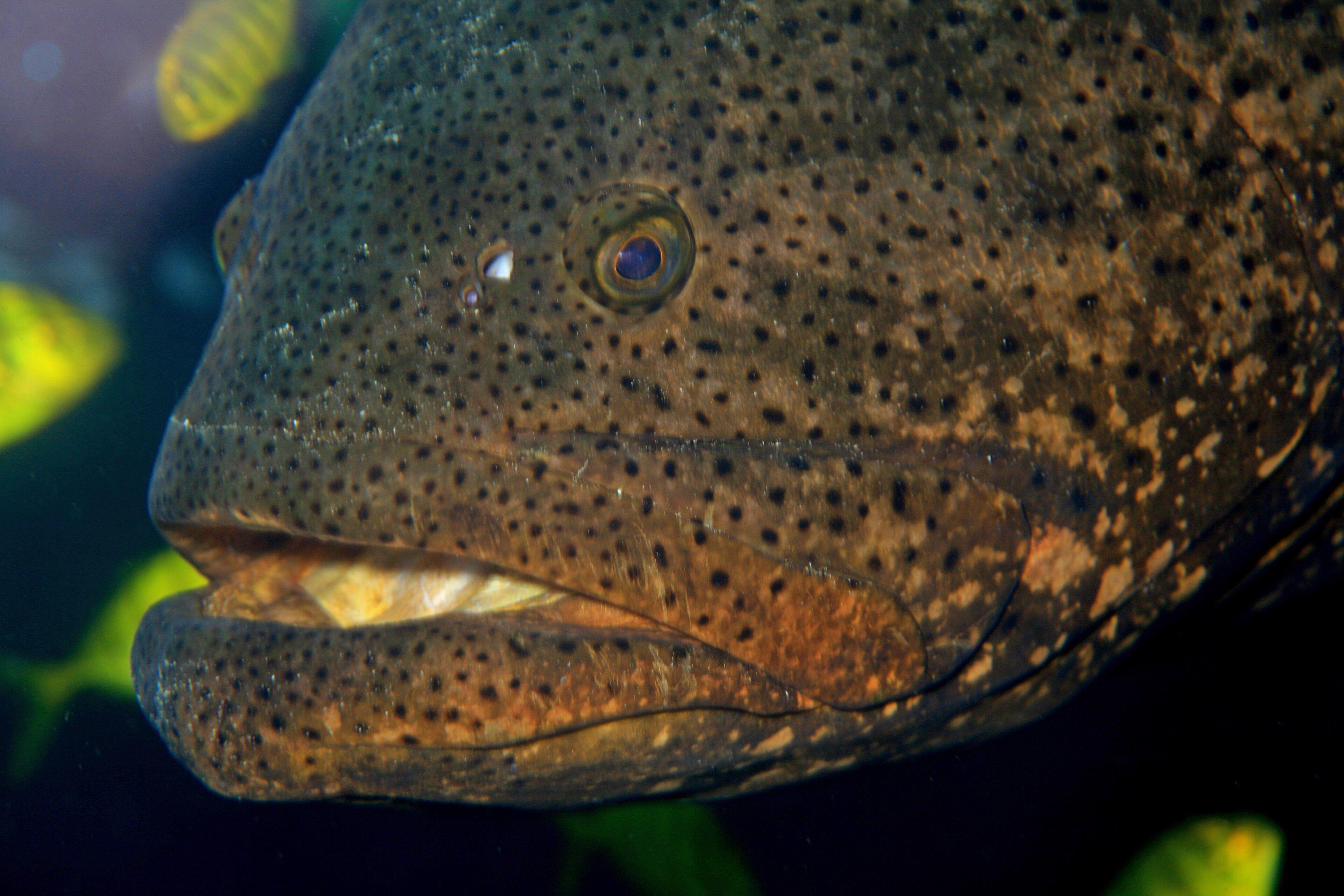
Goliath Grouper
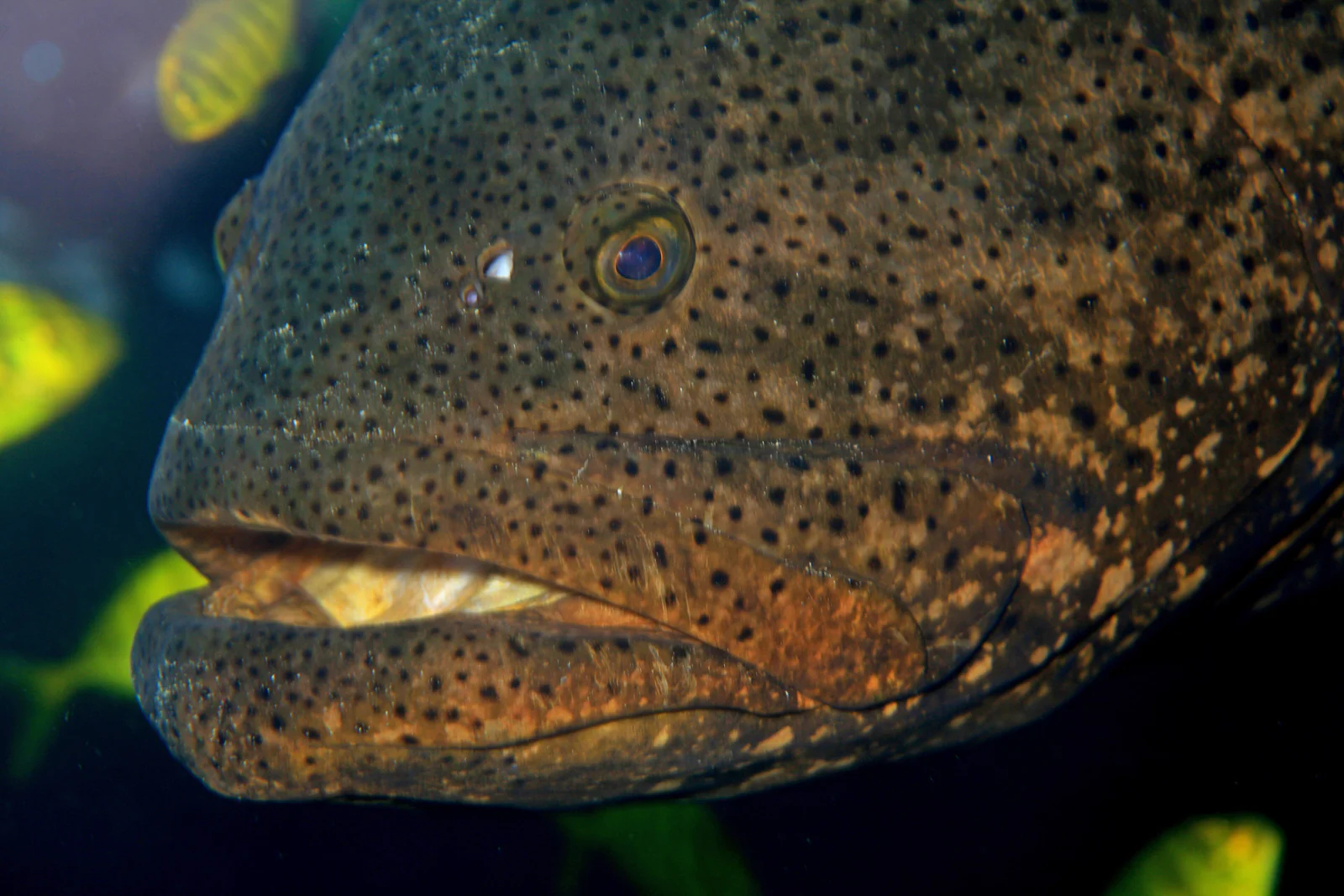
Epinephelus itajara
About Goliath Grouper.
The Goliath Grouper (Epinephelus itajara), a magnificent member of the Serranidae family, stands as one of the largest bony fish in the Atlantic Ocean. This impressive species is a true heavyweight of the reef, known for its immense size and commanding presence in its marine environment. Once severely overfished, the Goliath Grouper is currently listed as Vulnerable by the IUCN, a significant improvement from its previous Critically Endangered status, thanks to conservation efforts.
These gentle giants inhabit tropical and subtropical waters, preferring shallow, inshore areas. Divers can encounter them around a variety of structures, including rocky reefs, coral reefs, shipwrecks, artificial reefs, and even over mud bottoms. Juveniles, however, seek refuge in vital mangrove habitats and brackish estuaries, which serve as crucial nursery grounds. Goliath Groupers are typically found at depths ranging from 1 to 100 meters, though adults may be observed deeper, down to 200 meters. They thrive in warm waters, with their distribution being sensitive to temperatures below 11°C.
Primarily solitary and territorial, Goliath Groupers are ambush predators. Their diet mainly consists of slow-moving bottom dwellers such as crustaceans (crabs, shrimp, spiny lobsters), various fish, and cephalopods like octopus. The species has shown remarkable recovery in U.S. waters, particularly off Florida, following a harvest moratorium enacted in 1990 (and 1993 in the U.S. Caribbean). Dive sites like Cabo Pulmo are celebrated examples where these massive groupers have made a significant comeback, offering divers incredible encounters with these recovering populations.
Identification
Identifying a Goliath Grouper is relatively straightforward due to its distinctive characteristics:
- Size: They are truly massive, capable of reaching lengths of up to 2.5 meters (8.2 ft) and weighing over 360 kg (800 lbs), with some reports indicating weights up to 455 kg (1000 lbs).
- Body Shape: The body is robust, thick, and elongated, featuring an exceptionally broad, flat head and relatively small eyes.
- Coloration: Adults typically display a brownish-yellow, grey, or olive hue, adorned with numerous small, dark spots scattered across their head, body, and fins. Older, larger individuals often exhibit a more subdued, darker coloration.
- Juveniles: Younger Goliath Groupers are often tawny or orange-brown, characterized by irregular dark vertical bands and blotches along their sides.
- Fins:
- The dorsal fins are continuous, with the soft rays of the second dorsal fin being noticeably longer than the spines of the first. The membranes between the dorsal fin elements are typically notched.
- Pectoral fins are rounded and distinctly larger than the pelvic fins.
- The caudal (tail) fin is also rounded.
- Mouth and Teeth: They possess a very large mouth. The lower jaw contains three to five rows of small, weakly developed canine teeth, notably lacking prominent front canines.
Where it lives.
The Goliath Grouper (Epinephelus itajara) is a magnificent and imposing inhabitant of tropical and subtropical marine environments across the Atlantic Ocean. Divers frequently encounter these gentle giants in a variety of structured habitats, showcasing their adaptability and preference for complex underwater landscapes.
Geographic Distribution:
This species is primarily found in the Western Atlantic, ranging from the coast of Florida, throughout the Gulf of Mexico and the Caribbean Sea, and south along the coast of Brazil. It also inhabits the Eastern Atlantic, specifically off the coast of West Africa from Senegal to Congo. A closely related species, the Pacific Goliath Grouper (Epinephelus quinquefasciatus), occupies the Eastern Pacific from southern Mexico to Peru.
Habitat and Ecosystems:
Goliath Groupers are strongly associated with areas offering significant structural complexity, which provides both shelter and ambush points for these opportunistic predators. Their habitat preferences vary with age:
- Juveniles: Young Goliath Groupers spend their crucial first 5-6 years in shallow, protected estuarine and mangrove habitats. These mangrove shorelines and estuaries serve as vital nursery grounds, often characterized by brackish water and the presence of oyster bars.
- Adults: As they mature, Goliath Groupers transition to more offshore, shallow reef environments. They are commonly found around a diverse array of structures, including:
- Natural coral and rocky reefs
- Artificial reefs and shipwrecks, which are popular dive sites
- Rocky ledges, overhangs, and caves
- Man-made structures such as rock jetties, bridges, and piers
Depth Range:
Goliath Groupers are typically found in shallow tropical waters. While they generally prefer depths out to about 46 meters (150 feet), they have been observed across a broader range, from as shallow as 1 meter (3 feet) down to 100 meters (300 feet). Spawning aggregations, which occur during late summer, often form at consistent dive sites such as patch reefs and ledges at depths up to 50 meters.
How it behaves.
The Goliath Grouper (Epinephelus itajara) is a truly magnificent inhabitant of tropical and subtropical waters, renowned for its immense size and distinctive underwater presence. As one of the largest bony fish in the world, reaching up to 2.5 meters and weighing over 360 kg, encountering this species is often a highlight for divers.
- Underwater Encounter Behavior:
Goliath Groupers are generally solitary and territorial creatures, often found occupying limited home ranges around structures such as wrecks, rock ledges, and artificial reefs. They are known for producing a powerful, low-frequency "booming" sound using their swim bladder, which can be felt by divers and serves as a territorial defense or courtship display. Despite their formidable size, Goliath Groupers are often described as curious and docile, sometimes approaching divers without fear. However, if they feel threatened, they may exhibit defensive displays such as an open mouth and quivering body, though aggressive actions towards humans are rare.
- Feeding Habits:
As opportunistic ambush predators, Goliath Groupers primarily feed on a diverse diet of crustaceans, including crabs, shrimp, and spiny lobsters. Their diet also includes various fish species, such as stingrays and parrotfish, as well as octopus and even young sea turtles. They employ a unique feeding strategy, using their exceptionally large mouths to create negative pressure, effectively "sucking in" their prey whole. These apex predators play a crucial role in maintaining the health and balance of coral reef ecosystems.
- Social Structure:
Outside of their breeding season, Goliath Groupers are largely solitary, preferring to roam reefs alone. They are considered protogynous hermaphrodites, meaning individuals typically mature first as females and later transition to males, with the largest individuals invariably being male. While generally solitary, they do form impressive aggregations for reproduction.
- Notable Seasonal Patterns:
The most significant seasonal event for divers interested in Goliath Groupers is their annual spawning aggregation. These aggregations occur during the summer months, typically from July through September in the Northern Hemisphere, and are strongly influenced by the lunar cycle, often coinciding with full moons. During this period, Goliath Groupers migrate, sometimes hundreds of kilometers, to specific, predictable dive sites such as shipwrecks, rock ledges, and isolated patch reefs. These gatherings can involve tens to over 100 individuals congregating in waters typically encountered at 15–50 m. Juveniles spend their first five to six years in shallow mangrove estuaries, which serve as critical nursery habitats, before moving to offshore reefs to join adult populations. Goliath Groupers are vulnerable to environmental factors such as cold snaps and red tide events, which can impact their populations.
Where to see it.
Evidence for philippines · No dive sites
General range is not evidence of occurrence at a specific dive site.
No documented dive-site associations in this destination yet.
Gallery.