Gorgonian Sea Fan
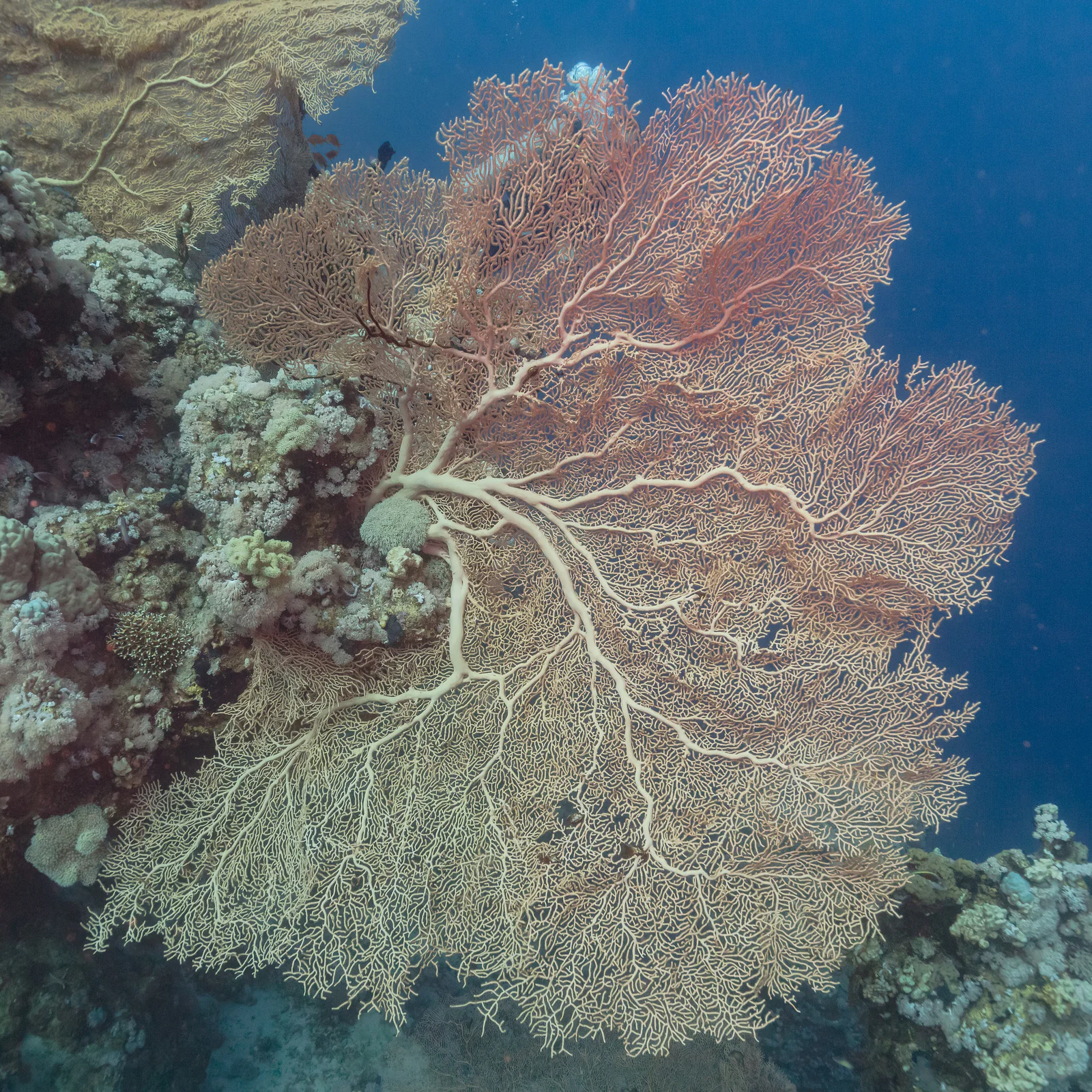
Image credit: Diego Delso · CC BY-SA 4.0 · Wikimedia Commons, cropped by this page
Annella mollis
About Gorgonian Sea Fan.
The gorgonian sea fan (Annella mollis) is an Indo-West Pacific octocoral of lower reef slopes and current-swept reefs, recorded at 12 to 18 m.
Names and classification
In the World Register of Marine Species (WoRMS), Annella mollis (Nutting, 1910) is the valid name, placed in the family Subergorgiidae, order Malacalcyonacea, class Octocorallia. WoRMS gives Euplexaura mollis Nutting, 1910 and Subergorgia mollis as earlier combinations of the name, and Subergorgia hicksoni Stiasny, 1938 as a junior synonym. SeaLifeBase calls it the gorgonian fan, and Wikipedia describes it as a soft coral.
Identification
None of the captured sources describes the colony itself, its shape, size, colour or polyps. Its size is therefore unknown here, and nothing in them helps tell it apart from other sea fans by eye.
Conservation
The IUCN has not assessed it: SeaLifeBase records it as Not Evaluated on the Red List (version 2025-2) and under CITES and CMS, and classes it as harmless to humans.
Where it lives.
The gorgonian sea fan grows on lower reef slopes and reefs exposed to strong tidal currents in the Indo-West Pacific, on rock or sand, at 12 to 18 m.
Range
SeaLifeBase and Wikipedia both give its range as the Indo-West Pacific. WoRMS holds no distribution records for it.
Depth and setting
SeaLifeBase describes it as a reef-associated species of tropical waters with a depth range of 12 to 18 m, citing a 1996 checklist of the gorgonians of Singapore by Goh and Chou; Wikipedia gives the same depths and cites SeaLifeBase, so the figure rests on one source. SeaLifeBase says it inhabits lower reef slopes and the bottom, and reefs exposed to strong tidal currents, on rock or sand substrates. SeaLifeBase also models a preferred water temperature of 24.8 to 29.3 °C with a mean of 28.6 °C, an estimate computed over 2,076 map cells rather than a measured value.
How it behaves.
Denise's pygmy seahorse (Hippocampus denise) is recorded in association with this sea fan of Indo-West Pacific reef slopes and current-swept reefs.
Associated species
SeaLifeBase lists the gorgonian sea fan as associated with Denise's pygmy seahorse (Hippocampus denise). The sources read name no other animal that lives on it.
Reproduction
SeaLifeBase gives only a note for the whole class Anthozoa, not for this species: its members are either gonochoric, with separate sexes, or hermaphroditic, and they spawn their gametes through the mouth. The fertilised egg develops into a planktonic planula larva, which begins to form its tentacles, septa and pharynx before it settles.
For feeding, growth or a spawning season the captured sources give nothing specific to this species, and they say nothing about how often it is seen at a given site or in which months.
Where to see it.
Evidence for great barrier reef · 2 dive sites
General range is not evidence of occurrence at a specific dive site.
Gallery.
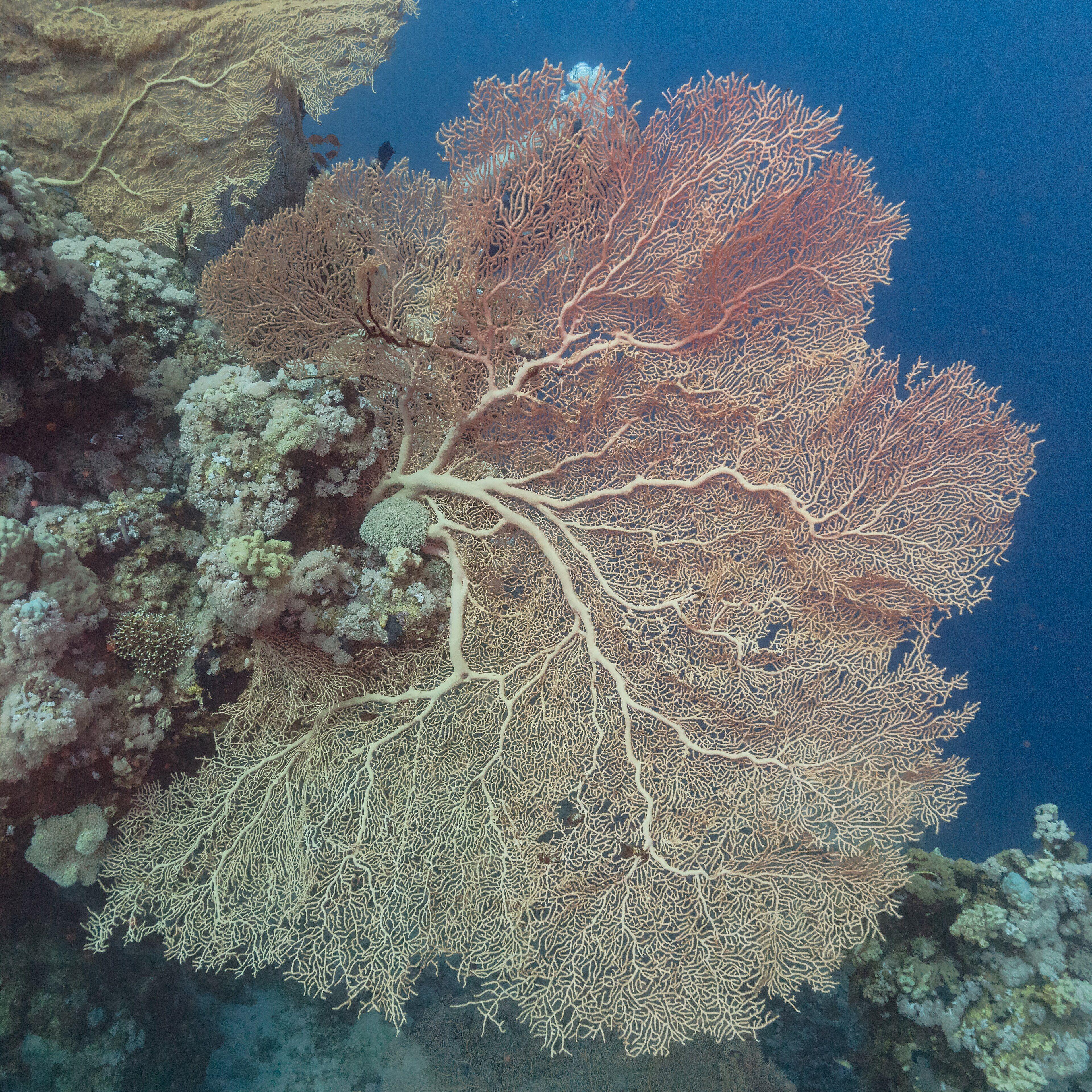
A gorgonian sea fan on a reef wall in open blue water. The photographer, Diego Delso, gives the place as Ras Muhammad National Park in the Red Sea, Egypt, and the date as 28 March 2022 on its Wikimedia Commons file page, which names it Annella mollis. It illustrates the species; it is not a sighting record for any dive site in this guide. This page shows a 3,840-pixel rendition made by Wikimedia Commons, and its frame crops the photograph.
Image credit: Diego Delso · CC BY-SA 4.0 · Wikimedia Commons, cropped by this page
 AI-generated
 illustration
Image credit: AI-generated illustration · Diveity