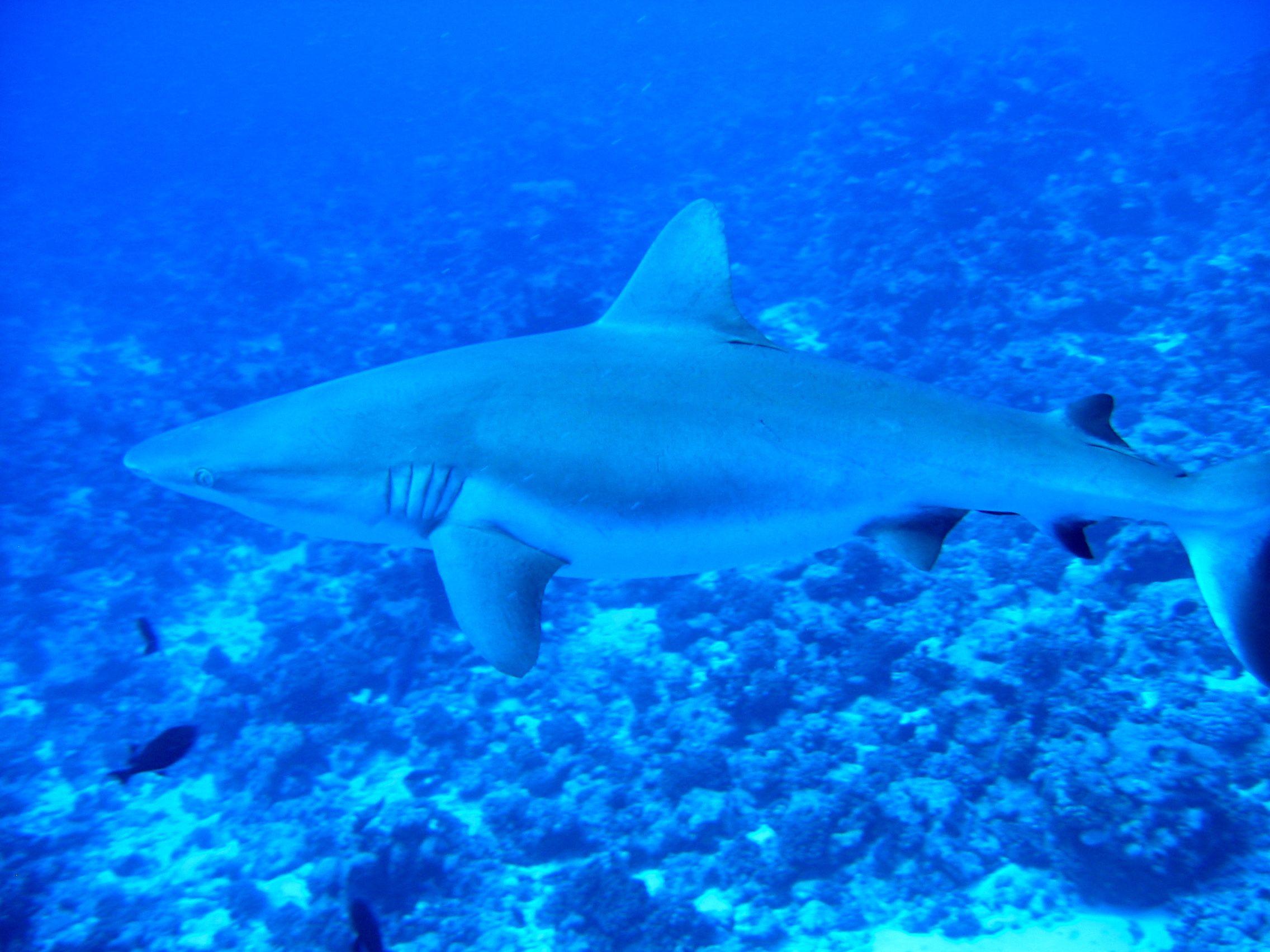
Grey Reef Shark
Carcharhinus amblyrhynchos
About Grey Reef Shark.
The Grey Reef Shark (Carcharhinus amblyrhynchos) is a compact requiem shark belonging to the family Carcharhinidae, frequently observed as a dominant predator on outer-reef walls and channels throughout the Indo-Pacific. This species is a quintessential inhabitant of tropical and subtropical waters, often encountered by divers near coral reef drop-offs and areas with strong currents. Known for its active and agile nature, the Grey Reef Shark plays a crucial role in maintaining the health of reef ecosystems. It is a social species, often forming aggregations of five to 20 individuals during the day, which then disperse at night for solitary hunting.
Despite its widespread distribution, the Grey Reef Shark is currently classified as Endangered by the IUCN, facing significant threats primarily from overfishing and habitat degradation. Its low reproductive rate and strong site fidelity make it particularly vulnerable to population declines. Observing these sharks at dive sites like Castle Rock, Crystal Rock, and Tubbataha North and South Atolls, where they are abundant, offers a unique glimpse into the vibrant life of healthy coral reefs.
Identification
The Grey Reef Shark possesses a classic, streamlined "reef shark" appearance, making it a recognizable, albeit sometimes challenging, species to distinguish from similar requiem sharks. Divers can look for several key features:
- Size and Build: It has a moderately stout, fusiform body, typically reaching a maximum length of 2.6 meters (8.5 feet), though most individuals encountered are less than 1.88 meters (6.2 feet).
- Coloration: The dorsal side is dark grey, sometimes with a bronze sheen, fading to a pale or white ventral (underside).
- Head Features: It has a long, broadly rounded snout and large, round eyes.
- Fin Markings:
- Caudal Fin: A distinctive and broad black margin is present on the entire trailing edge of the caudal (tail) fin. This is often the most reliable identification mark.
- Other Fins: Dusky to black tips are typically visible on the pectoral, pelvic, second dorsal, and anal fins.
- First Dorsal Fin: The first dorsal fin is usually plain grey or may have a narrow white margin at its tip, particularly in populations from the Western Indian Ocean and Red Sea.
- Interdorsal Ridge: A crucial distinguishing feature is the absence of an interdorsal ridge (a raised line of skin) between its first and second dorsal fins.
- Pectoral Fins: The pectoral fins are narrow and falcate (sickle-shaped).
When diving, Grey Reef Sharks may exhibit a unique "threat display" if they feel cornered or threatened, characterized by a hunched posture, dropped pectoral fins, and an exaggerated, side-to-side swimming motion. While generally curious, divers should always maintain a respectful distance, especially if such behavior is observed.
Where it lives.
The Grey Reef Shark (Carcharhinus amblyrhynchos) is a quintessential inhabitant of tropical and subtropical marine environments, widely distributed across the Indo-Pacific and Central Pacific Oceans. This species is a dominant presence in its chosen habitat, often found in areas with clear water and rugged topography.
Divers frequently encounter Grey Reef Sharks in a variety of dynamic reef ecosystems:
- Coral Reefs and Atolls: They are commonly associated with vibrant coral reef systems, including fringing reefs, atolls, and the outer edges of coral reefs.
- Channels and Drop-offs: These sharks show a strong preference for reef channels, atoll passes, and areas near reef drop-offs, particularly where strong currents are present. These locations often teem with fish, providing abundant prey.
- Shallow Lagoons and Offshore Pinnacles: While often found in deeper reef areas, they also frequent shallow lagoons adjacent to strong currents and offshore pinnacles.
- Continental and Insular Shelves: Grey Reef Sharks are also found over continental and insular shelves, indicating their adaptability to various coastal-pelagic and inshore environments.
Regarding depth, Grey Reef Sharks are typically observed from the surface down to depths of 280 meters. While they are generally considered a shallow-water species, often found in less than 60 meters, they have been known to dive to extreme depths of up to 1,000 meters. They are often seen swimming near the seafloor or forming aggregations over flats and reef-drop-off habitats during the day.
This species exhibits strong site fidelity to coral reefs, often returning to the same dive site day after day. Their reliance on healthy coral reef habitats makes them particularly vulnerable to habitat degradation.
How it behaves.
Underwater Encounter Behavior
Grey Reef Sharks are naturally inquisitive and frequently approach divers to investigate their presence. While generally considered safe to dive with when proper precautions are observed, they can exhibit aggression, especially if food is present or if they feel threatened or cornered. A distinctive "threat display," also known as an agonistic display, is a key behavioral cue for divers. This display involves the shark arching its back, lowering its pectoral fins, and swimming with an exaggerated, stiff, figure-of-eight motion, often accompanied by a sideways head and tail wag. If a diver continues to approach after this warning, the shark may either flee or deliver a swift, slashing bite before retreating. In frequently visited dive sites, Grey Reef Sharks can habituate to the presence of divers, often becoming less reactive to flash photography and bubbles. Divers should always maintain a respectful distance and avoid provoking these powerful animals.
Feeding Habits
As agile, carnivorous predators, Grey Reef Sharks primarily feed on small reef fish, typically less than 30 cm in length. Their diet also includes cephalopods such as squid and octopus, and various crustaceans like crabs, lobsters, and shrimp. They are active hunters, utilizing their keen senses to detect movement and electromagnetic signals in the water. While they often hunt alone, Grey Reef Sharks have been observed hunting in groups, sometimes cooperatively pinning schools of fish against reef walls to facilitate feeding. Their role as mid-level predators is crucial for maintaining the balance of coral reef ecosystems.
Social Structure
Grey Reef Sharks are a highly social species, often forming aggregations during the day. These groups, which can range from a few individuals to hundreds, are typically found in reef passes, shallow lagoons, and near reef drop-offs. They exhibit high site fidelity, often returning to the same areas daily. At night, these daytime aggregations disperse as individual sharks become more active and hunt alone across the reef. Research suggests that Grey Reef Sharks can form stable social groups and even long-term friendships, potentially benefiting from sharing information, such as the location of prey. They are considered the dominant shark species within their chosen reef habitats. A notable social behavior relevant to divers is their schooling at cleaning stations, where smaller cleaner fish remove parasites and dead skin from the sharks' bodies. These "underwater spas" are excellent opportunities for divers to observe this symbiotic relationship, with Grey Reef Sharks often hovering in an almost vertical position while being cleaned.
Notable Seasonal Patterns
Grey Reef Sharks are viviparous, meaning they give birth to live young. Females have a gestation period of approximately 12 to 14 months, typically giving birth to a small litter of 1 to 6 pups every two years. Pregnant females have been observed forming aggregations in shallow waters during specific periods, such as from March to June at Sand Island off Johnston Atoll. While generally exhibiting strong site fidelity, adult male Grey Reef Sharks have been documented undertaking repeated long-range migrations, covering distances of up to 700 km in consecutive years, which is believed to be linked to mating activities. These migrations, along with general shark movements, can be influenced by seasonal changes in water temperature and the availability of prey. Divers might observe a higher prevalence of female sharks and mating behaviors in specific channels during certain times of the year, indicating potential nursery areas.
Where to see it.
Evidence for philippines · 4 dive sites
General range is not evidence of occurrence at a specific dive site.
Mapating
Anilao
Site occurrence not yet documented
Season not yet documented
No dated observations available.
Shark Ridge (Apo Reef)
Apo Reef Natural Park
Site occurrence not yet documented
Season not yet documented
No dated observations available.
Tubbataha North Atoll
Tubbataha Reefs
Site occurrence not yet documented
Season not yet documented
No dated observations available.
Tubbataha South Atoll & Jessie Beazley
Tubbataha Reefs
Site occurrence not yet documented
Season not yet documented
No dated observations available.
Gallery.