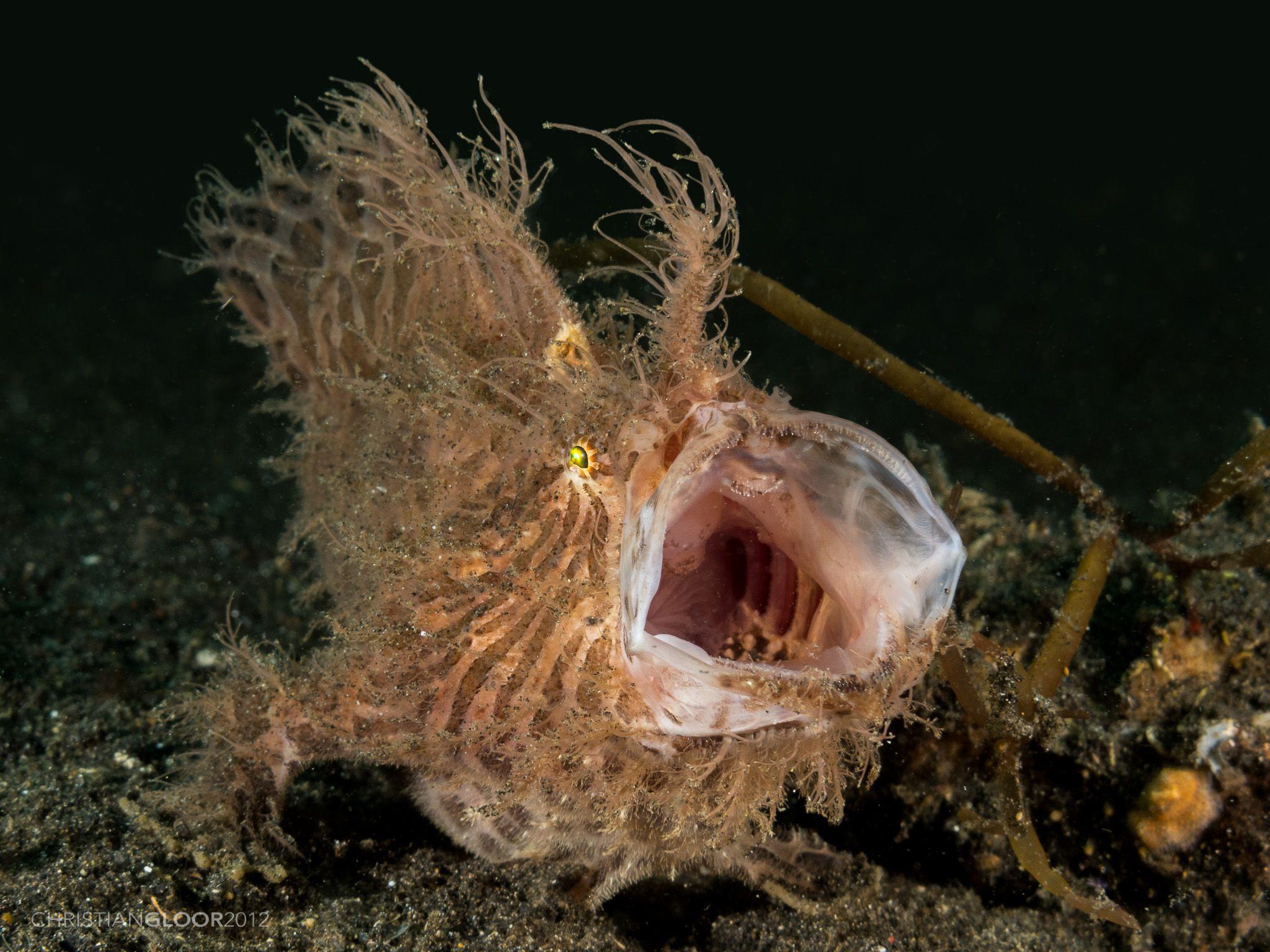
Hairy Frogfish
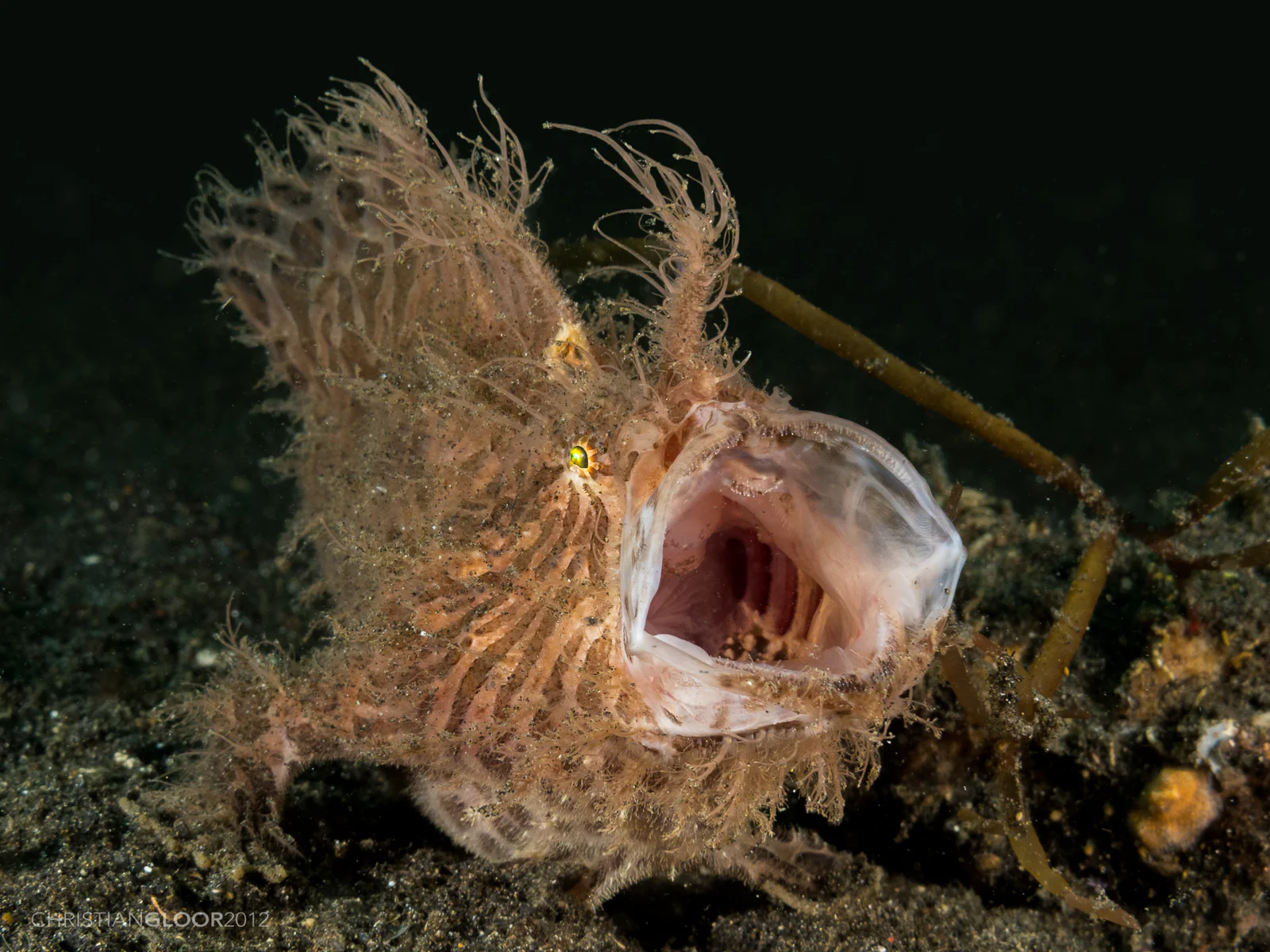
Antennarius striatus
About Hairy Frogfish.
The Hairy Frogfish, scientifically known as Antennarius striatus, is a fascinating member of the Antennariidae family, commonly referred to as frogfishes or anglerfishes. This species is a master of disguise and a highly sought-after subject for underwater photographers due to its unique appearance and behavior. Classified as "Least Concern" by conservation bodies, the Hairy Frogfish is found in tropical and subtropical waters across the Indo-Pacific and eastern Atlantic Oceans, notably absent only from the Mediterranean and Arctic regions.
Typically inhabiting benthic environments, these fish prefer rocky, sandy, and rubble habitats, as well as coral reefs and shallow estuaries. They are ambush predators, relying on exceptional camouflage and a specialized hunting strategy rather than active pursuit. Hairy Frogfish rarely swim, instead "walking" along the seabed using their modified pectoral and pelvic fins. Their most remarkable hunting tool is a worm-like lure, or esca, which they twitch to attract unsuspecting prey, striking with incredible speed—as fast as six milliseconds. Their highly extensible mouths and stomachs allow them to swallow prey nearly twice their own size. Divers often encounter these macro critters at dive sites such as Siaba Besar (occasional), Basura (occasional), Washing Machine (Verde Island) (rare), and Monkey Wreck (common).
Identification
- Size: The Hairy Frogfish can reach a maximum size of 22 cm (8.7 in), though some individuals may grow up to 25 cm (9.8 in).
- Body Shape: They possess a distinctive rounded, globular, and high-backed body that is laterally compressed and highly extensible.
- Skin and Coloration: Lacking scales, their loose skin is covered with irregularly arranged dermal spinules, which are small, fleshy extensions resembling hairs or filaments. These "hairs" are crucial for camouflage, helping the frogfish blend seamlessly with algae, sponges, or debris in its environment. Their coloration is extremely variable, ranging from yellow, orange, brown, grey, green, to off-white or black, often adorned with prominent darker stripes or blotches. They have the remarkable ability to change their color and pigment patterns to match their surroundings over a period of a few weeks.
- Head and Mouth: The Hairy Frogfish has a large, upturned mouth that is highly extensible, equipped with palatal teeth.
- Lure (Illicium and Esca): A key identification feature is the modified first dorsal fin spine, known as the illicium, which acts like a "fishing rod" extending from its snout. At the tip of this illicium is the esca, a fleshy, worm-like lure that the frogfish wiggles to attract prey. This worm-like esca helps distinguish it from similar species, such as the Shaggy Frogfish (*Antennarius hispidus*), which has a pom-pom-like lure. The esca typically features 2-7 worm-like appendages and can regenerate if lost.
- Fins: Their pectoral and pelvic fins are highly modified, appearing limb-like and used for "walking" or hopping along the seafloor. While capable of short bursts of swimming using their dorsal and caudal fins, this is a rare sight, usually employed only when fleeing predators.
Where it lives.
The Hairy Frogfish (Antennarius striatus) is a master of camouflage, perfectly adapted to a diverse range of benthic environments across the world's tropical and subtropical oceans. This fascinating species is a highly sought-after subject for underwater photographers and divers due to its unique appearance and cryptic nature.
- Habitat and Substrate: Hairy Frogfish are typically found in close contact with the seafloor, inhabiting areas rich in structures that allow them to blend seamlessly with their surroundings. Their preferred habitats include muck, sand, and rubble slopes, as well as rocky and coral reefs. They are also commonly observed among sponges, seaweed, and in weedy estuaries, where their dermal spinules (skin extensions resembling hairs) help them mimic algae or hydroids. This ability to change color and pigment patterns within weeks allows them to adapt to their living environment, appearing like coral, sponges, or even algae-covered rocks.
- Depth Range: While Hairy Frogfish can be found at considerable depths, ranging from 10 to 219 m, they are most frequently encountered by divers in shallower waters, typically between 10 and 40 m. Some observations place them in even shallower depths of 3–35 m. The average depth for this species is around 40 m.
- Temperature: These frogfish thrive in warm, tropical, and subtropical waters, with a preferred temperature range of 18.2–28.6°C. More specifically, they are often found in waters of 22–28°C.
- Geographic Distribution: The Hairy Frogfish boasts an extensive distribution, encompassing the Indo-Pacific Ocean, including the Red Sea, the East African coast, the Society and Hawaiian islands, north to Japan, and south to Australia and New Zealand. In the Atlantic Ocean, they are present on both western and eastern sides, from West Africa to the Americas, stretching from New Jersey to Brazil, and throughout the Gulf of Mexico and the Caribbean Sea. They are notably absent from the Eastern Pacific (with the exception of areas around the Isthmus of Panama) and the Mediterranean Sea.
How it behaves.
Underwater Encounter Behavior
Encountering a Hairy Frogfish is often a rewarding challenge for divers due to its masterful camouflage. Its body is covered in irregularly arranged dermal spinules, or "hairs," which, along with its warty skin, help it blend seamlessly with its surroundings, mimicking sponges, algae, or encrusted rocks. The species exhibits remarkable color plasticity, able to change its coloration and pigment pattern within a few weeks to match its specific environment, ranging from yellow, orange, red, brown, grey, green, off-white, and black. Divers often find them motionless, as they are primarily benthic, sit-and-wait predators.
While typically sedentary, Hairy Frogfish can move along the seafloor using their modified pectoral and pelvic fins in a "walking" or "hopping" motion. They can also use a form of jet propulsion by expelling water through their gill openings for short bursts of movement. When threatened, they may inflate their bodies with water to appear larger, similar to pufferfish, deterring potential predators like lizardfish and scorpionfish.
Feeding Habits
The Hairy Frogfish is an aggressive, carnivorous ambush predator with one of the fastest strikes in the animal kingdom. It employs a unique "lure-and-strike" technique using a modified first dorsal fin spine, called an illicium, which acts as a fishing rod. At the tip of this rod is a fleshy lure, or esca, which resembles a small worm, shrimp, or fish. The frogfish wiggles this lure to attract unsuspecting prey, such as small fish and crustaceans, to within striking distance. Notably, the Hairy Frogfish can enlarge its esca by up to 35% when actively luring. It can even use a chemical attractant, especially when foraging at night, to make its lure more effective.
Once prey is within approximately one body length, the frogfish strikes with incredible speed, expanding its large, extensible mouth and creating a vacuum to suck in its victim whole in as little as six milliseconds. They are voracious eaters and can swallow prey nearly their own size, including other frogfish. Their small, backward-pointing palatal teeth help hold prey, but are not used for chewing.
Social Structure
Hairy Frogfish lead a largely solitary lifestyle, a characteristic common among members of the Antennariidae family. Their exceptional camouflage allows them to remain hidden and independent. Interactions are typically limited to mating periods.
Notable Seasonal Patterns Relevant to Divers
Reproduction in Hairy Frogfish involves a brief pairing between a male and female. During mating, the female releases a large, gelatinous egg raft or "veil" containing thousands of eggs, which is then fertilized by the male. This egg raft is buoyant and drifts in the open water, aiding in the dispersal of larvae over wide geographical distances. After hatching, the larvae are planktonic for one to two months before settling on the seafloor and adopting the adult form. Divers might occasionally observe these egg rafts floating near the surface, or encounter juvenile frogfish, which are also masters of disguise, sometimes mimicking poisonous nudibranchs or flatworms. It's important to note that frogfish can exhibit aggressive behavior even towards their mates, with females sometimes attacking or consuming males if they remain too close after fertilization.
Dive sites like Siaba Besar, Basura, Washing Machine (Verde Island), and Monkey Wreck are known locations where divers have observed this species, offering opportunities to witness its incredible adaptations firsthand.
Where to see it.
Evidence for philippines · 5 dive sites
General range is not evidence of occurrence at a specific dive site.
Basura
Anilao
Site occurrence not yet documented
Season not yet documented
No dated observations available.
Boatyard
Puerto Galera
Site occurrence not yet documented
Season not yet documented
No dated observations available.
Monkey Wreck
Puerto Galera
Site occurrence not yet documented
Season not yet documented
No dated observations available.
The Hill
Puerto Galera
Site occurrence not yet documented
Season not yet documented
No dated observations available.
Washing Machine (Verde Island)
Verde Island
Site occurrence not yet documented
Season not yet documented
No dated observations available.
Gallery.