Hammerhead Shark (assorted)
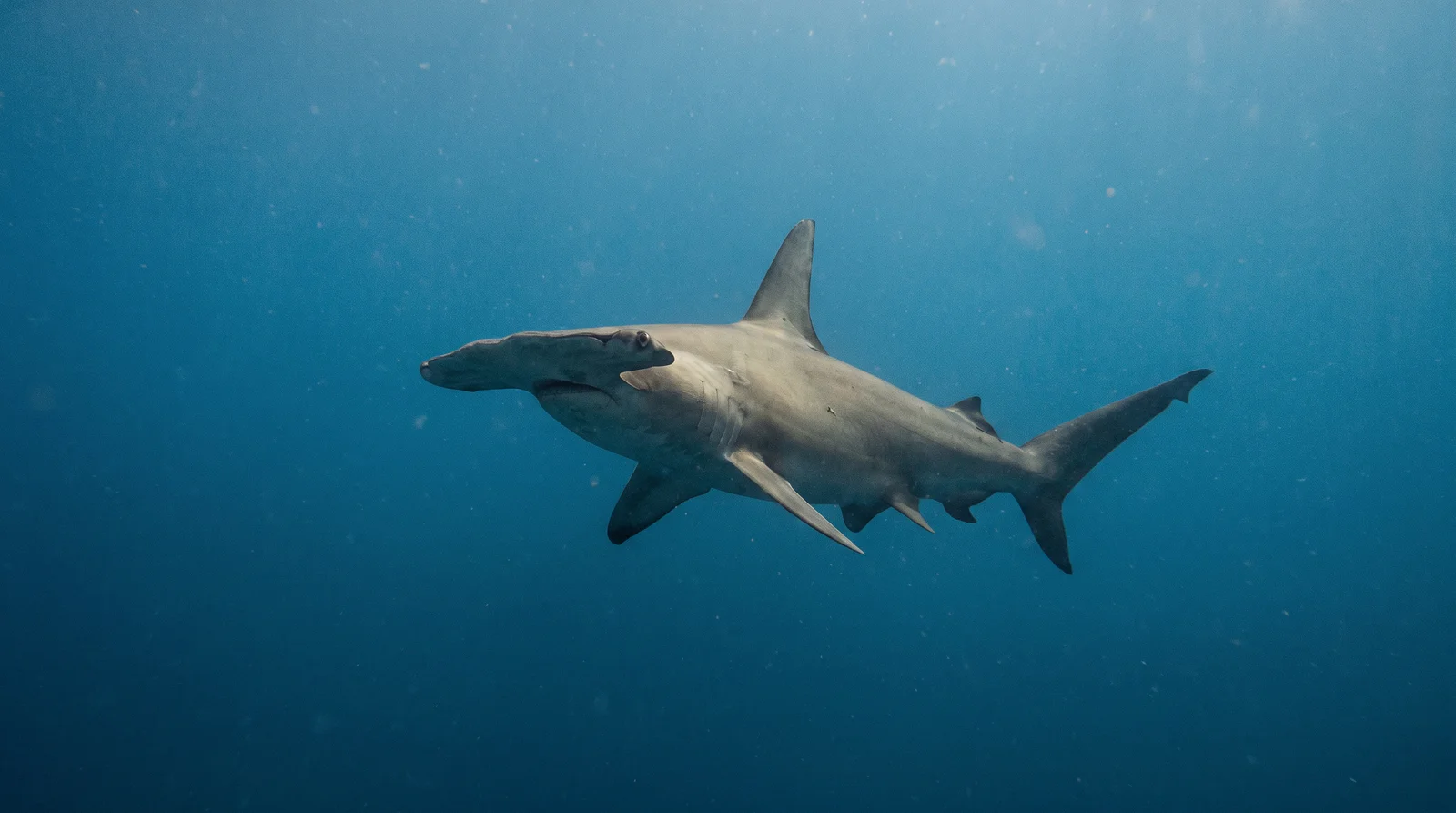 AI-generated
Image credit: AI-generated illustration · License unspecified · Source unspecified
Sphyrnidae spp.
About Hammerhead Shark (assorted).
Hammerhead sharks form the family Sphyrnidae. FishBase lists 13 species in two genera, Sphyrna and Eusphyra, covering hammerhead, bonnethead and scoophead sharks. The family occurs worldwide, chiefly in warm waters. This group entry covers hammerhead sightings that cannot be confirmed to species; the Great Hammerhead and the Scalloped Hammerhead have their own entries.
The family name comes from the Greek sphyra, meaning hammer, after the laterally expanded head. The eyes and nostrils sit much farther apart than in other sharks, at the ends of the head's flattened "blades", and FishBase notes that this shape is presumed to increase the sharks' sensory capabilities. All hammerheads are live-bearers, giving birth to fully developed young.
Identification
- Head: A flattened, sideways-expanded head with the eyes at its outer edges; no other shark family has this shape.
- Size: Varies widely. The Scalloped Hammerhead reaches about 4.3 m and the Great Hammerhead about 6.1 m total length, while bonnetheads and scoopheads are smaller.
- Species features: The outline of the front of the head and the height of the first dorsal fin help separate species, but they are hard to judge quickly in the water.
- When unsure: If you could not see the head and fins clearly, use this group entry rather than guessing a species.
- Lifespan: FishBase gives maximum reported ages of 30 years for the Great Hammerhead and 35 years for the Scalloped Hammerhead.
Conservation
Conservation status varies by species. On the IUCN Red List, the Great Hammerhead (Sphyrna mokarran) and the Scalloped Hammerhead (S. lewini) are both Critically Endangered (assessed in 2018). The Scalloped Hammerhead is also listed on CITES Appendix II and CMS Appendix II. FishBase also describes the Scalloped Hammerhead as commercially important and sought as a gamefish.
Where it lives.
Hammerheads live in warm temperate and tropical seas worldwide. The family is marine and mainly coastal, occasionally entering brackish water, but some species also range into deep water off the shelf.
- Scalloped Hammerhead: A coastal-pelagic, semi-oceanic shark over continental and island shelves and the adjacent deep water. It often comes close inshore and enters bays and estuaries. Recorded from the surface to about 1,043 m, but usually in the upper 25 m.
- Great Hammerhead: Also coastal-pelagic and semi-oceanic, over continental shelves, island terraces, passes and lagoons. Recorded to 300 m, usually in the upper 100 m, and often associated with the bottom or reefs at 1-80 m.
- Range: Both species are found around the world in warm coastal seas, including the western and eastern Atlantic, the Indo-Pacific and the eastern Pacific.
- Migration: The Great Hammerhead is highly migratory. In some areas, large schools of small Scalloped Hammerheads move poleward in summer, while other populations are permanent residents.
- Depth for divers: Because Scalloped Hammerheads are usually in the upper 25 m and Great Hammerheads often at 1-80 m, both overlap well with recreational depths, although a Scalloped Hammerhead has been filmed at 512 m on a baited camera.
- Scalloped Hammerhead range: Western Atlantic from New Jersey to Uruguay, eastern Atlantic from the western Mediterranean to Namibia, the Indo-Pacific from the Persian Gulf, Red Sea and East Africa to Japan, Hawaii and Tahiti, and the eastern Pacific from southern California to Ecuador.
For divers, this means hammerheads may be met both over shallow reefs, passes and lagoons and in open water beside steep reef edges, depending on the species and the location.
How it behaves.
Hammerheads are active predators with broad diets. For the family, FishBase lists bony fishes, sharks and rays, cephalopods and crustaceans. The Great Hammerhead prefers stingrays and other rays, groupers and sea catfishes, while the Scalloped Hammerhead feeds mainly on bony fishes and cephalopods, plus lobsters, shrimps, crabs and other sharks and rays. This mix of open-water and bottom prey means hammerheads may be seen cruising in mid-water as well as close to the reef or sand.
Underwater Encounter Behavior
- Schools: Adult Scalloped Hammerheads may be solitary, in pairs or in schools, and the young form large schools.
- Near the bottom: The Great Hammerhead is often found near the bottom and reefs, which fits its preference for rays.
- Risk to divers: FishBase lists the family as potentially dangerous, but notes that the Scalloped Hammerhead is often not aggressive toward divers.
Reproduction
Hammerheads are live-bearers with a yolk-sac placenta. Great Hammerhead litters contain about 13-42 young after a gestation of about 11 months, and newborns measure about 50-70 cm. Scalloped Hammerhead litters range from about 12 to 41 young after 9-10 months. Scalloped Hammerhead pups measure about 45-50 cm at birth. Great Hammerheads mature at around 2.5 m total length and Scalloped Hammerheads at around 2.1 m.
Diver Tips
- Stay still: Holding position and breathing steadily is better than swimming toward hammerheads.
- No chasing or feeding: Do not chase, touch or feed hammerheads.
- Record details: Note head shape, the height of the first dorsal fin, depth and group size to help confirm the species.
- Schools: If a school passes, a rough count or a wide photo of the group is useful; do not swim into the school.
- Depth discipline: Do not follow hammerheads deeper than your training or dive plan allows.
Where to see it.
Evidence for mactan · 1 dive site
General range is not evidence of occurrence at a specific dive site.
Gallery.
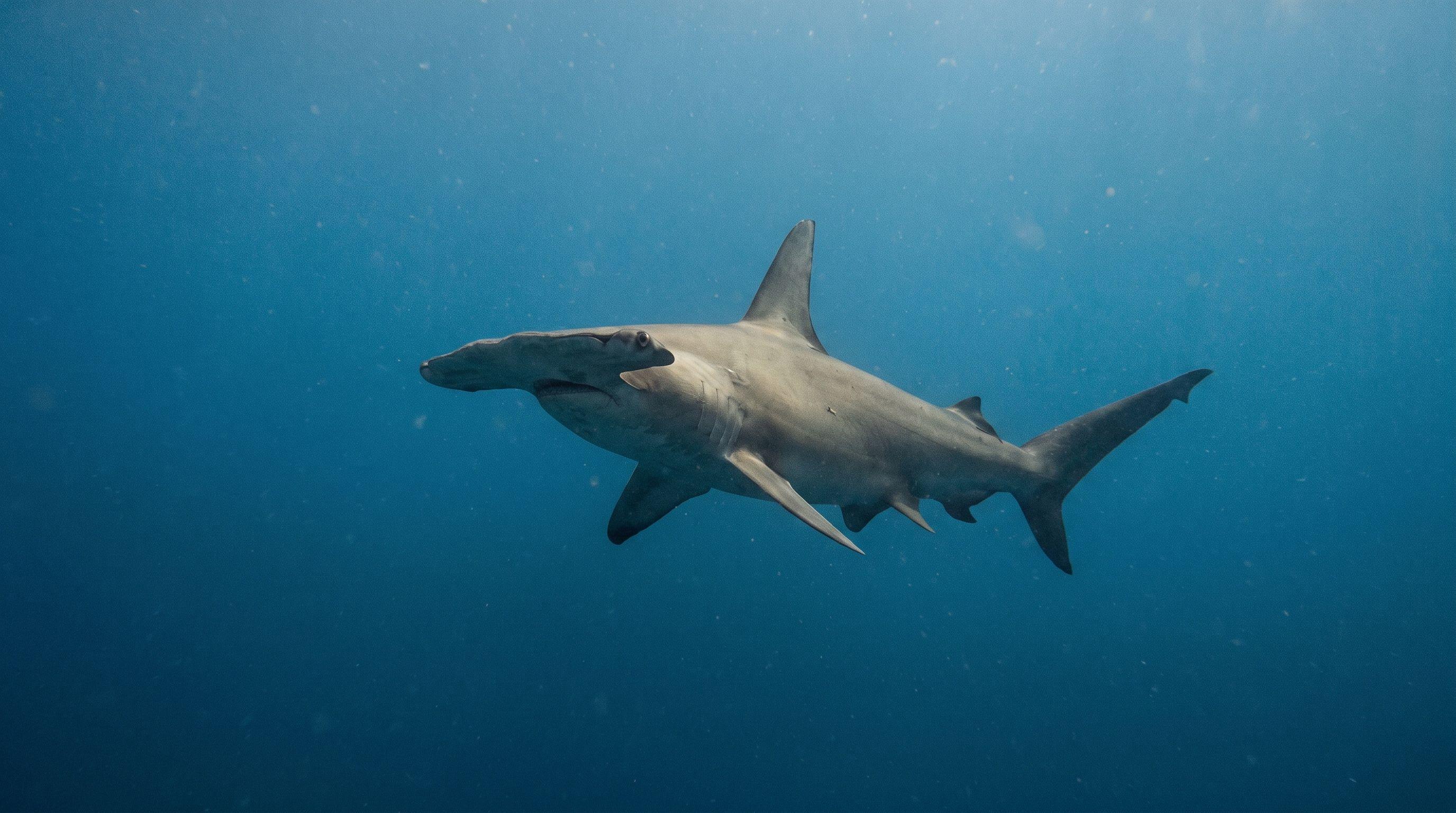 AI-generated
AI-generated illustration
Image credit: AI-generated illustration · License unspecified · Source unspecified