Honeycomb Moray
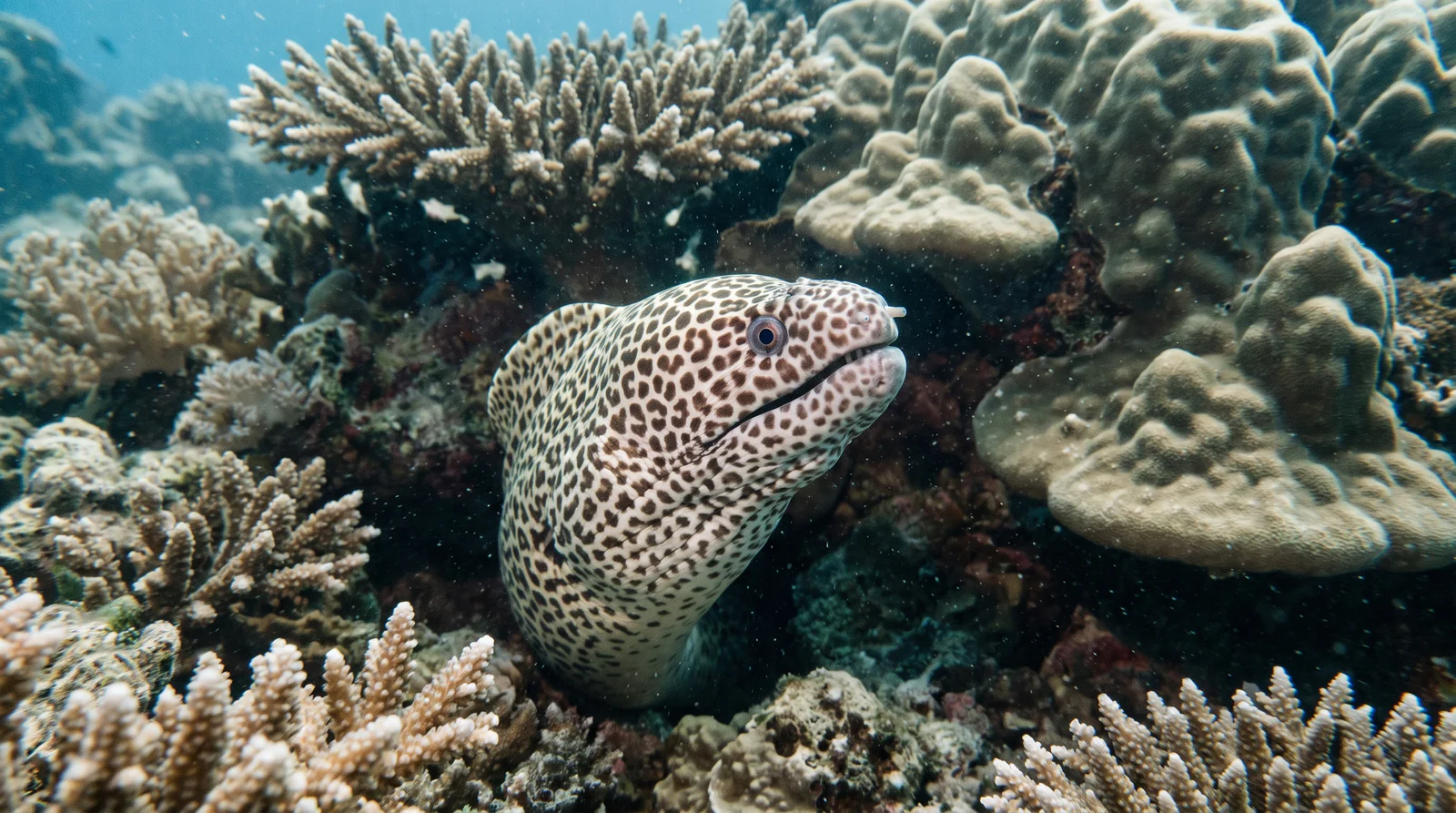 AI-generated
Image credit: AI-generated illustration · License unspecified · Source unspecified
Gymnothorax favagineus
About Honeycomb Moray.
The Honeycomb Moray, Gymnothorax favagineus, is a striking and powerfully built member of the Muraenidae family, commonly encountered by divers across the Indo-West Pacific. Known by several other names including Tessellate Moray, Leopard Moray, and Laced Moray, this species is one of the largest moray eels in its range, capable of reaching an impressive length of up to 3 meters (10 feet). Despite its formidable appearance, the Honeycomb Moray is currently listed as 'Least Concern' on the IUCN Red List, indicating a stable population.
Typically found in tropical marine waters, this moray inhabits coral reefs and rocky areas, often seeking shelter in crevices, caves, or under ledges during daylight hours. Divers can encounter them at depths ranging from 1–50 m, in waters with temperatures generally between 22–30°C. As nocturnal predators, they emerge at night to hunt a diet primarily consisting of small fish, cephalopods, and crustaceans.
Identification
The Honeycomb Moray is readily identifiable by its distinctive physical characteristics:
- Body Shape and Size: It possesses a robust, serpentine (eel-like) body, making it one of the largest moray species in the Indo-Pacific.
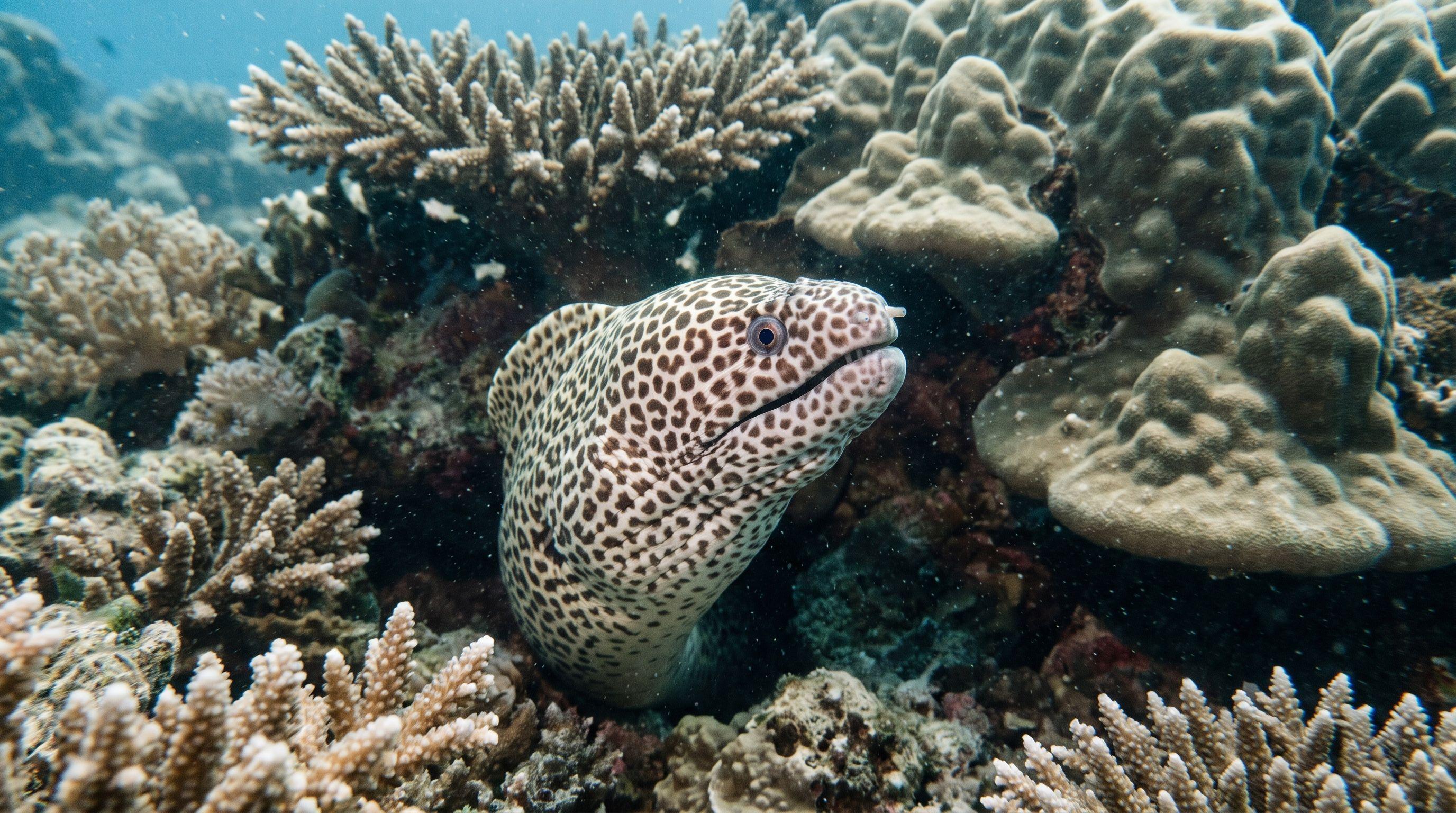
- Coloration and Pattern: The base color of its body ranges from white to yellowish or pale brown, adorned with numerous black spots that create a prominent honeycomb or leopard-like pattern.
- Spot Variation: The size and shape of these black spots can vary significantly. Juveniles typically display larger, more meandering spots, which become smaller, more widely spaced, and often more circular as the eel matures. Interestingly, individuals residing in clear coral reefs tend to have proportionally less black pigmentation than those found in more turbid environments, where some may even appear almost entirely black.
- Fins: Like other morays, the Honeycomb Moray lacks pectoral and pelvic fins. Its dorsal and anal fins are continuous, extending along much of the body and merging with the caudal (tail) fin.
- Head Features: It has a large mouth equipped with numerous sharp teeth, including elongate canines, and small, roundish gill openings located on the sides of its head. Divers will often observe the moray constantly opening and closing its mouth; this is not a sign of aggression but a necessary action to draw water over its gills for respiration, as it lacks gill covers.
For divers exploring the Indo-Pacific, the Honeycomb Moray is a captivating sight. This species has been observed at various dive sites, including Guraidhoo Kandu (occasional) and Shark Cave (common).
Where it lives.
Habitat and Ecosystems:
The Honeycomb Moray primarily thrives in the rich biodiversity of coral reefs and rocky areas throughout the Indo-West Pacific region. Its distribution spans from the eastern coast of Africa and the Red Sea, eastward to Papua New Guinea, north to southern Japan, and south to the Great Barrier Reef in Australia.
- Coral Reefs: These morays are strongly associated with healthy coral reef ecosystems, including outer reef slopes, reef flats, fore-reef slopes, and patch reefs within lagoons.
- Rocky Environments: They also inhabit rocky surf-zones and offshore rocky reefs, utilizing the natural structures for shelter.
- Shelter: During the day, Honeycomb Morays are typically found hidden within crevices, caves, and under ledges, with only their heads often protruding from these openings. They are solitary creatures, preferring to keep to themselves in these protected spots.
Depth Range:
Divers can encounter the Honeycomb Moray across a considerable depth range, typically found at depths of 1–50 m. While they can be observed in shallower waters, they are known to venture deeper along reef slopes.
Associated Species:
Despite their generally solitary nature, Honeycomb Morays are sometimes observed in symbiotic relationships with cleaner shrimp or wrasses, which help remove parasites from their skin.
Dive sites like Guraidhoo Kandu and Shark Cave are known locations where divers have the opportunity to observe this fascinating species in its natural habitat.
How it behaves.
The Honeycomb Moray (Gymnothorax favagineus) is a captivating species frequently encountered by divers in tropical and subtropical waters of the Indo-Pacific, including popular dive sites like Guraidhoo Kandu and Shark Cave. Known for its striking black-on-cream honeycomb pattern, this eel exhibits fascinating behaviors relevant to the diving community.
- Underwater Encounter Behavior:
Honeycomb Morays are generally solitary and territorial creatures, preferring to inhabit crevices, caves, and rocky areas within coral reefs during the day. Divers often observe them peeking out from these sheltered spots, showcasing their distinctive patterns. Despite their formidable appearance and sharp teeth, these eels are typically not aggressive towards humans unless provoked or cornered. Their characteristic constant opening and closing of the mouth is a natural breathing mechanism, facilitating water flow over their gills, and should not be interpreted as a sign of aggression. When encountering a Honeycomb Moray, divers should maintain a respectful distance to ensure both their safety and the well-being of the eel. Underwater photographers often find their intricate patterns and behaviors a rewarding subject. They are commonly found at depths ranging from 1 to 50 meters, thriving in waters with temperatures between 19°C and 31°C.
- Feeding Habits:
As nocturnal ambush predators, Honeycomb Morays primarily hunt at night, utilizing their keen sense of smell to locate prey, as their eyesight is relatively poor. Their carnivorous diet consists mainly of small fish, crustaceans such as crabs and shrimp, octopuses, and squid. A remarkable adaptation for feeding is their unique second set of pharyngeal jaws, located in the back of their throat. These specialized jaws extend forward to grasp prey and pull it efficiently into the stomach. For particularly large prey, Honeycomb Morays have been observed to knot their bodies, using the leverage to tear off manageable pieces. Interestingly, they may also engage in cooperative hunting, sometimes working alongside larger groupers to flush out prey from reef hiding spots.
- Social Structure:
Honeycomb Morays are largely solitary animals, preferring to occupy their own territories within the reef. While they are territorial and will defend their chosen crevices, they are known to form mutualistic relationships with cleaner shrimp and cleaner wrasses, which help remove parasites from their skin.
- Notable Seasonal Patterns:
Information regarding the specific breeding habits and seasonal patterns of Honeycomb Morays is not extensively documented and remains somewhat a mystery. It is thought that they are polygynandrous, meaning both males and females may have multiple mates. Reproduction typically involves spawning, where males and females release eggs and sperm into the water column. The fertilized eggs develop into larvae that drift in the open ocean for several months before settling onto the seafloor and maturing into juvenile eels. There are no widely recognized seasonal migrations or large aggregations that would be particularly relevant to divers.
Where to see it.
Evidence for philippines · 1 dive site
General range is not evidence of occurrence at a specific dive site.
Gallery.
 AI-generated
AI-generated illustration
Image credit: AI-generated illustration · License unspecified · Source unspecified