Lobster (assorted)
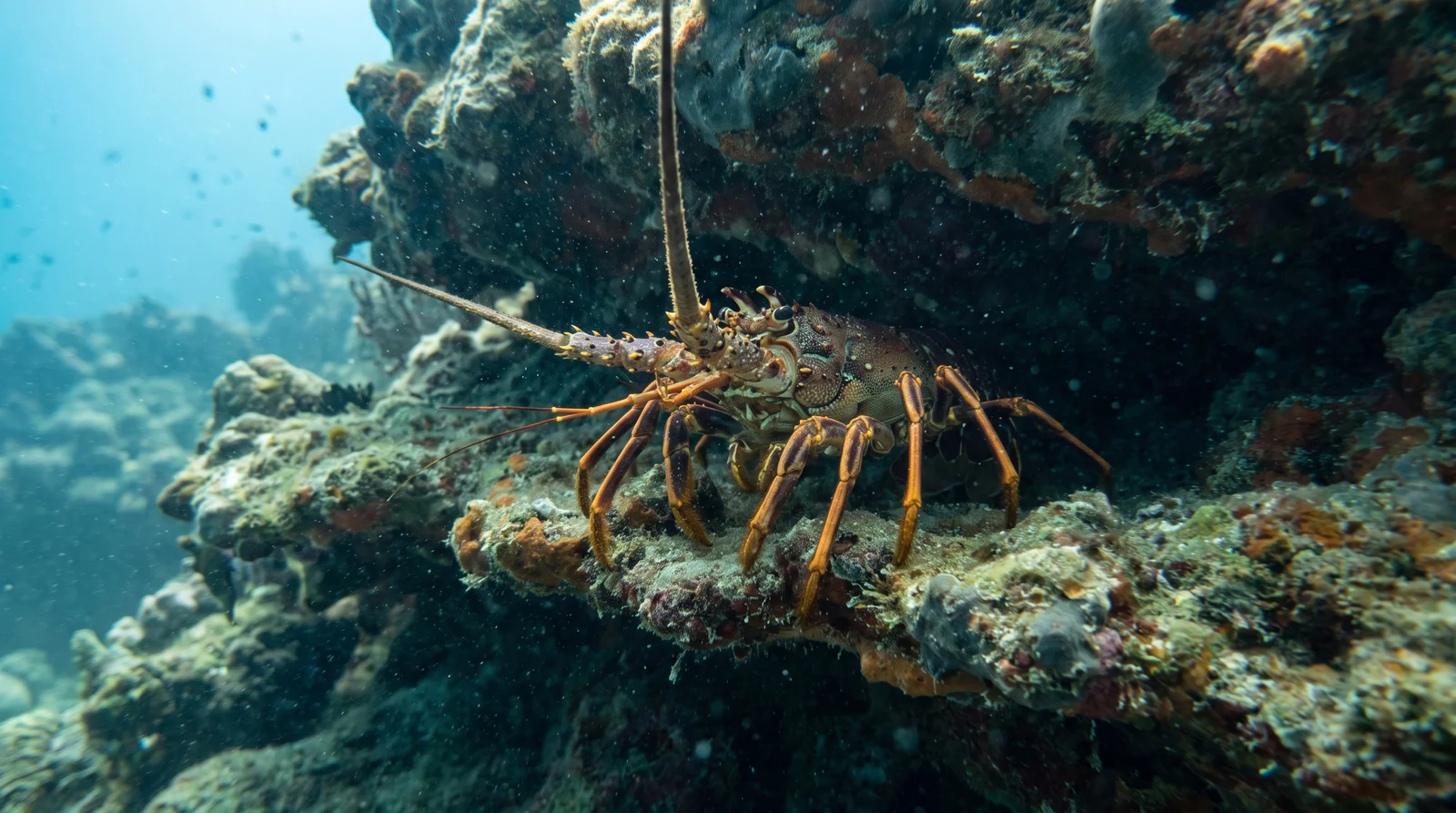 AI-generated
Image credit: AI-generated illustration · License unspecified · Source unspecified
Palinuridae and Scyllaridae spp.
About Lobster (assorted).
"Lobster (assorted)" is a group entry for spiny lobsters (family Palinuridae) and slipper lobsters (family Scyllaridae) on tropical reefs when a record simply says "lobster" without naming the species. Neither family has the large front claws of the cold-water clawed lobsters; spiny lobsters rely instead on a hard, spiny shell for defence. Species entries exist for Spiny Lobster (Indo-Pacific, Panulirus spp.) and Caribbean Spiny Lobster (Panulirus argus). The Hairy Squat Lobster is not a true lobster and is not part of this group.
Spiny vs. Slipper Lobsters
- Spiny lobsters (Palinuridae): Long, horn-like antennae above the eyes, which they wave to deter predators, and a body covered in spines. Reef examples include the painted spiny lobster (Panulirus versicolor), the pronghorn spiny lobster (P. penicillatus) and the ornate spiny lobster (P. ornatus).
- Slipper lobsters (Scyllaridae): Antennae enlarged into wide, flat plates that project forward from the head, with no long whips. Common names include fan lobster, mitten lobster and "bug"; reef examples include the blunt slipper lobster (Scyllarides squammosus) and the sculptured mitten lobster (Parribacus antarcticus).
- Size: Varies by species. SeaLifeBase gives up to about 40 cm total length for the painted spiny lobster and the blunt slipper lobster, and 50 cm for the ornate spiny lobster; NOAA gives about 18 in (46 cm) for the Caribbean spiny lobster.
Conservation
Conservation status varies by species. As verified examples, the painted spiny lobster, the ornate spiny lobster and the blunt slipper lobster are all assessed as Least Concern on the IUCN Red List (assessed 2009). Many species are fished commercially, and some fisheries set minimum legal sizes and seasons.
If photographs show the antennae clearly, a record can usually be assigned at least to the correct family, and often to a species entry.
Where it lives.
Spiny and slipper lobsters occur on tropical reefs in all the major oceans. In the Indo-Pacific, the painted spiny lobster ranges from South Africa and the Red Sea to Hawaii and from Japan to Australia, and the blunt slipper lobster from South Africa north to Japan, south to Australia and east to Hawaii. The Caribbean spiny lobster lives in the western Atlantic, including the Caribbean.
Typical Settings
- Reef crevices: By day, reef lobsters shelter in holes, crevices and cavities in coral and rock.
- Reef edges and surf zones: The painted spiny lobster favours the seaward edge of the reef plateau and clear-water surf zones.
- Soft bottoms: The ornate spiny lobster also uses sandy and muddy bottoms, sometimes near river mouths, and its juveniles shelter in holes partly covered by seagrass or algae.
- Depth: Varies by species: SeaLifeBase gives shallow water to about 15 m for P. versicolor, 1–50 m (usually 1–8 m) for P. ornatus and 0–80 m (usually 20–50 m) for S. squammosus; NOAA reports P. argus to about 90 m.
Where to Look
Shine a torch into overhangs, under ledges and into reef holes. The long antennae of spiny lobsters often stick out of a crevice before the body can be seen. Slipper lobsters lack those long antennae, so look instead for the flat, plate-like front of the head and the broad, armoured body pressed against the rock. Juveniles often use different places from adults, such as dense vegetation and holes partly covered by seagrass or algae.
How it behaves.
Most tropical reef lobsters are nocturnal. They hide in crevices by day and come out at night to forage, so night dives offer the best chance to see them moving in the open.
Feeding
Diets vary by species. NOAA describes juvenile and adult Caribbean spiny lobsters eating snails, crabs and clams; SeaLifeBase lists bivalves and sea urchins for the painted spiny lobster and describes the ornate spiny lobster as omnivorous. The blunt slipper lobster opens bivalves by wedging and prying the shell apart with its walking legs.
Social Behaviour and Movement
Social habits differ: the painted spiny lobster is described as not gregarious, while the ornate spiny lobster is mostly solitary but may live in pairs or larger concentrations. Caribbean spiny lobsters make seasonal migrations, travelling in single-file lines into deeper water to escape cold and turbid conditions.
When threatened, spiny lobsters wave their long antennae toward the intruder, a defensive display divers may see when they approach a den too closely.
Reproduction
In the Caribbean spiny lobster, the male places sperm packets on the female's underside, and the female carries roughly 230,000 to 2.6 million fertilised eggs under her tail until they hatch after about three weeks. The larvae drift in the plankton before settling, and juveniles shelter in dense vegetation and crevices. Spawning is year-round in the Caribbean, while on offshore Florida Keys reefs it runs from March through August.
Diver Tips
- Observe from outside the den: Do not reach into holes or pull lobsters out; crevices often shelter other animals too.
- Use your torch kindly: At night, avoid holding a bright beam on one animal for long.
- Respect local rules: Lobsters are fished in many places; never take one unless local regulations clearly allow it.
- Check the antennae: Long, whip-like antennae indicate a spiny lobster; flat plates indicate a slipper lobster.
Where to see it.
Evidence for davao gulf · 1 dive site
General range is not evidence of occurrence at a specific dive site.
Gallery.
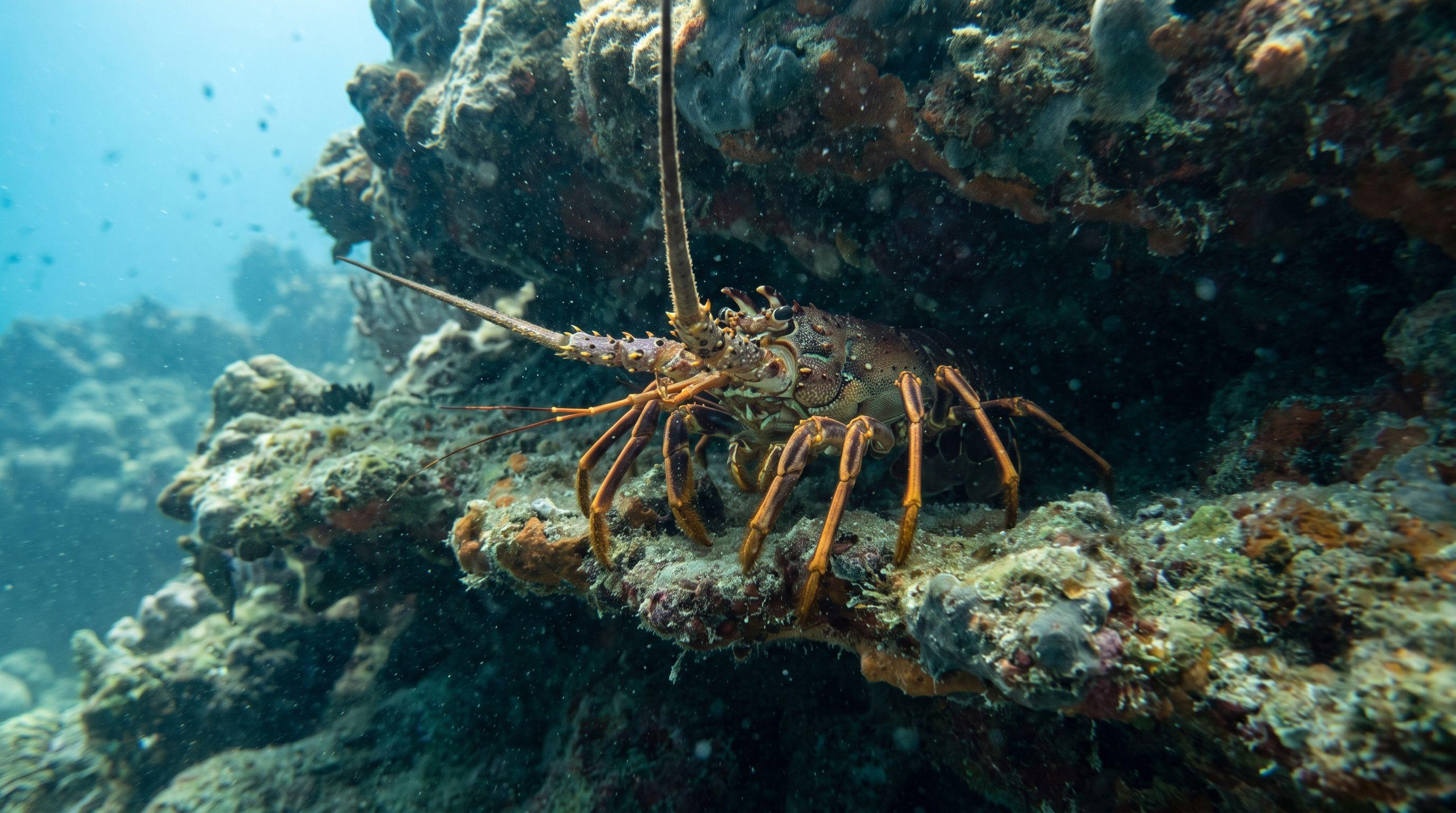 AI-generated
AI-generated illustration
Image credit: AI-generated illustration · License unspecified · Source unspecified