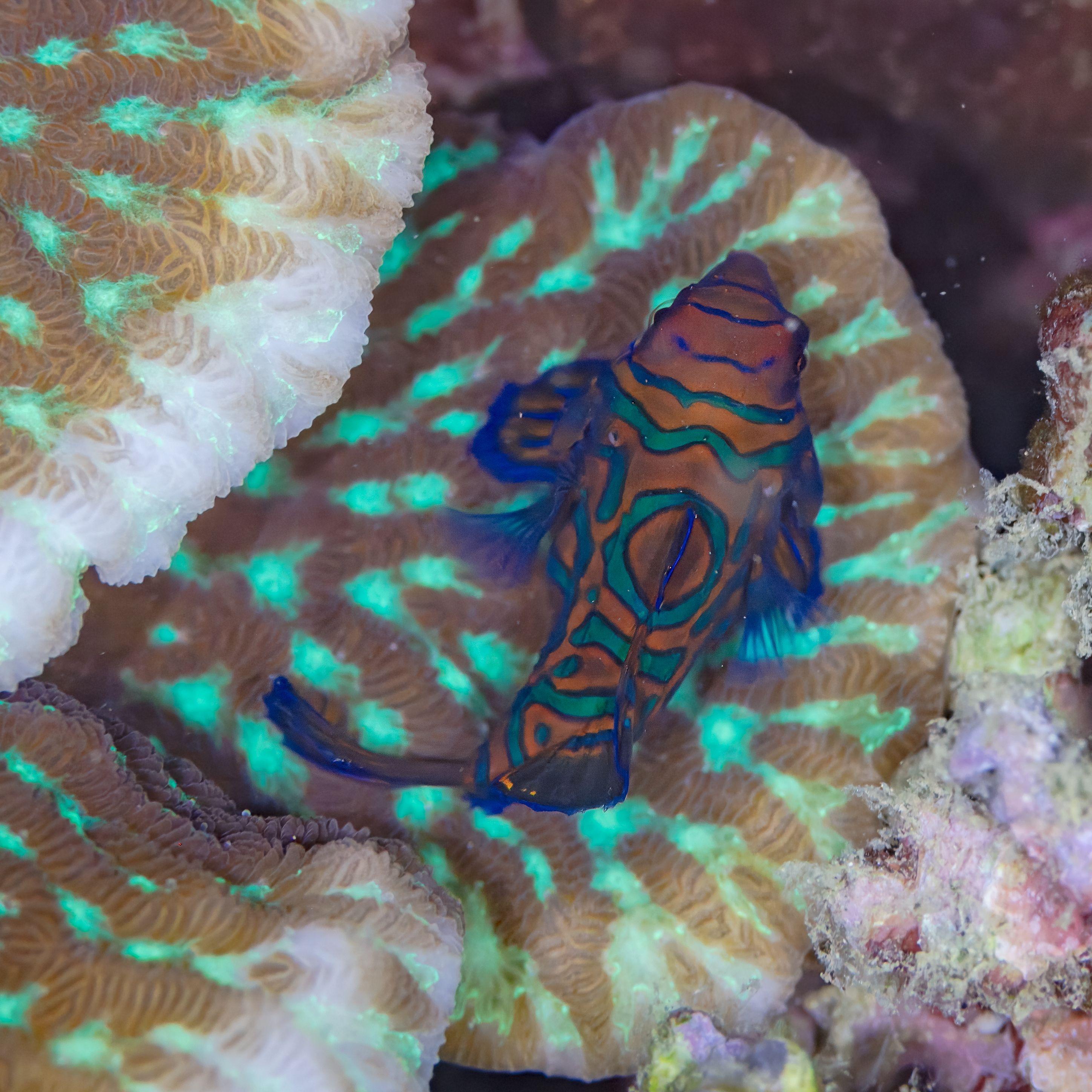
Mandarinfish
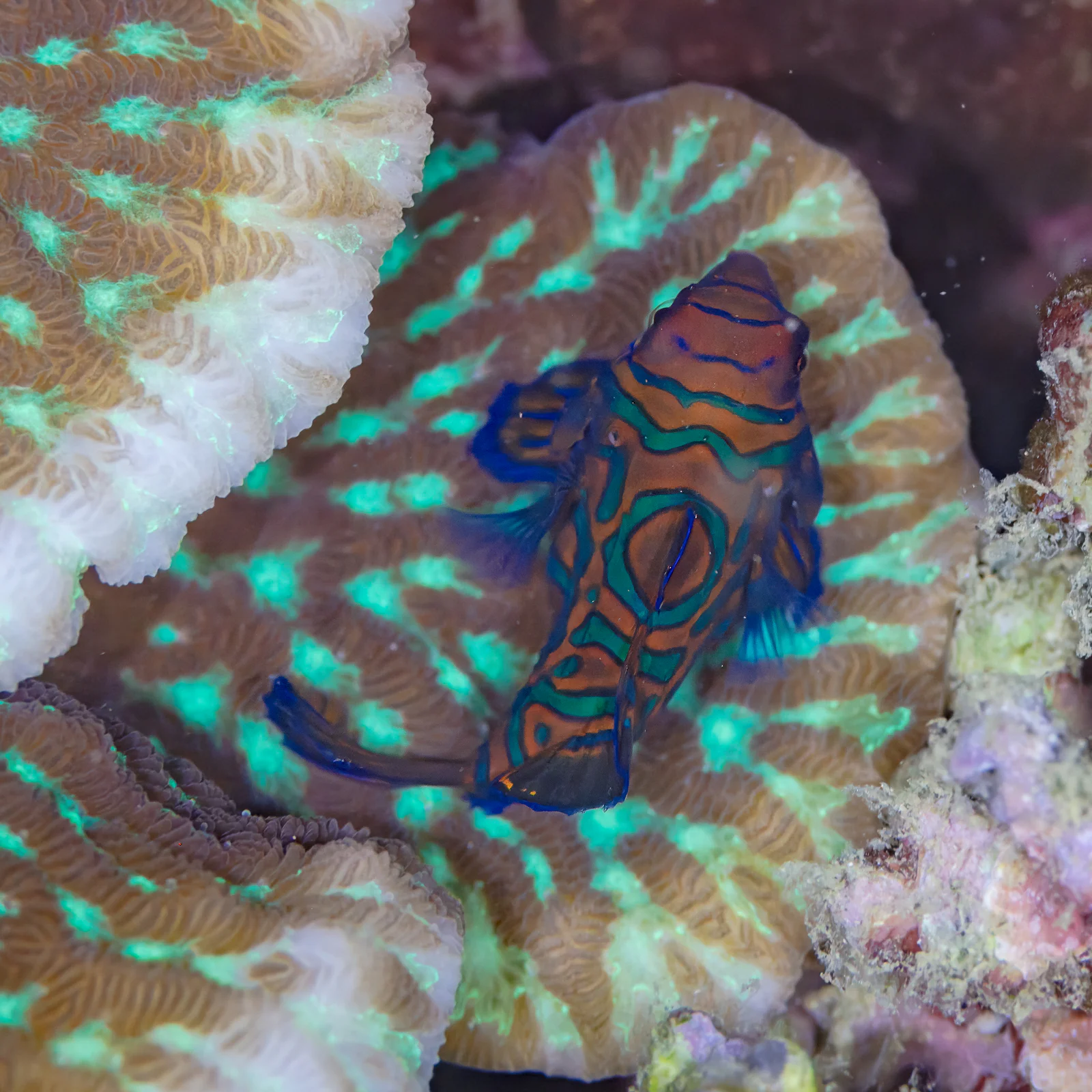
Synchiropus splendidus
About Mandarinfish.
The Mandarinfish, Synchiropus splendidus, is a captivating member of the Callionymidae family, commonly known as dragonets. Renowned for its extraordinarily vibrant coloration and intricate patterns, this small, benthic fish is a highlight for divers across the Indo-Pacific. Its common name is inspired by the elaborate, multicolored robes of Imperial Chinese mandarins, reflecting its striking appearance.
Found primarily in the western Pacific, from the Ryukyu Islands south to Australia, including the Philippines and Indonesia, Mandarinfish inhabit shallow, protected lagoons and inshore reefs. They prefer silty bottoms interspersed with coral and rubble, often seeking refuge among dead coral or branching coral formations. These macro-category subjects are typically observed at depths of 1–18 m, though they are frequently found in the shallower reaches, often within the first 6 m, in tropical waters of 24–28°C.
Mandarinfish are shy, slow-moving creatures that spend most of their day hidden, emerging primarily at dusk to forage for small crustaceans and other invertebrates, such as harpacticoid copepods and amphipods, which form the bulk of their specialized diet. This crepuscular activity also marks the time for their unique and highly anticipated spawning ritual. Just before sunset, males and females gather, with males displaying their elaborate fins to attract a mate. A chosen pair will then engage in a "spawning ascent," rising about 1 meter above the reef in a belly-to-belly position to release eggs and sperm into the water column. This pelagic spawning can occur weekly year-round, with females releasing up to 200 eggs.
Despite their popularity in the aquarium trade, Mandarinfish are classified as Least Concern by the IUCN, though local populations can be threatened by overfishing and habitat degradation. Dive sites such as Cars Wreck (Dauin), Talisay Pier, and Twin Peaks Reef are known for predictable dusk-dive aggregations, offering divers a chance to witness their remarkable courtship displays.
Identification
- Size: Mandarinfish are small, reaching a maximum length of approximately 7 cm (2.7 inches). Males are typically larger than females.
- Body Shape: They possess a distinctive, somewhat flattened body with a broad, depressed head and large, protruding eyes positioned high on the skull. Their small, protractile mouth is adapted for picking tiny prey from the substrate.
- Coloration: The most striking feature is their psychedelic coloration. The body is adorned with an intricate maze of swirling lines, dots, and spots in vivid hues of electric blue, green, orange, red, and yellow. Notably, the blue coloration in Mandarinfish is due to unique cellular pigments called cyanophores, a rare trait among vertebrates.
- Skin: Instead of scales, their skin is covered in a thick, protective mucus coating that is both smelly and bitter, believed to deter predators and provide disease resistance.
- Fins: They have two separate dorsal fins. A key distinguishing feature for males is an elongated first dorsal spine, which can be at least twice as long as the others and sometimes extends to the caudal peduncle. Their large, fan-like pelvic fins are often used to "walk" or "hop" along the seafloor, giving them a unique movement style. The pectoral fins are nearly transparent, while the caudal (tail) fin often features vibrant stripes.
Where it lives.
The Mandarinfish, Synchiropus splendidus, is a captivating and highly sought-after species among divers, renowned for its vibrant, psychedelic coloration. This small, bottom-dwelling dragonet is native to the warm, tropical waters of the Western Pacific Ocean.
Habitat and Distribution:
- Mandarinfish are primarily found in the Indo-Pacific region, with their range extending from the Ryukyu Islands of Japan south to Australia, encompassing areas like the Philippines, Indonesia, Hong Kong, New Guinea, and the Great Barrier Reef.
- They prefer sheltered environments within coral reef ecosystems, including shallow lagoons, inshore reefs, and outer reef flats.
- These shy fish are typically observed among coral rubble, dense live rock formations, and areas with sandy or silty substrates. They often hide within coral branches or crevices, and sometimes near the spines of sea urchins, using these structures for protection from predators.
Depth and Water Conditions:
- Mandarinfish are generally found in shallow waters, typically at depths ranging from 1 to 18 m. Some sources indicate they can be found down to 30 m, particularly in areas with suitable shelter and food sources.
- They thrive in tropical marine waters with temperatures generally between 24–28°C.
- While they can tolerate some water flow, they generally prefer slow-moving currents, which helps them graze for their primary diet of small benthic invertebrates like copepods and amphipods.
Divers often seek out specific dive sites known for Mandarinfish populations, such as Cars Wreck and Twin Peaks Reef in Dauin, Philippines, or Talisay Pier, where they are commonly observed, particularly during their spectacular courtship displays at dusk.
How it behaves.
The Mandarinfish (Synchiropus splendidus), a dazzling member of the dragonet family, is a highly sought-after macro subject for divers due to its vibrant, psychedelic coloration and unique behaviors. Growing up to 7 cm (2.7 in), these small, scaleless fish are adorned with intricate patterns of electric blue, green, orange, and yellow, reminiscent of the robes of ancient Chinese mandarins.
Underwater Encounter Behavior
Mandarinfish are typically shy and elusive during daylight hours, preferring to hide among coral rubble, branching corals, and in crevices within shallow, sheltered lagoons and inshore reefs, usually encountered at depths up to 18 m (59 ft) in waters of 24–26°C. They are slow-moving, often using their large, fan-like pelvic fins to "walk" along the bottom, making small hops as they forage. Their brilliant colors, while striking to divers, also serve as a warning to predators, as their skin is covered in a bitter, foul-tasting, and potentially toxic mucus, which also protects them from parasites.
Feeding Habits
Mandarinfish are specialized micro-predators, spending most of their daylight hours constantly grazing on tiny benthic (bottom-dwelling) invertebrates. Their diet primarily consists of small crustaceans such as copepods and amphipods, as well as small worms, protozoans, and occasional fish eggs or gastropods. Due to their small mouths, they must consume a large quantity of these tiny prey items throughout the day. They methodically hover over rock and coral surfaces, picking off individual prey rather than chasing food through the water column.
Social Structure
In the wild, Mandarinfish are often found in groups or pairs, inhabiting small patches of reef, sometimes as small as 10 square meters. While generally peaceful, males can be territorial, especially towards other males during breeding season. Males are typically larger and more vibrantly colored than females, and possess an elongated, spined dorsal fin used for display.
Seasonal Patterns and Reproduction
The most notable and diver-relevant seasonal pattern for Mandarinfish is their crepuscular spawning ritual, which occurs just before sunset. This daily event is a highlight for many divers and can be observed year-round in suitable dive sites, though some sources suggest a peak mating season between April and July in certain regions. Females gather in specific areas of the reef, waiting for males to approach and display courtship behaviors, which may involve flaring fins. Once a female chooses a male, she rests on his pelvic fin, and the pair ascends together, belly-to-belly, about 1 meter (3 ft) above the reef. At the apex of their ascent, they simultaneously release eggs and sperm into the water column before quickly returning to the reef. This "mating dance" is brief but spectacular, making sunset dives a popular way to witness this natural wonder.
Where to see it.
Evidence for philippines · 4 dive sites
General range is not evidence of occurrence at a specific dive site.
Cars Wreck (Dauin)
Dauin
Site occurrence not yet documented
Season not yet documented
No dated observations available.
Talisay Pier
Cabilao Island
Site occurrence not yet documented
Documented site seasonality: Jan, Feb, Mar, Apr, May, Jun, Jul, Aug, Sep, Oct, Nov, Dec
No dated observations available.
The Hill
Puerto Galera
Site occurrence not yet documented
Season not yet documented
No dated observations available.
Twin Peaks Reef
Coron
Site occurrence not yet documented
Documented site seasonality: Nov, Dec, Jan, Feb, Mar, Apr, May
No dated observations available.
Gallery.