Milkfish
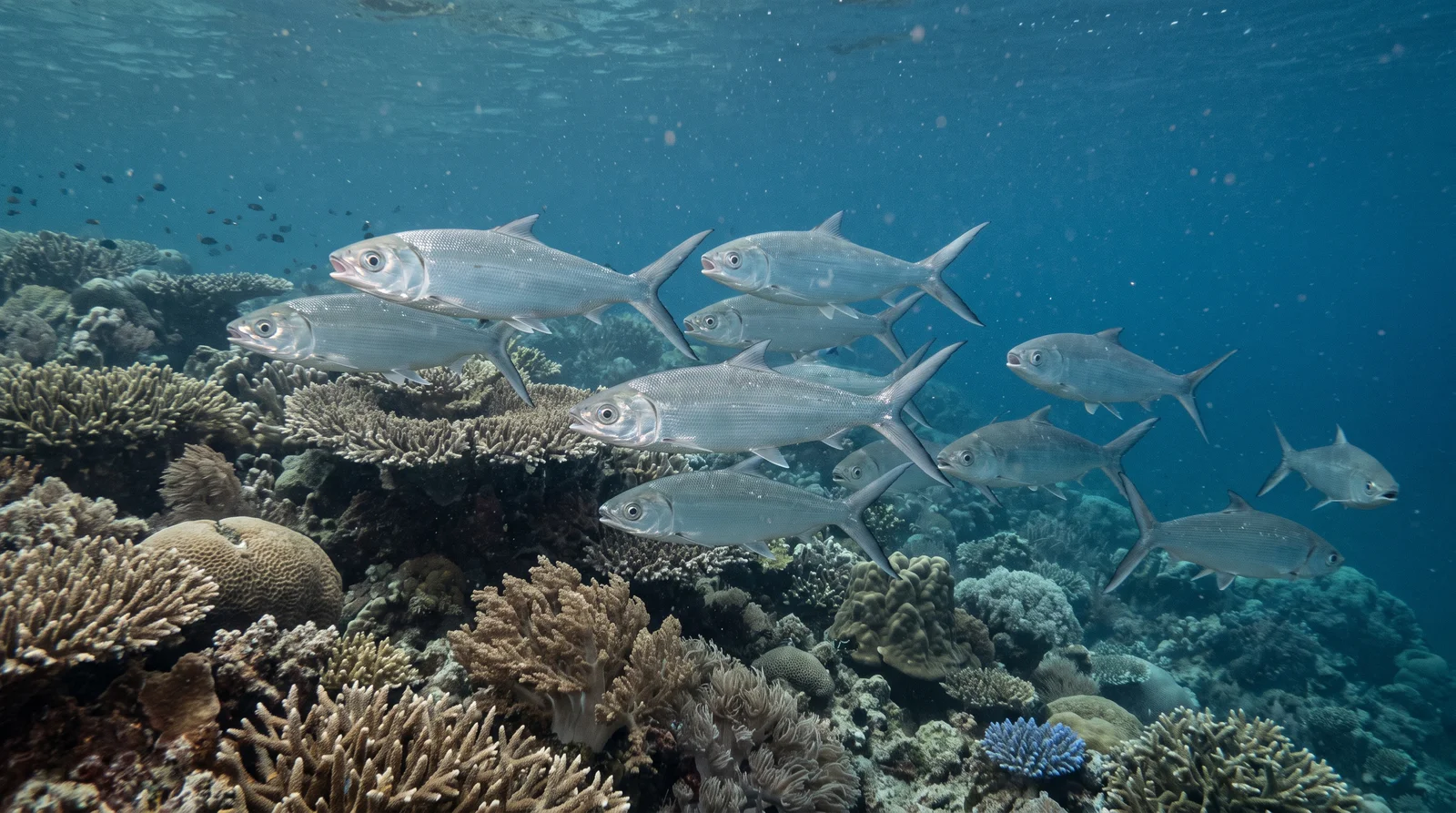 AI-generated
Image credit: AI-generated illustration · Diveity
Chanos chanos
About Milkfish.
The milkfish is a large, silvery, toothless fish of Indo-Pacific coasts and reefs that swims in schools, can reach 1.8 m and often enters estuaries.
Names and classification
WoRMS accepts the name Chanos chanos (Fabricius, 1775) in the family Chanidae, order Gonorynchiformes, and records over thirty older names as synonyms, among them Mugil chanos and Lutodeira chanos. Its vernacular list has milkfish in English, Milchfisch in German, sabalote in Spanish and サバヒー in Japanese. Wikipedia writes the author of the name as Forsskål rather than Fabricius, calls the milkfish the sole living species of its family and genus, and gives local names that include bangús in the Philippines, bandeng or bolu in Indonesia, awa in Hawaiian and ava in Tahitian.
Identification
FishBase describes an elongate, somewhat compressed body with one dorsal fin near the middle of the back, sickle-shaped pectoral fins, a large, deeply forked tail, a small mouth without teeth and no scutes along the belly. Its colours are olive green on the back and silver on the flanks, and the unpaired fins have dark edges; the database counts 2 dorsal spines with 13 to 17 soft rays, 2 anal spines with 8 to 10 soft rays, and 46 vertebrae. Wikipedia adds a head that is small for the body and 31 rays in the tail fin. It notes that the fish is often mistaken for herrings (Clupeidae), Megalops cyprinoides, Gonorhynchus gonorhynchus and Elops machnata, and tells it apart by its size, the missing scutes, a small knob on the lower jaw, the position of its fins, the absence of a bony plate between the arms of the lower jaw, and its four branchiostegal rays.
Size and age
The largest length in FishBase is 180 cm standard length for males or unsexed fish and 124 cm for females, with 100 cm as a common length and first maturity at about 86 cm. The same database gives 14 kg as the heaviest published weight and 15 years as the oldest reported age. Wikipedia also puts the maximum at 1.80 m and the age at 15 years, says most fish stay under 1 m, and gives a weight of about 19 kg for a pond-raised fish; it adds that wild milkfish take three to five years to mature.
Conservation and people
On the IUCN Red List the milkfish is rated Least Concern. FishBase, citing version 2025-2 of the list, dates that assessment to 23 June 2016, while Wikipedia's reference is a 2019 assessment; Wikipedia also notes that little is known about wild stocks. FishBase lists the species as harmless to people, as highly commercial in fisheries and commercial in aquaculture, and as a gamefish and bait. Wikipedia describes it as an important food fish of Southeast Asia and some Pacific islands, farmed in ponds for centuries, and reports that the Philippines prohibits catching adults longer than 60 cm.
Where it lives.
The milkfish lives in tropical coastal and offshore waters of the Indo-Pacific and eastern Pacific at 1 to 30 m, moving into estuaries and rivers.
Range
FishBase gives an Indo-West Pacific range from South Africa and the Red Sea east to Hawaii and the Marquesas, north to Japan and south to Victoria in Australia, and an eastern Pacific range from San Pedro in California to the Galápagos. Wikipedia describes the same spread and adds a single fish reported from the eastern Mediterranean in 2012, as well as an 1877 release of 100 milkfish from Hawaii into inland waters of Solano County, California, which did not take hold.
Water and depth
The WoRMS entry carries the marine, brackish and freshwater flags. FishBase calls the species benthopelagic and amphidromous, records it from 1 to 30 m and usually in the upper 15 m, and places adults in offshore waters and shallow coastal bays, along continental shelves and around islands where the water is warmer than 20 °C; they often enter estuaries and now and then freshwater streams. The database adds that adults gather where reefs are well developed and that the fish can thrive in water as hot as 32 °C. Wikipedia gives the same depth range, calls the milkfish strongly tolerant of changes in salinity, and lists coral lagoons, estuaries, marsh flats, tidal creeks and tide pools as places where juveniles settle.
How it behaves.
Milkfish move in small to large schools along coasts and around reef-fringed islands, feeding on algae, cyanobacteria and small invertebrates.
Schools and feeding
In FishBase the adults form schools of varied size close to coasts and around islands, and the diet shifts with age: larvae take zooplankton, while juveniles and adults eat cyanobacteria, soft algae, small bottom-living invertebrates and even the eggs and larvae of open-water fish. Its estimate of trophic level from these food items is 2.5, with a standard error of 0.14. Wikipedia calls the species an omnivorous, opportunistic feeder whose adults also take plankton and swimming prey such as young herrings.
Breeding and growth
FishBase says spawning happens at night in clear, shallow water over sand or coral no more than 30 km from shore, only in fully saline water, and that a female releases up to 5 million eggs, which hatch in about 24 hours. Wikipedia gives 0.5 to 6 million eggs, says females can spawn more than once a year, and describes spawning as strongly seasonal and possibly tied to the moon, with eggs 1.1 to 1.25 mm across. Both sources describe a young stage of two to three weeks at sea, after which the young move into mangroves, estuaries and sometimes lakes, then return to the sea to mature and breed.
Where to see it.
Evidence for visayas · 1 dive site
General range is not evidence of occurrence at a specific dive site.
Gallery.
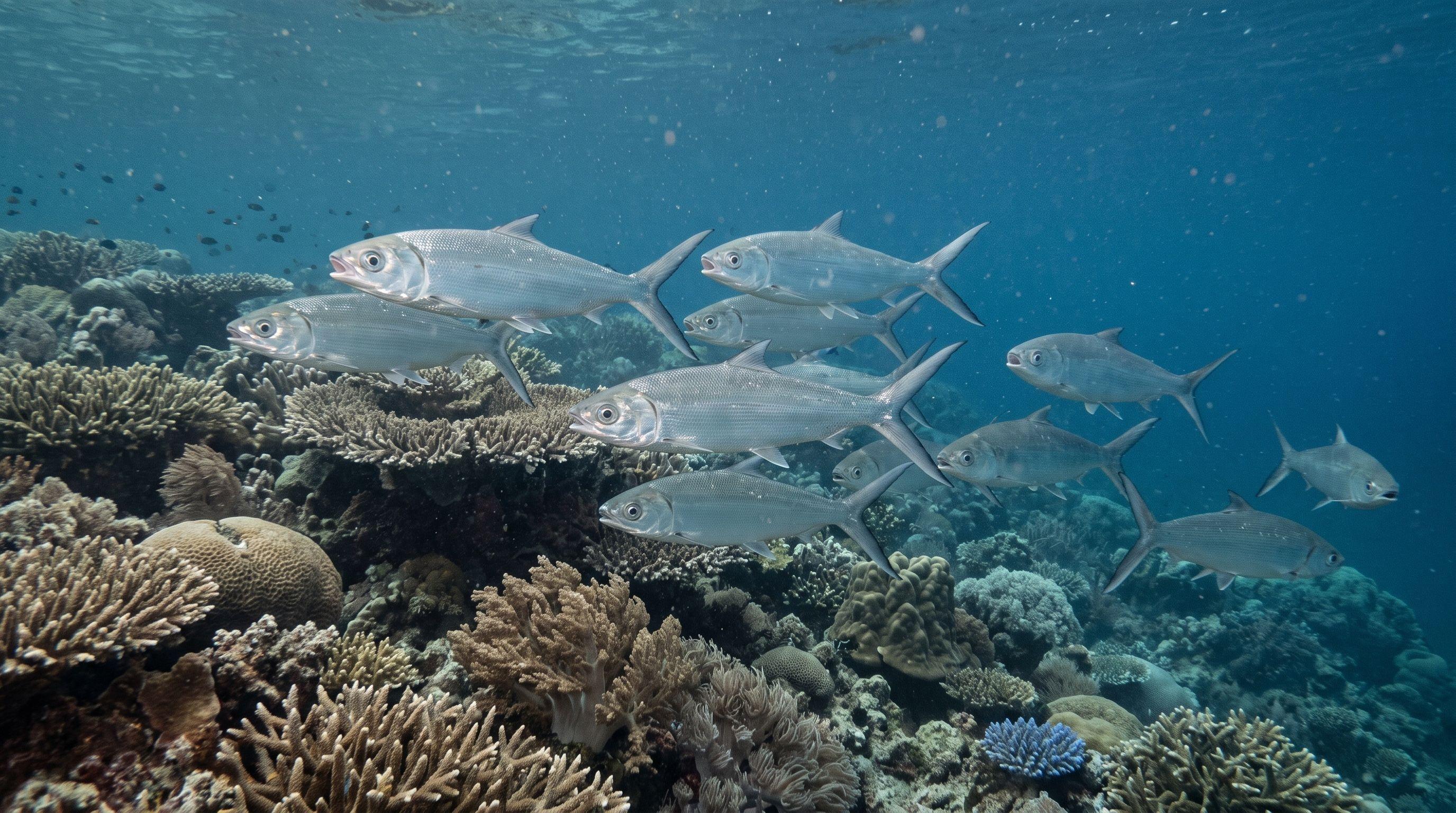 AI-generated
 illustration
Image credit: AI-generated illustration · Diveity